


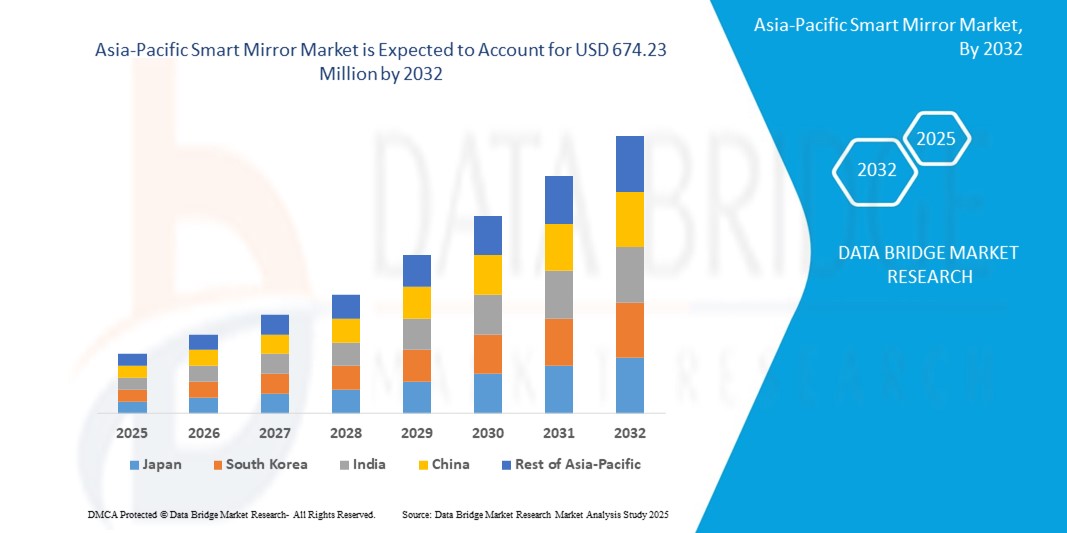
Smart Mirror Market Size
- The Asia-Pacific Smart Mirror Market size was valued at USD 201.45 Million in 2024 and is expected to reach USD 674.23 Million by 2032, at a CAGR of 18.8% during the forecast period
- This growth is driven by factors such as the rising adoption of technological advancements and growing safety concerns for protecting organization data
Smart Mirror Market Analysis
- The smart mirror, also called virtual mirror, is defined as the type of mirror that is embedded with electronic and smart technologies such as IoT, augmented reality, and high quality electronic displays, among others technology. These mirrors could be controlled using smart phones, computers or tablets, and are used in automotive industry and in retail shop to offer better comfort to the users.
- China is expected to dominate the Smart Mirrors market due to rise in demand for connect devices and transition to digital stores in the retail industry will further aggravate the market value.
- India is expected to be the fastest growing region in the Smart Mirror Market during the forecast period due to increase in the adoption of smart homes
- Hardware” Segment dominates the component segment of the Asia-Pacific smart mirror market with the 54.35% market share due to robotic technology. The high demand for remote monitoring is expected to influence the growth of Asia-Pacific smart mirror market over the forecast period of 2025 to 2032.
Report Scope and Smart Mirror Market Segmentation
|
Attributes |
Smart Mirror Key Market Insights |
|
Segments Covered |
|
|
Countries Covered |
Asia-Pacific
|
|
Key Market Players |
|
|
Market Opportunities |
|
|
Value Added Data Infosets |
In addition to the insights on market scenarios such as market value, growth rate, segmentation, geographical coverage, and major players, the market reports curated by the Data Bridge Market Research also include import export analysis, production capacity overview, production consumption analysis, price trend analysis, climate change scenario, supply chain analysis, value chain analysis, raw material/consumables overview, vendor selection criteria, PESTLE Analysis, Porter Analysis, and regulatory framework. |
Smart Mirror Market Trends
“Integration of AI and IoT in Smart Mirrors”
- The Asia-Pacific Smart Mirror Market is experiencing significant growth due to the integration of Artificial Intelligence (AI) and the Internet of Things (IoT) technologies. These advancements enable smart mirrors to offer personalized experiences, such as facial recognition, health monitoring, and seamless connectivity with other smart home devices. Consumers are increasingly seeking products that provide convenience, efficiency, and enhanced user experience.
- Smart mirrors equipped with AI and IoT capabilities cater to these demands by offering features like virtual try-ons, real-time health analytics, and voice-controlled interfaces. This trend is particularly evident in countries like China and India, where technological adoption is high, and consumers are open to embracing innovative solutions. The growing emphasis on home automation and personalized living spaces further drives the demand for such advanced smart mirrors.
- For instance, In January 2024, Indian tech company Baracoda launched the BMind Smart Mirror, designed to support mental wellness through AI integration. The mirror includes features like emotion recognition, light therapy, and voice interaction to promote daily well-being. It connects with other smart devices, creating a seamless wellness experience at home. This product reflects the growing demand in Asia-Pacific for personalized, AI-driven smart home solutions. Baracoda’s innovation highlights India’s leadership in next-gen smart mirror technology.
Smart Mirror Market Dynamics
Driver
“High Demand for Connected Devices”
- The growing demand for connected devices is playing a crucial role in accelerating the growth of the Asia-Pacific smart mirror market. Consumers are increasingly embracing smart technology in everyday life, including mirrors that interact with other devices to enhance convenience, functionality, and personalization. In the retail sector especially, smart mirrors are being adopted to offer virtual try-ons and personalized product recommendations. This is fueled by rapid advancements in technologies like artificial intelligence (AI), gesture recognition, and augmented reality (AR). These features make smart mirrors more interactive and engaging, enhancing the customer experience in stores and at home.
- In Asia-Pacific, tech-forward nations like China, Japan, and India are witnessing increased implementation in both residential and commercial applications. Smart mirrors are also becoming integral to home automation systems, especially in luxury and high-tech homes. Manufacturers are investing in R&D to create products that support voice control, facial recognition, and IoT connectivity. This rising dependence on smart ecosystems ensures that smart mirrors will remain a key product in the growing connected device market. As the need for real-time interaction and automation continues to grow, the demand for smart mirrors is set to rise steadily.
For instance,
- In February 2024, Himirror, a division of New Kinpo Group, expanded its presence in Asia-Pacific by introducing smart beauty mirrors with built-in AI and IoT features. These devices analyze skin conditions in real-time and suggest beauty routines or products through Wi-Fi-enabled interfaces. The mirrors also sync with mobile apps, enhancing the connected experience for users. This innovation reflects rising demand for connected personal care devices across Asia-Pacific households. Himirror’s launch taps into the growing appetite for integrated, tech-savvy solutions in everyday routines.
Opportunity
“Integration of AI and IoT in Smart Mirrors”
- he Asia-Pacific Smart Mirror Market is witnessing significant growth due to the integration of Artificial Intelligence (AI) and the Internet of Things (IoT) technologies. These advancements enable smart mirrors to offer personalized experiences, such as facial recognition, health monitoring, and seamless connectivity with other smart home devices. Consumers are increasingly seeking products that provide convenience, efficiency, and enhanced user experience.
- Smart mirrors equipped with AI and IoT capabilities cater to these demands by offering features like virtual try-ons, real-time health analytics, and voice-controlled interfaces. This trend is particularly evident in countries like China and India, where technological adoption is high, and consumers are open to embracing innovative solutions. The growing emphasis on home automation and personalized living spaces further drives the demand for such advanced smart mirrors.
For instance,
- In January 2024, Indian company Baracoda introduced the BMind Smart Mirror, a product designed to support mental wellness using AI. It features voice recognition, light therapy, and emotion-detecting technology to promote relaxation and mindfulness. The mirror integrates seamlessly with smart home ecosystems and is tailored for personal health tracking. Its launch reflects growing consumer interest in tech-driven wellness solutions across Asia-Pacific
Restraint/Challenge
“High Cost and Data Security Concerns”
- Despite growing interest, the Asia-Pacific Smart Mirror Market faces notable challenges, particularly due to the high cost of these advanced devices. Smart mirrors often come with premium features like AI, voice recognition, and IoT integration, making them significantly more expensive than traditional mirrors. This price barrier limits accessibility for average consumers, especially in price-sensitive markets.
- Moreover, security concerns around the storage and use of personal data—such as facial recognition, voice inputs, or health tracking—raise privacy issues. Consumers are wary of how their data is collected, stored, and shared, especially with increasing cyber threats. These concerns are further heightened in smart homes and connected vehicles, where data vulnerabilities could have broader implications. Additionally, many potential buyers across Asia-Pacific remain unaware of the benefits and applications of smart mirrors. Limited product education and visibility, especially outside major urban centers, hinder wider adoption.
For instance,
- In April 2025, Seura Inc., a U.S.-based smart mirror manufacturer, paused its expansion plans in certain Eastern Asia-Pacific markets due to lower-than-expected adoption. The company cited high retail pricing and lack of consumer familiarity with smart mirror technology as key barriers. Additionally, privacy regulations in Asia-Pacific posed challenges for implementing facial recognition features. Seura emphasized the need to enhance education and address data concerns before scaling further. This example highlights the hurdles even established brands face in this emerging market.
Smart Mirror Market Scope
The market is segmented on the basis component, types, technology, functionality, augmented reality feature and application.
|
Segmentation |
Sub-Segmentation |
|
Component |
|
|
Types |
|
|
Technology |
|
|
Functionality |
|
|
Augmented reality |
|
|
Application |
|
In 2025, the Hardware is projected to dominate the market with a largest share in segment
In 2025, the hardware segment is projected to dominate the Asia-Pacific Smart Mirror Market with the largest share of 54.35%. This is largely due to increasing demand for integrated devices that offer real-time display, sensors, and touch interface capabilities. Hardware components such as displays, cameras, and sensors are crucial in enhancing mirror functionality across smart homes, retail, and automotive sectors. As consumers prioritize high-performance and interactive features, hardware investments remain a key focus for manufacturers. This dominance reflects the segment's critical role in powering the core functionality of smart mirrors
The Software is expected to account for the largest share during the forecast period in market
The software segment is expected to account for the largest share of 51.12% during the forecast period in the Asia-Pacific Smart Mirror Market. This growth is driven by the increasing need for advanced interfaces, personalized user experiences, and seamless integration with AI and IoT platforms. Software enables smart mirrors to provide features like facial recognition, voice control, health tracking, and smart home connectivity. As users demand more interactive and adaptive functionalities, software becomes a key value driver. Continuous updates and cloud-based services further enhance the relevance of this segment in the evolving smart mirror landscape.
Smart Mirror Market Regional Analysis
“China Holds the Largest Share in the Smart Mirror Market”
- China holds the largest share in the Asia-Pacific Smart Mirror Market due to its strong technological infrastructure and high consumer adoption of smart home solutions. The country’s advanced manufacturing sector and innovation-driven economy support the development and integration of smart devices, including mirrors. China consumers are increasingly investing in connected living spaces, driving demand for multifunctional home technologies.
- Additionally, China’s well-established automotive industry is incorporating smart mirrors for enhanced safety and user experience. The retail sector is also exploring smart mirrors for virtual try-ons and customer engagement. Government initiatives promoting energy-efficient smart homes further bolster the market. With a mature digital ecosystem and rising disposable income, China continues to lead in smart mirror deployment. These factors collectively make it a dominant force in Asia-Pacific’s smart mirror market.
“India is Projected to Register the Highest CAGR in the Smart Mirror Market”
- India is projected to register the highest CAGR in the Asia-Pacific Smart Mirror Market due to growing demand for smart home technologies and connected lifestyle products. The country is witnessing increased consumer interest in AI-powered home devices that offer convenience, energy efficiency, and personalization. Indian tech companies and startups are also actively innovating in the smart mirror space, contributing to local growth. Government initiatives supporting digital transformation and sustainable housing further encourage adoption. The fashion and retail industries in India are integrating smart mirrors for enhanced customer experiences, such as virtual fitting and product recommendations.
- Additionally, rising awareness about wellness and smart healthcare is driving demand for mirrors with integrated health-tracking features. Urbanization and the shift toward modern, tech-enabled living spaces are also accelerating market expansion. These factors together position India as a high-growth market for smart mirrors in the forecast period.
Smart Mirror Market Share
The market competitive landscape provides details by competitor. Details included are company overview, company financials, revenue generated, market potential, investment in research and development, new market initiatives, Asia-Pacific presence, production sites and facilities, production capacities, company strengths and weaknesses, product launch, product width and breadth, application dominance. The above data points provided are only related to the companies' focus related to market.
The Major Market Leaders Operating in the Market Are:
- ELECTRIC MIRROR, INC,
- Séura,
- Murakami Corporation,
- Ficosa Internacional SA,
- S.L.,
- SAMSUNG,
- Mirrocool,
- memorymirror,
- Archello,
- actiMirror Corporation,
- GLANCE,
- ad notam AG,
- MURAKAMI CO., LTD,
- DENSION LTD,
- Embrace,
- Ficosa Internacional SA,
- Japan Display Inc.,
- Gentex Corporation,
- MAGNA INTERNATIONAL INC
Latest Developments in Asia-Pacific Smart Mirror Market
- In January 2025, Samsung unveiled its AI-powered Beauty Mirror, which uses micro-LED technology to analyze skin conditions such as pigmentation, wrinkles, and pores. The mirror provides personalized skincare recommendations and product suggestions in partnership with Amorepacific, enhancing the beauty and wellness experience.
- In June 2023, Gentex Corporation equipped Peugeot’s all-new 9X8 Hybrid Hypercar with an intelligent rear vision system designed to optimize the vehicle’s rearward view. The mirror captures video from a rearward-facing camera and streams it to a mirror-integrated liquid-crystal display (LCD), providing drivers with a wide and unobstructed view behind the vehicle..
- In January 2023, Japan Display Inc. announced the development of the world’s first transparent liquid crystal meta-surface reflector that can change the direction of millimeter-wave reflection to any direction. This innovation enhances the functionality of smart mirrors, particularly in automotive applications.
- In April 2025, Murakami Kaimeido, a Japanese company, specializes in developing smart mirrors for the beauty industry. Its mirrors incorporate features such as LED lighting and facial recognition technology, allowing users to customize their makeup and skincare routines.
- In May 2025, Séura launched a new smart mirror with integrated home automation features. The mirror connects with various smart home devices, allowing users to control lighting, temperature, and security systems through voice commands and touch gestures. It also provides real-time news updates, weather forecasts, and calendar reminders, serving as a central hub for home management.

- Interactive Data Analysis Dashboard
- Company Analysis Dashboard for high growth potential opportunities
- Research Analyst Access for customization & queries
- Competitor Analysis with Interactive dashboard
- Latest News, Updates & Trend analysis
- Harness the Power of Benchmark Analysis for Comprehensive Competitor Tracking
Asia Pacific Smart Mirror Market, Supply Chain Analysis and Ecosystem Framework
To support market growth and help clients navigate the impact of geopolitical shifts, DBMR has integrated in-depth supply chain analysis into its Asia Pacific Smart Mirror Market research reports. This addition empowers clients to respond effectively to global changes affecting their industries. The supply chain analysis section includes detailed insights such as Asia Pacific Smart Mirror Market consumption and production by country, price trend analysis, the impact of tariffs and geopolitical developments, and import and export trends by country and HSN code. It also highlights major suppliers with data on production capacity and company profiles, as well as key importers and exporters. In addition to research, DBMR offers specialized supply chain consulting services backed by over a decade of experience, providing solutions like supplier discovery, supplier risk assessment, price trend analysis, impact evaluation of inflation and trade route changes, and comprehensive market trend analysis.
Data collection and base year analysis are done using data collection modules with large sample sizes. The stage includes obtaining market information or related data through various sources and strategies. It includes examining and planning all the data acquired from the past in advance. It likewise envelops the examination of information inconsistencies seen across different information sources. The market data is analysed and estimated using market statistical and coherent models. Also, market share analysis and key trend analysis are the major success factors in the market report. To know more, please request an analyst call or drop down your inquiry.
The key research methodology used by DBMR research team is data triangulation which involves data mining, analysis of the impact of data variables on the market and primary (industry expert) validation. Data models include Vendor Positioning Grid, Market Time Line Analysis, Market Overview and Guide, Company Positioning Grid, Patent Analysis, Pricing Analysis, Company Market Share Analysis, Standards of Measurement, Global versus Regional and Vendor Share Analysis. To know more about the research methodology, drop in an inquiry to speak to our industry experts.
Data Bridge Market Research is a leader in advanced formative research. We take pride in servicing our existing and new customers with data and analysis that match and suits their goal. The report can be customized to include price trend analysis of target brands understanding the market for additional countries (ask for the list of countries), clinical trial results data, literature review, refurbished market and product base analysis. Market analysis of target competitors can be analyzed from technology-based analysis to market portfolio strategies. We can add as many competitors that you require data about in the format and data style you are looking for. Our team of analysts can also provide you data in crude raw excel files pivot tables (Fact book) or can assist you in creating presentations from the data sets available in the report.













