


What is the Smart Transportation Size and Growth Rate?
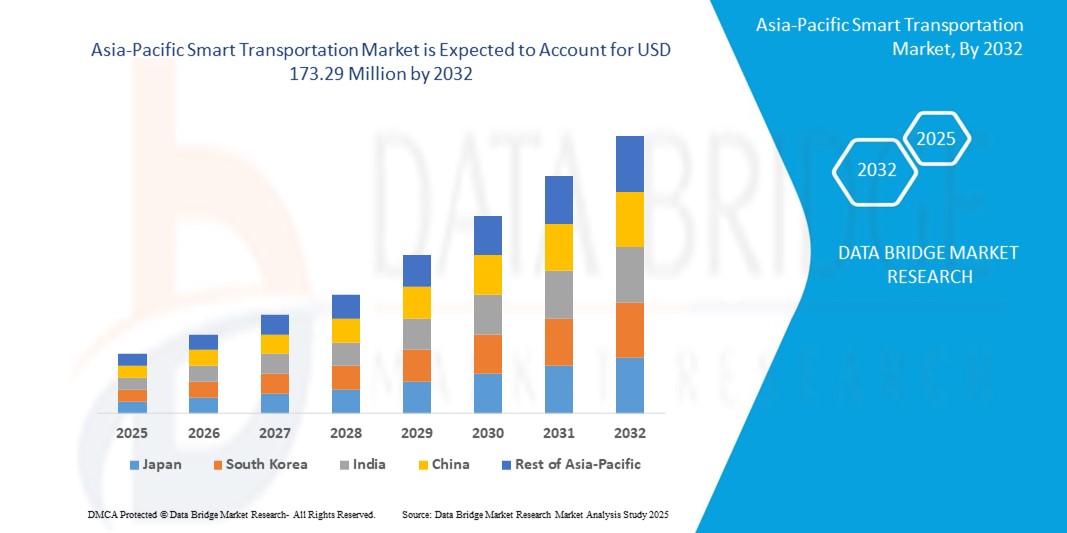
- As per Data Bridge Market Research Analysis the Asia-Pacific Smart Transportation Market size was valued at USD 31.40 million in 2024 and is expected to reach USD 173.29 million by 2032, at a CAGR of 27.6% during the forecast period.
- This growth is driven by the countries are investing heavily in smart city infrastructure, including intelligent transport systems (ITS), real-time traffic management, and multimodal transport solutions.
Market Size & Forecast
- Global Market Value (2024): USD 31.40 million
- Expected Market Value (2032): USD 173.29 million
- Forecast CAGR (2024–2032): 27.6%
What are the Major Takeaways of Smart Transportation?
- Governments are promoting sustainable transportation, electric vehicles (EVs), and data-driven traffic management systems through funding, regulations, and partnerships with tech firms.
- The market is propelled by Integration of Internet of Things (IoT), AI, and big data in transport systems enhances traffic flow, safety, and predictive maintenance, opening new markets for smart mobility services.
- China holds a significant market share due to its advanced technology infrastructure, high adoption of Smart Transportation technologies, and presence of key players like Kapsch Traffic Com AG, Thales Group, Alstom, Schneider Electric.
- China is expected to register the fastest growth, fuelled by Integration of Internet of Things (IoT), AI, and big data in transport systems enhances traffic flow, safety, and predictive maintenance, opening new markets for smart mobility services.
- The Traffic Management Solution segment is projected to account for a significant market share of approximately 38.10% in 2025, driven by the widespread adoption of Smart Transportation systems in the country.
Report Scope and Smart Transportation Market Segmentation
|
Attributes |
Asia-Pacific Smart Transportation Key Market Insights |
|
Segments Covered |
|
|
Countries Covered |
Asia-Pacific
|
|
Key Market Players |
|
|
Market Opportunities |
|
|
Value Added Data Infosets |
|
What is the Key Trend in the Smart Transportation?
“Advancements in AI, and Machine Learning (ML)”
- AI and ML are being integrated into transportation systems to enhance operational efficiency. These technologies enable predictive maintenance, optimize traffic management, and improve system reliability by analyzing vast datasets to identify patterns and predict congestion.
- The integration of smart grids with transportation systems allows for efficient energy distribution, especially for electric vehicles (EVs). Smart grids support bidirectional energy flow, enabling vehicles to not only consume but also supply energy back to the grid, enhancing overall energy efficiency.
- For instance, In May 2025, Uber partnered with May Mobility to deploy thousands of autonomous vehicles across U.S. cities, starting with Arlington, Texas. These vehicles, initially equipped with safety drivers, aim to transition to full autonomy. May Mobility, backed by Toyota and BMW, also collaborates with Lyft for autonomous services in Atlanta.
- Governments are promoting sustainable transportation, electric vehicles (EVs), and data-driven traffic management systems through funding, regulations, and partnerships with tech firms.
Smart Transportation Market Dynamics
Driver
“Urbanization & Smart Cities Development”
- Rapid adoption of digital technologies such as AI, IoT, cloud computing, and 5G is transforming industries across APAC.
- Massive urban migration is driving the need for sustainable and efficient city planning using smart technologies.
- For instance, in 2025 Siemens launched an upgraded intelligent traffic management system featuring machine learning capabilities to predict traffic patterns and adjust signals in real-time, reducing congestion by 20%.
- Japan's Tier IV has initiated projects to develop self-driving electric taxis, aiming to address driver shortages and enhance urban mobility. These initiatives are supported by government policies promoting smart transportation solutions.
Opportunity
“Expansion of Smart Infrastructure and Green Technologies”
- Governments across APAC are investing heavily in green and resilient infrastructure to meet climate goals and improve sustainability.
- AI and automation are being widely adopted across sectors such as manufacturing, healthcare, finance, and logistics.
- For instance, In November 2025, IBM introduced an AI-powered cloud platform for smart transportation in 2024, offering real-time analytics for public transit and smart parking systems, aiding cities in optimizing traffic flow.
- Innovations in solar technology, such as micro-inverters and AI-driven energy management systems, are making solar installations more efficient and user-friendly. These advancements support the integration of solar energy into smart transportation infrastructures.
Restraint/Challenge
“High Development Costs and Cybersecurity Risks”
- While some countries in the Asia-Pacific (e.g., Singapore, South Korea, Japan) have world-class digital infrastructure, others—especially developing nations like parts of Southeast Asia, South Asia, and the Pacific Islands—lack sufficient broadband connectivity, IoT readiness, and cloud infrastructure.
- Rapid digitization increases vulnerabilities to cyberattacks and data breaches. Countries have varying regulations on data protection
- For instance (2023), Alstom faced stalled smart metro projects in parts of Southeast Asia due to capital-intensive smart rail modernization efforts that exceeded municipal budgets.
- Smart transportation systems often require substantial up-front investments in infrastructure (e.g., sensors, communication networks, electric vehicle charging stations, autonomous vehicle tech). This cost barrier slows down adoption, especially in emerging economies and municipalities with budget constraints.
How is the Smart Transportation Segmented?
The market is segmented based on solution, service, transportation mode and application
|
Segmentation |
Sub-Segmentation |
|
By Solution |
|
|
By Service |
|
|
By Transportation Mode |
|
|
By Applications |
|
In 2025, Traffic Management Solution segment is projected to dominate the Solution segment
The Traffic Management Solution segment is expected to hold a market share of approximately 38.10% in 2025, driven Rapid Urbanization and Smart City Initiatives.
The Mobility as a Service application segment is expected to account for the largest share during the forecast period in the application market
In 2025, the Mobility as a Service application segment is projected to account for a market share of 25.1%, driven by Increasing Public Demand for Safe and Efficient Transport.
“China Holds the Largest Share in the Smart Transportation Market”
-
China dominates the market due to increasingly being integrated into smart home ecosystems, allowing users to monitor and manage energy usage more effectively. Rising population and urban traffic congestion are pushing demand for efficient public transport, real-time tracking, and cashless fare systems, creating business opportunities.
- The U.S. holds a significant share, driven by Advancements in AI and Software-Defined Smart Transportation Technologies.
- The region benefits from significant advancements in AI and software-defined technologies.
“China is Projected to Register the Highest CAGR in the Smart Transportation Market”
-
Asia-Pacific’s growth is driven by rising Rapid Urbanization and Smart City Initiatives, and government initiatives for secure transportation in countries like China, India, and Japan.
- China is projected to exhibit the highest CAGR due to its Rapid Urbanization and Smart City Initiatives
- Many Asia-Pacific countries (like China, India, Singapore, and South Korea) are investing heavily in smart city infrastructure, including intelligent transport systems (ITS), real-time traffic management, and multimodal transport solutions.
Which are the Top Companies in Smart Transportation?
The market competitive landscape provides details by competitor. Details included are company overview, company financials, revenue generated, market potential, investment in research and development, new market initiatives, global presence, production sites and facilities, production capacities, company strengths and weaknesses, product launch, product width and breadth, application dominance. The above data points provided are only related to the companies' focus related to market.
The Major Market Leaders Operating in the Market Are:
- Kapsch Traffic Com AG
- Thales Group
- Alstom
- Schneider Electric
- Siemens
- MSR-Traffic GmbH
- Cubic Corporation
- atkinsglobal
- Cisco
- Accenture
- IBM India Pvt Ltd
- G CNS
- Toshiba Corporation
- Oracle
- SAP
- Huawei Technologies Co., Ltd.
- Intel Corporation
- Parsons Corporation
What are Latest Developments in Smart Transportation?
- In December 2024, Thales was selected by Avinor to deploy Norway's next-generation nationwide air traffic management system, enhancing safety and efficiency in the country's airspace operations.
- In 2023, CJ Darcl partnered with Netradyne to enhance driving behavior through AI-based safety technology solutions. The company also introduced electric vehicles for intra-city cargo movement in Bangalore in June 2024.
- In October 2024, Huawei partnered with Talaat Moustafa Group to develop a smart city in Madinaty City, Egypt, utilizing advanced technologies for smart applications in transportation, water management, and security.
- In October 2024, Cubic delivered a smart ticketing solution for Tasmania's public transport network, modernizing fare collection and improving efficiency across the state.
- Tesla plans to launch its Cybercab robotaxi service in Austin later this year, with production commencing in 2026.

- Interactive Data Analysis Dashboard
- Company Analysis Dashboard for high growth potential opportunities
- Research Analyst Access for customization & queries
- Competitor Analysis with Interactive dashboard
- Latest News, Updates & Trend analysis
- Harness the Power of Benchmark Analysis for Comprehensive Competitor Tracking
Asia Pacific Smart Transportation Market, Supply Chain Analysis and Ecosystem Framework
To support market growth and help clients navigate the impact of geopolitical shifts, DBMR has integrated in-depth supply chain analysis into its Asia Pacific Smart Transportation Market research reports. This addition empowers clients to respond effectively to global changes affecting their industries. The supply chain analysis section includes detailed insights such as Asia Pacific Smart Transportation Market consumption and production by country, price trend analysis, the impact of tariffs and geopolitical developments, and import and export trends by country and HSN code. It also highlights major suppliers with data on production capacity and company profiles, as well as key importers and exporters. In addition to research, DBMR offers specialized supply chain consulting services backed by over a decade of experience, providing solutions like supplier discovery, supplier risk assessment, price trend analysis, impact evaluation of inflation and trade route changes, and comprehensive market trend analysis.
Data collection and base year analysis are done using data collection modules with large sample sizes. The stage includes obtaining market information or related data through various sources and strategies. It includes examining and planning all the data acquired from the past in advance. It likewise envelops the examination of information inconsistencies seen across different information sources. The market data is analysed and estimated using market statistical and coherent models. Also, market share analysis and key trend analysis are the major success factors in the market report. To know more, please request an analyst call or drop down your inquiry.
The key research methodology used by DBMR research team is data triangulation which involves data mining, analysis of the impact of data variables on the market and primary (industry expert) validation. Data models include Vendor Positioning Grid, Market Time Line Analysis, Market Overview and Guide, Company Positioning Grid, Patent Analysis, Pricing Analysis, Company Market Share Analysis, Standards of Measurement, Global versus Regional and Vendor Share Analysis. To know more about the research methodology, drop in an inquiry to speak to our industry experts.
Data Bridge Market Research is a leader in advanced formative research. We take pride in servicing our existing and new customers with data and analysis that match and suits their goal. The report can be customized to include price trend analysis of target brands understanding the market for additional countries (ask for the list of countries), clinical trial results data, literature review, refurbished market and product base analysis. Market analysis of target competitors can be analyzed from technology-based analysis to market portfolio strategies. We can add as many competitors that you require data about in the format and data style you are looking for. Our team of analysts can also provide you data in crude raw excel files pivot tables (Fact book) or can assist you in creating presentations from the data sets available in the report.













