


What is the Asia-Pacific Soft Tissue Repair Market Size and Growth Rate?
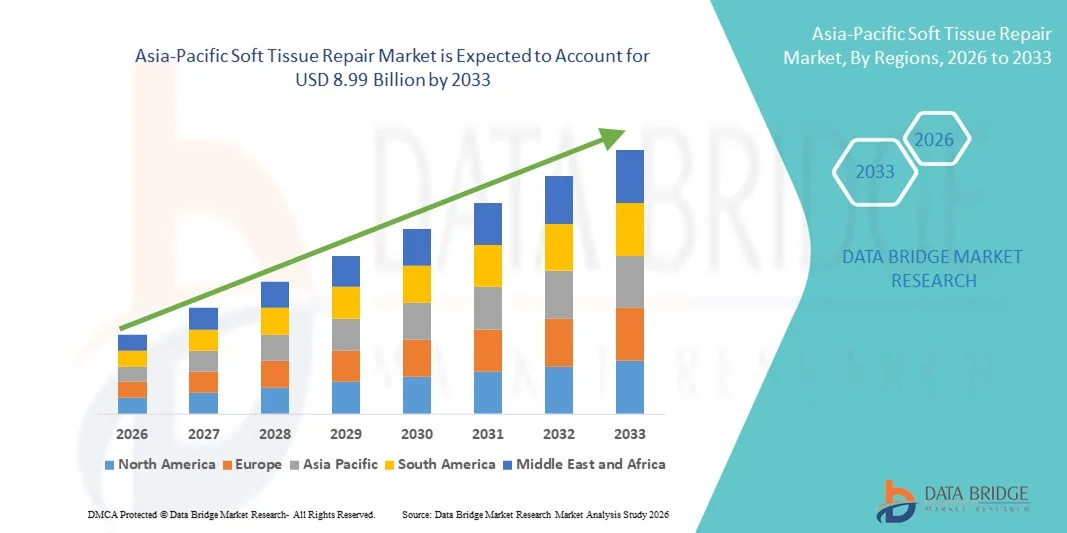
- As per Data Bridge Market Research Analysis the Asia-Pacific soft tissue repair market size was valued at USD 5.45 billion in 2025 and is expected to reach USD 8.99 billion by 2033, at a CAGR of 6.47% during the forecast period
- The market growth is largely fueled by increasing incidences of sports injuries, accidents, and age-related musculoskeletal disorders, driving demand for advanced soft tissue repair solutions
- Furthermore, rising patient awareness, technological advancements in minimally invasive procedures, and growing adoption of biologics, scaffolds, and sutures are accelerating the uptake of Soft Tissue Repair solutions, thereby significantly boosting the industry's growth
Market Size and Forecast:
- Market Value (2025): USD 5.45 billion
- Expected Market Value (2033): USD 8.99 billion
- Forecast CAGR (2026–2033): 6.47%
What are the Major Takeaways of Asia-Pacific Soft Tissue Repair Market?
- Soft tissue repair solutions, including ligament, tendon, and muscle repair devices, are increasingly vital components in orthopedic and sports medicine, helping restore mobility, reduce pain, and improve patient quality of life across hospitals, clinics, and surgical centers
- The escalating demand for soft tissue repair is primarily fueled by the rising incidence of sports injuries, age-related musculoskeletal disorders, growing awareness of advanced surgical interventions, and the preference for minimally invasive procedures that enable faster recovery
- China dominated the soft tissue repair market with the largest revenue share of approximately 35.4% in 2025, supported by high injury prevalence, adoption of advanced repair techniques, and well-established healthcare infrastructure
- India is expected to be the fastest-growing region in the soft tissue repair market during the forecast period, projected to register a CAGR of approximately 24.7% from 2026 to 2033, driven by increasing hospital networks, growing awareness of orthopedic care, and rising adoption of modern surgical technologies
- The tissue patch/mesh segment dominated the largest market revenue share of 42.5% in 2025, driven by its extensive use in hernia repair, skin repair, and orthopedic procedures
Report Scope and Soft Tissue Repair Market Segmentation
|
Attributes |
Soft Tissue Repair Key Market Insights |
|
Segments Covered |
|
|
Countries Covered |
Asia-Pacific
|
|
Key Market Players |
|
|
Market Opportunities |
|
|
Value Added Data Infosets |
In addition to the insights on market scenarios such as market value, growth rate, segmentation, geographical coverage, and major players, the market reports curated by the Data Bridge Market Research also include in-depth expert analysis, patient epidemiology, pipeline analysis, pricing analysis, and regulatory framework. |
What are the Asia-Pacific Soft Tissue Repair Market Trends?
Advancements in Minimally Invasive and Biocompatible Repair Solutions
- A key trend in the Asia-Pacific Soft Tissue Repair market is the increasing development and adoption of minimally invasive surgical techniques and biocompatible repair materials
- Surgeons and hospitals are moving toward solutions that reduce operative time, minimize postoperative complications, and improve patient recovery outcomes
- For instance, in February 2023, Johnson & Johnson Medical Devices launched a next-generation soft tissue repair mesh for laparoscopic and minimally invasive procedures in Asia-Pacific hospitals, emphasizing biocompatibility and enhanced healing outcomes
- In addition, there is a rising focus on resorbable scaffolds and advanced suturing technologies that support tissue regeneration while reducing foreign body reactions
- Patient-centric design, improved durability, and compatibility with robotic-assisted surgeries are reshaping the standard of care in soft tissue repair procedures
Asia-Pacific Soft Tissue Repair Market Dynamics
Driver
Rising Incidence of Soft Tissue Injuries and Surgical Procedures
- The growing prevalence of soft tissue injuries due to aging populations, sports activities, and road accidents is driving demand for advanced repair solutions. Minimally invasive procedures are preferred for faster recovery, reduced hospital stays, and lower risk of complications
- For instance, in January 2022, a study published in the Journal of Surgical Research reported that 3–5% of patients undergoing certain non-resorbable mesh repairs experienced complications, prompting hospitals in Asia-Pacific to carefully evaluate product selection and adopt newer, safer alternatives
- Rising awareness among surgeons about advanced biomaterials, patient safety, and long-term repair outcomes is encouraging adoption of premium soft tissue repair products
- Government healthcare initiatives promoting minimally invasive surgeries and hospital modernization in countries like India, China, and Japan further support market growth
Restraint/Challenge
High Product Costs and Regulatory Hurdles
- High costs of advanced soft tissue repair devices, including biocompatible meshes, scaffolds, and robotic-compatible systems, remain a major barrier for smaller hospitals and clinics. This can limit adoption, particularly in price-sensitive regions
- For instance, in March 2023, Medtronic highlighted that certain resorbable scaffold systems faced slower uptake in Southeast Asian hospitals due to high procurement costs and the need for specialized surgical training
- Strict regulatory requirements, clinical trial validations, and post-market surveillance obligations add additional challenges to manufacturers seeking to expand in the Asia-Pacific region
- Hospitals and clinics may also face limitations in skilled personnel and infrastructure, particularly for adopting robotic-assisted or high-end minimally invasive procedures
- Overcoming these challenges through cost-effective product development, training programs, and regional regulatory alignment will be critical for sustained market expansion
Asia-Pacific Soft Tissue Repair Market Scope
The market is segmented on the basis of product, application, and end user.
- By Product
On the basis of product, the Soft Tissue Repair market is segmented into tissue patch/mesh, fixation devices, and laparoscopic instruments. The tissue patch/mesh segment dominated the largest market revenue share of 42.5% in 2025, driven by its extensive use in hernia repair, skin repair, and orthopedic procedures. Tissue patches provide superior biocompatibility, improved structural support, and reduced recovery times, making them a preferred choice for surgeons worldwide. Their versatility in minimally invasive surgeries and compatibility with various tissue types further boosts adoption. The segment also benefits from strong clinical outcomes, high patient satisfaction, and widespread presence in hospitals and surgical centers. Increasing awareness among healthcare professionals and growing adoption in emerging markets further strengthen market leadership. Advanced materials, such as bioresorbable and synthetic meshes, continue to enhance performance and surgical efficiency, contributing to the segment’s dominance in revenue generation.
The fixation devices segment is anticipated to witness the fastest CAGR of 20.8% from 2026 to 2033, fueled by rising demand in orthopedic, dental, and other reconstructive procedures. Innovations in bioresorbable implants, screws, and pins improve tissue stabilization, reduce complication rates, and enable faster recovery, driving adoption. Surgeons increasingly prefer fixation devices for minimally invasive surgeries due to ease of implantation and reliable outcomes. Rising prevalence of sports injuries, trauma cases, and an aging population contribute to increased procedure volumes. The segment also benefits from growing awareness of advanced surgical techniques and adoption in ambulatory surgical centers. Enhanced product designs and integration with modern surgical tools support market growth. Favorable reimbursement policies and hospital investments in advanced devices further boost the segment’s rapid expansion.
- By Application
On the basis of application, the Soft Tissue Repair market is segmented into hernia repair, dural repair, skin repair, vaginal sling procedures, orthopedic repair, dental repair, and breast reconstruction repair. The hernia repair segment dominated the largest market revenue share of 38.6% in 2025, owing to the high prevalence of hernia cases globally. Hernia repair products such as meshes and patches offer reduced recurrence, improved post-operative outcomes, and compatibility with minimally invasive surgery techniques. Surgeons prefer these solutions due to proven clinical results and ease of use in operating theaters. The segment’s dominance is further strengthened by rising patient awareness, increasing elective surgeries, and advancements in mesh materials. The adoption of laparoscopic techniques and hospital investment in modern surgical tools also drive growth. Rising demand in both developed and emerging markets, coupled with robust supply chains and skilled surgical expertise, reinforces the segment’s market leadership.
The orthopedic repair segment is expected to witness the fastest CAGR of 21.4% from 2026 to 2033, driven by increasing incidence of sports injuries, fractures, and degenerative disorders. Advanced tissue scaffolds, fixation devices, and minimally invasive implants enhance surgical precision and accelerate recovery, boosting adoption. Surgeons rely on these solutions for complex ligament, tendon, and bone repairs, and patient preference for quicker recovery supports market growth. Rising healthcare expenditure, growing awareness of advanced procedures, and expanding geriatric population contribute to higher procedure volumes. Hospitals and ambulatory surgical centers increasingly invest in orthopedic repair technologies. Technological innovation, such as bioengineered scaffolds and resorbable implants, further accelerates growth. The segment also benefits from training programs and awareness campaigns that highlight improved surgical outcomes, ensuring strong future demand.
- By End User
On the basis of end user, the Soft Tissue Repair market is segmented into hospitals, ambulatory surgical centers, and clinics. The hospitals segment accounted for the largest market revenue share of 46.3% in 2025, due to their ability to perform complex surgical procedures and access to advanced infrastructure. Hospitals house specialized surgical teams and equipment, making them ideal for high-risk procedures like hernia, dural, and breast reconstruction surgeries. The segment’s dominance is reinforced by high procedure volumes, comprehensive patient care, and strong adoption of minimally invasive technologies. Hospitals also benefit from better reimbursement policies, advanced supply chains, and partnerships with medical device manufacturers. Increased investments in infrastructure and training programs contribute to robust segment growth. Availability of skilled surgeons and technological capabilities ensures high adoption of advanced tissue repair products.
The ambulatory surgical centers segment is expected to witness the fastest CAGR of 22.1% from 2026 to 2033, driven by the rising preference for outpatient procedures and cost-effective surgical solutions. These centers offer shorter recovery times, lower operating costs, and convenience for patients, encouraging adoption of soft tissue repair devices. Increasing awareness of minimally invasive procedures, rising procedure volumes for orthopedic and dental repairs, and integration of advanced surgical technologies fuel growth. Ambulatory surgical centers also benefit from flexible scheduling, reduced hospitalization costs, and growing acceptance among patients and surgeons. Investment in advanced instruments and modern surgical workflows further accelerates market adoption. The segment is supported by favorable regulatory frameworks and patient preference for home recovery, ensuring strong CAGR growth.
Asia-Pacific Soft Tissue Repair Market Regional Analysis
- The Asia-Pacific soft tissue repair market is poised to grow at the fastest CAGR during the forecast period of 2026 to 2033, driven by increasing urbanization, rising disposable incomes, and technological advancements in countries such as China, Japan, and India
- The region’s growing inclination towards advanced healthcare solutions, supported by government initiatives promoting digitalization and modernization of healthcare facilities, is driving the adoption of advanced soft tissue repair techniques
- Furthermore, as APAC emerges as a manufacturing hub for Soft Tissue Repair components and systems, the affordability and accessibility of advanced repair solutions are expanding to a wider patient base
China Soft Tissue Repair Market Insight
The China soft tissue repair market accounted for the largest market revenue share in Asia-Pacific in 2025, approximately 35.4%, supported by high injury prevalence, adoption of advanced repair techniques, and well-established healthcare infrastructure. China stands as one of the largest markets for soft tissue repair devices and systems, with rapid urbanization, expanding hospital networks, and high rates of technological adoption propelling the market. The push towards modern healthcare infrastructure and the availability of affordable repair options, alongside strong domestic manufacturers, are key factors driving growth in China.
India Soft Tissue Repair Market Insight
India soft tissue repair market is expected to be the fastest-growing region in the Soft Tissue Repair market during the forecast period, projected to register a CAGR of approximately 24.7% from 2026 to 2033. Growth is driven by increasing hospital networks, growing awareness of orthopedic and soft tissue care, and rising adoption of modern surgical technologies. Expansion of healthcare facilities, improvements in medical infrastructure, and government initiatives to enhance healthcare accessibility are further fueling market growth.
Which are the Top Companies in Asia-Pacific Soft Tissue Repair Market?
The Soft Tissue Repair industry is primarily led by well-established companies, including:
- Johnson & Johnson (U.S.)
- Medtronic (Ireland)
- Stryker (U.S.)
- Zimmer Biomet (U.S.)
- CONMED Corporation (U.S.)
- B. Braun Melsungen AG (Germany)
- Smith & Nephew (U.K.)
- Integra LifeSciences (U.S.)
- Baxter International (U.S.)
- Globus Medical (U.S.)
- Wright Medical Group N.V. (U.S.)
- Arthrex (U.S.)
- Cook Medical (U.S.)
- Orthofix (U.S.)
- Acelity (U.S.)
- C.R. Bard (U.S.)
- Terumo Corporation (Japan)
- Boston Scientific (U.S.)
- Depuy Synthes (U.S.)
- NuVasive (U.S.)
What are the Latest Developments in Asia-Pacific Soft Tissue Repair Market?
- In June 2025, OSSIO Inc. announced the launch of its new OSSIOfiber 2.5mm suture anchors, an advanced fixation device designed for soft tissue surgery, enhancing surgical options and outcomes in tendon and ligament repair procedures
- In March 2025, TELA Bio introduced OviTex PRS, a product tailored for plastic and reconstructive surgery, expanding soft tissue repair solutions with reinforced biologic mesh technology for improved tissue integration
- In April 2025, BD commercially launched the Phasix ST Umbilical Mesh, an industry‑first bioabsorbable mesh specifically developed for umbilical hernia repair — offering a non‑permanent solution that aligns with patient and surgeon preferences
- In March 2024, Medtronic introduced the Symbotex Composite Mesh, a synthetic soft tissue reinforcement mesh aimed at improving outcomes in abdominal wall repair and reinforcing surgical repair strength
- In June 2024, Axogen Inc. launched the Avive+ soft tissue matrix, a resorbable, multi‑layer amniotic membrane allograft designed to support wound healing and soft tissue regeneration during reconstructive procedures
- In June 2023, Integra LifeSciences completed enrollment in the clinical trial for DuraSorb Monofilament Mesh, a soft tissue reinforcement mesh evaluated for potential use in complex reconstructive surgeries such as breast reconstruction
- In March 2023, Smith & Nephew expanded its soft tissue repair product line with innovations in sports medicine, introducing advanced repair technologies focused on enhancing tissue regeneration and structural support for orthopedic soft tissue injuries
- In August 2022, CONMED Corporation announced plans to acquire Biorez Inc., strengthening its position in the sports medicine and soft tissue healing technology market through consolidation and technology integration

- Interactive Data Analysis Dashboard
- Company Analysis Dashboard for high growth potential opportunities
- Research Analyst Access for customization & queries
- Competitor Analysis with Interactive dashboard
- Latest News, Updates & Trend analysis
- Harness the Power of Benchmark Analysis for Comprehensive Competitor Tracking
Data collection and base year analysis are done using data collection modules with large sample sizes. The stage includes obtaining market information or related data through various sources and strategies. It includes examining and planning all the data acquired from the past in advance. It likewise envelops the examination of information inconsistencies seen across different information sources. The market data is analysed and estimated using market statistical and coherent models. Also, market share analysis and key trend analysis are the major success factors in the market report. To know more, please request an analyst call or drop down your inquiry.
The key research methodology used by DBMR research team is data triangulation which involves data mining, analysis of the impact of data variables on the market and primary (industry expert) validation. Data models include Vendor Positioning Grid, Market Time Line Analysis, Market Overview and Guide, Company Positioning Grid, Patent Analysis, Pricing Analysis, Company Market Share Analysis, Standards of Measurement, Global versus Regional and Vendor Share Analysis. To know more about the research methodology, drop in an inquiry to speak to our industry experts.
Data Bridge Market Research is a leader in advanced formative research. We take pride in servicing our existing and new customers with data and analysis that match and suits their goal. The report can be customized to include price trend analysis of target brands understanding the market for additional countries (ask for the list of countries), clinical trial results data, literature review, refurbished market and product base analysis. Market analysis of target competitors can be analyzed from technology-based analysis to market portfolio strategies. We can add as many competitors that you require data about in the format and data style you are looking for. Our team of analysts can also provide you data in crude raw excel files pivot tables (Fact book) or can assist you in creating presentations from the data sets available in the report.













