


Asia-Pacific Sports Management Software Market Overview
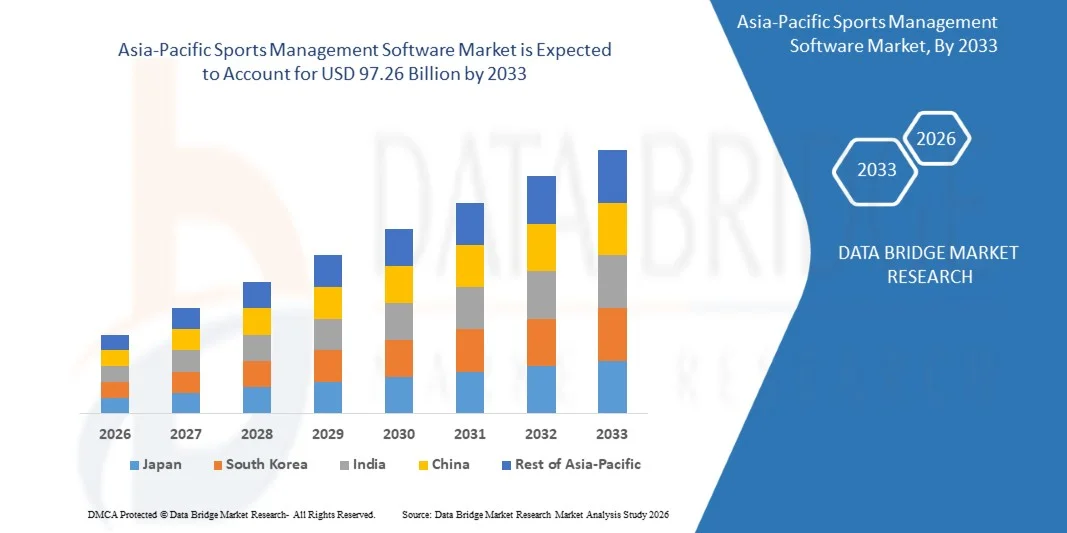
As per Data Bridge Market Research analysis the Asia-Pacific sports management software market was valued at USD 13.33 billion in 2025 and is projected to reach USD 97.26 billion by 2033, growing at a CAGR of 28.20% from 2026 to 2033. The market continues to expand as sports clubs, leagues, educational institutions, and governing bodies increasingly rely on integrated software platforms to streamline administrative operations, athlete performance monitoring, scheduling, communication, and financial management.
Growing participation in organized sports, rising government initiatives promoting sports development, and increasing commercialization of sporting events are encouraging organizations to adopt digital management platforms that improve operational efficiency and enhance athlete engagement. Sports management software has evolved beyond basic scheduling functions to include player analytics, performance tracking, event management, online registration, payment processing, marketing automation, and recruitment management. Furthermore, advancements in artificial intelligence, mobile applications, cloud computing, and data analytics are enabling software providers to deliver intelligent, scalable, and user-friendly solutions tailored to the diverse requirements of sports organizations across the Asia-Pacific region.
Market Size & Forecast
- Global Market Value (2025): USD 13.33 Billion
- Expected Market Value (2033): USD 97.26 Billion
- Forecast CAGR (2026–2033): 28.20%
Key Market Trends & Insights
- China dominated the Asia-Pacific sports management software market with the largest revenue share of 34.76% in 2025, supported by increasing digitalization across sports organizations, rising investments in professional leagues, and widespread adoption of cloud-based sports management platforms.
- The Solution segment led the market with a 72.84% share in 2025, driven by the growing demand for comprehensive software platforms that streamline team administration, athlete performance monitoring, scheduling, communication, and operational management.
- India is expected to be the fastest-growing country in the Asia-Pacific market at a CAGR of 15.8% from 2026 to 2033, fueled by expanding sports infrastructure, increasing government initiatives promoting sports participation, rapid digital transformation, and growing investments in grassroots and professional sports.
- The Services segment is the fastest-growing offering, projected to register a CAGR of 14.6%, reflecting the increasing demand for software implementation, consulting, integration, training, and managed support services among sports organizations.
- The Cloud segment dominated the deployment model category with a 68.92% revenue share in 2025, led by its scalability, lower deployment costs, enhanced data accessibility, and growing preference for Software-as-a-Service (SaaS) solutions.
- Windows accounted for 46.38% of the operating system market, preferred due to its widespread deployment across sports clubs, educational institutions, leagues, and administrative organizations.
- The Subscription pricing model is the fastest-growing segment, with a CAGR of 15.1%, driven by the increasing adoption of cloud-based subscription services that offer continuous software updates, flexible pricing, and lower upfront investment requirements.
Report Scope and Asia-Pacific Sports Management Software Market Segmentation
|
Attributes |
Sports Management Software Key Market Insights |
|
Segments Covered |
|
|
Countries Covered |
Asia-Pacific · China · Japan · India · South Korea · Singapore · Malaysia · Australia · Thailand · Indonesia · Philippines · Rest of Asia-Pacific |
|
Key Market Players |
|
|
Market Opportunities |
· Increasing adoption of cloud-based sports management platforms across professional and amateur sports organizations · Growing investment in digital transformation initiatives and smart sports infrastructure throughout the Asia-Pacific region · Rising integration of artificial intelligence, data analytics, and wearable technologies for athlete performance management |
|
Value Added Data Infosets |
In addition to the market insights such as market value, growth rate, market segments, geographical coverage, market players, and market scenario, the market report curated by the Data Bridge Market Research team includes in-depth expert analysis, import/export analysis, pricing analysis, production consumption analysis, and pestle analysis. |
Asia-Pacific Sports Management Software Market Trends
Trend: Growing Adoption of Cloud-Based and AI-Powered Sports Management Platforms
Sports organizations across the Asia-Pacific region are increasingly adopting cloud-based and artificial intelligence (AI)-powered sports management software to improve operational efficiency, enhance athlete performance monitoring, and streamline administrative workflows. The integration of advanced technologies such as AI, machine learning, data analytics, and mobile applications enables clubs, leagues, coaches, and sports associations to automate scheduling, player registration, communication, performance analysis, and financial management. Organizations are also utilizing centralized cloud platforms to improve collaboration, enhance data accessibility, and deliver better experiences for athletes, coaches, and administrators. Continuous innovation in software capabilities, including wearable device integration, predictive analytics, and real-time performance tracking, is further accelerating digital transformation across the regional sports ecosystem.
For instance, in April 2024, Hudl introduced new AI-powered performance analysis capabilities designed to provide coaches and teams with deeper match insights and automated video analytics, highlighting the growing adoption of intelligent sports management technologies across the Asia-Pacific market.
Asia-Pacific Sports Management Software Market Dynamics
Key Market Driver: Increasing Digital Transformation Across Sports Organizations
The growing digital transformation of sports organizations has created substantial demand for sports management software that improves operational efficiency, enhances athlete performance management, and simplifies administrative processes across professional and amateur sports. Sports clubs, leagues, coaches, educational institutions, and governing bodies are increasingly adopting integrated software solutions to manage registrations, scheduling, communication, performance analytics, financial operations, and player development through centralized digital platforms. Rising investments in sports infrastructure, expanding participation in organized sports, and increasing government initiatives supporting sports digitization continue to strengthen market growth throughout the Asia-Pacific region.
For instance, in February 2024, Stack Sports expanded its cloud-based sports management solutions by introducing enhanced digital tools for registration, scheduling, and communication, reflecting the growing demand for integrated sports management platforms.
Key Restraint/Challenge: High Implementation Costs and Data Security Concerns
A significant restraint in the Asia-Pacific sports management software market is the high implementation cost associated with advanced software platforms, particularly for small sports clubs, grassroots organizations, and amateur leagues operating with limited budgets. The adoption of comprehensive software solutions often requires investments in subscription services, employee training, system integration, and ongoing maintenance. In addition, increasing concerns regarding cybersecurity, athlete data privacy, and regulatory compliance continue to present challenges for software vendors and sports organizations managing sensitive personal and performance-related information.
For instance, in September 2024, several sports technology providers increased investments in cybersecurity and data protection capabilities to address rising concerns regarding athlete information security and compliance with regional data privacy regulations.
Key Market Opportunity: Expansion of Artificial Intelligence, Wearable Technology, and Data Analytics Integration
The increasing integration of artificial intelligence, wearable technologies, and advanced analytics presents a significant growth opportunity for the Asia-Pacific sports management software market. AI-powered analytics can provide deeper insights into athlete performance, injury prevention, training optimization, and tactical decision-making, enabling coaches and sports organizations to improve competitive outcomes. The growing adoption of wearable devices, IoT-enabled sensors, and cloud-connected performance monitoring platforms is further expanding opportunities for software providers to deliver intelligent, data-driven sports management solutions across professional and grassroots sports throughout the region.
For instance, in May 2024, Catapult Sports expanded its athlete monitoring ecosystem by enhancing wearable technology integration and cloud-based analytics capabilities, demonstrating the growing opportunity for AI-driven sports performance management solutions in the Asia-Pacific market.
Asia-Pacific Sports Management Software Market Scope
The Asia-Pacific sports management software market is segmented on the basis of offering, sports type, deployment model, operating system, pricing model, application, and end user.
• By Offering
On the basis of offering, the Asia-Pacific sports management software market is segmented into solution and services. The solution segment dominated the market with an estimated 72.84% share in 2025, owing to the increasing adoption of integrated software platforms for managing sports operations, athlete performance, scheduling, communication, and financial administration. Organizations increasingly prefer comprehensive software solutions that centralize multiple operational functions into a single platform, improving efficiency and reducing administrative complexity. The growing popularity of cloud-based software and mobile applications has further strengthened demand across professional clubs, leagues, and sports academies. Continuous innovation in artificial intelligence, analytics, and automation capabilities is further supporting market expansion. The scalability and flexibility offered by modern software platforms continue to position the solution segment as the market leader.
The services segment is projected to register the fastest growth at a CAGR of 14.6% from 2026 to 2033, driven by increasing demand for implementation, consulting, customization, integration, maintenance, and technical support services. Organizations are investing in professional services to ensure successful software deployment and seamless integration with existing digital ecosystems. Growing adoption among small and medium-sized sports organizations is further contributing to segment growth. Continuous software upgrades and increasing demand for managed services are expected to accelerate market expansion during the forecast period.
• By Sports Type
On the basis of sports type, the Asia-Pacific sports management software market is segmented into individual sports and team sports. The team sports segment accounted for the largest market share of 66.18% in 2025, driven by the widespread adoption of digital management platforms across football, cricket, basketball, volleyball, rugby, and other organized team sports. Sports organizations require centralized solutions for player management, scheduling, communication, attendance tracking, and performance analysis. Increasing investments in professional leagues and youth development programs continue to support software adoption. The growing commercialization of team sports across Asia-Pacific further strengthens the dominance of this segment.
The individual sports segment is anticipated to witness the fastest growth at a CAGR of 13.8% from 2026 to 2033, supported by increasing participation in tennis, badminton, athletics, swimming, golf, and martial arts. Coaches and training academies are increasingly adopting digital platforms to manage athlete development, performance tracking, and competition scheduling. Rising awareness regarding personalized coaching and athlete analytics is further driving market growth.
• By Deployment Model
On the basis of deployment model, the Asia-Pacific sports management software market is segmented into cloud and on premises. The cloud segment dominated the market with an estimated 68.92% share in 2025 due to its scalability, lower infrastructure costs, remote accessibility, and simplified software maintenance. Cloud-based deployment enables sports organizations to manage operations across multiple locations while supporting real-time collaboration among administrators, coaches, and athletes. The growing adoption of Software-as-a-Service (SaaS) solutions and increasing investment in digital infrastructure continue to strengthen the segment's leadership position. Continuous improvements in cybersecurity and cloud technologies are further supporting market demand.
The on premises segment is expected to register steady growth during the forecast period, driven by organizations requiring greater control over sensitive operational and athlete data. Large sports associations and government organizations continue to invest in on-premises deployments to meet internal security policies and regulatory requirements. Increasing investments in enterprise IT infrastructure are expected to sustain market demand.
• By Operating System
On the basis of operating system, the Asia-Pacific sports management software market is segmented into Mac, Windows, Linux, iOS, and Android. The Windows segment dominated the market with an estimated 46.38% share in 2025 owing to its widespread adoption across sports clubs, educational institutions, leagues, and administrative offices. Windows-based platforms provide compatibility with a broad range of enterprise applications, making them the preferred operating environment for sports management software. Strong IT infrastructure and extensive software support continue to reinforce market leadership.
The Android segment is projected to register the fastest growth at a CAGR of 15.4% from 2026 to 2033, driven by rising smartphone adoption, increasing mobile application usage, and growing demand for on-the-go access to sports management platforms. Mobile-first solutions are enabling coaches, athletes, and administrators to manage activities from virtually any location, supporting continued segment expansion.
• By Pricing Model
On the basis of pricing model, the Asia-Pacific sports management software market is segmented into free and subscription. The subscription segment accounted for the largest market share of 74.15% in 2025, driven by the increasing adoption of Software-as-a-Service (SaaS) business models across sports organizations. Subscription-based platforms provide continuous software updates, cloud storage, technical support, and flexible pricing options, making them attractive for organizations of all sizes. Predictable operating costs and scalable deployment further contribute to the segment's dominance.
The free segment is expected to witness healthy growth throughout the forecast period, supported by increasing adoption among grassroots clubs, schools, and community sports organizations. Many software providers continue to introduce freemium offerings that encourage user adoption before transitioning customers to premium subscription plans.
• By Application
On the basis of application, the Asia-Pacific sports management software market is segmented into team management, event management and scheduling, training management, marketing management, player fitness, scouting insights, performance insights, payment solutions, and recruiting. Theteam management segment dominated the market with an estimated 27.84% share in 2025 owing to the increasing need for centralized management of player information, scheduling, attendance, communication, and roster administration. Sports organizations increasingly rely on team management platforms to improve operational efficiency and coordination among athletes, coaches, and administrators. Continuous software innovation and growing digital adoption continue to strengthen segment growth.
The performance insights segment is projected to register the fastest growth at a CAGR of 16.2% from 2026 to 2033, driven by increasing adoption of artificial intelligence, wearable technologies, video analytics, and real-time performance monitoring solutions. Sports organizations are increasingly utilizing advanced analytics to improve athlete development, injury prevention, and tactical decision-making, creating significant growth opportunities across the region.
• By End User
On the basis of end user, the Asia-Pacific sports management software market is segmented into clubs, leagues, sports association, and coaches. Theclubs segment dominated the market with an estimated 43.26% share in 2025 owing to the rapid digitalization of professional, amateur, and grassroots sports organizations. Clubs increasingly utilize sports management software for athlete registration, scheduling, financial management, communication, and performance analysis. Growing participation in organized sports and increasing investment in club infrastructure continue to support software adoption across the region.
The sports association segment is projected to witness the fastest growth at a CAGR of 14.8% from 2026 to 2033, driven by increasing government investment in sports governance, digital transformation initiatives, and centralized athlete management systems. National and regional sports associations are adopting integrated software platforms to improve competition management, member administration, compliance monitoring, and athlete development programs. Continued investment in digital sports ecosystems is expected to accelerate market growth throughout the forecast period.
Asia-Pacific Sports Management Software Market Regional Analysis
The Asia-Pacific sports management software market is expected to witness substantial growth, driven by increasing digital transformation across sports organizations, rising investments in professional and grassroots sports, and growing adoption of cloud-based management platforms across countries such as China, India, Japan, Australia, and South Korea. Growing awareness regarding operational efficiency, increasing demand for athlete performance analytics, and expanding use of mobile and AI-powered software solutions are supporting regional market expansion. In addition, rising government initiatives promoting sports development, expanding sports infrastructure, and increasing participation in organized sporting activities are accelerating the adoption of sports management software across both professional and amateur sports organizations.
Japan Sports Management Software Market Insight
The Japan sports management software market is witnessing steady growth due to increasing digitalization of sports organizations, rising investments in sports technology, and growing demand for advanced athlete performance management solutions. Sports clubs, educational institutions, and professional leagues are increasingly adopting integrated software platforms to improve team management, scheduling, communication, and performance analysis. Moreover, the increasing adoption of artificial intelligence, wearable technology integration, and data-driven coaching strategies, along with Japan's continued focus on sports innovation and athlete development, are further contributing to market growth.
China Sports Management Software Market Insight
The China sports management software market is growing rapidly, driven by expanding sports infrastructure, increasing government support for sports modernization, and rising investments in digital technologies across professional and amateur sports. Growing adoption of cloud-based management platforms, performance analytics, athlete monitoring solutions, and digital event management systems across sports clubs, leagues, and associations is significantly boosting market demand. In addition, increasing investments in sports technology innovation, expanding participation in organized sporting activities, and rapid digital transformation are positioning China as one of the fastest-growing markets for sports management software in the Asia-Pacific region.
Asia-Pacific Sports Management Software Market Share
The sports management software is primarily led by well-established companies, including:
- TeamSnap Inc. (U.S.)
- SportsEngine, Inc. (U.S.)
- Stack Sports (U.S.)
- Teamworks Innovations, Inc. (U.S.)
- Active Network, LLC (U.S.)
- Jersey Watch (U.S.)
- Upper Hand, Inc. (U.S.)
- Jonas Club Software (Canada)
- TeamLinkt Inc. (Canada)
- Catapult Group International Ltd (Australia)
- PlayHQ (Australia)
- SportLoMo (Ireland)
- SportMember A/S (Denmark)
- Spond AS (Norway)
- Hudl (U.S.)
- Kitman Labs (Ireland)
- ClubSpark (U.K.)
- LeagueRepublic (U.K.)
- SportEasy (France)
Latest Developments in Asia-Pacific Sports Management Software Market
- In October 2025, Hudl announced the expansion of its AI-powered performance analysis platform with advanced automated video tagging and real-time athlete insights. The enhanced capabilities enable coaches and teams to improve tactical analysis, player development, and match preparation. The launch strengthens Hudl's position in the sports analytics market while supporting the growing adoption of artificial intelligence in sports management software.
- In August 2025, Catapult Sports introduced enhanced cloud-based athlete monitoring solutions featuring improved wearable device integration and predictive performance analytics. The update enables sports organizations to monitor player workload, reduce injury risks, and optimize training programs. The development reinforces the company's commitment to advancing data-driven sports performance management across professional and amateur sports.
- In April 2024, TeamSnap launched new club and league management features designed to streamline registration, scheduling, communication, and payment processing through a unified cloud platform. The enhanced solution improves administrative efficiency for sports clubs and recreational organizations while expanding the accessibility of digital sports management tools.
- In March 2024, Stack Sports expanded its sports management platform by introducing enhanced tournament management, online registration, and mobile engagement capabilities. The latest upgrades improve event organization, participant communication, and operational efficiency for sports associations, leagues, and tournament organizers, supporting the growing digital transformation of the sports industry.
- In February 2024, PlayHQ strengthened its digital sports ecosystem by introducing advanced competition management and real-time scoring capabilities for community and professional sporting events. The platform enhancements improve competition administration, data management, and user experience while supporting the increasing adoption of cloud-based sports management software across the Asia-Pacific region.

- Interactive Data Analysis Dashboard
- Company Analysis Dashboard for high growth potential opportunities
- Research Analyst Access for customization & queries
- Competitor Analysis with Interactive dashboard
- Latest News, Updates & Trend analysis
- Harness the Power of Benchmark Analysis for Comprehensive Competitor Tracking
Data collection and base year analysis are done using data collection modules with large sample sizes. The stage includes obtaining market information or related data through various sources and strategies. It includes examining and planning all the data acquired from the past in advance. It likewise envelops the examination of information inconsistencies seen across different information sources. The market data is analysed and estimated using market statistical and coherent models. Also, market share analysis and key trend analysis are the major success factors in the market report. To know more, please request an analyst call or drop down your inquiry.
The key research methodology used by DBMR research team is data triangulation which involves data mining, analysis of the impact of data variables on the market and primary (industry expert) validation. Data models include Vendor Positioning Grid, Market Time Line Analysis, Market Overview and Guide, Company Positioning Grid, Patent Analysis, Pricing Analysis, Company Market Share Analysis, Standards of Measurement, Global versus Regional and Vendor Share Analysis. To know more about the research methodology, drop in an inquiry to speak to our industry experts.
Data Bridge Market Research is a leader in advanced formative research. We take pride in servicing our existing and new customers with data and analysis that match and suits their goal. The report can be customized to include price trend analysis of target brands understanding the market for additional countries (ask for the list of countries), clinical trial results data, literature review, refurbished market and product base analysis. Market analysis of target competitors can be analyzed from technology-based analysis to market portfolio strategies. We can add as many competitors that you require data about in the format and data style you are looking for. Our team of analysts can also provide you data in crude raw excel files pivot tables (Fact book) or can assist you in creating presentations from the data sets available in the report.













