


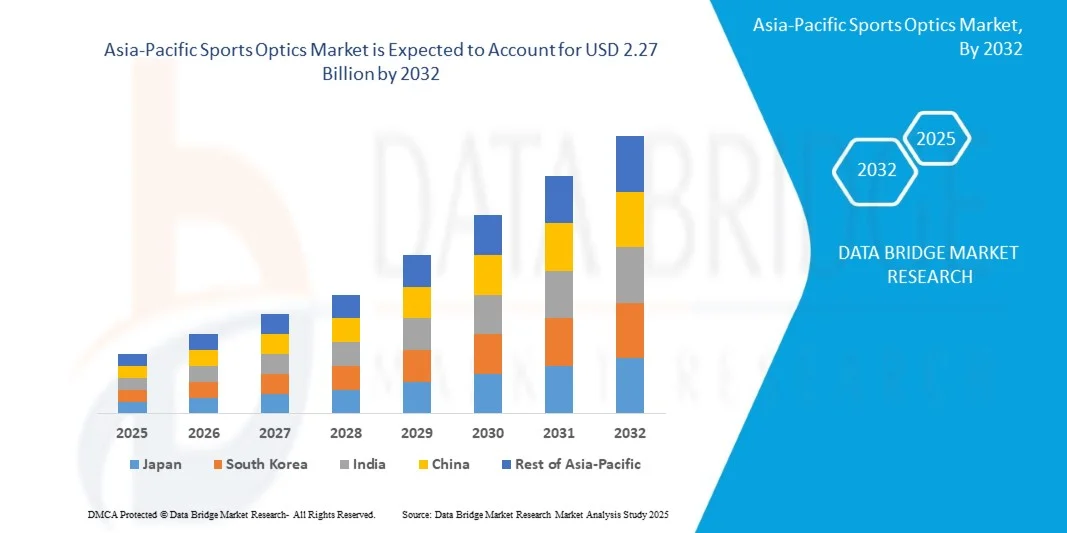
What is the Asia-Pacific Sports Optics Market Size and Growth Rate?
- The Asia-Pacific Sports Optics market size was valued at USD 1.70 billion in 2024 and is expected to reach USD 2.27 billion by 2032, at a CAGR of 3.70% during the forecast period
- The upsurge in the demand for sports optics such as sunglasses and goggles and the rise in the adoption rate of sports optic products among various end-use industries are the major factor driving market growth
- Furthermore, technological advancement, rise in the number of events and increasing disposable income will enhance the growth rate of sports optics market. Also, improved fan experience and superior performance specifications including sharpness, clarity, magnification and portability will positively impact the market growth rate
What are the Major Takeaways of Sports Optics Market?
- The rise in games using sports optics and increasing applications in sports technology will create beneficial opportunities for the growth of the market
- However, high cost associated with advanced sports optics, growing requirement for specific material and integration of software will hamper the growth of sports optics market. Intense competition among market players will further challenge the growth of the market
- China dominated the sports optics market with the largest revenue share of 62.5% in 2024, driven by fueled by the rising popularity of outdoor recreation, defense-grade optics demand, and government support for advanced optical technologies
- The India sports optics market is expected to be the fastest growing in the region with a CAGR of 12.5%, driven by government initiatives promoting defense modernization, smart surveillance projects, and the adoption of advanced optical devices for recreational and professional use
- The binoculars segment dominated the market with a revenue share of 45% in 2024, owing to their versatility, portability, and widespread use across birdwatching, wildlife observation, and sporting events
Report Scope and Asia-Pacific Sports Optics Market Segmentation
|
Attributes |
Asia-Pacific Sports Optics Key Market Insights |
|
Segments Covered |
|
|
Countries Covered |
Asia-Pacific
|
|
Key Market Players |
|
|
Market Opportunities |
|
|
Value Added Data Infosets |
In addition to the insights on market scenarios such as market value, growth rate, segmentation, geographical coverage, and major players, the market reports curated by the Data Bridge Market Research also include in-depth expert analysis, pricing analysis, brand share analysis, consumer survey, demography analysis, supply chain analysis, value chain analysis, raw material/consumables overview, vendor selection criteria, PESTLE Analysis, Porter Analysis, and regulatory framework. |
What is the Key Trend in the Asia-Pacific Sports Optics Market?
“AI-Powered Automation and Cloud-Based Workflow Integration”
- A major and accelerating trend in the global sports optics market is the increasing adoption of artificial intelligence (AI) and cloud-enabled platforms. These technologies are enabling automated image analysis, predictive measurement optimization, and real-time monitoring, improving operational efficiency and observation accuracy
- For instance, companies such as Nikon and ZEISS are integrating AI-driven image processing and cloud-based data management, allowing users to automate repetitive observation tasks and optimize measurement workflows across multiple devices
- AI-powered software can analyze optical images in real time, detect anomalies, suggest optimal device settings, and streamline complex observational processes. Cloud integration enables remote monitoring, data sharing, and collaborative decision-making across locations
- Seamless integration between sensors, imaging software, and optical devices ensures centralized control and efficient workflow management, improving consistency and reducing human error
- This trend toward intelligent, automated, and connected optics systems is reshaping user expectations, pushing manufacturers to develop more sophisticated, user-friendly solutions. Companies such as Leica Camera AG are enhancing their optics platforms with AI-assisted image analysis and cloud data integration features
- Demand for AI and cloud-enabled optics systems is rapidly increasing in defense, surveillance, and wildlife observation, as organizations prioritize precision, scalability, and real-time performance
What are the Key Drivers of Asia-Pacific Sports Optics Market?
- The rising demand for high-precision observation and measurement, coupled with the growing adoption of digital optics in defense, sports, and wildlife applications, is driving market growth. Accurate and repeatable data are critical for effective decision-making
- For instance, in 2024, Nikon expanded its AI-assisted optics solutions to enable automated tracking and image enhancement, reflecting the industry trend of efficiency-focused technologies
- Users increasingly prefer optics systems that are compatible with multiple sensors, imaging devices, and software platforms, reducing manual intervention and improving operational productivity
- The emphasis on real-time monitoring and predictive analytics encourages the adoption of AI-enabled solutions, enabling organizations to detect events, optimize workflows, and make faster decisions
- Advanced user interfaces, cloud integration, and automated reporting are key factors propelling adoption among commercial, defense, and research users, allowing operators to achieve precise results with minimal training
Which Factor is Challenging the Growth of the Asia-Pacific Sports Optics Market?
- High equipment costs and software complexity remain significant barriers, especially for small and medium enterprises. Advanced AI and cloud-enabled optics systems often require substantial upfront investment
- Interoperability challenges with different sensors, imaging devices, and software platforms can restrict adoption, particularly for organizations using mixed-vendor equipment
- Cybersecurity concerns, including potential data breaches during cloud-managed image transfer or storage, create hesitation among users handling proprietary or sensitive information. Companies such as ZEISS and Leica emphasize secure cloud encryption to address these risks
- While basic optics solutions are gradually becoming more affordable, premium AI-driven systems with automated tracking, cloud collaboration, and predictive analytics often have high price tags, limiting accessibility for smaller organizations
- Overcoming these challenges will require cost-effective, modular solutions, improved device compatibility, and robust cybersecurity measures, ensuring broader adoption and sustained market growth
How is the Asia-Pacific Sports Optics Market Segmented?
The market is segmented on the basis of type, games, price range, and distribution channel.
- By Type
On the basis of type, the sports optics market is segmented into telescopes, binoculars, rifle scopes, and rangefinders. The binoculars segment dominated the market with a revenue share of 45% in 2024, owing to their versatility, portability, and widespread use across birdwatching, wildlife observation, and sporting events. Binoculars are favored for their ergonomic designs, optical clarity, and multi-purpose applications, making them essential for both casual users and professional enthusiasts.
The rifle scopes segment is expected to witness the fastest CAGR of 18% during 2025–2032, driven by growing adoption in hunting and competitive shooting sports. Technological advancements such as illuminated reticles, variable zoom, and digital rangefinding are enhancing targeting accuracy and usability, boosting demand in North America, Europe, and Asia-Pacific. The trend toward precision optics and AI-assisted adjustment systems further supports rapid growth in rifle scope adoption across professional and recreational segments.
- By Games
On the basis of games, the sports optics market is segmented into golf, wheel sport, snow sport, water sport, shooting sports, horse racing, and others. The shooting sports segment dominated the market with 33% revenue share in 2024, fueled by the increasing popularity of competitive shooting, hunting, and tactical sports. Enthusiasts prioritize high-precision optics such as rifle scopes, rangefinders, and binoculars for accuracy and performance.
The golf segment is anticipated to witness the fastest CAGR of 17% from 2025 to 2032, driven by demand for rangefinders and spotting scopes to measure distances, enhance visibility, and improve game strategy. Rising participation in golf tournaments, adoption of AI-assisted rangefinders, and integration with GPS-enabled devices are further boosting market growth. The trend toward sports-specific optics solutions is shaping consumer preferences for tailored designs and advanced functionalities, expanding applications across amateur and professional players asuch as.
- By Price Range
On the basis of price range, the sports optics market is segmented into low, mid, and high. The mid-price segment dominated the market with a 45% revenue share in 2024, offering a balance between affordability and advanced optical features such as high-quality lenses, durable construction, and multi-coated optics. Mid-range optics appeal to a wide audience, including amateur enthusiasts and semi-professional users seeking reliable performance without premium costs.
The high-price segment is expected to witness the fastest CAGR of 19% during 2025–2032, driven by professional-grade equipment with features such as laser rangefinding, advanced night vision, and AI-assisted image stabilization. Increased disposable incomes, rising interest in competitive sports, and demand for cutting-edge technologies in hunting, shooting, and wildlife observation are fueling growth in the high-end optics segment. Consumer preference is shifting toward premium optics for specialized applications requiring precision and durability.
- By Distribution Channel
On the basis of distribution channel, the sports optics market is segmented into online and offline channels. The offline segment dominated the market in 2024 with a 52% revenue share, driven by the importance of hands-on experience, personalized guidance, and post-sales services offered in specialty stores, sports retailers, and optical showrooms. Consumers often prefer offline purchase to inspect product quality, test optical clarity, and receive expert recommendations.
The online segment is expected to witness the fastest CAGR of 21% from 2025 to 2032, fueled by e-commerce platforms, direct-to-consumer sales, and virtual demos. Convenience, wider product selection, competitive pricing, and integration with AI-assisted recommendation tools are driving online adoption. The trend of digital purchasing, especially among younger and tech-savvy users, is transforming buying behavior while expanding market reach globally.
Which Region Holds the Largest Share of the Asia-Pacific Sports Optics Market?
- China dominated the sports optics market with the largest revenue share of 62.5% in 2024, driven by fueled by the rising popularity of outdoor recreation, defense-grade optics demand, and government support for advanced optical technologies
- Local manufacturers provide cost-effective binoculars, scopes, and spotting devices, while investments in AI and IoT-enabled solutions improve precision and usability.
- China’s expanding production capabilities and growing outdoor sports culture make it a critical market driving growth across the Asia-Pacific region
India Sports Optics Market Insight
The India sports optics market is expected to be the fastest growing in the region with a CAGR of 12.5%, driven by government initiatives promoting defense modernization, smart surveillance projects, and the adoption of advanced optical devices for recreational and professional use. Affordability of locally produced optics, coupled with increasing awareness of outdoor activities, is accelerating adoption. India’s emergence as a production and innovation hub ensures wider accessibility, strengthening penetration across both recreational and defense applications.
Japan Sports Optics Market Insight
Japan’s sports optics market is witnessing steady growth due to its high-tech culture, demand for precision optics, and emphasis on outdoor sports and hunting activities. Adoption is driven by integration with AI-assisted targeting, cloud-enabled features, and customization for professional and recreational users. The aging population, coupled with interest in user-friendly, automated solutions, encourages deployment across both commercial and small-scale applications, positioning Japan as a strategic growth market in Asia-Pacific.
Which are the Top Companies in Asia-Pacific Sports Optics Market?
The sports optics industry is primarily led by well-established companies, including:
- Beretta Holding S.p.A. (Italy)
- Nikon Corporation (Japan)
- ZEISS International (Germany)
- U.S. OPTICS (U.S.)
- LEUPOLD & STEVENS, INC. (U.S.)
- Trijicon, Inc. (U.S.)
- VISTA OUTDOOR OPERATIONS LLC. (U.S.)
- Celestron, LLC. (U.S.)
- Leica Camera AG (Germany)
- Schmidt & Bender GmbH & Co. KG (Germany)
- NIGHTFORCE OPTICS (U.S.)
- Teledyne FLIR LLC (U.S.)
- EOTECH (U.S.)
- ATN (U.S.)
- Vortex Optics (U.S.)
- Nightforce Optics, Inc. (U.S.)
- Athlon (U.S.)
- Meopta – optika, s.r.o. (Czech Republic)
What are the Recent Developments in Asia-Pacific Sports Optics Market?
- In August 2023, Fujifilm Corporation launched its flagship store, the "Fujifilm X Space," in Lajpat Nagar, New Delhi, India, with Indian photographer Dabboo Ratnani attending alongside FUJIFILM India's leadership, marking a key milestone in expanding its consumer engagement and brand presence
- In January 2023, Swarovski Optik, an Austria-based optical instrument manufacturer, launched the AX Visio on its 75th anniversary, featuring AI-supported binoculars capable of identifying over 9,000 wildlife and bird species, ideal for outdoor activities such as birdwatching and hunting, enhancing precision and user experience
- In January 2023, ZEISS, a Germany-based optoelectronics and optical system manufacturer, unveiled the ZEISS SFL 30 binoculars, featuring a compact, lightweight design with ultra-high definition optics, offering improved clarity and portability for outdoor and professional applications
- In August 2021, Vista Outdoor Operations LLC reintroduced three enhanced Elite 4500 4X riflescopes under the Bushnell performance optics brand, providing upgraded precision, durability, and performance for sporting and recreational shooting enthusiasts
- In January 2020, Nikon Corporation introduced the AF-S NIKKOR 120-300 mm f/2.8E FL ED SR VR telephoto zoom lens in Tokyo, Japan, equipped with a vibration reduction mechanism, enabling users to efficiently capture and analyze sporting and wildlife photography with enhanced clarity and stability

- Interactive Data Analysis Dashboard
- Company Analysis Dashboard for high growth potential opportunities
- Research Analyst Access for customization & queries
- Competitor Analysis with Interactive dashboard
- Latest News, Updates & Trend analysis
- Harness the Power of Benchmark Analysis for Comprehensive Competitor Tracking
Asia Pacific Sports Optics Market, Supply Chain Analysis and Ecosystem Framework
To support market growth and help clients navigate the impact of geopolitical shifts, DBMR has integrated in-depth supply chain analysis into its Asia Pacific Sports Optics Market research reports. This addition empowers clients to respond effectively to global changes affecting their industries. The supply chain analysis section includes detailed insights such as Asia Pacific Sports Optics Market consumption and production by country, price trend analysis, the impact of tariffs and geopolitical developments, and import and export trends by country and HSN code. It also highlights major suppliers with data on production capacity and company profiles, as well as key importers and exporters. In addition to research, DBMR offers specialized supply chain consulting services backed by over a decade of experience, providing solutions like supplier discovery, supplier risk assessment, price trend analysis, impact evaluation of inflation and trade route changes, and comprehensive market trend analysis.
Data collection and base year analysis are done using data collection modules with large sample sizes. The stage includes obtaining market information or related data through various sources and strategies. It includes examining and planning all the data acquired from the past in advance. It likewise envelops the examination of information inconsistencies seen across different information sources. The market data is analysed and estimated using market statistical and coherent models. Also, market share analysis and key trend analysis are the major success factors in the market report. To know more, please request an analyst call or drop down your inquiry.
The key research methodology used by DBMR research team is data triangulation which involves data mining, analysis of the impact of data variables on the market and primary (industry expert) validation. Data models include Vendor Positioning Grid, Market Time Line Analysis, Market Overview and Guide, Company Positioning Grid, Patent Analysis, Pricing Analysis, Company Market Share Analysis, Standards of Measurement, Global versus Regional and Vendor Share Analysis. To know more about the research methodology, drop in an inquiry to speak to our industry experts.
Data Bridge Market Research is a leader in advanced formative research. We take pride in servicing our existing and new customers with data and analysis that match and suits their goal. The report can be customized to include price trend analysis of target brands understanding the market for additional countries (ask for the list of countries), clinical trial results data, literature review, refurbished market and product base analysis. Market analysis of target competitors can be analyzed from technology-based analysis to market portfolio strategies. We can add as many competitors that you require data about in the format and data style you are looking for. Our team of analysts can also provide you data in crude raw excel files pivot tables (Fact book) or can assist you in creating presentations from the data sets available in the report.













