


SWIR Market Size
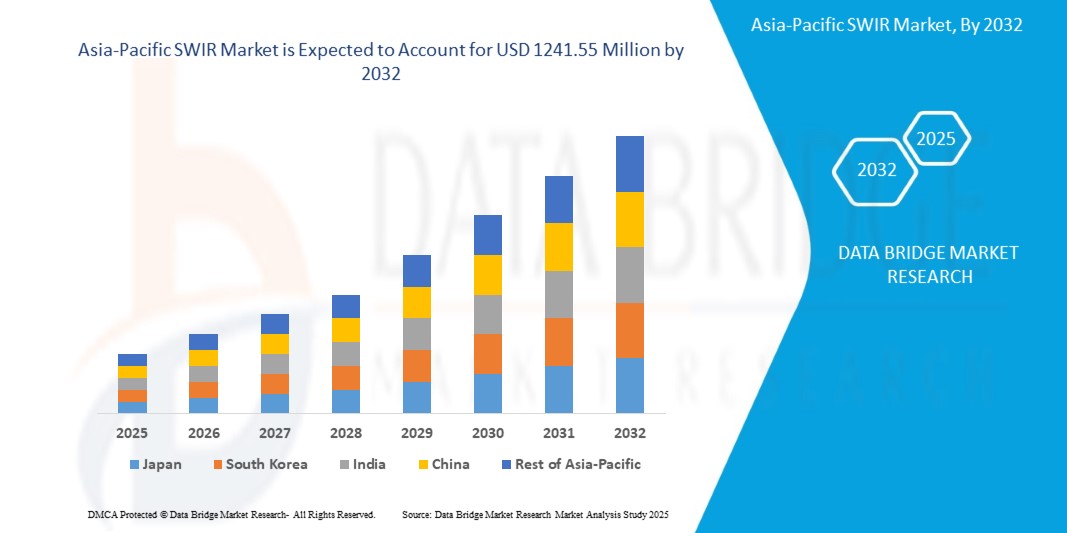
- The Asia-Pacific SWIR Market size was valued at USD 515.63 Million in 2024 and is expected to reach USD 1241.55 Million by 2032, at a CAGR of 11.6% during the forecast period
- This growth is driven by rising demand for shortwave infrared cameras in machine vision applications and growing adoption of night vision technologies.
SWIR Market Analysis
- Short-wave infrared (SWIR) is typically defined as light in the 0.9–1.7μm wavelength range, or can also be in range of 0.7–2.5μm. Short-wave Infrared imaging (SWIR) refers to an advanced technique which is used for producing images based on radiation in the region of the electromagnetic spectrum invisible to the naked eye. SWIR imaging requires unique optical and electronic components capable of performing in the specific SWIR range.
- A large number of applications that are difficult or impossible to perform using visible light are possible using SWIR. When imaging in SWIR, water vapor, fog, other environment constraints and certain materials such as silicon are transparent. SWIR imagers are used in a large number of applications such as silicon inspection, laser beam profiling, hyperspectral imaging, chemical and plastics sensing, machine vision imaging, agricultural sensing, surveillance systems, and medical imaging. They are also intended for use in mobile phone facial recognition sensors, and autonomous vehicle imaging though obscured environments.
- China dominates the Asia-Pacific SWIR market owing to the owing to factors such as presence of large number of SWIR suppliers and providers and increasing adoption of automation for business processes.
- The hardware segment is projected to hold the largest share of approximately 48.75% in 2025. This leadership is attributed to the high demand for robust SWIR sensors, detectors, and camera systems in industrial automation, quality inspection, and biomedical imaging applications.
Report Scope and SWIR Market Segmentation
|
Attributes |
SWIR Key Market Insights |
|
Segments Covered |
|
|
Countries Covered |
Asia-Pacific
|
|
Key Market Players |
|
|
Market Opportunities |
|
|
Value Added Data Infosets |
In addition to the insights on market scenarios such as market value, growth rate, segmentation, geographical coverage, and major players, the market reports curated by the Data Bridge Market Research also include import export analysis, production capacity overview, production consumption analysis, price trend analysis, climate change scenario, supply chain analysis, value chain analysis, raw material/consumables overview, vendor selection criteria, PESTLE Analysis, Porter Analysis, and regulatory framework. |
SWIR Market Trends
“Expansion of Machine Vision Applications Driving SWIR Camera Demand in Asia-Pacific”
- The accelerating adoption of machine vision systems across various Asia-Pacifican industries is significantly contributing to the demand for short-wave infrared (SWIR) imaging solutions.
- SWIR cameras are uniquely suited to detect defects, perform material classification, and support non-destructive inspection, making them indispensable in sectors like semiconductor manufacturing, electronics assembly, and food processing.
For Instance,
- In December 2024, a prominent semiconductor fabrication facility based in South Korea implemented advanced SWIR imaging technology into its wafer inspection lines. The integration aims to enhance detection of sub-surface defects and contamination during high-precision semiconductor processing, significantly improving yield rates and quality assurance across critical production stages.
- This trend is expected to continue as manufacturers in the region increasingly prioritize automation and precision-driven inspection tools.
SWIR Market Dynamics
Driver
“Heightened Use of SWIR Technology in Night Vision and Surveillance Systems”
- Another key growth driver in the Asia-Pacifican SWIR market is the growing emphasis on national security and defense readiness, which is prompting greater investment in night vision and surveillance technologies.
- SWIR cameras provide the ability to capture high-resolution images even in low-light or obscured environments—such as through fog, smoke, or camouflage—making them ideal for both military and civilian security applications.
For instance,
- In October 2024, the Indian Ministry of Defence initiated a military modernization initiative that incorporates the deployment of SWIR-enabled night vision scopes and helmet-mounted displays. These advanced optical systems are designed to support special reconnaissance units operating in dense forests and low-light environments, enhancing situational awareness and tactical precision during night-time missions.
- This rising need for enhanced situational awareness and perimeter monitoring continues to fuel the market for SWIR-based imaging solutions in Asia-Pacific.
Opportunity
“Miniaturization of SWIR Sensors Unlocking New Applications”
- Technological advancements in sensor miniaturization are opening up new avenues for SWIR deployment in emerging industries such as consumer electronics, healthcare wearables, and smart agriculture.
- Smaller, lightweight SWIR sensors are now being designed to fit into compact devices such as augmented reality (AR) glasses, drones, and medical imaging tools, offering real-time imaging capabilities in unconventional environments.
For instance,
- In January 2025, a Japan-based photonics firm partnered with a South Korean wearable technology startup to integrate miniaturized SWIR sensors into next-generation smart glasses. These smart glasses are designed for use in industrial environments, enabling real-time monitoring of temperature gradients, fluid levels, and material inconsistencies, thereby improving operational safety and maintenance efficiency in sectors like manufacturing and energy.
- This innovation is paving the way for SWIR to move beyond traditional industrial uses into high-growth consumer and medical technology markets.
Restraint/Challenge
“Persistent Challenges in Cost and Sensor Efficiency Limit Broader Adoption”
- A significant obstacle facing the Asia-Pacifican SWIR market is the high cost of production and limited performance scalability of Indium Gallium Arsenide (InGaAs)-based sensors, which are central to most SWIR imaging systems.
- While InGaAs sensors provide excellent sensitivity in the SWIR band, their expensive fabrication process, dependence on specialized materials, and limited pixel density present barriers for integration into mainstream, cost-sensitive applications.
For instance,
- In November 2024, a collaborative research consortium in Japan and Singapore initiated a pilot program focused on developing cost-effective alternatives to InGaAs for SWIR imaging applications. The project explores the use of colloidal quantum dots (CQDs) and other novel semiconductor materials to reduce production costs and improve accessibility for commercial imaging and industrial inspection. While still in early R&D phases, this initiative reflects the region's growing commitment to next-generation SWIR technology innovation.
- Unless these challenges are addressed, the full potential of SWIR imaging in sectors like agriculture, consumer electronics, and autonomous vehicles may remain untapped in the near term.
SWIR Market Scope
Asia-Pacific SWIR market is segmented on the basis of scanning type, detector type, chemical composition, application, component and industry.
|
Segmentation |
Sub-Segmentation |
|
By Scanning Type |
|
|
By Detector Type |
|
|
By Chemical Composition |
|
|
By Application |
|
|
By Component |
|
|
By Industry
|
|
In 2025, the security & surveillance segment is projected to dominate the Asia-Pacific SWIR Market in the application category
The security & surveillance segment is expected to command the largest market share of approximately 34.45% in 2025. This dominance is driven by the increasing integration of SWIR imaging technologies into defense and homeland security operations across Asia-Pacific. Enhanced capabilities such as facial recognition in low-light environments, detection through fog and smoke, and covert surveillance have made SWIR cameras indispensable tools for military and law enforcement agencies. Additionally, rising geopolitical tensions and growing government investments in border control and critical infrastructure protection are accelerating the deployment of advanced surveillance systems equipped with SWIR imaging.
In 2025, the hardware segment is anticipated to lead the Asia-Pacific SWIR Market within the component segment
The hardware segment is projected to hold the largest share of approximately 48.75% in 2025. This leadership is attributed to the high demand for robust SWIR sensors, detectors, and camera systems in industrial automation, quality inspection, and biomedical imaging applications. With ongoing advancements in sensor miniaturization and performance optimization, hardware components continue to be the backbone of SWIR systems across the region. The presence of key Asia-Pacifican manufacturers investing in high-performance optical hardware and integrated systems further supports the strong position of this segment in the market.
SWIR Market Regional Analysis
“China Holds the Largest Share and fastest growing in the SWIR Market”
- China is projected to lead the Asia-Pacific SWIR market, driven by its expanding high-tech manufacturing base, increasing investments in research and development (R&D), and growing adoption of advanced imaging technologies across multiple sectors. The country has emerged as a major hub for electronics, photonics, and semiconductor innovation, with strong government backing for emerging technologies through initiatives like "Made in China 2025."
- Additionally, China’s robust defense, industrial automation, and consumer electronics industries are increasingly integrating SWIR technology for enhanced surveillance, machine vision, and quality inspection applications. Local companies and regional branches of global SWIR component manufacturers are contributing to rapid product innovation and cost-effective system integration.
- With accelerating demand from automotive, security, and manufacturing sectors, combined with strategic investments in photonics and quantum materials, China is positioned as both the largest and fastest-growing market for SWIR imaging technologies in the Asia-Pacific region.
SWIR Market Share
The market competitive landscape provides details by competitor. Details included are company overview, company financials, revenue generated, market potential, investment in research and development, new market initiatives, Asia-Pacific presence, production sites and facilities, production capacities, company strengths and weaknesses, product launch, product width and breadth, application dominance. The above data points provided are only related to the companies' focus related to market.
The Major Market Leaders Operating in the Market Are:
- Teledyne Technologies Incorporated(United States)
- Xenics nv(Belgium)
- Lynred (France)
- Allied Vision Technologies GmbH(Germany)
- Hamamatsu Photonics K.K.(Japan)
- NIT (New Imaging Technologies)(France)
- Raptor Photonics(United Kingdom)
- InfraTec GmbH (Germany)
- TTP plc. (United Kingdom)
- Photonic Science and Engineering Limited(United Kingdom)
- Edmund Optics Inc.(United States)
- Atik Cameras Limited (Subsidiary of SDI Group)(United Kingdom)
- Silent Sentinel (United Kingdom)
Latest Developments in Asia-Pacific SWIR Market
- In July 2024: onsemi (Semiconductor Components Industries, LLC) finalized its acquisition of SWIR Vision Systems, a leading company known for its innovative use of colloidal quantum dots (CQD) in SWIR imaging. This acquisition is aimed at bolstering onsemi’s SWIR sensor portfolio, allowing them to enhance their offerings in automotive, industrial, and healthcare applications, particularly in machine vision and surveillance solutions.
- In August 2024: Teledyne FLIR IIS, a division of Teledyne Technologies, introduced the Forge® 1GigE SWIR camera series, powered by the Sony SenSWIR IMX990 1.3 MP InGaAs sensor. This advanced camera captures both visible and SWIR light (400nm to 1700nm), making it ideal for applications such as semiconductor inspection, food quality control, recycling, and precision agriculture.
- In September 2024: Quantum Solutions partnered with TOPODRONE to launch the Q.Fly—a quantum dot SWIR camera compatible with DJI drones. Designed for UAV applications, it offers real-time video streaming and high-speed spectral imaging (220 Hz), making it perfect for use in industries like agriculture, security, industrial inspection, and fire safety.
- In January 2024: Emberion unveiled its enhanced VS20 vis-SWIR camera series at Photonics West 2024. The upgraded models deliver frame rates of up to 400 fps at VGA resolution, catering to high-speed inspection needs. A newly released compact version, weighing just 450g, is perfect for integration into UAVs and other mobile platforms.

- Interactive Data Analysis Dashboard
- Company Analysis Dashboard for high growth potential opportunities
- Research Analyst Access for customization & queries
- Competitor Analysis with Interactive dashboard
- Latest News, Updates & Trend analysis
- Harness the Power of Benchmark Analysis for Comprehensive Competitor Tracking
Asia Pacific Swir Market, Supply Chain Analysis and Ecosystem Framework
To support market growth and help clients navigate the impact of geopolitical shifts, DBMR has integrated in-depth supply chain analysis into its Asia Pacific Swir Market research reports. This addition empowers clients to respond effectively to global changes affecting their industries. The supply chain analysis section includes detailed insights such as Asia Pacific Swir Market consumption and production by country, price trend analysis, the impact of tariffs and geopolitical developments, and import and export trends by country and HSN code. It also highlights major suppliers with data on production capacity and company profiles, as well as key importers and exporters. In addition to research, DBMR offers specialized supply chain consulting services backed by over a decade of experience, providing solutions like supplier discovery, supplier risk assessment, price trend analysis, impact evaluation of inflation and trade route changes, and comprehensive market trend analysis.
Data collection and base year analysis are done using data collection modules with large sample sizes. The stage includes obtaining market information or related data through various sources and strategies. It includes examining and planning all the data acquired from the past in advance. It likewise envelops the examination of information inconsistencies seen across different information sources. The market data is analysed and estimated using market statistical and coherent models. Also, market share analysis and key trend analysis are the major success factors in the market report. To know more, please request an analyst call or drop down your inquiry.
The key research methodology used by DBMR research team is data triangulation which involves data mining, analysis of the impact of data variables on the market and primary (industry expert) validation. Data models include Vendor Positioning Grid, Market Time Line Analysis, Market Overview and Guide, Company Positioning Grid, Patent Analysis, Pricing Analysis, Company Market Share Analysis, Standards of Measurement, Global versus Regional and Vendor Share Analysis. To know more about the research methodology, drop in an inquiry to speak to our industry experts.
Data Bridge Market Research is a leader in advanced formative research. We take pride in servicing our existing and new customers with data and analysis that match and suits their goal. The report can be customized to include price trend analysis of target brands understanding the market for additional countries (ask for the list of countries), clinical trial results data, literature review, refurbished market and product base analysis. Market analysis of target competitors can be analyzed from technology-based analysis to market portfolio strategies. We can add as many competitors that you require data about in the format and data style you are looking for. Our team of analysts can also provide you data in crude raw excel files pivot tables (Fact book) or can assist you in creating presentations from the data sets available in the report.













