


Asia-Pacific Urinalysis Market Overview
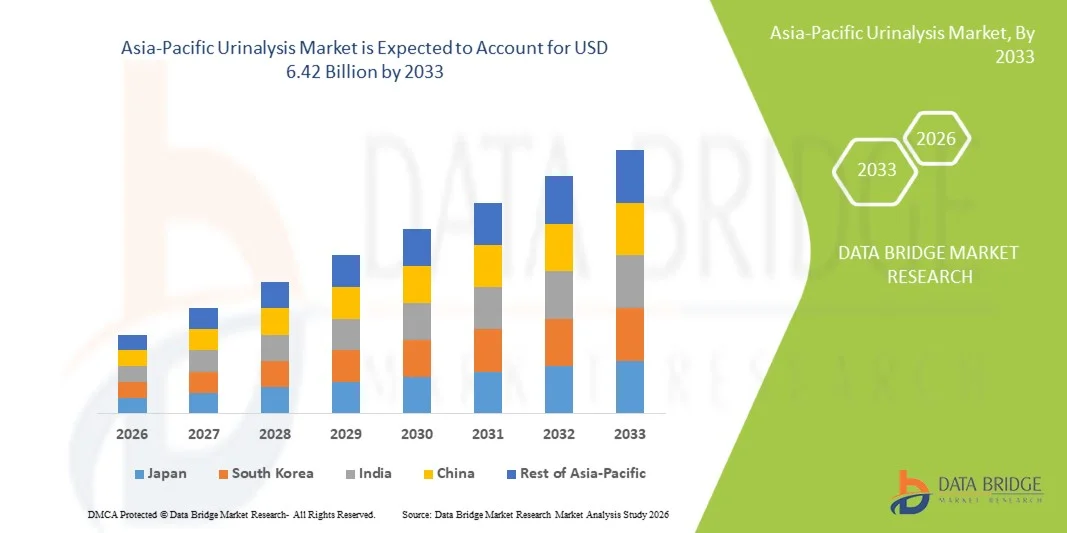
The Asia-Pacific Urinalysis market was valued at USD 4.28 billion in 2025 and is projected to reach USD 6.42 billion by 2033, growing at a CAGR of 5.20% from 2026 to 2033. The market is experiencing steady growth driven by the rising prevalence of urinary tract infections (UTIs), kidney disorders, diabetes, and chronic kidney diseases, along with increasing awareness regarding preventive healthcare and routine diagnostic testing across the region.
The growing burden of lifestyle-related diseases, expanding geriatric population, and increasing healthcare expenditure across countries such as China, India, Japan, and South Korea are encouraging healthcare providers and diagnostic laboratories to adopt advanced urinalysis solutions. Automated urinalysis analyzers and point-of-care testing systems are increasingly replacing conventional manual testing methods by offering faster turnaround times, improved diagnostic accuracy, and enhanced workflow efficiency. Furthermore, government initiatives aimed at strengthening healthcare infrastructure, expanding access to diagnostic services, and promoting early disease detection are supporting market growth. The rapid expansion of diagnostic laboratories, hospitals, and community healthcare centers, coupled with increasing adoption of digital healthcare technologies and laboratory automation, continues to drive demand for urinalysis products across the Asia-Pacific region
Key Market Trends & Insights
- China dominated the Asia-Pacific Urinalysis market with the largest revenue share of 36.48% in 2025, supported by its large patient population, expanding healthcare infrastructure, growing prevalence of diabetes and kidney disorders, increasing adoption of automated diagnostic technologies, and strong investments in laboratory modernization. Rising demand for routine screening and preventive healthcare continues to support market growth across the country.
- The Consumables segment led the market with a 64.27% share in 2025, driven by the high volume of routine urinalysis testing conducted across hospitals, diagnostic laboratories, and healthcare centers. Frequent usage of urine test strips, reagents, calibrators, and controls for disease screening and monitoring contributes significantly to recurring demand.
- India is expected to be the fastest-growing country in the Asia-Pacific Urinalysis market, registering a CAGR of 8.9% from 2026 to 2033, fueled by increasing healthcare expenditure, expanding diagnostic laboratory networks, growing awareness of preventive healthcare, rising diabetes prevalence, and improving access to diagnostic services in urban and rural areas.
- Portable Urinalysis Systems are the fastest-growing modality segment, projected to register a CAGR of 8.5% from 2026 to 2033, reflecting increasing demand for point-of-care testing, home healthcare diagnostics, and rapid disease screening solutions that offer convenience and faster clinical decision-making.
- The Urinary Tract Infections (UTIs) segment dominated the application category with a 31.84% revenue share in 2025, owing to the high prevalence of UTIs across all age groups, increasing diagnostic testing volumes, and growing awareness regarding early detection and treatment of urinary tract disorders.
- Hospitals accounted for 46.72% of the market in 2025, supported by high patient inflow, availability of advanced diagnostic infrastructure, increasing inpatient and outpatient testing volumes, and widespread adoption of automated urinalysis analyzers for routine clinical diagnostics.
- The Direct Tender segment dominated the distribution channel category with a 58.36% share in 2025, driven by bulk procurement of urinalysis instruments, consumables, and reagents by hospitals, government healthcare institutions, and large diagnostic laboratory chains seeking cost-effective purchasing agreements and long-term supply contracts.
- The Instruments segment is anticipated to be the fastest-growing product category, registering a CAGR of 8.1% from 2026 to 2033, supported by rising adoption of automated urinalysis analyzers, increasing laboratory automation initiatives, growing demand for high-throughput diagnostic systems, and technological advancements in digital urine testing platforms across the Asia-Pacific region.
- The Urine Biochemistry Testing segment dominated the market with a 48% share in 2025 due to its extensive utilization in routine clinical diagnostics, preventive health screening programs, diabetes monitoring, kidney function assessment, liver disease evaluation, and urinary tract infection diagnosis across hospitals and laboratories throughout Asia-Pacific.
Market Size & Forecast
- Asia-Pacific Market Value (2025): USD 4.28 Billion
- Expected Market Value (2033): USD 6.42 Billion
- Forecast CAGR (2026–2033): 5.20%
- Leading Region in 2025: China
- Fastest Growing Region: India
Report Scope and Asia-Pacific Urinalysis Market Segmentation
|
Attributes |
Urinalysis Key Market Insights |
|
Segments Covered |
· By Testing Type: Urine Biochemistry Testing, Urine Sediment Testing · By Product: Instruments, Consumables · By Modality: Portable, Standalone, Table Top, Bench Top, Others · By Application: Urinary Tract Infections and Kidney Diseases, Diabetes, Liver Diseases, Pregnancy & Fertility, Others · By End User: Hospitals, Laboratories, Home Care Settings, and Others · By Distribution Channel: Direct Tender and Retail Sales |
|
Countries Covered |
Asia-Pacific · China · Japan · India · South Korea · Singapore · Malaysia · Australia · Thailand · Indonesia · Philippines · Rest of Asia-Pacific · |
|
Key Market Players |
• F. Hoffmann-La Roche Ltd. (Switzerland) |
|
Market Opportunities |
· Expansion of Point-of-Care and Home-Based Urinalysis Testing · Integration of Artificial Intelligence and Laboratory Automation · Rising Demand for Preventive Healthcare and Early Disease Screening |
|
Value Added Data Infosets |
In addition to the insights on market scenarios such as market value, growth rate, segmentation, geographical coverage, and major players, the market reports curated by the Data Bridge Market Research also include in-depth expert analysis, geographically represented company-wise production and capacity, network layouts of distributors and partners, detailed and updated price trend analysis and deficit analysis of supply chain and demand. |
Asia-Pacific Urinalysis Market Trends
Trend: Growing Adoption of Point-of-Care Testing and Automated Urinalysis Systems
The Asia-Pacific urinalysis market is witnessing a strong trend toward the adoption of point-of-care (POC) testing solutions and automated urinalysis platforms. Healthcare providers are increasingly utilizing portable analyzers, automated urine sediment analyzers, and digital urine chemistry systems to improve diagnostic efficiency and reduce turnaround times. The growing burden of diabetes, chronic kidney disease (CKD), urinary tract infections (UTIs), and other metabolic disorders is driving demand for rapid and accurate urine testing. Countries such as China, Japan, India, and South Korea are investing heavily in healthcare modernization and laboratory automation, while the expansion of home healthcare and preventive screening programs is further accelerating the adoption of user-friendly urinalysis technologies.
Asia-Pacific Urinalysis Market Dynamics
Key Market Driver: Rising Prevalence of Kidney Diseases, Diabetes, and Urinary Tract Infections
The increasing incidence of chronic kidney disease, diabetes, urinary tract infections, and other renal disorders is a major factor driving demand for urinalysis products across the Asia-Pacific region. According to the International Diabetes Federation (IDF), the Western Pacific region accounts for the largest number of adults living with diabetes globally, while South-East Asia continues to witness a significant rise in diabetic populations. Urinalysis remains one of the most commonly used diagnostic tools for detecting proteinuria, glucose abnormalities, kidney dysfunction, and urinary infections.
Furthermore, aging populations, changing lifestyles, increasing obesity rates, and growing awareness regarding preventive healthcare are contributing to higher testing volumes. Governments across Asia-Pacific are expanding healthcare access and encouraging routine health screenings, leading to increased utilization of urinalysis products in hospitals, diagnostic laboratories, and primary care settings. The growing adoption of automated analyzers and digital laboratory solutions is also supporting market expansion by improving diagnostic accuracy and workflow efficiency.
Key Restraint/Challenge: Limited Healthcare Access and Cost Constraints in Emerging Markets
A significant challenge in the Asia-Pacific urinalysis market is the disparity in healthcare infrastructure and diagnostic accessibility across developing economies. While countries such as Japan, South Korea, Singapore, and Australia possess advanced laboratory networks, many rural and underserved regions in emerging markets continue to face shortages of diagnostic equipment and trained healthcare professionals.
In addition, advanced automated urinalysis analyzers require substantial investment in equipment procurement, maintenance, calibration, and laboratory infrastructure. Smaller healthcare facilities and community diagnostic centers often face budget limitations that restrict the adoption of high-end diagnostic systems. Reimbursement limitations and variations in healthcare spending across countries can also impact the widespread implementation of advanced urinalysis technologies. For example, many rural healthcare facilities in developing parts of Asia continue to rely on manual urine testing methods due to lower operational costs and limited laboratory resources.
Key Market Opportunity: Expansion of Home-Based Diagnostics and AI-Enabled Urinalysis Solutions
The increasing adoption of home-based diagnostics, digital healthcare technologies, and artificial intelligence presents a significant opportunity for the Asia-Pacific urinalysis market. AI-powered urinalysis systems can automate sample interpretation, improve diagnostic accuracy, reduce human error, and support faster clinical decision-making. Smartphone-enabled urine testing kits and portable urinalysis devices are gaining popularity among patients seeking convenient monitoring of diabetes, kidney function, pregnancy, and urinary tract health.
The rapid growth of telemedicine and remote patient monitoring programs across China, India, Japan, and Southeast Asia is further creating demand for connected urinalysis solutions. In addition, rising investments in healthcare digitization, laboratory automation, and preventive medicine initiatives are supporting the development of next-generation urinalysis platforms capable of delivering real-time results and seamless integration with electronic health record systems. These advancements are expected to create substantial growth opportunities for manufacturers and healthcare providers across the Asia-Pacific region during the forecast period.
Asia-Pacific Urinalysis Market Scope
The Asia-Pacific Urinalysis market is segmented on the basis of testing type, product, modality, application, end user, and distribution channel.
- By Testing Type
On the basis of testing type, the Asia-Pacific Urinalysis market is segmented into Urine Biochemistry Testing and Urine Sediment Testing. The Urine Biochemistry Testing segment dominated the market with a 62.48% share in 2025 due to its extensive utilization in routine clinical diagnostics, preventive health screening programs, diabetes monitoring, kidney function assessment, liver disease evaluation, and urinary tract infection diagnosis across hospitals and laboratories throughout Asia-Pacific. The segment benefits from the rapidly growing burden of chronic diseases, particularly diabetes and chronic kidney disease, which require frequent urine-based testing for disease monitoring and treatment management. Urine biochemistry tests offer a non-invasive, cost-effective, and rapid diagnostic approach, making them widely adopted across both developed and emerging healthcare markets. Increasing government investments in public health screening programs, expanding healthcare coverage, and rising patient awareness regarding early disease detection continue to strengthen demand. Healthcare providers are increasingly adopting automated urine chemistry analyzers and advanced reagent strip technologies that improve testing accuracy and workflow efficiency. Growing diagnostic laboratory networks across China, India, Japan, South Korea, and Southeast Asia are further contributing to market expansion. In addition, rising geriatric populations and increasing incidence of lifestyle-related diseases are generating sustained testing volumes. Continuous technological advancements and broad clinical applicability continue to reinforce the dominant position of the urine biochemistry testing segment across the regional market.
The Urine Sediment Testing segment is expected to witness the fastest CAGR of 7.9% from 2026 to 2033, driven by increasing demand for advanced microscopic examination of urine samples to identify kidney disorders, urinary tract infections, glomerular diseases, and other renal abnormalities. The growing prevalence of nephrological disorders across Asia-Pacific is significantly increasing the need for comprehensive urine sediment analysis. Healthcare providers are increasingly adopting automated urine sediment analyzers that utilize digital imaging, artificial intelligence, and machine learning technologies to improve diagnostic accuracy and reduce manual workload. Rising investments in laboratory automation and modernization programs are supporting the adoption of advanced sediment analysis platforms. Furthermore, growing awareness regarding early detection of kidney diseases and increasing utilization of specialized nephrology diagnostic services are accelerating market demand. Large hospitals and reference laboratories are increasingly integrating automated sediment analyzers into routine workflows to enhance productivity and standardize results. The segment is also benefiting from rising healthcare expenditure and expanding access to advanced diagnostic technologies across emerging economies. Continuous innovation in image recognition systems and AI-assisted microscopy is expected to further support strong segment growth during the forecast period.
- By Product
On the basis of product, the Asia-Pacific Urinalysis market is segmented into Instruments and Consumables. The Consumables segment dominated the market with a 58.76% share in 2025 owing to the recurring requirement for urine test strips, reagents, controls, calibrators, sample collection products, and other disposable materials used during urinalysis procedures. The growing volume of urine testing performed across hospitals, diagnostic laboratories, physician offices, and home healthcare settings continues to generate strong demand for consumables throughout the region. Rising prevalence of diabetes, kidney diseases, urinary tract infections, and metabolic disorders is significantly increasing testing frequency. Consumables represent a recurring purchase category, creating a stable revenue stream for manufacturers and distributors. Increasing adoption of automated urinalysis systems further supports demand for compatible reagent kits and testing supplies. Expansion of healthcare infrastructure across China, India, Indonesia, Vietnam, and other emerging economies is also contributing to higher consumable utilization. In addition, growing awareness regarding preventive healthcare and routine health checkups is driving test volume growth. Product innovations focused on improved accuracy, longer shelf life, and enhanced usability continue to support market expansion. These factors collectively reinforce the leading position of the consumables segment.
The Instruments segment is projected to register the fastest CAGR of 8.1% from 2026 to 2033, driven by increasing adoption of automated urine analyzers, digital diagnostic systems, and point-of-care testing platforms across healthcare facilities. Healthcare providers are investing heavily in laboratory automation solutions to improve efficiency, reduce turnaround time, and enhance diagnostic accuracy. Technological advancements in artificial intelligence, image analysis, and cloud-based reporting are supporting the development of next-generation urinalysis instruments. Rising investments in healthcare modernization initiatives across Asia-Pacific countries are further accelerating adoption. Increasing demand for high-throughput analyzers capable of processing large sample volumes is supporting market growth among hospitals and reference laboratories. Moreover, expanding
- By Modality
On the basis of modality, the Asia-Pacific Urinalysis market is segmented into Portable, Standalone, Table Top, Bench Top, and Others. The Bench Top segment dominated the market with a 34.92% share in 2025 due to its widespread utilization across hospitals, diagnostic laboratories, reference laboratories, and large healthcare institutions that require high-throughput testing capabilities and superior diagnostic accuracy. Bench-top analyzers offer automated sample processing, enhanced workflow efficiency, reduced manual intervention, and the ability to manage large testing volumes on a daily basis. The increasing burden of chronic diseases such as diabetes, kidney disorders, and urinary tract infections across Asia-Pacific is generating significant demand for laboratory-based urinalysis testing. Healthcare providers are increasingly investing in advanced bench-top systems to improve operational efficiency and support growing patient volumes. The segment also benefits from rising healthcare infrastructure investments and laboratory modernization initiatives across China, Japan, South Korea, India, and Southeast Asia. Integration of digital reporting, automated microscopy, and connectivity features further enhances the adoption of bench-top analyzers. In addition, growing emphasis on accurate diagnosis and quality assurance supports demand for sophisticated laboratory equipment. The segment continues to benefit from increasing healthcare expenditure and expansion of diagnostic services throughout the region. These factors collectively reinforce the dominance of the bench-top modality segment in the Asia-Pacific urinalysis market.
The Portable segment is expected to witness the fastest CAGR of 8.5% from 2026 to 2033, driven by increasing demand for point-of-care diagnostics, home-based testing, and decentralized healthcare delivery models. Portable urinalysis devices provide rapid diagnostic results, operational flexibility, and improved accessibility in remote and underserved regions. Growing adoption of telemedicine and home healthcare services across Asia-Pacific is significantly supporting segment growth. Healthcare providers are increasingly utilizing portable devices for community screening programs, chronic disease monitoring, and elderly patient care. Advances in miniaturization, wireless connectivity, and smartphone-integrated diagnostic technologies are enhancing device performance and user convenience. Rising healthcare awareness and growing emphasis on preventive healthcare are encouraging broader adoption of portable testing solutions. Furthermore, increasing government initiatives aimed at expanding healthcare access in rural areas are creating favorable growth opportunities. The affordability and convenience of portable analyzers continue to accelerate market penetration across both developed and emerging economies.
- By Application
On the basis of application, the Asia-Pacific Urinalysis market is segmented into Urinary Tract Infections, Kidney Diseases, Diabetes, Liver Diseases, Pregnancy & Fertility, and Others. The Urinary Tract Infections (UTIs) segment dominated the market with a 29.83% share in 2025 owing to the high prevalence of urinary infections among women, elderly individuals, pediatric populations, and immunocompromised patients across the region. Urinalysis remains one of the most widely utilized diagnostic tools for the detection and monitoring of urinary tract infections due to its speed, affordability, and clinical effectiveness. Growing awareness regarding infection prevention and early diagnosis is contributing significantly to testing demand. Hospitals, clinics, and diagnostic laboratories perform large volumes of urine tests annually for UTI diagnosis and treatment monitoring. The increasing incidence of antibiotic-resistant infections has further emphasized the importance of early and accurate detection. Expanding healthcare access and growing diagnostic infrastructure across emerging economies continue to strengthen segment growth. Furthermore, rising healthcare expenditure and improved patient awareness regarding urinary health are driving testing volumes. Technological advancements in automated urine analyzers and digital microscopy systems are improving diagnostic accuracy and workflow efficiency. These factors collectively support the continued leadership of the UTI application segment.
The Diabetes segment is projected to register the fastest CAGR of 8.4% from 2026 to 2033, driven by the rapidly increasing diabetic population across China, India, Indonesia, and other Asia-Pacific countries. Urinalysis plays an important role in monitoring glucose, ketones, protein levels, and kidney complications associated with diabetes management. Rising awareness regarding diabetes prevention and disease monitoring is accelerating demand for regular urine testing. Government health initiatives aimed at controlling diabetes prevalence are also supporting market growth. Increasing adoption of home-based diagnostic solutions and preventive screening programs is contributing to testing volume expansion. Healthcare providers are increasingly emphasizing early detection of diabetic nephropathy through routine urinalysis procedures. Furthermore, rising healthcare spending and growing availability of affordable diagnostic products are expected to support strong growth throughout the forecast period.
- By End User
On the basis of end user, the Asia-Pacific Urinalysis market is segmented into Hospitals, Laboratories, Home Care Settings, and Others. The Hospitals segment dominated the market with a 41.27% share in 2025 due to the large patient volumes, comprehensive diagnostic capabilities, and extensive availability of advanced urinalysis systems within hospital settings. Hospitals perform a substantial proportion of routine urine testing for disease diagnosis, treatment monitoring, emergency care, and preventive health screening programs. Rising hospitalization rates associated with chronic diseases, infectious diseases, and age-related conditions are significantly increasing demand for urinalysis services. Large hospitals increasingly utilize automated analyzers to improve workflow efficiency, minimize human error, and support high testing volumes. Government investments in healthcare infrastructure and expansion of tertiary care facilities across Asia-Pacific are further contributing to segment growth. Integration of laboratory information systems and digital healthcare technologies is enhancing operational efficiency and data management capabilities. In addition, growing adoption of advanced diagnostic technologies and increasing emphasis on early disease detection continue to support market expansion. The presence of skilled healthcare professionals and advanced laboratory infrastructure further reinforces hospital dominance across the regional market.
The Home Care Settings segment is expected to witness the fastest CAGR of 8.8% from 2026 to 2033, driven by increasing adoption of self-monitoring solutions, growing prevalence of chronic diseases, and rising demand for convenient diagnostic testing. Patients are increasingly utilizing home-based urinalysis kits for diabetes monitoring, kidney health assessment, pregnancy testing, and general wellness screening. Expanding telehealth services and digital healthcare platforms are further supporting home-based diagnostics. Technological advancements in portable testing devices and smartphone-enabled applications are improving accessibility and user experience. Growing aging populations and increasing healthcare awareness across Asia-Pacific countries are encouraging greater adoption of home diagnostic solutions. Furthermore, the affordability and convenience of self-testing products are expected to drive substantial segment growth during the forecast period.
- By Distribution Channel
On the basis of distribution channel, the Asia-Pacific Urinalysis market is segmented into Direct Tender and Retail Sales. The Direct Tender segment dominated the market with a 64.18% share in 2025 owing to large-scale procurement activities conducted by hospitals, government healthcare organizations, public laboratories, and healthcare networks throughout the region. Direct tender procurement enables healthcare institutions to secure urinalysis instruments, analyzers, consumables, and reagent supplies through long-term contracts at competitive pricing. Increasing investments in healthcare infrastructure and laboratory modernization programs across Asia-Pacific are supporting procurement activities. Government-sponsored healthcare initiatives and public health screening programs are generating substantial demand for urinalysis products through centralized purchasing mechanisms. Large hospitals and diagnostic laboratory chains prefer direct procurement models to ensure product consistency, reliable supply chains, and cost efficiency. Furthermore, increasing deployment of automated urinalysis systems is contributing to higher procurement volumes. Expansion of healthcare services in emerging economies and growing patient populations continue to support segment growth. These factors collectively reinforce the leading position of the direct tender segment within the regional market.
The Retail Sales segment is anticipated to witness the fastest CAGR of 7.8% from 2026 to 2033, driven by rising consumer awareness regarding preventive healthcare, increasing demand for home diagnostic kits, and expanding availability of urinalysis products through pharmacies, online platforms, and healthcare retail channels. Consumers are increasingly purchasing urine test strips and self-testing kits for monitoring diabetes, pregnancy, urinary tract infections, and kidney health. Growth in e-commerce healthcare platforms across Asia-Pacific is improving product accessibility and convenience. Rising disposable incomes and increasing emphasis on personal health management are supporting market expansion. Manufacturers are also launching user-friendly home testing products designed for non-professional users. Furthermore, growing adoption of self-care and remote healthcare solutions is expected to drive strong retail sales growth throughout the forecast period.
Asia-Pacific Urinalysis Market Regional Analysis
The Asia-Pacific Urinalysis market is witnessing significant growth due to the increasing prevalence of chronic diseases, expanding healthcare infrastructure, and rising awareness regarding preventive diagnostics across the region. Growing demand for early disease detection, routine health screening, and point-of-care testing is driving the adoption of advanced urinalysis solutions in hospitals, diagnostic laboratories, and home care settings. Furthermore, increasing healthcare expenditure, rapid urbanization, and ongoing investments in laboratory automation technologies are supporting market expansion. The growing burden of diabetes, kidney diseases, urinary tract infections, and liver disorders across emerging economies continues to accelerate the demand for urinalysis products throughout the Asia-Pacific region.
China Urinalysis Market Insight
The China Urinalysis market dominated the Asia-Pacific region and accounted for the largest revenue share of 36.48% in 2025, supported by its large patient population, expanding healthcare infrastructure, growing prevalence of diabetes and kidney disorders, increasing adoption of automated diagnostic technologies, and strong investments in laboratory modernization. Rising demand for routine screening, preventive healthcare services, and chronic disease management programs continues to support market growth across the country. Furthermore, government initiatives aimed at improving healthcare accessibility, coupled with expanding diagnostic laboratory networks and growing healthcare awareness, are accelerating the adoption of urinalysis testing solutions throughout China.
India Urinalysis Market Insight
The India Urinalysis market is expected to be the fastest-growing country in the Asia-Pacific region, registering a CAGR of 8.9% from 2026 to 2033. Growth is driven by increasing healthcare expenditure, expanding diagnostic laboratory networks, growing awareness regarding preventive healthcare, rising prevalence of diabetes and kidney diseases, and improving access to diagnostic services in both urban and rural areas. In addition, government healthcare initiatives, growing penetration of health insurance, and rising adoption of point-of-care diagnostic technologies are supporting market expansion. The increasing focus on early disease detection and routine health monitoring is further creating substantial growth opportunities for urinalysis manufacturers and diagnostic service providers across India.
Asia-Pacific Urinalysis Market Share
The Urinalysis industry is primarily led by well-established companies, including:
- F. Hoffmann-La Roche Ltd. (Switzerland)
- Siemens Healthineers AG (Germany)
- Danaher Corporation (Beckman Coulter, Inc.) (U.S.)
- Abbott Laboratories (U.S.)
- Sysmex Corporation (Japan)
- ARKRAY, Inc. (Japan)
- ACON Laboratories, Inc. (U.S.)
- QuidelOrtho Corporation (U.S.)
- Bio-Rad Laboratories, Inc. (U.S.)
- Thermo Fisher Scientific Inc. (U.S.)
- 77 Elektronika Kft. (Hungary)
- DIRUI Industrial Co., Ltd. (China)
- Mindray Medical International Limited (China)
- URIT Medical Electronic Co., Ltd. (China)
- Shenzhen Genius Electronics Co., Ltd. (China)
- EKF Diagnostics Holdings plc (U.K.)
- Analyticon Biotechnologies GmbH (Germany)
- Nova Biomedical Corporation (U.S.)
- Randox Laboratories Ltd. (U.K.)
- Cardinal Health, Inc. (U.S.)
- BD (Becton, Dickinson and Company) (U.S.)
- BioMaxima S.A. (Poland)
- HUMAN Gesellschaft für Biochemica und Diagnostica mbH (Germany)
- Erba Mannheim (Transasia Bio-Medicals Ltd.) (India)
- Agappe Diagnostics Ltd. (India)
- Tulip Diagnostics (P) Ltd. (India)
- Trivitron Healthcare Pvt. Ltd. (India)
- HTI Medical Inc. (U.S.)
- DFI Co., Ltd. (South Korea)
- Wondfo Biotech Co., Ltd. (China)
- Zhejiang Orient Gene Biotech Co., Ltd. (China)
- Diagnox Health (India)
- Avecon Healthcare Pvt. Ltd. (India)
- Abbott Rapid Diagnostics (U.S.)
- Roche Diagnostics International Ltd. (Switzerland)
Latest Developments in Asia-Pacific Urinalysis Market
- In September 2025, Moog Inc. has unveiled its latest motion systems all electric E60 Series and the electro pneumatic P60 Series, setting a new benchmark for simulation across aviation, land, and maritime training with support for up to 14,000 kg loads and high fidelity motion for Level D flight simulators and other professional uses. The upgraded platforms deliver enhanced reliability, compact design and sustained operational uptime, reflecting modernized electronics and sustainable operation. These new systems strengthen Moog’s market leadership in simulation motion technology by boosting performance, energy efficiency, and usability
- In January 2025, Exail Technologies has acquired Leukos, a French photonics specialist known for pulsed micro lasers, supercontinuum laser sources, ultrafast lasers, and simulation-enabled optical systems, strengthening its technological and industrial capabilities in advanced laser and simulation technologies. The deal integrates Leukos’s expertise with Exail’s photonics, optical, and simulation platforms, broadening product offerings for applications in biophotonics, microelectronics, and high-fidelity training simulations. This strategic acquisition accelerates Exail’s innovation in high-tech technologies, creating synergies that expand its reach in scientific, industrial, and simulation applications while reinforcing its position as a leading advanced-technology provider
- In November 2025, IPG Automotive launched CarMaker 15.0, the latest version of its driving simulation software used for virtual vehicle development. The new release improves simulation accuracy by integrating virtual electronic control units (vECUs), allowing engineers to test software and vehicle systems at earlier development stages. It also includes enhanced sensor models and improved endurance testing capabilities for ADAS and autonomous vehicles. This development strengthens IPG Automotive’s position in the driving simulator market, as CarMaker enables automotive manufacturers to perform complex vehicle tests in a virtual driving environment instead of physical road testing.
- In November 2024, IPG Automotive released CarMaker 14.0, introducing new simulation capabilities including advanced sensor models and more realistic virtual environments. The update allows developers to simulate complex traffic scenarios involving pedestrians, vehicles, and different weather conditions. These features help automotive companies test ADAS and autonomous driving systems more efficiently in driving simulators, reducing development time and cost. The upgrade also expanded simulation capabilities for heavy-duty vehicles using the TruckMaker platform.
- In June 2023, IPG Automotive participated in the UNICARagil research project, collaborating with universities and industry partners to develop automated vehicle architectures. The company contributed its CarMaker driving simulation platform to support simulation and validation of automated driving systems in Software-in-the-Loop (SIL) and Hardware-in-the-Loop (HIL) environments. This collaboration demonstrates the application of Urinalysis in research and development of autonomous mobility solutions

- Interactive Data Analysis Dashboard
- Company Analysis Dashboard for high growth potential opportunities
- Research Analyst Access for customization & queries
- Competitor Analysis with Interactive dashboard
- Latest News, Updates & Trend analysis
- Harness the Power of Benchmark Analysis for Comprehensive Competitor Tracking
Data collection and base year analysis are done using data collection modules with large sample sizes. The stage includes obtaining market information or related data through various sources and strategies. It includes examining and planning all the data acquired from the past in advance. It likewise envelops the examination of information inconsistencies seen across different information sources. The market data is analysed and estimated using market statistical and coherent models. Also, market share analysis and key trend analysis are the major success factors in the market report. To know more, please request an analyst call or drop down your inquiry.
The key research methodology used by DBMR research team is data triangulation which involves data mining, analysis of the impact of data variables on the market and primary (industry expert) validation. Data models include Vendor Positioning Grid, Market Time Line Analysis, Market Overview and Guide, Company Positioning Grid, Patent Analysis, Pricing Analysis, Company Market Share Analysis, Standards of Measurement, Global versus Regional and Vendor Share Analysis. To know more about the research methodology, drop in an inquiry to speak to our industry experts.
Data Bridge Market Research is a leader in advanced formative research. We take pride in servicing our existing and new customers with data and analysis that match and suits their goal. The report can be customized to include price trend analysis of target brands understanding the market for additional countries (ask for the list of countries), clinical trial results data, literature review, refurbished market and product base analysis. Market analysis of target competitors can be analyzed from technology-based analysis to market portfolio strategies. We can add as many competitors that you require data about in the format and data style you are looking for. Our team of analysts can also provide you data in crude raw excel files pivot tables (Fact book) or can assist you in creating presentations from the data sets available in the report.













