


Asia-Pacific Ventilator Market Size
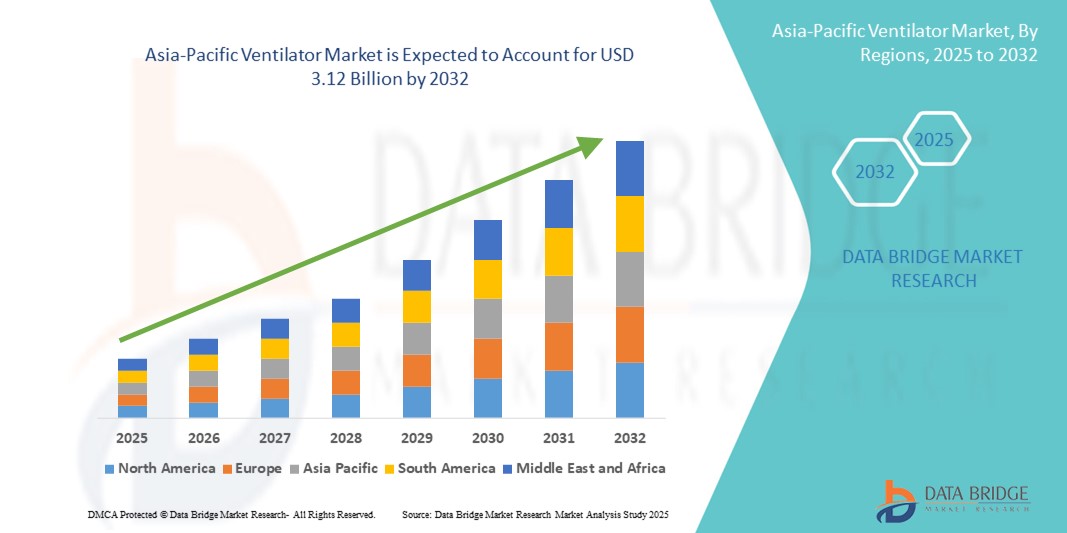
- The Asia-Pacific ventilator market size was valued at USD 1.08 Billion in 2024 and is expected to reach USD 3.12 Billion by 2032, at a CAGR of 14.20% during the forecast period
- The market growth of the Asia-Pacific Ventilator market is largely driven by increasing demand for advanced respiratory support, rising prevalence of chronic respiratory diseases, and the expansion of healthcare infrastructure across key countries such as China, India, Japan, and Australia. This growth is further fueled by the rising adoption of ventilators in critical care units, emergency rooms, and homecare settings, enabling timely and effective management of respiratory conditions
- Escalating investments in medical facilities, the establishment of specialized pulmonary care centers, and increasing government initiatives for critical care preparedness are driving market expansion. The growing presence of both international ventilator manufacturers and domestic production capabilities, coupled with rising awareness of respiratory health and ongoing technological advancements, is further boosting the adoption of ventilators across hospitals, clinics, and ambulatory surgical centers throughout the Asia-Pacific region
Asia-Pacific Ventilator Market Analysis
- The Asia-Pacific ventilator market is experiencing robust growth, driven by the rapid expansion of healthcare infrastructure, rising prevalence of respiratory diseases, and increasing adoption of advanced respiratory care technologies across countries such as China, India, Japan, South Korea, Australia, Thailand, Indonesia, and Vietnam
- Increasing R&D investments, government initiatives to improve critical care services, rising demand for emergency and intensive care support, and growing awareness of respiratory health are fueling market expansion across the region
- China dominated the Asia-Pacific ventilator market, accounting for the largest revenue share of 33.2% in 2024, supported by its strong healthcare infrastructure, increasing government initiatives to address chronic respiratory diseases, high patient volume, and rapid adoption of advanced ventilator technologies
- India is projected to register the fastest CAGR of 18.55% in the Asia-Pacific ventilator market during the forecast period, driven by growing healthcare access, expansion of specialty respiratory care centers, increasing adoption of minimally invasive procedures, and rising awareness of advanced ventilator treatment options among patients
- The invasive ventilation segment dominated the Asia-Pacific ventilator market with a share of 55.1% in 2024, reflecting its widespread use in critical care units, surgical procedures, and the treatment of severe respiratory illnesses that require mechanical airway support
Report Scope and Asia-Pacific Ventilator Market Segmentation
|
Attributes |
Asia-Pacific Ventilator Key Market Insights |
|
Segments Covered |
|
|
Countries Covered |
Asia-Pacific
|
|
Key Market Players |
|
|
Market Opportunities |
|
|
Value Added Data Infosets |
In addition to the insights on market scenarios such as market value, growth rate, segmentation, geographical coverage, and major players, the market reports curated by the Data Bridge Market Research also include in-depth expert analysis, pricing analysis, brand share analysis, consumer survey, demography analysis, supply chain analysis, value chain analysis, raw material/consumables overview, vendor selection criteria, PESTLE Analysis, Porter Analysis, and regulatory framework. |
Asia-Pacific Ventilator Market Trends
Rising Demand for Advanced Ventilator Technologies and Regulatory Compliance in Asia-Pacific
- A significant and accelerating trend in the Asia-Pacific ventilator market is the increasing emphasis on high-precision device testing, quality assurance, and regulatory compliance support. This includes efforts to improve product reliability, safety, and adherence to evolving international medical device standards
- Major ventilator manufacturers and service providers across the region are collaborating with hospitals, research institutes, and healthcare technology companies to deliver next-generation ventilator solutions, including advanced ICU and portable devices. These initiatives address the growing demand for validated, reliable, and audit-ready respiratory care equipment
- Increasing adoption of ventilators in hospitals, ambulatory care centers, and emergency response units is further accelerating market growth. These devices are critical for patient safety, effective respiratory management, and compliance with stringent clinical protocols
- Academic institutions, research centers, and government hospitals in countries such as Japan, India, and Australia are conducting studies on new ventilator technologies, automation in device operation, and integration with digital monitoring platforms—leading to product enhancements backed by scientific evidence and tailored to patient-specific requirements
- As the Asia-Pacific region continues to prioritize quality healthcare delivery, innovation, and patient safety, the Ventilator market is poised for sustained expansion—driven by technological advancements, regulatory stringency, and the increasing integration of R&D with clinical expertise
Asia-Pacific Ventilator Market Dynamics
Driver
Strong Growth Fueled by Healthcare Infrastructure Expansion and Advanced Ventilator Technologies
- The Asia-Pacific Ventilator market is witnessing accelerated growth, fueled by the expansion of healthcare infrastructure, advanced hospital facilities, and biotechnology and pharmaceutical developments across countries such as China, India, Japan, South Korea, and Australia. Rising investments in ICU development, emergency care, and precision respiratory support devices are boosting the demand for state-of-the-art ventilators that meet international safety and performance standards
- For instance, in March 2024, WuXi AppTec expanded its ventilator testing and validation facilities in China, enhancing capabilities in device calibration, bioengineering support, and performance testing to support both domestic and global clients in achieving faster regulatory approvals
- The increasing prevalence of respiratory disorders, coupled with a focus on patient safety and device reliability, is driving hospitals and healthcare providers to adopt advanced ventilators equipped with digital monitoring, automated control systems, and compliance with rigorous clinical standards
- Government initiatives promoting medical technology adoption, local manufacturing capabilities, and incentives for advanced healthcare deployment are further supporting market growth. Countries such as Singapore and South Korea are positioning themselves as regional hubs for high-quality ventilator solutions, attracting global healthcare partners through strong IP protection, clinical compliance, and cost-effective solutions
- The integration of digital platforms, device management systems, and predictive maintenance technologies is enabling service providers and hospitals to efficiently monitor ventilator performance, ensure timely maintenance, and improve clinical outcomes across multiple healthcare facilities
Restraint/Challeng
Challenges Due to Limited Penetration in Rural and Small-Scale Healthcare Facilities
- Despite rapid urbanization and healthcare modernization, the Asia-Pacific Ventilator market faces barriers in penetrating smaller hospitals, clinics, and rural healthcare facilities, particularly in Southeast Asia and parts of South Asia. High equipment costs, limited awareness of advanced ventilator benefits, and budgetary constraints often prevent smaller healthcare providers from adopting modern devices
- Infrastructure limitations, such as inadequate power supply, underdeveloped transport systems, and limited technical support in non-metropolitan areas, hinder timely deployment, installation, and servicing of ventilators
- Many smaller healthcare units still rely on older or manual ventilation systems, which do not meet international safety or operational standards, resulting in a gap in patient care quality
- The uneven distribution of trained biomedical engineers and service technicians across the region further increases downtime, operational costs, and maintenance delays for ventilators in remote areas
- To address these challenges, leading market players are exploring decentralized service models, mobile ventilator maintenance units, and partnerships with local healthcare authorities to enhance accessibility. Cost-effective device leasing, training programs, and modular ventilator solutions are being introduced to improve adoption in price-sensitive and resource-limited markets while ensuring compliance with clinical and regulatory norms
Asia-Pacific Ventilator Market Scope
The Asia-Pacific Ventilator market is segmented into five notable segments based on product type, modality, type, mode, and end user.
- By Product Type
On the basis of product type, the Asia-Pacific Ventilator market is segmented into intensive care ventilators, portable ventilators, and neonatal ventilators. The intensive care ventilators segment dominated the market in 2024 with the largest revenue share of 42.3%, driven by its indispensable role in managing patients experiencing severe respiratory failure, acute respiratory distress syndrome (ARDS), and other life-threatening respiratory conditions. Hospitals, tertiary care centers, and specialized respiratory care units heavily rely on these ventilators due to their advanced functionality, comprehensive monitoring features, and compatibility with multiple ventilation modes. The segment’s dominance is further supported by increasing investment in critical care infrastructure, growing awareness about the importance of timely respiratory intervention, and the rising prevalence of chronic and acute respiratory disorders in the Asia-Pacific region.
In contrast, the portable ventilators segment is projected to witness the fastest CAGR of 10.5% from 2025 to 2032, propelled by the rising demand for flexible and mobile respiratory support solutions in homecare environments, emergency medical services, ambulatory care, and remote healthcare facilities where rapid deployment and on-the-go patient support are essential. The growing preference for compact, lightweight, and battery-operated ventilators that allow patients to receive uninterrupted care outside the hospital setting is also contributing to this growth.
- By Modality
On the basis of modality, the Asia-Pacific Ventilator market is segmented into non-invasive ventilation and invasive ventilation. The invasive ventilation segment held the largest share of 55.1% in 2024, reflecting its extensive use in critical care units, surgical procedures, and the treatment of severe respiratory illnesses that require direct mechanical airway support. This segment’s leadership is bolstered by hospitals’ reliance on invasive ventilators for high-acuity patients, the integration of advanced monitoring systems, and adherence to stringent ICU protocols.
Meanwhile, the non-invasive ventilation segment is anticipated to register the fastest CAGR of 9.8% from 2025 to 2032, driven by technological advancements in mask interfaces, improved patient comfort, and reduced complications associated with intubation. Rising awareness among healthcare professionals about the benefits of non-invasive ventilation in managing chronic respiratory conditions, rehabilitation programs, and homecare applications is accelerating adoption. Additionally, the non-invasive segment benefits from easier training requirements for healthcare staff and minimal procedural risks, making it a preferred choice for many outpatient and homecare settings.
- By Type
On the basis of type, the Asia-Pacific Ventilator market is segmented into adult, paediatric, and neonatal ventilators. The adult ventilators segment dominated the market in 2024 with a substantial share of 48.6%, driven by the high prevalence of chronic respiratory illnesses such as COPD, asthma, and pneumonia among adults, coupled with the increasing need for emergency interventions and critical care management. The segment is further supported by rising hospital admissions for respiratory complications, growing awareness of timely ventilation support, and expanding healthcare infrastructure capable of managing adult critical care patients.
In contrast, the neonatal ventilators segment is projected to witness the fastest CAGR of 10.2% from 2025 to 2032, propelled by the expansion of neonatal intensive care units (NICUs), continuous advancements in neonatal respiratory support technologies, and increasing awareness among healthcare providers and parents regarding infant respiratory health. Rising preterm birth rates, neonatal morbidity, and the adoption of technologically advanced ventilators designed specifically for delicate neonatal physiology are further driving growth in this segment.
- By Mode
On the basis of mode, the Asia-Pacific Ventilator market is segmented into combined-mode ventilation, volume-mode ventilation, pressure-mode ventilation, and others. The volume-mode ventilation segment held the largest share of 39.4% in 2024, owing to its proven reliability, user-friendly operation, and widespread adoption in critical care and perioperative settings where precise control over tidal volumes is crucial for patient safety and therapeutic effectiveness. The segment’s dominance is also supported by clinician preference for ventilators that provide consistent volume delivery and adaptability in treating diverse respiratory conditions.
The combined-mode ventilation segment is expected to grow at the fastest CAGR of 9.7% from 2025 to 2032, supported by increasing demand for versatile ventilator systems capable of switching between modes based on patient condition. These systems enhance clinical flexibility, optimize patient outcomes, and allow hospitals and homecare providers to manage a broader range of respiratory cases efficiently. The rising prevalence of mixed respiratory disorders and the growing adoption of advanced multi-mode ventilators in high-acuity care environments are further contributing to this trend.
- By End User
On the basis of end user, the Asia-Pacific Ventilator market is segmented into hospitals and clinics, homecare, ambulatory centers, specialty clinics, rehabilitation centers, long-term care centers, homecare settings, and others. The hospitals and clinics segment dominated the market in 2024 with a significant share of 52.8%, driven by centralized healthcare delivery models, high patient throughput, and seamless integration with advanced ICU infrastructure, monitoring systems, and emergency response protocols. Hospitals remain the primary centers for acute respiratory care, complex surgeries, and critical interventions, making them key drivers of ventilator demand.
Meanwhile, homecare and long-term care centers are projected to register the fastest CAGR of 10.1% from 2025 to 2032, fueled by the growing adoption of home-based ventilatory support solutions, telehealth-enabled remote patient monitoring, and an increasing geriatric population requiring chronic respiratory care. Additionally, rising awareness about the benefits of patient-centric care, supportive reimbursement policies for homecare, and the availability of user-friendly portable ventilators are enhancing market growth in non-hospital settings.
Asia-Pacific Ventilator Market Regional Analysis
- Asia-Pacific held a revenue share of 33% in the global ventilator market in 2024. This leadership position is driven by the region’s vast population base, rapidly expanding healthcare infrastructure, and increasing adoption of advanced ventilator technologies. Government initiatives to improve critical care capabilities, rising prevalence of chronic respiratory diseases, and growing investments in hospitals and specialty care centers are further fueling market growth
- The presence of skilled medical professionals, combined with technological advancements in both invasive and non-invasive ventilators, is enabling the region to meet rising patient demand efficiently
- The market growth is also supported by strategic partnerships between regional healthcare providers and global ventilator manufacturers, the expansion of digital monitoring solutions, and rising demand for ICU and emergency care services. Increasing public and private sector investments in respiratory care, along with the proliferation of specialty respiratory centers, are boosting the adoption of ventilators across Asia-Pacific. Rising awareness of ventilator-assisted therapies among patients and healthcare providers is further accelerating market uptake
China Asia-Pacific Ventilator Market Insight
The China ventilator market dominated the Asia-Pacific region with a revenue share of 33.2% in 2024, supported by a strong healthcare infrastructure, high patient volumes, and increasing government initiatives to address chronic respiratory diseases. The rapid adoption of advanced ventilator technologies, including portable and ICU-grade devices, has strengthened the country’s leadership position. China’s well-established hospital networks, coupled with investments in modern critical care units, facilitate widespread ventilator deployment. Additionally, the presence of both domestic and international ventilator manufacturers ensures a competitive market environment and encourages ongoing innovation in respiratory care technologies.
India Asia-Pacific Ventilator Market Insight
The India ventilator market is projected to register the fastest CAGR of 18.55% from 2025 to 2032, driven by the expansion of healthcare access, the growth of specialty respiratory care centers, and increasing adoption of minimally invasive procedures. Rising awareness among patients regarding advanced ventilator therapies and government-led initiatives to improve critical care infrastructure are key growth factors. The proliferation of private hospitals and diagnostic centers across tier 2 and tier 3 cities, coupled with investments in training healthcare professionals, is further enhancing market penetration. Strategic collaborations between Indian healthcare providers and global ventilator manufacturers are positioning India as one of the fastest-growing markets for advanced ventilator solutions in the Asia-Pacific region.
Asia-Pacific Ventilator Market Share
The Asia-Pacific Ventilator industry is primarily led by well-established companies, including:
- General Electric Company.(U.S.)
- Smiths Group plc (U.K.)
- Zoll Medical Corporation (U.S.)
- Koninklijke Philips N.V. (Netherlands)
- Getinge (Sweden)
- ResMed (U.S.)
- Medtronic (Ireland)
- Fisher & Paykel Healthcare Ltd (New Zealand)
- Avasarala Technologies Limited (India)
- Allied Healthcare Products, Inc. (U.S.)
- Shenzhen Mindray Bio-Medical Electronics Co., Ltd (China)
- Drägerwerk AG & Co. KGaA (Germany)
- Nihon Kohden Corporation (Japan)
- Asahi Kasei Corporation (Japan)
- Air Liquide (France)
Latest Developments in Asia-Pacific Ventilator market
- In July 2025, researchers from the University of Michigan Medical School, led by Anna Barker, M.D., Ph.D., and Michael Sjoding, M.D., published findings in the Annals of the American Thoracic Society revealing that one in three hospitalized patients remain connected to a ventilator after passing a spontaneous breathing trial (SBT). This delay in extubation poses increased risks for ventilator-associated complications such as pneumonia, lung injury, and prolonged sedation
- In July 2025, a seven-year international, multi-center clinical trial led by the London Health Sciences Centre Research Institute (LHSCRI) and St. Michael's Hospital, Unity Health Toronto, published in the New England Journal of Medicine, found that a new ventilation mode, proportional assist ventilation (PAV+TM), could improve outcomes for ICU patients requiring mechanical ventilation

- Interactive Data Analysis Dashboard
- Company Analysis Dashboard for high growth potential opportunities
- Research Analyst Access for customization & queries
- Competitor Analysis with Interactive dashboard
- Latest News, Updates & Trend analysis
- Harness the Power of Benchmark Analysis for Comprehensive Competitor Tracking
Data collection and base year analysis are done using data collection modules with large sample sizes. The stage includes obtaining market information or related data through various sources and strategies. It includes examining and planning all the data acquired from the past in advance. It likewise envelops the examination of information inconsistencies seen across different information sources. The market data is analysed and estimated using market statistical and coherent models. Also, market share analysis and key trend analysis are the major success factors in the market report. To know more, please request an analyst call or drop down your inquiry.
The key research methodology used by DBMR research team is data triangulation which involves data mining, analysis of the impact of data variables on the market and primary (industry expert) validation. Data models include Vendor Positioning Grid, Market Time Line Analysis, Market Overview and Guide, Company Positioning Grid, Patent Analysis, Pricing Analysis, Company Market Share Analysis, Standards of Measurement, Global versus Regional and Vendor Share Analysis. To know more about the research methodology, drop in an inquiry to speak to our industry experts.
Data Bridge Market Research is a leader in advanced formative research. We take pride in servicing our existing and new customers with data and analysis that match and suits their goal. The report can be customized to include price trend analysis of target brands understanding the market for additional countries (ask for the list of countries), clinical trial results data, literature review, refurbished market and product base analysis. Market analysis of target competitors can be analyzed from technology-based analysis to market portfolio strategies. We can add as many competitors that you require data about in the format and data style you are looking for. Our team of analysts can also provide you data in crude raw excel files pivot tables (Fact book) or can assist you in creating presentations from the data sets available in the report.













