


Australia Tomatoes Market Size
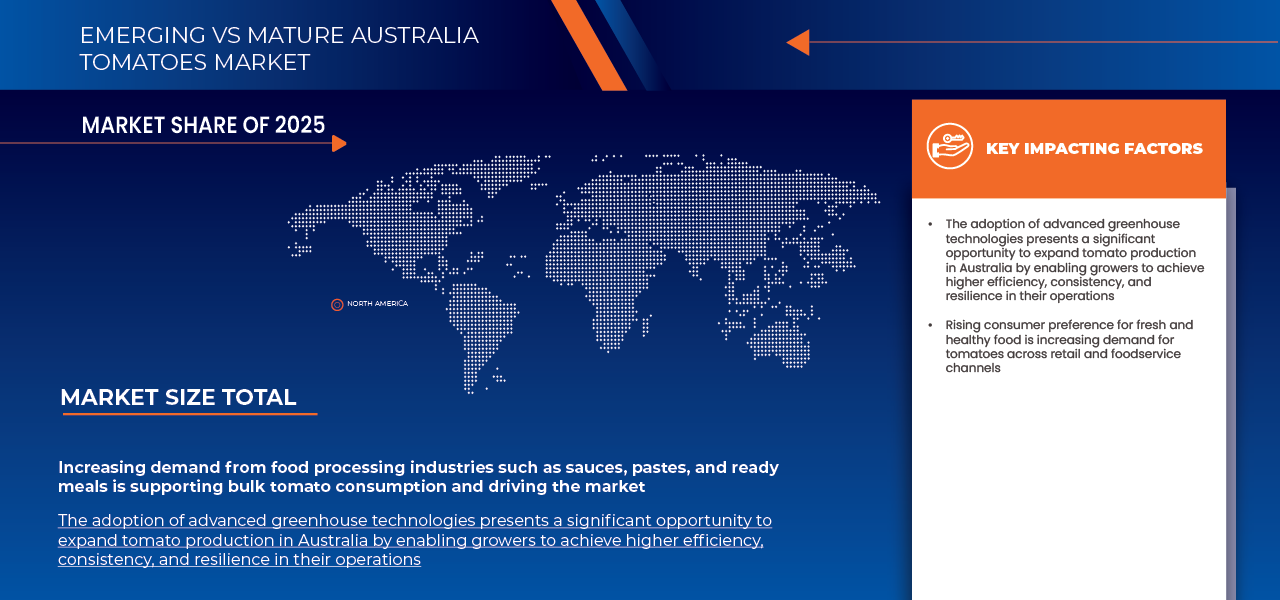
- The Australia Tomatoes market size was valued at USD 1.10 billion in 2025 and is expected to reach USD 1.49 billion by 2033, at a CAGR of 3.9% during the forecast period
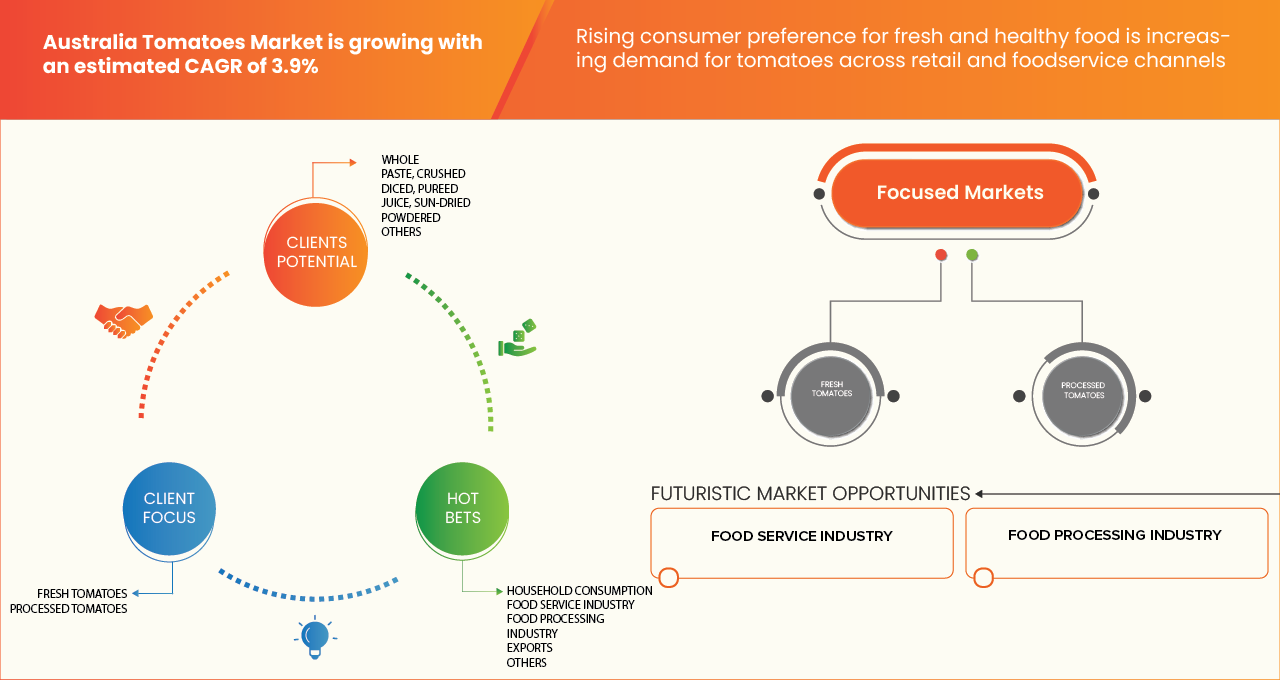
- The market is primarily driven by strong domestic demand, increasing consumer preference for fresh and healthy food, and the growing adoption of controlled environment agriculture, such as greenhouse and hydroponic farming.
- Rising demand from food service industries, expanding retail distribution networks, and increasing exports to Asia-Pacific countries further support market growth. Seasonal production patterns and climate conditions also play a key role in influencing supply dynamics
Australia Tomatoes Market Analysis
- The Australia tomatoes market refers to the commercial ecosystem involved in the cultivation, harvesting, processing, distribution, and consumption of tomatoes across the country. This market encompasses a wide range of product types, including fresh tomatoes (such as round, cherry, grape, roma, and vine-ripened varieties) as well as processed tomato products like paste, sauces, diced, canned, juice, and dried forms used across multiple applications
- The Australia tomatoes market is witnessing steady growth, driven by strong domestic consumption and increasing demand for fresh, healthy, and locally sourced produce. The country’s well-established horticulture sector, supported by advanced farming practices and favorable climatic conditions in key growing regions, is enabling consistent production of high-quality tomatoes. The rising popularity of specialty varieties such as cherry, grape, and vine-ripened tomatoes is further contributing to market expansion.
- The adoption of controlled environment agriculture (CEA), including greenhouse and hydroponic systems, is transforming tomato cultivation by improving yield, quality, and year-round supply while reducing dependency on seasonal conditions. Increasing demand from the food service and food processing industries, particularly for sauces, pastes, and ready-to-eat products, is also supporting market growth
- Health-conscious consumers are driving demand for organic and chemical-free tomatoes, while retail expansion through supermarkets and online grocery platforms is enhancing product accessibility. Although domestic production meets a large portion of demand, exports to Asia-Pacific markets are growing steadily, supported by trade agreements and rising international demand.
- The market operates under strict regulatory frameworks to ensure food safety, quality standards, and biosecurity compliance. Additionally, challenges such as climate variability, water scarcity, and labor shortages are influencing production dynamics, encouraging technological adoption and efficiency improvements
- The fresh tomatoes segment dominated the largest market revenue share of 53.90% in 2025, driven by strong consumer preference for fresh produce in daily diets. Fresh tomatoes are widely used in households, restaurants, and food service establishments for salads, cooking, and garnishing, which consistently drives high demand
Report Scope and Australia Tomatoes Market Segmentation
|
Attributes |
Australia Tomatoes Key Market Insights |
|
Segments Covered |
|
|
Countries Covered |
|
|
Key Market Players |
|
|
Market Opportunities |
|
|
Value Added Data Infosets |
In addition to the insights on market scenarios such as market value, growth rate, segmentation, geographical coverage, and major players, the market reports curated by the Data Bridge Market Research also include in-depth expert analysis, pricing analysis, brand share analysis, consumer survey, demography analysis, supply chain analysis, value chain analysis, raw material/consumables overview, vendor selection criteria, PESTLE Analysis, Porter Analysis, and regulatory framework. |
Australia Tomatoes Market Trends
“Adoption of Advanced Greenhouse Technologies”
- The adoption of advanced greenhouse technologies presents a significant opportunity to expand tomato production in Australia by enabling growers to achieve higher efficiency, consistency, and resilience in their operations.
- Unlike traditional open-field farming, greenhouse systems provide a controlled environment where factors such as temperature, humidity, light, and irrigation can be precisely managed to optimize plant growth. This allows producers to extend growing seasons, reduce dependency on unpredictable weather patterns, and maintain stable output throughout the year.
- Advanced systems such as hydroponics and automated climate control further enhance resource efficiency by minimizing water usage and optimizing nutrient delivery, which is particularly valuable in regions facing water scarcity.
- Additionally, the integration of digital monitoring tools and sensors enables real-time decision-making, improving crop health management and reducing the risk of disease outbreaks. These technologies also support higher yield quality and uniformity, making Australian tomatoes more competitive in both domestic and export markets.
- Furthermore, greenhouse production reduces reliance on large labor forces through automation, helping address labor shortages and rising wage pressures. Overall, the shift toward technologically advanced greenhouse cultivation strengthens the industry’s ability to scale production sustainably while improving operational efficiency and market responsiveness.
Australia Tomatoes Market Dynamics
Driver
“Rising Consumer Preference for Fresh and Healthy Food is Increasing Demand for Tomatoes Across Retail and Foodservice Channels”
- Rising consumer preference for fresh and healthy food is significantly driving demand for tomatoes across retail and foodservice channels in Australia. Increasing awareness of balanced diets, natural ingredients, and minimally processed foods has positioned tomatoes as a staple in everyday consumption due to their versatility and perceived health benefits.
- Consumers are actively incorporating tomatoes into salads, home-cooked meals, and plant-based diets, reinforcing steady demand through supermarkets and local grocery outlets. At the same time, the growing popularity of clean-label and farm-fresh produce is encouraging retailers to expand their fresh tomato offerings, including organic and specialty varieties.
- In the foodservice sector, restaurants, cafés, and quick-service outlets are responding to evolving dietary preferences by integrating tomatoes into a wide range of menu items such as sandwiches, pasta, and healthy bowls.
- The shift toward Mediterranean and plant-forward cuisines further amplifies this trend, as tomatoes are a core ingredient in these dietary patterns.
- Overall, the alignment of tomatoes with health-conscious consumption trends and their adaptability across multiple cuisines continues to strengthen their demand across both retail and foodservice channels in Australia.
Restraint/Challenge
“High Costs, Regulatory Hurdles, and Limited Accessibility in Emerging Markets”
- High production costs are a major constraint on profitability for tomato growers in Australia, as the industry is heavily dependent on labor, energy, and advanced infrastructure to maintain consistent output and quality.
- Tomato cultivation, especially in protected environments such as greenhouses, requires a steady workforce for planting, monitoring, harvesting, and post-harvest handling, making labor one of the most significant cost burdens.
- At the same time, energy expenses remain elevated due to the need for climate control systems, irrigation pumps, and cold storage, all of which are essential to ensure year-round production and reduce spoilage. Infrastructure investments, including modern greenhouse setups, automated irrigation systems, and transportation networks, further add to the financial pressure, particularly for small and medium-sized growers who may struggle to achieve economies of scale.
- These combined costs reduce operating margins and limit growers’ ability to absorb market fluctuations or invest in innovation. As a result, producers often face difficult trade-offs between maintaining quality standards and controlling expenses, ultimately constraining overall profitability and long-term sustainability within the sector.
- For Instances, In December 2025, FinancialModelsLab.com published a blog that stated a startup company involved in tomato production needs between USD 35,750 and USD 71,500 for labor funding. This restricts startups from entering the market.
- In conclusion, high production costs significantly constrain the profitability of tomato growers in Australia by placing continuous financial pressure on operations. The combined burden of elevated labor wages, rising energy expenses, and substantial infrastructure investments limits growers’ ability to maintain healthy margins. These cost challenges are particularly pronounced for smaller producers who lack scale advantages. As input costs continue to rise, growers face reduced flexibility in pricing and investment decisions, making it difficult to sustain competitiveness. Ultimately, unless cost efficiencies or supportive measures are introduced, these structural challenges will continue to hinder long-term growth and sustainability in the industry

Australia Tomatoes Market Scope
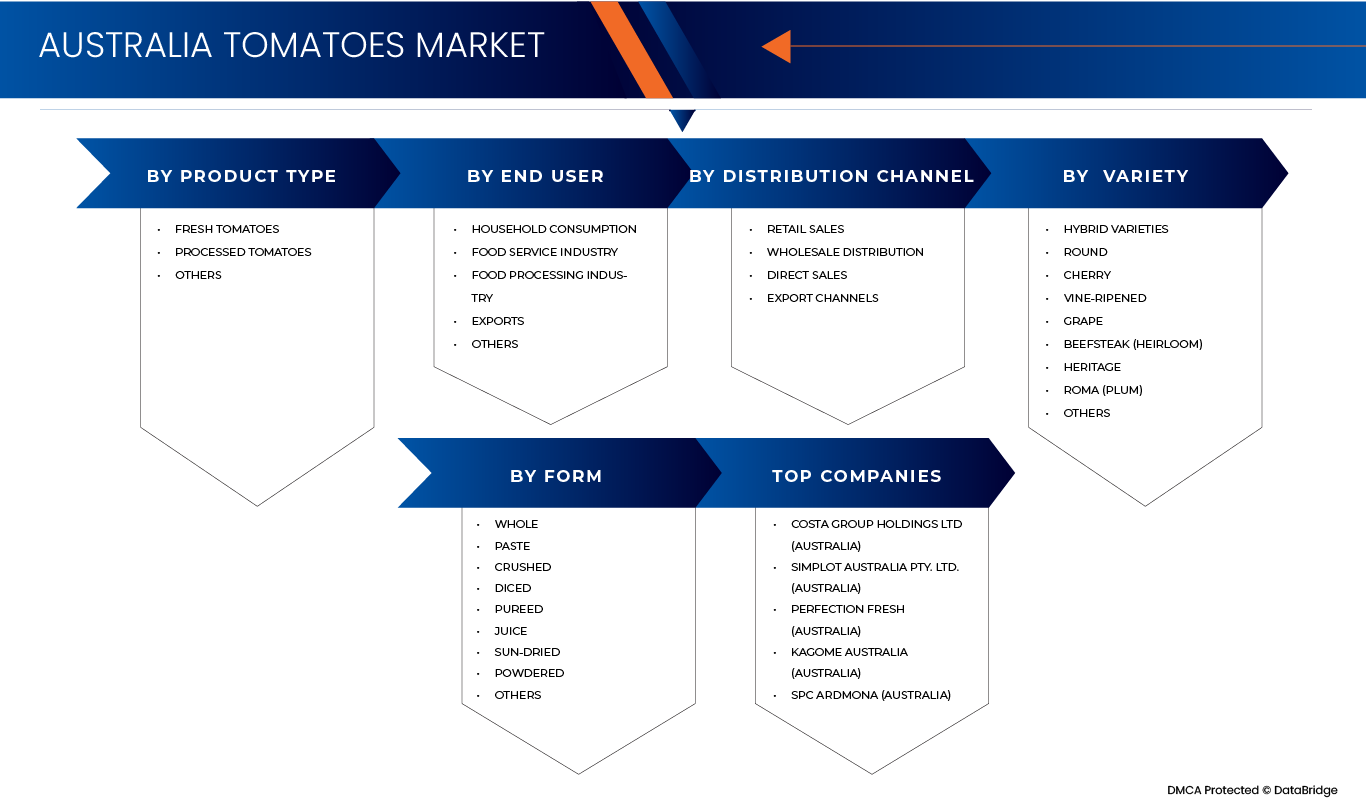
The market is segmented on the basis of product type, variety, end user, form, and distribution channel.
• By Product Type
On the basis of product type, the Australia Tomatoes Market is segmented into fresh tomatoes, processed tomatoes, and others. The fresh tomatoes segment dominated the largest market revenue share of 53.90% in 2025, driven by strong consumer preference for fresh and minimally processed vegetables. Fresh tomatoes are widely valued for their natural taste, nutritional content, and versatility in a variety of culinary applications. They are commonly used in everyday cooking, salads, sauces, and numerous traditional and international dishes, making them a staple ingredient in both households and food service establishments. Restaurants, hotels, and catering services rely heavily on fresh tomatoes for preparing a wide range of menu items, which further contributes to steady demand. Additionally, growing health awareness among consumers and the increasing preference for fresh ingredients in daily diets have strengthened the consumption of fresh produce.
The fresh tomatoes segment is anticipated to witness the fastest CAGR of 4.1% from 2026 to 2033, primarily driven by the growing consumer shift toward fresh, minimally processed, and natural food products. Increasing health awareness has encouraged consumers to incorporate more fresh vegetables into their daily diets, as they are widely recognized for their high nutritional value, including essential vitamins, antioxidants, and dietary fiber. Fresh tomatoes are particularly valued for their richness in vitamin C, potassium, and lycopene, which are associated with various health benefits such as improved heart health and enhanced immunity. In addition, rising demand for clean-label and farm-fresh produce has further strengthened the consumption of fresh tomatoes across households, restaurants, and foodservice establishments.
• By Variety
On the basis of variety, the Australia Tomatoes Market is segmented into hybrid varieties, round, cherry, vine-ripened, grape, beefsteak (Heirloom), heritage, roma (Plum), and others. The hybrid varieties segment held the largest market revenue share of 44.31% in 2025, driven by their superior agronomic performance and higher productivity compared to traditional or open-pollinated varieties. Hybrid tomato seeds are widely preferred by farmers because they offer higher yield potential, uniform fruit size, better shelf life, and enhanced resistance to common pests and diseases, which helps reduce crop losses and improve overall profitability. In addition, hybrid varieties are often developed with improved tolerance to environmental stresses such as temperature fluctuations and soil conditions, making them suitable for cultivation across diverse climatic regions.
The cheery segment is expected to witness the fastest CAGR of 4.3% from 2026 to 2033, driven by increasing consumer demand for convenient and ready-to-eat vegetables. Cherry tomatoes are widely favored for their small size, sweet flavor, and ease of consumption, making them an ideal ingredient for salads, snacks, and a variety of gourmet dishes. As modern lifestyles become busier, consumers are increasingly seeking healthy food options that require minimal preparation, which has boosted the popularity of cherry tomatoes in households and foodservice establishments. Additionally, the growing trend toward healthy eating, plant-based diets, and fresh ingredient-based cuisine has further supported their demand.
• By End User
On the basis of end user, the Australia Tomatoes Market is segmented into household consumption, food service industry, food processing industry, exports, and others. The household consumption segment dominated the market with a revenue share of 40.17% in 2025, primarily driven by the widespread use of tomatoes in everyday home cooking across diverse cuisines. Tomatoes are considered a staple ingredient in many households due to their versatility, flavor, and nutritional value. They are commonly used in the preparation of a wide range of dishes such as sauces, curries, soups, stews, and salads, making them a frequent and essential item in household grocery purchases. In addition, the growing preference for home-cooked meals, increasing health awareness, and the use of fresh ingredients in daily diets have further strengthened demand from household consumers. The affordability and easy availability of tomatoes across local markets, supermarkets, and grocery stores also contribute to their consistent consumption at the household level.
The household consumption segment is anticipated to witness the fastest CAGR of 4.4% from 2026 to 2033, driven by the increasing preference for home-cooked meals and rising awareness of healthy dietary habits among consumers. As more individuals focus on preparing fresh and nutritious food at home, the demand for essential cooking ingredients such as tomatoes continues to grow. Tomatoes are widely valued for their versatility and are used in a variety of everyday dishes including sauces, curries, soups, and salads across numerous cuisines. Their rich nutritional profile, including vitamins, antioxidants, and minerals, further encourages regular consumption among health-conscious households. Additionally, the growing trend of balanced diets, plant-based eating, and the use of fresh ingredients in daily meal preparation is reinforcing the demand for tomatoes in household kitchens.
• By Form
On the basis of form, the Australia Tomatoes Market is segmented into whole, paste, crushed, diced, pureed, juice, sun-dried, powdered, and others. The whole segment dominated the market with a revenue share of 41.20% in 2025, driven by strong consumer preference for whole tomatoes due to their freshness, natural taste, and versatility in culinary applications. Whole tomatoes are widely used in both household cooking and foodservice establishments for preparing a variety of dishes such as sauces, soups, salads, curries, and stews. Their ability to be easily sliced, chopped, or blended according to different recipes makes them a convenient and essential ingredient in everyday meal preparation. In addition, consumers often perceive whole tomatoes as a more natural and less processed option, which aligns with the growing demand for fresh and minimally processed food products. The consistent demand from households, restaurants, and catering services, along with their widespread availability across retail and wholesale channels, has significantly contributed to the strong market share of the whole tomatoes segment.
The sun-dried segment is expected to witness the fastest CAGR of 4.6% from 2026 to 2033, fueled by the rising demand for premium and value-added tomato products across both retail and foodservice sectors. Sun-dried tomatoes are widely appreciated for their concentrated flavor, extended shelf life, and versatility in culinary applications such as pasta, pizzas, salads, sandwiches, and gourmet dishes. As consumers increasingly explore diverse and international cuisines, the popularity of specialty ingredients like sun-dried tomatoes continues to grow. Additionally, the expansion of premium packaged food products, ready-to-cook meals, and gourmet offerings in supermarkets and restaurants has further supported the demand for these products. Their convenience, unique taste profile, and ability to enhance the flavor of various dishes make them attractive to both home cooks and professional chefs.
• By Distribution Channel
On the basis of distribution channel, the Australia Tomatoes Market is segmented into retail sales, wholesale distribution, direct sales, and export channels. The retail sales segment dominated the market with a revenue share of 50.91% in 2025, by the widespread availability of tomatoes through supermarkets, hypermarkets, grocery stores, and local markets. Retail channels offer consumers convenient access to a wide range of tomato products, including fresh tomatoes as well as processed forms such as canned, sun-dried, and packaged varieties. The strong presence of organized retail networks across urban and regional areas has made it easier for consumers to purchase tomatoes as part of their regular grocery shopping. In addition, attractive product displays, packaging innovations, and promotional activities in retail outlets further encourage consumer purchases. As tomatoes are a staple ingredient in everyday cooking, their easy accessibility through retail stores plays a crucial role in supporting consistent household demand and maintaining the dominance of the retail sales segment in the market.
The retail sales segment is expected to witness the fastest CAGR of 4.2% from 2026 to 2033, fueled by continued expansion of modern retail formats such as supermarkets, hypermarkets, and online grocery platforms. These channels provide consumers with convenient access to a wide variety of fresh and processed tomato products in a single shopping location. As urbanization and busy lifestyles increase, consumers are increasingly preferring organized retail outlets that offer quality assurance, product variety, and convenient purchasing experiences. Additionally, the rapid growth of e-commerce and online grocery delivery services is further strengthening the retail distribution network, allowing consumers to easily purchase fresh produce from their homes. Retailers are also enhancing customer engagement through promotional offers, improved product packaging, and better in-store displays, which encourage higher purchasing frequency.
Australia Tomatoes Market Share
The Australia Tomatoes industry is primarily led by well-established companies, including:
- COSTA GROUP HOLDINGS LTD (Australia)
- FLAVORITE TOMATOES (Australia)
- Mars, Incorporated and its Affiliates (U.S.)
- Perfection Fresh Australia (Australia)
- Sundrop Farms (Australia)
- MON Natural Foods (Australia)
- Simplot Australia Pty. Ltd. (U.S.)
- Premier Fresh Australia (Australia)
- KAGOME AUSTRALIA (Japan)
- Rosella (SABRANDS AUSTRALIA) (Australia)
- Three Threes Condiments Pty Ltd (Australia)
- Beerenberg Pty Ltd. (Australia)
- Billabong Produce (Australia)
- SPC Global Limited (Australia)
Latest Developments in Australia Tomatoes Market
- In October 2025, Costa Group teamed up with Coles and Opal to try out new recyclable cardboard packaging for its Perino tomatoes instead of traditional plastic. The trial is happening in Coles stores in Victoria and aims to reduce plastic use and support more environmentally friendly packaging. The recyclable cardboard packs are designed to still protect the tomatoes and keep them fresh while helping lower packaging waste. If the trial goes well, this new packaging could be used more widely in the future
- In September 2025, Costa’s international berry team achieved a milestone by registering five new blueberry plant varieties in Laos, marking the first official plant variety registrations in the country. This was celebrated in a ceremony at the Lao Ministry of Industry and Commerce, highlighting the work of Costa’s researchers and breeders. The registration helps protect these new varieties and encourages ongoing innovation in plant development. It also supports Costa’s growing blueberry operations in the region
- In November 2023, Simplot Australia Pty Ltd completed the acquisition of Agronico, a major seed potato production business in Tasmania. This move strengthens Simplot’s ability to produce early‑generation seed potatoes (minitubers) and gives the company full control over key stages of the potato supply chain in Australia. Agronico has supplied Simplot with seed and storage services for many years, and this acquisition will help ensure a steady supply and expanded expertise in potato seed production
- In September 2023, Simplot celebrated major recognition at the Healthy Food Guide Magazine Awards, with 11 of its food products winning awards for nutrition and quality. These awards are judged by expert dietitians and highlight products that are both tasty and nutritious on supermarket shelves across Australia and New Zealand.
- In June 2025, Kagome Australia began supplying cold‑pressed tomato seed oil derived from by-products of its tomato processing operations to the cosmetics industry for use in moisturisers, facial scrubs, sunscreen, and other beauty products. The move turns previously unused tomato seed waste into a high‑value cosmetic ingredient, supporting sustainability goals and diversifying the company’s revenue streams. This initiative enhances Kagome’s commercial resilience amid industry challenges by creating new market opportunities in the cosmetic and personal care sectors.

- Interactive Data Analysis Dashboard
- Company Analysis Dashboard for high growth potential opportunities
- Research Analyst Access for customization & queries
- Competitor Analysis with Interactive dashboard
- Latest News, Updates & Trend analysis
- Harness the Power of Benchmark Analysis for Comprehensive Competitor Tracking
Table of Content
1 INTRODUCTION
1.1 OBJECTIVES OF THE STUDY
1.2 MARKET DEFINITION
1.3 OVERVIEW OF THE AUSTRALIA TOMATOES MARKET
1.4 CURRENCY AND PRICING
1.5 LIMITATIONS
1.6 MARKETS COVERED
2 MARKET SEGMENTATION
2.1 MARKETS COVERED
2.2 GEOGRAPHICAL SCOPE
2.3 YEARS CONSIDERED FOR THE STUDY
2.4 DBMR TRIPOD DATA VALIDATION MODEL
2.5 MULTIVARIATE MODELLING
2.6 PRIMARY INTERVIEWS WITH KEY OPINION LEADERS
2.7 MARKET END USER COVERAGE GRID
2.8 VENDOR SHARE ANALYSIS
2.9 SECONDARY SOURCES
2.1 ASSUMPTIONS
3 EXECUTIVE SUMMARY
4 PREMIUM INSIGHTS
4.1 PORTER’S FIVE FORCES
4.1.1 THREAT OF NEW ENTRANTS – MODERATE
4.1.2 THREAT OF SUBSTITUTES – LOW TO MODERATE
4.1.3 BARGAINING POWER OF BUYERS – HIGH
4.1.4 BARGAINING POWER OF SUPPLIERS – MODERATE TO HIGH
4.1.5 COMPETITIVE RIVALRY WITHIN THE INDUSTRY – HIGH
4.2 PRICING ANALYSIS
4.3 VENDOR SELECTION CRITERIA
4.3.1 TECHNICAL CAPABILITY AND PRODUCT SPECIFICATIONS
4.3.2 QUALITY ASSURANCE AND RELIABILITY
4.3.3 COMPLIANCE, SECURITY, AND SUSTAINABILITY
4.3.4 SUPPORT SERVICES AND AFTER-SALES CAPABILITY
4.3.5 COST CONSIDERATIONS
4.3.6 CUSTOMIZATION AND SCALABILITY
4.3.7 CONCLUSION
4.4 RAW MATERIAL COVERAGE
4.4.1 CORE RAW MATERIALS
4.4.1.1 SEEDS (HYBRID SEEDS AND OPEN-POLLINATED SEEDS)
4.4.1.2 FERTILIZERS (NITROGEN (N), PHOSPHORUS (P), POTASSIUM (K), AND ORGANIC)
4.4.1.3 CROP PROTECTION CHEMICALS (PESTICIDES, HERBICIDES, FUNGICIDES)
4.4.2 SUPPORTING/ SECONDARY RAW MATERIALS
4.4.2.1 LABOR
4.4.2.2 AGRICULTURAL EQUIPMENT (TRACTORS, IRRIGATION SYSTEMS, HARVESTING TOOLS)
4.5 SUPPLY CHAIN ANALYSIS
4.5.1 OVERVIEW
4.5.2 LOGISTIC COST SCENARIO
4.5.3 IMPORTANCE OF LOGISTIC SERVICE PROVIDERS
4.6 BRAND OUTLOOK
4.7 CONSUMER BUYING BEHAVIOUR
4.7.1 PRODUCT FEATURES AND PERCEIVED PERFORMANCE
4.7.2 BRAND VALUE AS A PURCHASE DRIVER
4.7.3 GOVERNMENT POLICIES AND EXTERNAL INFLUENCES
4.7.4 PRICING SENSITIVITY AND ECONOMIC FACTORS
4.7.5 PRODUCT AVAILABILITY & DISTRIBUTION REACH
4.7.6 VALUE‑ADDED SERVICES AND CONSUMER ENGAGEMENT
4.7.7 CONCLUSION
4.8 INDUSTRY ECOSYSTEM ANALYSIS
4.8.1 COMPANY EVALUATION QUADRANT
4.8.1.1 LEADERS (HIGH MARKET PRESENCE, HIGH INNOVATION)
4.8.1.2 DOMINANT PLAYERS (HIGH MARKET PRESENCE, LOWER INNOVATION)
4.8.1.3 PARTICIPANTS (MODERATE MARKET PRESENCE, MODERATE INNOVATION)
4.8.1.4 EMERGING PLAYERS (LOW MARKET PRESENCE, HIGH INNOVATION)
4.8.2 END USER
4.8.2.1 HOUSEHOLD CONSUMPTION
4.8.2.2 FOOD SERVICE INDUSTRY
4.8.2.3 FOOD PROCESSING INDUSTRY
4.8.2.4 EXPORTS
4.9 VALUE CHAIN ANALYSIS
4.9.1 OVERVIEW
4.9.2 DETAILED VALUE CHAIN STAGES
4.9.2.1 INPUT SUPPLY STAGE
4.9.2.2 PRODUCTION STAGE (FARMING)
4.9.2.3 POST-HARVEST HANDLING
4.9.2.4 AGGREGATION AND PRIMARY TRADING
4.9.2.5 PROCESSING STAGE
4.9.2.6 LOGISTICS AND DISTRIBUTION
4.9.2.7 RETAIL STAGE
4.9.2.8 CONSUMPTION STAGE
4.9.3 VALUE DISTRIBUTION ALONG THE CHAIN
4.9.4 KEY INEFFICIENCIES IN THE AUSTRALIAN TOMATO VALUE CHAIN
4.9.5 OPPORTUNITIES IN THE AUSTRALIAN TOMATO VALUE CHAIN
4.1 INNOVATION TRACKER AND STRATEGIC ANALYSIS
4.10.1 MAJOR DEALS AND STRATEGIC ALLIANCES ANALYSIS
4.10.2 PRODUCTS DEVELOPMENT
4.10.3 STAGE OF DEVELOPMENT
4.10.4 TIMELINES AND MILESTONES
4.10.5 INNOVATION STRATEGIES AND METHODOLOGIES
4.10.6 RISK ASSESSMENT AND MITIGATION
4.10.7 FUTURE OUTLOOK BY END USE
4.10.7.1 HOUSEHOLD CONSUMPTION
4.10.7.2 FOOD SERVICE INDUSTRY
4.10.7.3 FOOD PROCESSING INDUSTRY
4.10.7.4 EXPORTS
4.10.7.5 OTHERS (INSTITUTIONAL, NICHE & EMERGING USES)
4.11 CLIMATE CHANGE SCENARIO
4.11.1 ENVIRONMENTAL CONCERNS
4.11.2 INDUSTRY RESPONSE
4.11.2.1 PROTECTED CROPPING & CLIMATE-RESILIENT SYSTEMS
4.11.2.2 PRECISION AGRICULTURE & DIGITAL TOOLS
4.11.2.3 AUTOMATION & LABOUR-SAVING INNOVATIONS
4.11.2.4 CLIMATE-SMART SOIL & WATER MANAGEMENT
4.11.2.5 COLLABORATIVE RESEARCH & KNOWLEDGE TRANSFER
4.11.2.6 INDUSTRY FUNDING & INNOVATION INITIATIVES
4.11.2.7 GOVERNMENT’S ROLE
4.11.2.8 ANALYST RECOMMENDATIONS
4.12 TECHNOLOGICAL ADVANCEMENTS
4.12.1 PRECISION AGRICULTURE AND DATA DRIVEN FARMING
4.12.2 ROBOTICS AND AUTOMATED HARVESTING
4.12.2.1 ARTIFICIAL INTELLIGENCE (AI) IN CROP MONITORING AND DECISION SUPPORT
4.12.2.2 ENVIRONMENTAL CONTROL AND SUSTAINABILITY TECHNOLOGIES
4.12.2.3 DIGITAL WORKFORCE MANAGEMENT AND LABOUR EFFICIENCY SYSTEMS
5 TARIFFS & IMPACT ON THE MARKET
5.1 CURRENT TARIFF RATE (S) IN TOP-5 COUNTRY MARKETS
5.2 OUTLOOK: LOCAL PRODUCTION V/S IMPORT RELIANCE
5.3 VENDOR SELECTION CRITERIA DYNAMICS
5.4 IMPACT ON SUPPLY CHAIN
5.4.1 RAW MATERIAL PROCUREMENT
5.4.2 MANUFACTURING AND PRODUCTION
5.4.3 LOGISTICS AND DISTRIBUTION
5.4.4 PRICE PITCHING AND MARKET POSITION
5.5 INDUSTRY PARTICIPANTS: PROACTIVE MOVES
5.5.1 SUPPLY CHAIN OPTIMIZATION
5.5.2 INDUSTRY PARTICIPANTS: PROACTIVE MOVES
5.6 IMPACT ON PRICES
5.7 REGULATORY INCLINATION
5.7.1 GEOPOLITICAL SITUATION
5.7.2 TRADE PARTNERSHIPS BETWEEN COUNTRIES
5.7.2.1 FREE TRADE AGREEMENTS
5.7.2.2 ALLIANCES ESTABLISHMENTS
5.7.3 STATUS ACCREDITATION (INCLUDING MFTN)
5.7.4 DOMESTIC COURSE OF CORRECTION
5.7.4.1 INCENTIVE SCHEMES TO BOOST PRODUCTION OUTPUTS
5.7.4.2 ESTABLISHMENT OF SEZS/INDUSTRIAL PARKS
6 REGULATION COVERAGE
6.1 PRODUCT CODES
6.2 CERTIFIED STANDARDS
6.2.1 AUSTRALIA NEW ZEALAND FOOD STANDARDS CODE (FSANZ)
6.2.2 GOOD AGRICULTURAL PRACTICE (GAP)
6.2.3 GLOBALG.A.P.
6.2.4 ISO 22000
6.2.5 ORGANIC CERTIFICATION
6.2.6 FRESHCARE FOOD SAFETY AND QUALITY STANDARD (FSQ)
6.3 SAFETY STANDARDS
6.3.1 MATERIAL HANDLING & STORAGE
6.3.2 TRANSPORT & PRECAUTIONS
6.3.3 HAZARD IDENTIFICATION
7 MARKET OVERVIEW
7.1 DRIVERS
7.1.1 RISING CONSUMER PREFERENCE FOR FRESH AND HEALTHY FOOD IS INCREASING DEMAND FOR TOMATOES ACROSS RETAIL AND FOODSERVICE CHANNELS
7.1.2 EXPANSION OF SUPERMARKET CHAINS IS STRENGTHENING THE ORGANIZED PROCUREMENT AND DISTRIBUTION OF FRESH PRODUCE
7.1.3 INCREASING DEMAND FROM FOOD PROCESSING INDUSTRIES, SUCH AS SAUCES, PASTES, AND READY MEALS, IS SUPPORTING BULK TOMATO CONSUMPTION
7.2 RESTRAINTS
7.2.1 HIGH PRODUCTION COSTS, PARTICULARLY LABOR, ENERGY, AND INFRASTRUCTURE, ARE LIMITING PROFITABILITY FOR GROWERS
7.2.2 WATER SCARCITY AND STRICT IRRIGATION REGULATIONS ARE CONSTRAINING CULTIVATION IN KEY AGRICULTURAL REGIONS
7.3 OPPORTUNITIES
7.3.1 ADOPTION OF ADVANCED GREENHOUSE TECHNOLOGIES PRESENTS OPPORTUNITIES TO EXPAND PRODUCTION WITH HIGHER EFFICIENCY
7.3.2 INCREASING EXPORTS ARE CREATING OPPORTUNITIES FOR AUSTRALIAN TOMATO PRODUCERS TO EXPAND THEIR MARKET REACH
7.4 CHALLENGES
7.4.1 REGULATORY COMPLIANCE RELATED TO FOOD SAFETY, ENVIRONMENTAL STANDARDS, AND LABOR LAWS ADDS OPERATIONAL COMPLEXITY
7.4.2 CLIMATE VARIABILITY, INCLUDING HEATWAVES AND EXTREME WEATHER EVENTS, IS IMPACTING CROP YIELD AND QUALITY
8 AUSTRALIA TOMATOES MARKET, BY PRODUCT TYPE
8.1 OVERVIEW
8.2 FRESH TOMATOES
8.3 PROCESSED TOMATOES
8.4 OTHERS
8.5 AUSTRALIA FRESH TOMATOES IN TOMATOES MARKET, BY VARIETY, 2018-2033 (USD THOUSAND)
8.5.1 TRUSS
8.5.2 ROUND
8.5.3 CHERRY
8.5.4 VINE-RIPENED
8.5.5 GRAPE
8.5.6 BEEFSTEAK/HEIRLOOM
8.5.7 ROMA (PLUM)
8.5.8 OTHERS
8.6 AUSTRALIA FRESH TOMATOES IN TOMATOES MARKET, BY CULTIVATION METHOD, 2018-2033 (USD THOUSAND)
8.6.1 OPEN FIELD
8.6.2 PROTECTED CULTIVATION
8.7 AUSTRALIA OPEN FIELD IN TOMATOES MARKET, BY SCALE, 2018-2033 (USD THOUSAND)
8.7.1 COMMERCIAL FARMS
8.7.2 SMALLHOLDER FARMS
8.8 AUSTRALIA PROTECTED CULTIVATION IN TOMATOES MARKET, BY TYPE, 2018-2033 (USD THOUSAND)
8.8.1 GREENHOUSE
8.8.2 HYDROPONIC SYSTEMS
8.9 AUSTRALIA GREENHOUSE IN TOMATOES MARKET, BY TYPE, 2018-2033 (USD THOUSAND)
8.9.1 GLASSHOUSE
8.9.2 POLYHOUSE
8.1 AUSTRALIA PROCESSED TOMATOES IN TOMATOES MARKET, BY TYPE, 2018-2033 (USD THOUSAND)
8.10.1 TOMATO PASTE
8.10.2 TOMATO PUREE
8.10.3 TOMATO SAUCE
8.10.4 CANNED TOMATOES
8.11 AUSTRALIA TOMATO PASTE IN TOMATOES MARKET, BY PACKAGING FORM, 2018-2033 (USD THOUSAND)
8.11.1 BULK
8.11.2 RETAIL
8.12 AUSTRALIA TOMATO SAUCE IN TOMATOES MARKET, BY FLAVOR TYPE, 2018-2033 (USD THOUSAND)
8.12.1 REGULAR
8.12.2 SPICY
8.12.3 HERB-INFUSED
8.12.4 OTHERS
8.13 AUSTRALIA TOMATO SAUCE IN TOMATOES MARKET, BY PACKAGING FORMAT, 2018-2033 (USD THOUSAND)
8.13.1 CANS
8.13.2 BOTTLES
8.13.3 POUCHES
8.13.4 OTHERS
8.14 AUSTRALIA CANNED SAUCE IN TOMATOES MARKET, BY TYPE, 2018-2033 (USD THOUSAND)
8.14.1 DICED
8.14.2 WHOLE PEELED
8.14.3 CRUSHED
8.14.4 SLICED
9 AUSTRALIA TOMATOES MARKET, BY VARIETY
9.1 OVERVIEW
9.2 HYBRID VARIETIES
9.3 ROUND
9.4 CHERRY
9.5 VINE-RIPENED
9.6 GRAPE
9.7 BEEFSTEAK (HEIRLOOM)
9.8 HERITAGE
9.9 ROMA (PLUM)
9.1 OTHERS
10 AUSTRALIA TOMATOES MARKET, BY END USE
10.1 OVERVIEW
10.2 HOUSEHOLD CONSUMPTION
10.3 FOOD SERVICE INDUSTRY
10.4 FOOD PROCESSING INDUSTRY
10.5 EXPORTS
10.6 OTHERS
10.7 AUSTRALIA FOOD SERVICE INDUSTRY IN TOMATOES MARKET, BY TYPE, 2018-2033 (USD THOUSAND)
10.7.1 QUICK SERVICE RESTAURANTS (QSR)
10.7.2 RESTAURANTS & CAFES
10.7.3 FAST FOOD CHAINS
10.7.4 INSTITUTIONS & CATERING
10.7.5 OTHERS
10.8 AUSTRALIA QUICK SERVICE RESTAURANTS (QSR) IN TOMATOES MARKET, BY TYPE, 2018-2033 (USD THOUSAND)
10.8.1 CHAIN QSR
10.8.2 INDEPENDENT QSR
10.9 AUSTRALIA CHAIN QSR IN TOMATOES MARKET, BY TYPE, 2018-2033 (USD THOUSAND)
10.9.1 PROCESSED TOMATOES
10.9.2 FRESH TOMATOES
10.9.3 OTHERS
10.1 AUSTRALIA INDEPENDENT QSR IN TOMATOES MARKET, BY TYPE, 2018-2033 (USD THOUSAND)
10.10.1 PROCESSED TOMATOES
10.10.2 FRESH TOMATOES
10.10.3 OTHERS
10.11 AUSTRALIA FOOD PROCESSING INDUSTRY IN TOMATOES MARKET, BY TYPE, 2018-2033 (USD THOUSAND)
10.11.1 SAUCES & CONDIMENTS MANUFACTURING
10.11.2 CANNING INDUSTRY
10.11.3 JUICES & BEVERAGES
10.11.4 READY-TO-EAT MEALS
10.11.5 OTHERS
11 AUSTRALIA TOMATOES MARKET, BY FORM
11.1 OVERVIEW
11.2 WHOLE
11.3 PASTE
11.4 CRUSHED
11.5 DICED
11.6 PUREED
11.7 JUICE
11.8 SUN-DRIED
11.9 POWDERED
11.1 OTHERS
12 AUSTRALIA TOMATOES MARKET, BY DISTRIBUTION CHANNEL
12.1 OVERVIEW
12.2 RETAIL SALES
12.3 WHOLESALE DISTRIBUTION
12.4 DIRECT SALES
12.5 EXPORT CHANNELS
12.6 AUSTRALIA RETAIL SALES IN TOMATOES MARKET, BY TYPE, 2018-2033 (USD THOUSAND)
12.6.1 SUPERMARKETS & HYPERMARKETS
12.6.2 CONVENIENCE STORES
12.6.3 LOCAL GREEN GROCERIES
12.6.4 FARMERS MARKETS
12.6.5 ONLINE RETAILERS
12.7 AUSTRALIA SUPERMARKETS & HYPERMARKETS IN TOMATOES MARKET, BY TYPE, 2018-2033 (USD THOUSAND)
12.7.1 FRESH TOMATOES
12.7.2 PROCESSED TOMATOES
12.7.3 OTHERS
12.8 AUSTRALIA CONVENIENCE STORES IN TOMATOES MARKET, BY TYPE, 2018-2033 (USD THOUSAND)
12.8.1 FRESH TOMATOES
12.8.2 PROCESSED TOMATOES
12.8.3 OTHERS
12.9 AUSTRALIA LOCAL GREEN GROCERIES IN TOMATOES MARKET, BY TYPE, 2018-2033 (USD THOUSAND)
12.9.1 FRESH TOMATOES
12.9.2 PROCESSED TOMATOES
12.9.3 OTHERS
12.1 AUSTRALIA FARMERS MARKETS IN TOMATOES MARKET, BY TYPE, 2018-2033 (USD THOUSAND)
12.10.1 FRESH TOMATOES
12.10.2 PROCESSED TOMATOES
12.10.3 OTHERS
12.11 AUSTRALIA ONLINE RETAILERS IN TOMATOES MARKET, BY TYPE, 2018-2033 (USD THOUSAND)
12.11.1 FRESH TOMATOES
12.11.2 PROCESSED TOMATOES
12.11.3 OTHERS
12.12 AUSTRALIA DIRECT SALES IN TOMATOES MARKET, BY TYPE, 2018-2033 (USD THOUSAND)
12.12.1 B2B DISTRIBUTION
12.12.2 CONTRACT FARMING
12.13 AUSTRALIA B2B DISTRIBUTION IN TOMATOES MARKET, BY TYPE, 2018-2033 (USD THOUSAND)
12.13.1 FOOD PROCESSORS
12.13.2 HORECA (HOTELS, RESTAURANTS, CATERING)
12.14 AUSTRALIA FOOD PROCESSORS IN TOMATOES MARKET, BY TYPE, 2018-2033 (USD THOUSAND)
12.14.1 PROCESSED TOMATOES
12.14.2 FRESH TOMATOES
12.14.3 OTHERS
12.15 AUSTRALIA HORECA (HOTELS, RESTAURANTS, CATERING) IN TOMATOES MARKET, BY TYPE, 2018-2033 (USD THOUSAND)
12.15.1 FRESH TOMATOES
12.15.2 PROCESSED TOMATOES
12.15.3 OTHERS
12.16 AUSTRALIA CONTRACT FARMING IN TOMATOES MARKET, BY TYPE, 2018-2033 (USD THOUSAND)
12.16.1 PROCESSED TOMATOES
12.16.2 FRESH TOMATOES
12.16.3 OTHERS
12.17 AUSTRALIA EXPORT CHANNELS IN TOMATOES MARKET, BY TYPE, 2018-2033 (USD THOUSAND)
12.17.1 EXPORTERS
12.17.2 DIRECT EXPORTS
13 AUSTRALIA TOMATOES MARKET, COMPANY LANDSCAPE
13.1 COMPANY SHARE ANALYSIS: AUSTRALIA
14 SWOT ANALYSIS
15 COMPANY PROFILES
15.1 COSTA
15.1.1 COMPANY SNAPSHOT
15.1.2 PRODUCT PORTFOLIO
15.1.3 RECENT DEVELOPMENT
15.2 SIMPLOT AUSTRALIA PTY. LTD.
15.2.1 COMPANY SNAPSHOT
15.2.2 PRODUCT PORTFOLIO
15.2.3 RECENT DEVELOPMENT
15.3 PERFECTION FRESH AUSTRALIA
15.3.1 COMPANY SNAPSHOT
15.3.2 PRODUCT PORTFOLIO
15.3.3 RECENT DEVELOPMENT
15.4 KAGOME AUSTRALIA PTY LTD
15.4.1 COMPANY SNAPSHOT
15.4.2 PRODUCT PORTFOLIO
15.4.3 RECENT DEVELOPMENT
15.5 SPC GLOBAL HOLDINGS LTD
15.5.1 COMPANY SNAPSHOT
15.5.2 REVENUE ANALYSIS
15.5.3 PRODUCT PORTFOLIO
15.5.4 RECENT DEVELOPMENT
15.6 BEERENBERG PTY LTD.
15.6.1 COMPANY SNAPSHOT
15.6.2 PRODUCT PORTFOLIO
15.6.3 RECENT DEVELOPMENT
15.7 BILLABONG PRODUCE
15.7.1 COMPANY SNAPSHOT
15.7.2 PRODUCT PORTFOLIO
15.7.3 RECENT DEVELOPMENT
15.8 FLAVORITE
15.8.1 COMPANY SNAPSHOT
15.8.2 PRODUCT PORTFOLIO
15.8.3 RECENT DEVELOPMENT
15.9 MARS, INCORPORATED AND ITS AFFILIATES
15.9.1 COMPANY SNAPSHOT
15.9.2 PRODUCT PORTFOLIO
15.9.3 RECENT DEVELOPMENT
15.1 MON NATURAL FOODS.
15.10.1 COMPANY SNAPSHOT
15.10.2 PRODUCT PORTFOLIO
15.10.3 RECENT DEVELOPMENT
15.11 PREMIER FRESH AUSTRALIA
15.11.1 COMPANY SNAPSHOT
15.11.2 PRODUCT PORTFOLIO
15.11.3 RECENT DEVELOPMENT
15.12 ROSELLA
15.12.1 COMPANY SNAPSHOT
15.12.2 PRODUCT PORTFOLIO
15.12.3 RECENT DEVELOPMENT
15.13 SUNDROP FARMS
15.13.1 COMPANY SNAPSHOT
15.13.2 PRODUCT PORTFOLIO
15.13.3 RECENT DEVELOPMENT
15.14 THREE THREES CONDIMENTS PTY LTD
15.14.1 COMPANY SNAPSHOT
15.14.2 PRODUCT PORTFOLIO
15.14.3 RECENT DEVELOPMENT
16 QUESTIONNAIRE
17 RELATED REPORTS
List of Table
TABLE 1 BRAND COMPARATIVE ANALYSIS
TABLE 2 COMPANY VS BRAND OVERVIEW
TABLE 3 CONSUMER PREFERENCE MATRIX
TABLE 4 COMPANY QUADRANT – MARKET & IMPORT EXPOSURE
TABLE 5 VALUE DISTRIBUTION
TABLE 6 OPPORTUNITY IN VALUE CHAIN
TABLE 7 TIMELINES AND MILESTONES IN THE AUSTRALIA TOMATOES MARKET
TABLE 8 INNOVATION STRATEGIES AND METHODOLOGIES
TABLE 9 TABLE: RISK ASSESSMENT AND MITIGATION
TABLE 10 ENVIRONMENTAL CONCERNS SUMMARY TABLE
TABLE 11 INDUSTRY RESPONSE SUMMARY TABLE
TABLE 12 ANALYST RECOMMENDATIONS
TABLE 13 TARIFF TREATMENT FOR THE KEY TOMATO CATEGORIES
TABLE 14 LOCAL PRODUCTION V/S IMPORT RELIANCE
TABLE 15 PRODUCT TYPES AND ITS SUPPLY AND PRICE DYNAMICS
TABLE 16 TOMATO PRODUCT CATEGORIES AND CORRESPONDING HS CODES
TABLE 17 AUSTRALIA TOMATOES MARKET, BY PRODUCT TYPE, 2018-2033 (USD THOUSAND)
TABLE 18 AUSTRALIA TOMATOES MARKET, BY PRODUCT TYPE, 2018-2033 (TONS)
TABLE 19 AUSTRALIA FRESH TOMATOES IN TOMATOES MARKET, BY VARIETY, 2018-2033 (USD THOUSAND)
TABLE 20 AUSTRALIA FRESH TOMATOES IN TOMATOES MARKET, BY CULTIVATION METHOD, 2018-2033 (USD THOUSAND)
TABLE 21 AUSTRALIA OPEN FIELD IN TOMATOES MARKET, BY SCALE, 2018-2033 (USD THOUSAND)
TABLE 22 AUSTRALIA PROTECTED CULTIVATION IN TOMATOES MARKET, BY TYPE, 2018-2033 (USD THOUSAND)
TABLE 23 AUSTRALIA GREENHOUSE IN TOMATOES MARKET, BY TYPE, 2018-2033 (USD THOUSAND)
TABLE 24 AUSTRALIA PROCESSED TOMATOES IN TOMATOES MARKET, BY TYPE, 2018-2033 (USD THOUSAND)
TABLE 25 AUSTRALIA TOMATO PASTE IN TOMATOES MARKET, BY PACKAGING FORM, 2018-2033 (USD THOUSAND)
TABLE 26 AUSTRALIA TOMATO SAUCE IN TOMATOES MARKET, BY FLAVOR TYPE, 2018-2033 (USD THOUSAND)
TABLE 27 AUSTRALIA TOMATO SAUCE IN TOMATOES MARKET, BY PACKAGING FORMAT, 2018-2033 (USD THOUSAND)
TABLE 28 AUSTRALIA CANNED SAUCE IN TOMATOES MARKET, BY TYPE, 2018-2033 (USD THOUSAND)
TABLE 29 AUSTRALIA TOMATOES MARKET, BY VARIETY, 2018-2033 (USD THOUSAND)
TABLE 30 AUSTRALIA TOMATOES MARKET, BY VARIETY, 2018-2033 (TONS)
TABLE 31 AUSTRALIA TOMATOES MARKET, BY END USE, 2018-2033 (USD THOUSAND)
TABLE 32 AUSTRALIA TOMATOES MARKET, BY END USE, 2018-2033 (TONS)
TABLE 33 AUSTRALIA FOOD SERVICE INDUSTRY IN TOMATOES MARKET, BY TYPE, 2018-2033 (USD THOUSAND)
TABLE 34 AUSTRALIA QUICK SERVICE RESTAURANTS (QSR) IN TOMATOES MARKET, BY TYPE, 2018-2033 (USD THOUSAND)
TABLE 35 AUSTRALIA CHAIN QSR IN TOMATOES MARKET, BY TYPE, 2018-2033 (USD THOUSAND)
TABLE 36 AUSTRALIA INDEPENDENT QSR IN TOMATOES MARKET, BY TYPE, 2018-2033 (USD THOUSAND)
TABLE 37 AUSTRALIA FOOD PROCESSING INDUSTRY IN TOMATOES MARKET, BY TYPE, 2018-2033 (USD THOUSAND)
TABLE 38 AUSTRALIA TOMATOES MARKET, BY FORM, 2018-2033 (USD THOUSAND)
TABLE 39 AUSTRALIA TOMATOES MARKET, BY FORM, 2018-2033 (TONS)
TABLE 40 AUSTRALIA TOMATOES MARKET, BY DISTRIBUTION CHANNEL, 2018-2033 (USD THOUSAND)
TABLE 41 AUSTRALIA TOMATOES MARKET, BY DISTRIBUTION CHANNEL, 2018-2033 (TONS)
TABLE 42 AUSTRALIA RETAIL SALES IN TOMATOES MARKET, BY TYPE, 2018-2033 (USD THOUSAND)
TABLE 43 AUSTRALIA SUPERMARKETS & HYPERMARKETS IN TOMATOES MARKET, BY TYPE, 2018-2033 (USD THOUSAND)
TABLE 44 AUSTRALIA CONVENIENCE STORES IN TOMATOES MARKET, BY TYPE, 2018-2033 (USD THOUSAND)
TABLE 45 AUSTRALIA LOCAL GREEN GROCERIES IN TOMATOES MARKET, BY TYPE, 2018-2033 (USD THOUSAND)
TABLE 46 AUSTRALIA FARMERS MARKETS IN TOMATOES MARKET, BY TYPE, 2018-2033 (USD THOUSAND)
TABLE 47 AUSTRALIA ONLINE RETAILERS IN TOMATOES MARKET, BY TYPE, 2018-2033 (USD THOUSAND)
TABLE 48 AUSTRALIA DIRECT SALES IN TOMATOES MARKET, BY TYPE, 2018-2033 (USD THOUSAND)
TABLE 49 AUSTRALIA B2B DISTRIBUTION IN TOMATOES MARKET, BY TYPE, 2018-2033 (USD THOUSAND)
TABLE 50 AUSTRALIA FOOD PROCESSORS IN TOMATOES MARKET, BY TYPE, 2018-2033 (USD THOUSAND)
TABLE 51 AUSTRALIA HORECA (HOTELS, RESTAURANTS, CATERING) IN TOMATOES MARKET, BY TYPE, 2018-2033 (USD THOUSAND)
TABLE 52 AUSTRALIA CONTRACT FARMING IN TOMATOES MARKET, BY TYPE, 2018-2033 (USD THOUSAND)
TABLE 53 AUSTRALIA EXPORT CHANNELS IN TOMATOES MARKET, BY TYPE, 2018-2033 (USD THOUSAND)
List of Figure
FIGURE 1 AUSTRALIA TOMATOES MARKET: SEGMENTATION
FIGURE 2 AUSTRALIA TOMATOES MARKET: DATA TRIANGULATION
FIGURE 3 AUSTRALIA TOMATOES MARKET: DROC ANALYSIS
FIGURE 4 AUSTRALIA TOMATOES MARKET: REGIONAL MARKET ANALYSIS
FIGURE 5 AUSTRALIA TOMATOES MARKET: COMPANY RESEARCH ANALYSIS
FIGURE 6 AUSTRALIA TOMATOES MARKET: INTERVIEW DEMOGRAPHICS
FIGURE 7 AUSTRALIA TOMATOES MARKET: MARKET END USER COVERAGE GRID
FIGURE 8 AUSTRALIA TOMATOES MARKET: VENDOR SHARE ANALYSIS
FIGURE 9 AUSTRALIA TOMATOES MARKET: SEGMENTATION
FIGURE 10 RISING HEALTH AWARENESS, STRONG DOMESTIC CONSUMPTION, GREENHOUSE FARMING ADOPTION, EXPORT DEMAND, RETAIL EXPANSION, AND PREFERENCE FOR FRESH, ORGANIC PRODUCE DRIVE MARKET GROWTH OF THE AUSTRALIA TOMATOES MARKET FROM 2026 TO 2033
FIGURE 11 THE FRESH TOMATOES SEGMENT IS EXPECTED TO ACCOUNT FOR THE LARGEST SHARE OF THE AUSTRALIA TOMATOES MARKET IN 2026 - 2033
FIGURE 12 STRATEGIC DECISIONS
FIGURE 13 AUSTRALIA TOMATOES MARKET, 2018-2033, AVERAGE PRICE (USD/TONS)
FIGURE 14 VENDOR SELECTION CRITERIA
FIGURE 15 COMPANY EVALUATION QUADRANT
FIGURE 16 DROC ANALYSIS
FIGURE 17 AUSTRALIA TOMATOES MARKET: BY PRODUCT TYPE, 2025
FIGURE 18 AUSTRALIA TOMATOES MARKET: BY VARIETY, 2025
FIGURE 19 AUSTRALIA TOMATOES MARKET: BY END USE, 2025
FIGURE 20 AUSTRALIA TOMATOES MARKET: BY FORM, 2025
FIGURE 21 AUSTRALIA TOMATOES MARKET: BY DISTRIBUTION CHANNEL, 2025
FIGURE 22 AUSTRALIA TOMATOES MARKET: COMPANY SHARE 2025 (%)

Australia Tomatoes Market, Supply Chain Analysis and Ecosystem Framework
To support market growth and help clients navigate the impact of geopolitical shifts, DBMR has integrated in-depth supply chain analysis into its Australia Tomatoes Market research reports. This addition empowers clients to respond effectively to global changes affecting their industries. The supply chain analysis section includes detailed insights such as Australia Tomatoes Market consumption and production by country, price trend analysis, the impact of tariffs and geopolitical developments, and import and export trends by country and HSN code. It also highlights major suppliers with data on production capacity and company profiles, as well as key importers and exporters. In addition to research, DBMR offers specialized supply chain consulting services backed by over a decade of experience, providing solutions like supplier discovery, supplier risk assessment, price trend analysis, impact evaluation of inflation and trade route changes, and comprehensive market trend analysis.
Data collection and base year analysis are done using data collection modules with large sample sizes. The stage includes obtaining market information or related data through various sources and strategies. It includes examining and planning all the data acquired from the past in advance. It likewise envelops the examination of information inconsistencies seen across different information sources. The market data is analysed and estimated using market statistical and coherent models. Also, market share analysis and key trend analysis are the major success factors in the market report. To know more, please request an analyst call or drop down your inquiry.
The key research methodology used by DBMR research team is data triangulation which involves data mining, analysis of the impact of data variables on the market and primary (industry expert) validation. Data models include Vendor Positioning Grid, Market Time Line Analysis, Market Overview and Guide, Company Positioning Grid, Patent Analysis, Pricing Analysis, Company Market Share Analysis, Standards of Measurement, Global versus Regional and Vendor Share Analysis. To know more about the research methodology, drop in an inquiry to speak to our industry experts.
Data Bridge Market Research is a leader in advanced formative research. We take pride in servicing our existing and new customers with data and analysis that match and suits their goal. The report can be customized to include price trend analysis of target brands understanding the market for additional countries (ask for the list of countries), clinical trial results data, literature review, refurbished market and product base analysis. Market analysis of target competitors can be analyzed from technology-based analysis to market portfolio strategies. We can add as many competitors that you require data about in the format and data style you are looking for. Our team of analysts can also provide you data in crude raw excel files pivot tables (Fact book) or can assist you in creating presentations from the data sets available in the report.













