


Automotive Fastener Market Overview
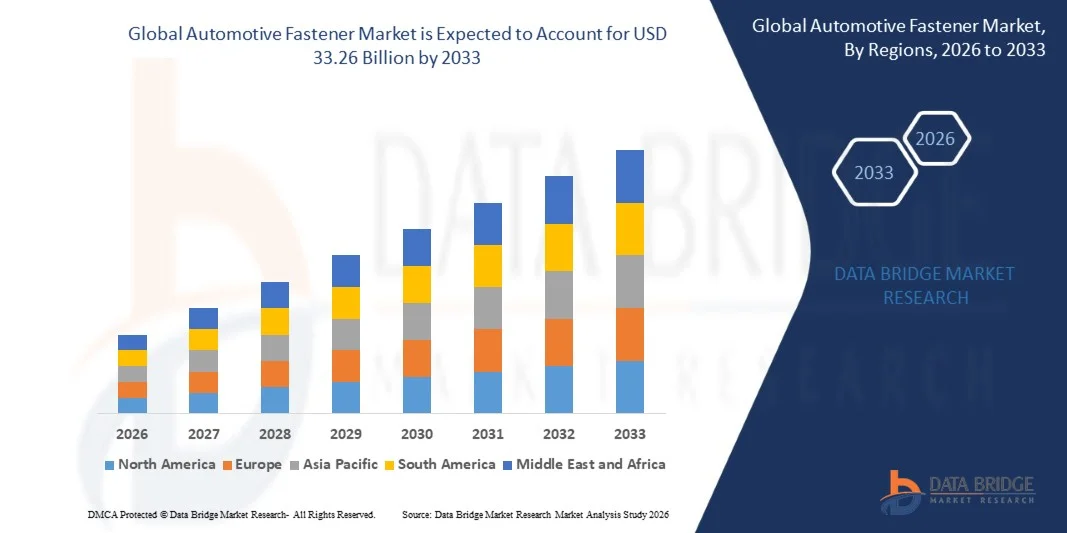
The Automotive Fastener Market was valued at USD 23.96 billion in 2025 and is projected to reach USD 33.26 billion by 2033, growing at a CAGR of 4.19% from 2026 to 2033. The market is experiencing steady growth driven by increasing global vehicle production, rising demand for lightweight and fuel-efficient automobiles, and growing integration of advanced fastening solutions across passenger and commercial vehicles.
The rapid evolution of automotive manufacturing, combined with stringent fuel efficiency and vehicle safety regulations, is encouraging automakers to adopt high-performance fastening systems that improve structural integrity while reducing vehicle weight. Advanced automotive fasteners made from lightweight materials such as aluminum, titanium, and engineered plastics are increasingly replacing conventional steel fasteners in many vehicle platforms, supporting weight reduction initiatives and improving overall vehicle efficiency. In addition, the growing production of electric vehicles is creating substantial demand for specialized fastening solutions used in battery packs, powertrain assemblies, chassis systems, and electronic components. Continuous advancements in automated assembly technologies, corrosion-resistant coatings, and smart fastening systems are further supporting market expansion, while increasing investments in automotive manufacturing facilities worldwide continue to strengthen demand for durable, reliable, and high-precision fastening solutions.
Key Market Trends & Insights
- North America dominated the automotive fastener market with the largest revenue share of 35.84% in 2025, supported by a strong automotive manufacturing base, increasing production of electric vehicles, high adoption of advanced vehicle technologies, and the presence of major automotive OEMs and component suppliers.
- Asia-Pacific is expected to be the fastest-growing region, recording a CAGR of 5.3% from 2026 to 2033. Growth is driven by expanding automotive production, rapid industrialization, rising electric vehicle manufacturing, increasing disposable incomes, and significant investments in automotive supply chain infrastructure across China, India, Japan, and South Korea.
- The Threaded segment held the largest market revenue share of approximately 68.9% in 2025 driven by its extensive use in engine assemblies, chassis systems, transmission components, and structural automotive applications. Threaded fasteners are preferred due to their superior holding strength, ease of maintenance, and ability to withstand vibration and dynamic vehicle loads.
- The Non-Threaded segment is projected to register the fastest growth at a CAGR of 5.2% from 2026 to 2033, driven by increasing adoption of lightweight fastening solutions, clips, rivets, and retaining rings in electric vehicles and interior automotive assemblies. Rising demand for automated assembly processes is accelerating segment expansion.
- The Chassis segment held the largest market revenue share of approximately 26.8% in 2025 driven by the high volume of fasteners required for structural integrity, suspension systems, body assemblies, and vehicle safety components. Increasing vehicle production and growing safety requirements continue to support segment dominance.
- The Interior Trim segment is projected to register the fastest growth at a CAGR of 5.6% from 2026 to 2033, driven by rising demand for lightweight materials, enhanced vehicle aesthetics, and advanced cabin features across passenger and electric vehicles. Growing integration of smart interior technologies is contributing to segment growth.
- The Removable Fasteners segment held the largest market revenue share of approximately 57.4% in 2025 driven by their widespread application in vehicle maintenance, repair operations, and modular automotive assembly processes. Their ability to facilitate easy servicing and component replacement supports strong market adoption.
- The Semi-Permanent Fasteners segment is projected to register the fastest growth at a CAGR of 5.4% from 2026 to 2033, driven by increasing use in advanced vehicle architectures where durability and controlled disassembly are both required. Growing adoption in electric vehicle battery systems is supporting segment expansion.
- The Stainless-Steel segment held the largest market revenue share of approximately 34.6% in 2025 driven by its superior corrosion resistance, durability, strength, and suitability for demanding automotive environments. Stainless steel fasteners remain widely utilized across engines, chassis systems, and exterior vehicle components.
- The Aluminum segment is projected to register the fastest growth at a CAGR of 6.1% from 2026 to 2033, driven by increasing automotive lightweighting initiatives and growing production of electric vehicles. Automakers are increasingly utilizing aluminum fasteners to reduce vehicle weight and improve energy efficiency.
- The Passenger Car (PC) segment held the largest market revenue share of approximately 61.3% in 2025 driven by high global passenger vehicle production volumes and extensive use of fasteners across body structures, interiors, powertrains, and safety systems. Rising consumer demand for technologically advanced vehicles continues to support segment growth.
- The Electric Vehicle Type segment is projected to register the fastest growth at a CAGR of 8.3% from 2026 to 2033, driven by accelerating global EV adoption, increasing battery manufacturing activities, and rising investments in electric mobility infrastructure. Growing demand for specialized lightweight and high-performance fastening solutions is fueling segment expansion.
Market Size & Forecast
- Global Market Value (2025): USD 23.96 Billion
- Expected Market Value (2033): USD 33.26 Billion
- Forecast CAGR (2026–2033): 4.19%
- Leading Region in 2025: North America
- Fastest Growing Region: Asia-Pacific
Report Scope and Automotive Fastener Market Segmentation
|
Attributes |
Automotive Fastener Key Market Insights |
|
Segments Covered |
· By Product: Threaded and Non-Threaded · By Application: Engine, Chassis, Transmission, Steering, Front/Rear Axle, Interior Trim and Others · By Characteristics: Removable Fasteners, Permanent Fasteners and Semi-Permanent Fasteners · By Material Type: Stainless Steel, Iron, Bronze, Nickle, Aluminum, Brass and Plastic · By Vehicle Type: Passenger Car (PC), Light Commercial Vehicle (LCV), Heavy Commercial Vehicle (HCV)), Electric Vehicle Type and Plug-in Hybrid Electric Vehicle (PHEV) |
|
Countries Covered |
North America · U.S. · Canada · Mexico Europe · Germany · France · U.K. · Netherlands · Switzerland · Belgium · Russia · Italy · Spain · Turkey · Rest of Europe Asia-Pacific · China · Japan · India · South Korea · Singapore · Malaysia · Australia · Thailand · Indonesia · Philippines · Rest of Asia-Pacific Middle East and Africa · Saudi Arabia · U.A.E. · South Africa · Egypt · Israel · Rest of Middle East and Africa South America · Brazil · Argentina · Rest of South America |
|
Key Market Players |
• Arconic Corporation (U.S.) |
|
Market Opportunities |
• Increasing Adoption Of Lightweight Fasteners In Electric Vehicles • Growing Demand For Advanced Corrosion-Resistant And High-Performance Fastening Solutions |
|
Value Added Data Infosets |
In addition to the market insights such as market value, growth rate, market segments, geographical coverage, market players, and market scenario, the market report curated by the Data Bridge Market Research team includes in-depth expert analysis, import/export analysis, pricing analysis, production consumption analysis, and pestle analysis. |
Automotive Fastener Market Trends
Trend: Rising Adoption Of Lightweight Fasteners In Electric Vehicles And Advanced Automotive Platforms
Increasing demand for lightweight, high-strength, and corrosion-resistant fastening solutions across passenger vehicles, commercial vehicles, and electric vehicle platforms is transforming the automotive fastener industry. Traditional steel fasteners contribute to vehicle weight and fuel consumption, encouraging automakers to adopt advanced fastening materials such as aluminum, titanium, engineered plastics, and hybrid composites that improve efficiency without compromising structural integrity.
In modern electric vehicles, manufacturers are integrating lightweight fasteners, For instance in battery enclosures, chassis assemblies, and powertrain systems, to reduce vehicle weight and extend driving range. Advanced fasteners are also being increasingly utilized in aluminum-intensive vehicle architectures and mixed-material body structures to support automotive lightweighting initiatives. The rapid expansion of electric mobility and autonomous vehicle development is further increasing demand for specialized fastening systems capable of meeting stringent safety and durability requirements. In addition, automotive manufacturers are investing in automated fastening technologies to improve assembly precision and production efficiency. Industry vehicle development programs conducted during 2025 reported vehicle weight reductions of nearly 5–10% in selected EV platforms through the increased use of lightweight materials and advanced fastening systems.
Automotive Fastener Market Dynamics
Key Market Driver: Growing Global Vehicle Production And Automotive Lightweighting Initiatives
Automotive manufacturers worldwide are facing increasing regulatory pressure to improve fuel efficiency, reduce emissions, and enhance vehicle performance. These objectives are creating strong demand for advanced fastening solutions capable of supporting lightweight vehicle designs while maintaining structural reliability and safety standards.
Automotive OEMs and component manufacturers are increasingly deploying high-performance fasteners across body structures, engines, transmissions, interiors, and electronic systems to improve assembly quality and operational durability. Manufacturers are actively adopting lightweight fastening solutions, For instance aluminum and engineered polymer fasteners, to support fuel economy targets and electric vehicle development strategies. The growing production of electric and hybrid vehicles is further accelerating demand for specialized fasteners used in battery packs, charging systems, and thermal management assemblies. Real-world automotive production programs implemented across Europe and Asia during 2024 demonstrated vehicle weight reductions of approximately 2–4% through optimized fastener selection and lightweight assembly designs.
Key Restraint/Challenge: Volatility In Raw Material Prices And Stringent Quality Requirements
Automotive fasteners must meet strict safety, durability, and performance standards across diverse operating environments, creating significant manufacturing and material challenges. Fluctuations in steel, aluminum, titanium, and specialty alloy prices directly impact production costs and profitability for fastener manufacturers.
In addition, stringent automotive certification requirements, complex quality assurance processes, and increasing demand for customized fastening solutions contribute to higher development and manufacturing expenses. Automotive suppliers must continuously invest in precision manufacturing technologies and testing capabilities to meet evolving OEM specifications. Supply chain disruptions affecting raw materials and metal processing operations further create cost uncertainties across the industry. Industry procurement assessments conducted during 2024 indicated that fluctuations in specialty metal prices increased production costs for certain automotive fastener categories by approximately 8–15% compared with previous years.
Key Market Opportunity: Expansion Of Electric Vehicles And Smart Manufacturing Technologies
The rapid growth of electric vehicles, connected mobility solutions, and advanced automotive manufacturing technologies is creating substantial opportunities for automotive fastener suppliers worldwide. Modern vehicle architectures increasingly require specialized fastening systems capable of supporting lightweight materials, complex electronics, and high-voltage battery systems.
Automotive companies are increasingly adopting advanced fasteners, For instance for battery pack assembly, electronic control units, and lightweight body structures, to improve vehicle efficiency, safety, and manufacturing productivity. In smart factories, growing deployment of robotic assembly systems is accelerating demand for precision-engineered fastening solutions that support automated installation processes. In addition, advancements in corrosion-resistant coatings, intelligent fastening technologies, and high-strength lightweight materials are creating new opportunities across electric mobility and next-generation vehicle platforms. EV manufacturing expansions announced during 2025 across China, the U.S., and Europe reported double-digit increases in demand for specialized automotive fastening components supporting battery-electric vehicle production.
Automotive Fastener Market Scope
The market is segmented on the basis of product, application, characteristics, material type, and vehicle type.
- By Product
On the basis of product, the automotive fastener market is segmented into Threaded and Non-Threaded. The Threaded segment held the largest market revenue share of approximately 68.9% in 2025 driven by its extensive use in engine assemblies, chassis systems, transmission components, and structural automotive applications. Threaded fasteners are preferred due to their superior holding strength, ease of maintenance, and ability to withstand vibration and dynamic vehicle loads.
The Non-Threaded segment is projected to register the fastest growth at a CAGR of 5.2% from 2026 to 2033, driven by increasing adoption of lightweight fastening solutions, clips, rivets, and retaining rings in electric vehicles and interior automotive assemblies. Rising demand for automated assembly processes is accelerating segment expansion.
- By Application
On the basis of application, the automotive fastener market is segmented into Engine, Chassis, Transmission, Steering, Front/Rear Axle, Interior Trim and Others. The Chassis segment held the largest market revenue share of approximately 26.8% in 2025 driven by the high volume of fasteners required for structural integrity, suspension systems, body assemblies, and vehicle safety components. Increasing vehicle production and growing safety requirements continue to support segment dominance.
The Interior Trim segment is projected to register the fastest growth at a CAGR of 5.6% from 2026 to 2033, driven by rising demand for lightweight materials, enhanced vehicle aesthetics, and advanced cabin features across passenger and electric vehicles. Growing integration of smart interior technologies is contributing to segment growth.
- By Characteristics
On the basis of characteristics, the automotive fastener market is segmented into Removable Fasteners, Permanent Fasteners and Semi-Permanent Fasteners. The Removable Fasteners segment held the largest market revenue share of approximately 57.4% in 2025 driven by their widespread application in vehicle maintenance, repair operations, and modular automotive assembly processes. Their ability to facilitate easy servicing and component replacement supports strong market adoption.
The Semi-Permanent Fasteners segment is projected to register the fastest growth at a CAGR of 5.4% from 2026 to 2033, driven by increasing use in advanced vehicle architectures where durability and controlled disassembly are both required. Growing adoption in electric vehicle battery systems is supporting segment expansion.
- By Material Type
On the basis of material type, the automotive fastener market is segmented into Stainless Steel, Iron, Bronze, Nickle, Aluminum, Brass and Plastic. The Stainless-Steel segment held the largest market revenue share of approximately 34.6% in 2025 driven by its superior corrosion resistance, durability, strength, and suitability for demanding automotive environments. Stainless steel fasteners remain widely utilized across engines, chassis systems, and exterior vehicle components.
The Aluminum segment is projected to register the fastest growth at a CAGR of 6.1% from 2026 to 2033, driven by increasing automotive lightweighting initiatives and growing production of electric vehicles. Automakers are increasingly utilizing aluminum fasteners to reduce vehicle weight and improve energy efficiency.
- By Vehicle Type
On the basis of vehicle type, the automotive fastener market is segmented into Passenger Car (PC), Light Commercial Vehicle (LCV), Heavy Commercial Vehicle (HCV), Electric Vehicle Type and Plug-in Hybrid Electric Vehicle (PHEV). The Passenger Car (PC) segment held the largest market revenue share of approximately 61.3% in 2025 driven by high global passenger vehicle production volumes and extensive use of fasteners across body structures, interiors, powertrains, and safety systems. Rising consumer demand for technologically advanced vehicles continues to support segment growth.
The Electric Vehicle Type segment is projected to register the fastest growth at a CAGR of 8.3% from 2026 to 2033, driven by accelerating global EV adoption, increasing battery manufacturing activities, and rising investments in electric mobility infrastructure. Growing demand for specialized lightweight and high-performance fastening solutions is fueling segment expansion.
Automotive Fastener Market Regional Analysis
North America Automotive Fastener Market Insight
North America dominated the automotive fastener market with the largest revenue share of 35.84% in 2025, supported by strong automotive manufacturing capabilities, high vehicle ownership rates, and increasing production of electric and lightweight vehicles. The region benefits from the presence of major automotive OEMs and component suppliers that continuously invest in advanced fastening technologies to improve vehicle performance, safety, and fuel efficiency. Growing adoption of lightweight materials and stringent vehicle safety standards further support demand for high-performance automotive fasteners across passenger and commercial vehicle segments.
U.S. Automotive Fastener Market Insight
The U.S. automotive fastener market captured the largest revenue share in 2025 within North America, fueled by robust automotive production, increasing investments in electric vehicle manufacturing, and rising adoption of advanced vehicle architectures. Automakers are increasingly utilizing specialized fastening solutions to support lightweight vehicle designs and battery-electric vehicle platforms. In addition, the growing presence of automated manufacturing facilities and demand for high-strength fastening systems continue to contribute to market expansion.
Europe Automotive Fastener Market Insight
The Europe automotive fastener market is expected to witness the fastest growth rate from 2026 to 2033, primarily driven by stringent vehicle emission regulations, increasing electric vehicle adoption, and strong demand for lightweight automotive components. European automakers are actively integrating aluminum, composite, and mixed-material structures into vehicle designs, creating substantial demand for advanced fastening solutions. The region continues to experience growth across passenger vehicle, commercial vehicle, and electric mobility applications.
U.K. Automotive Fastener Market Insight
The U.K. automotive fastener market is expected to witness the fastest growth rate from 2026 to 2033, driven by increasing investments in electric vehicle manufacturing, growing automotive innovation, and expanding adoption of lightweight vehicle technologies. Automotive manufacturers are increasingly focusing on reducing vehicle weight and improving energy efficiency, encouraging greater use of advanced fastening systems. The country's transition toward sustainable mobility solutions is expected to further support market growth.
Germany Automotive Fastener Market Insight
The Germany automotive fastener market is expected to witness the fastest growth rate from 2026 to 2033, fueled by its strong automotive manufacturing base and leadership in premium vehicle production. Germany’s emphasis on engineering excellence, vehicle safety, and lightweight automotive construction is accelerating the adoption of high-performance fastening solutions. Growing investments in electric mobility, autonomous driving technologies, and advanced manufacturing processes continue to strengthen market demand.
Asia-Pacific Automotive Fastener Market Insight
The Asia-Pacific automotive fastener market is expected to witness the fastest growth rate from 2026 to 2033, supported by rising vehicle production, rapid industrialization, increasing disposable incomes, and expanding electric vehicle manufacturing activities. Countries such as China, Japan, India, and South Korea are investing heavily in automotive production capacity and supply chain development. Furthermore, the region's strong manufacturing ecosystem and cost-effective production capabilities are encouraging widespread adoption of automotive fastening solutions.
Japan Automotive Fastener Market Insight
The Japan automotive fastener market is expected to witness the fastest growth rate from 2026 to 2033 due to the country's advanced automotive industry, technological innovation, and strong focus on vehicle quality and reliability. Japanese automakers are increasingly utilizing lightweight materials and precision-engineered fastening systems to enhance fuel efficiency and vehicle performance. The growing production of hybrid and electric vehicles is further driving demand for specialized automotive fasteners across multiple vehicle platforms.
China Automotive Fastener Market Insight
The China automotive fastener market accounted for the largest market revenue share in Asia-Pacific in 2025, attributed to the country's position as the world's largest automotive manufacturing hub and its rapidly expanding electric vehicle industry. China continues to witness strong demand for passenger vehicles, commercial vehicles, and new energy vehicles, creating substantial requirements for advanced fastening solutions. Government support for electric mobility, expanding automotive production facilities, and a strong domestic supplier base are key factors propelling market growth in China.
Automotive Fastener Market Share
The Automotive Fastener industry is primarily led by well-established companies, including:
• Arconic Corporation (U.S.)
• Bulten AB (Sweden)
• STANLEY Engineered Fastening (U.S.)
• HILTI INDIA PVT LTD (India)
• LISI SA (France)
• MacLean-Fogg Company (U.S.)
• MISUMI Corporation (Japan)
• Nifco Inc. (Japan)
• Precision Castparts Corp. (U.S.)
• SFS Group AG (Switzerland)
• A & G Fasteners Pty Ltd. (Australia)
• Penn Engineering & Manufacturing Corp. (U.S.)
• Illinois Tool Works Inc. (U.S.)
• Stanley Black & Decker, Inc. (U.S.)
• MW Industries, Inc. (U.S.)
• Brunner Manufacturing Co., Inc. (U.S.)
• Hilti Corporation (Liechtenstein)
• Birmingham Fastener and Supply Inc. (U.S.)
• Sesco Industries Inc. (U.S.)
Latest Developments in Automotive Fastener Market
- In February 2026, Bulten AB, product expansion, announced investments in advanced lightweight fastening technologies for electric vehicles to strengthen its EV component portfolio. The development is expected to improve fastening performance in battery systems and lightweight vehicle structures while supporting the growing demand for sustainable mobility solutions. This initiative is likely to enhance competition and innovation within the automotive fastener market.
- In August 2025, STANLEY Engineered Fastening, capacity expansion, expanded its advanced manufacturing capabilities for high-strength automotive fasteners used in electric and hybrid vehicles. The expansion aims to increase production efficiency, strengthen supply reliability, and support rising automotive OEM demand. The move is expected to accelerate adoption of next-generation fastening solutions across global vehicle platforms.
- In January 2024, MEIDOH Co. Ltd., acquisition, acquired Pilgrim Screw Corp., a manufacturer of aerospace fasteners, to diversify its operations beyond the automotive sector and strengthen its precision fastening expertise. The acquisition is expected to expand the company’s customer base, improve technological capabilities, and create new growth opportunities across high-performance fastening applications.
- In June 2022, Sundram Fasteners Limited, investment, announced an investment of USD 48.43 million to expand its fastener and defense manufacturing operations over the following two years. The initiative aims to enhance production capacity, strengthen product development capabilities, and support increasing demand from automotive and industrial customers. This investment is expected to reinforce the company’s long-term market position.
- In May 2022, Navitas Capital, acquisition, acquired a controlling interest in MULTIFIX Group to support the company’s long-term growth strategy and strengthen its position in technical fastening solutions. The transaction is expected to improve operational capabilities, expand market reach, and increase competitiveness within the global fastening industry.
- In October 2021, PennEngineering, geographic expansion, expanded its presence through the launch of PEM operations in Tokyo, Japan. The expansion was undertaken to strengthen customer support capabilities, improve access to the Asia-Pacific market, and enhance regional distribution networks. The development contributed to greater availability of advanced fastening technologies across automotive and industrial applications.

- Interactive Data Analysis Dashboard
- Company Analysis Dashboard for high growth potential opportunities
- Research Analyst Access for customization & queries
- Competitor Analysis with Interactive dashboard
- Latest News, Updates & Trend analysis
- Harness the Power of Benchmark Analysis for Comprehensive Competitor Tracking
Data collection and base year analysis are done using data collection modules with large sample sizes. The stage includes obtaining market information or related data through various sources and strategies. It includes examining and planning all the data acquired from the past in advance. It likewise envelops the examination of information inconsistencies seen across different information sources. The market data is analysed and estimated using market statistical and coherent models. Also, market share analysis and key trend analysis are the major success factors in the market report. To know more, please request an analyst call or drop down your inquiry.
The key research methodology used by DBMR research team is data triangulation which involves data mining, analysis of the impact of data variables on the market and primary (industry expert) validation. Data models include Vendor Positioning Grid, Market Time Line Analysis, Market Overview and Guide, Company Positioning Grid, Patent Analysis, Pricing Analysis, Company Market Share Analysis, Standards of Measurement, Global versus Regional and Vendor Share Analysis. To know more about the research methodology, drop in an inquiry to speak to our industry experts.
Data Bridge Market Research is a leader in advanced formative research. We take pride in servicing our existing and new customers with data and analysis that match and suits their goal. The report can be customized to include price trend analysis of target brands understanding the market for additional countries (ask for the list of countries), clinical trial results data, literature review, refurbished market and product base analysis. Market analysis of target competitors can be analyzed from technology-based analysis to market portfolio strategies. We can add as many competitors that you require data about in the format and data style you are looking for. Our team of analysts can also provide you data in crude raw excel files pivot tables (Fact book) or can assist you in creating presentations from the data sets available in the report.













