


Bangladesh Cold Chain Market Size
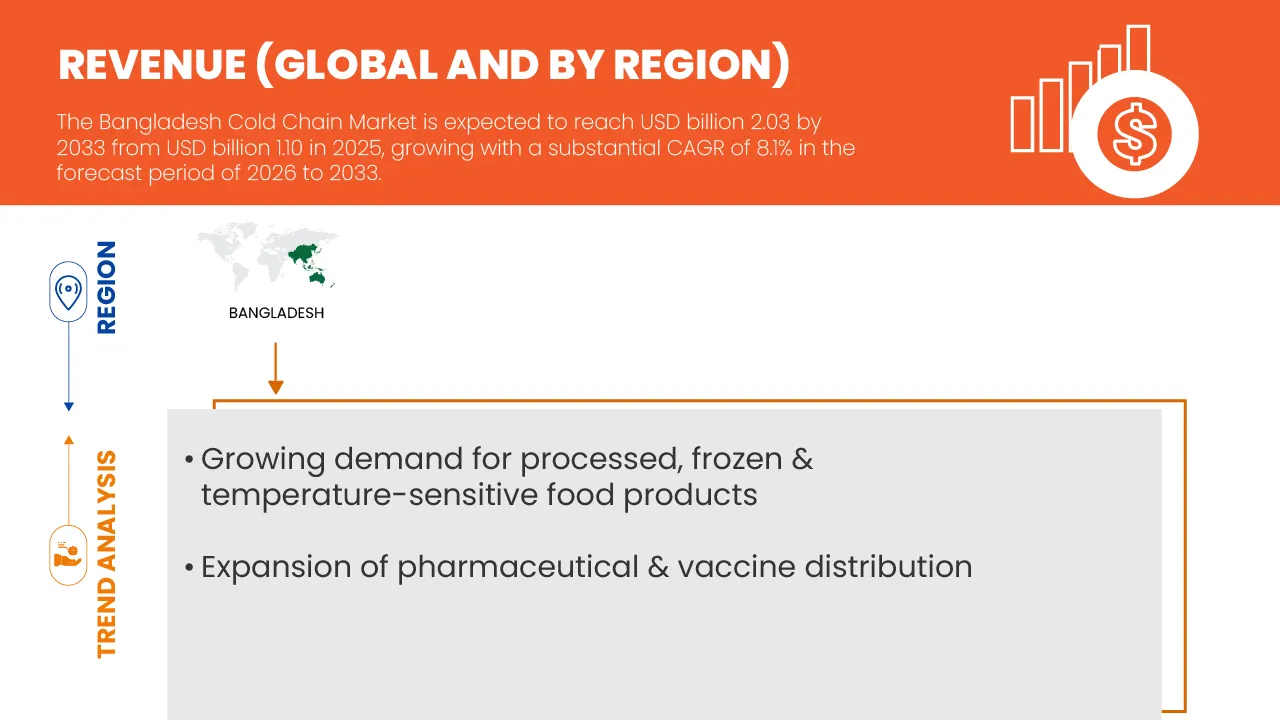
- The Bangladesh Cold Chain Market was valued at USD 1.10 Billion in 2025 and is expected to reach USD 2.03 Billion by 2033 at a CAGR of 8.1% during the forecast period
- The market is primarily driven by the rising need for temperature-controlled logistics, expanding demand for perishable food products, and increasing reliance on cold storage solutions across the pharmaceutical and healthcare sectors.
- This growth is supported by factors such as the surge in organized retail, expanding export-oriented agriculture, rising vaccine and biologics distribution requirements, and the rapid modernization of cold chain infrastructure to ensure product quality and safety
Bangladesh Cold Chain Market Analysis
- The Bangladesh Cold Chain Market is witnessing accelerated growth, driven by rising demand for reliable, energy-efficient, and high-performance temperature-controlled logistics solutions. Cold chain systems offer advantages such as reduced product wastage, improved temperature precision, and scalable storage and transport compared to conventional handling methods. Their adoption is increasing across food & beverage (meat, seafood, dairy, fruits & vegetables), pharmaceuticals (vaccines, insulin, biologics), healthcare supplies, and horticulture exports. However, the market still faces challenges related to energy costs, limited rural cold storage penetration, infrastructure gaps, and the need for improved temperature monitoring and operational reliability.
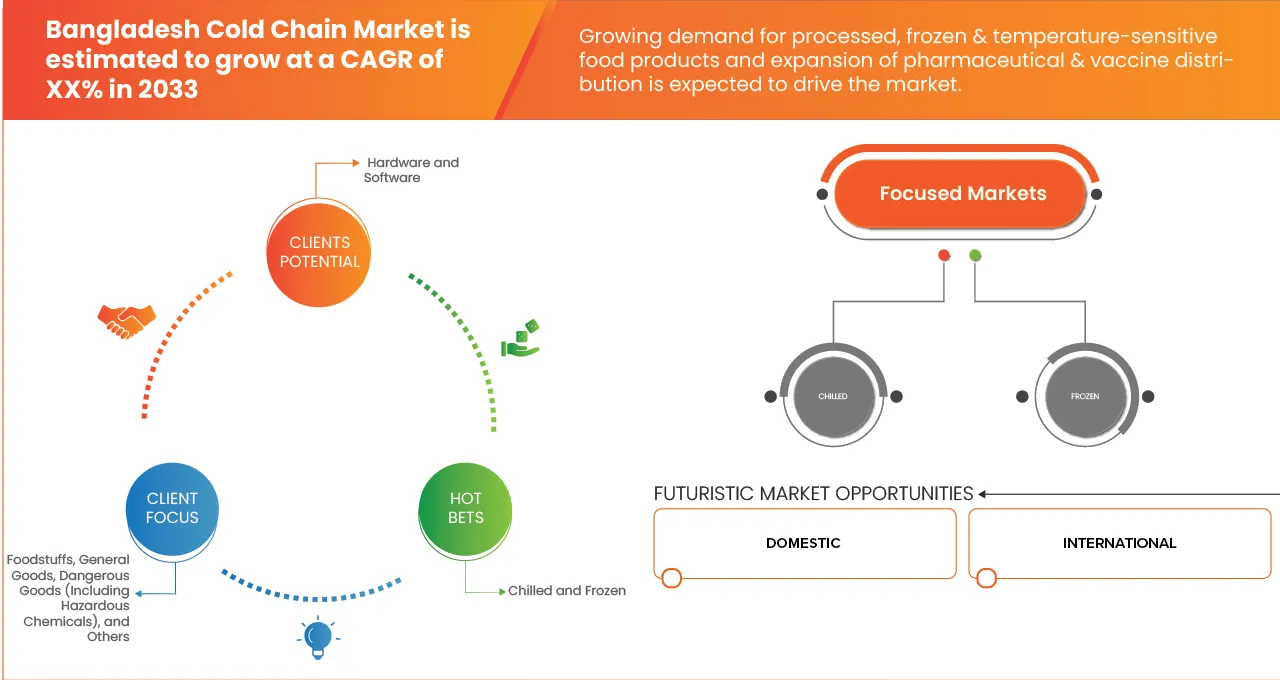
- The food and agriculture sector remains a key growth catalyst, as temperature-sensitive commodities require dependable cold storage and refrigerated transport to maintain freshness and reduce spoilage. Pharmaceutical distribution is also expanding rapidly, driven by vaccines, biologics, and life-saving drugs that require stringent temperature control. At the same time, modern retail, quick-commerce platforms, and frozen food brands are boosting demand for efficient cold chain networks. In addition, seafood and horticulture exporters increasingly rely on advanced cold logistics to meet international quality and safety standards, further strengthening market expansion.
- Asia-Pacific countries are helping influence market practices as Bangladesh continues integrating modern cold storage standards, while regions such as Europe and the Middle East are key destinations for Bangladesh’s temperature-sensitive exports, supporting the adoption of globally aligned cold chain protocols. Meanwhile, developing regions across South Asia and Africa are emerging as new markets with growing interest in improved cold supply systems.
- Key providers are investing in advanced refrigeration technologies, solar-powered cold rooms, real-time temperature monitoring, and improved insulation systems to enhance energy efficiency and reduce operational costs. New solutions include modular cold storage units, digital fleet tracking for reefer trucks, and humidity-controlled chambers for specialized products. Among the segments, cold storage facilities hold a significant share due to their widespread use in food processing, agriculture, and pharmaceuticals. Strategic partnerships between logistics providers, food processors, and government bodies are shaping industry development. As Bangladesh further strengthens regulatory standards for food safety, export quality, and pharmaceutical compliance, maintaining long-term reliability and adopting advanced monitoring systems will be essential for competitiveness and sustainable market growth.
- The Hardware segment is projected to dominate the Bangladesh Cold Chain Market, accounting for the largest market share of 77.99% in 2026, as short-term and on-demand freight requirements continue to increase in line with the country’s growing retail, construction, and agricultural activities. Flexible, pay-per-trip trucking services are being preferred over long-term contracts, particularly by SMEs whose shipment volumes vary, thereby strengthening the demand for hardware-driven cold chain infrastructure.
Report Scope and Bangladesh Cold Chain Market Segmentation
|
Attributes |
Bangladesh Cold Chain Market Key Market Insights |
|
Segments Covered |
|
|
Countries Covered |
|
|
Key Market Players |
|
|
Market Opportunities |
|
|
Value Added Data Infosets |
In addition to the insights on market scenarios such as market value, growth rate, segmentation, geographical coverage, and major players, the market reports curated by the Data Bridge Market Research also include in-depth expert analysis, pricing analysis, brand share analysis, consumer survey, demography analysis, supply chain analysis, value chain analysis, raw material/consumables overview, vendor selection criteria, PESTLE Analysis, Porter Analysis, and regulatory framework. |
Bangladesh Cold Chain Market Trends
“Advancements in Efficiency, Capacity Expansion, and Emerging Applications”
- One prominent trend in the Bangladesh Cold Chain Market is the accelerated adoption of advanced refrigeration technologies and modern storage systems to enhance cooling efficiency, increase capacity, and support diverse applications across food processing, pharmaceuticals, agriculture, and retail distribution.
- The market is experiencing growing demand for high-capacity cold storage units and energy-efficient refrigerated transport, driven by their superior temperature stability, reduced wastage, and ability to maintain product integrity compared to traditional handling methods. This shift is particularly strong in perishable food logistics, vaccine and biologics distribution, and export-oriented supply chains where reliability and operational efficiency are essential.
- For instance, in 2024, several cold chain operators in Bangladesh expanded their temperature-controlled warehouse networks and introduced solar-assisted cold rooms to support sustainable operations and improve last-mile connectivity for rural and urban markets. Likewise, logistics firms are increasingly integrating IoT-based temperature monitoring systems to ensure real-time visibility and compliance for sensitive pharmaceutical and food products.
- Industry players are incorporating innovations such as humidity-controlled environments, enhanced insulation materials, and advanced thermal management systems to meet the rising needs of processed foods, seafood exports, and horticulture supply chains. At the same time, upgraded packaging technologies and digital tracking solutions are improving transport reliability and reducing spoilage rates across distribution routes.
- As sectors like quick-commerce, modern retail, and healthcare continue to expand, the demand for reliable, energy-efficient, and scalable cold chain solutions is intensifying. Market participants are also aligning with global best practices by adopting environmentally sustainable refrigerants, adhering to food safety and pharmaceutical regulations, and improving supply chain transparency to strengthen their position in fast-growing domestic and export markets
Bangladesh Cold Chain Market Dynamics
Driver
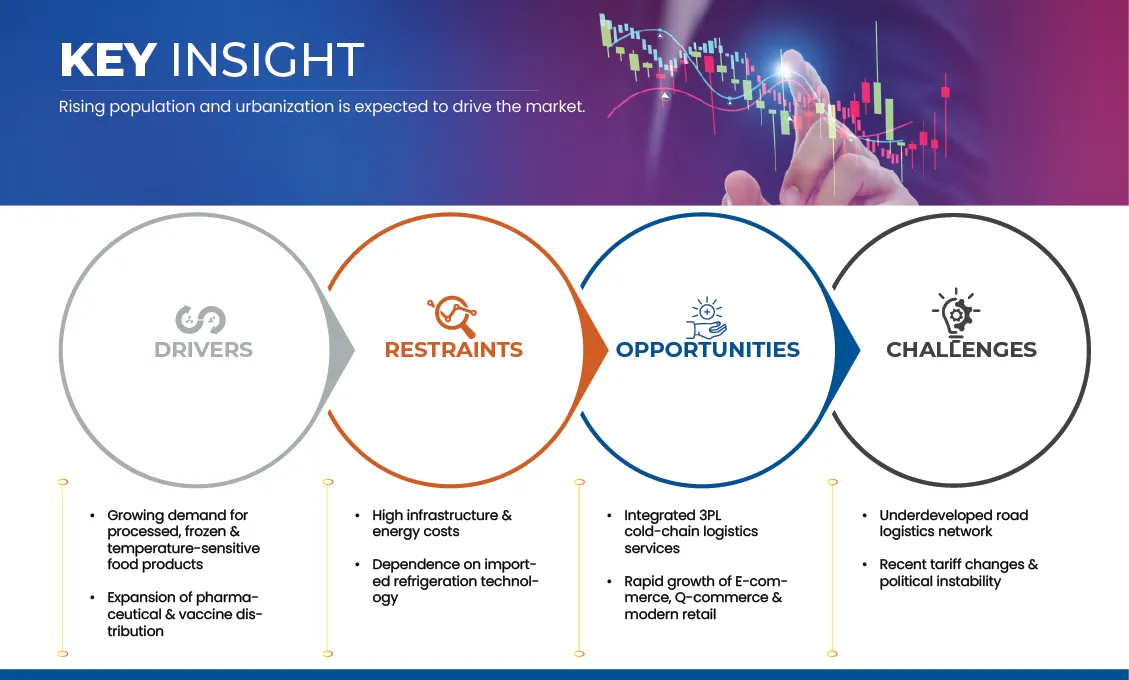
“Growing demand for processed, frozen & temperature-sensitive food products”
- Bangladesh is undergoing a rapid transformation in food consumption driven by urbanization, changing lifestyles, and rising disposable incomes. A growing number of consumers—especially in major cities like Dhaka, Chattogram, and Sylhet—are shifting away from traditional fresh wet-market purchases toward ready-to-cook and ready-to-eat options. This shift is fueled by busy lifestyles, higher female workforce participation, and greater exposure to global food trends.
- The rising popularity of branded frozen foods (such as poultry, fish fillets, shrimp, snacks, bakery items, ice cream, and dairy products), along with increased production of temperature-sensitive goods (vaccines, pharmaceuticals, fruits, vegetables), is creating sustained demand for reliable cold storage, refrigerated transport, and temperature-controlled distribution networks.
- Additionally, Bangladesh is a major fish and seafood exporter, requiring world-class cold logistics to meet strict international quality and safety standards for markets such as the EU, Japan, and the Middle East. Ensuring integrity across the supply chain—from landing and processing sites to export gateways—is critical to maintaining competitiveness
- Modern retail formats, including supermarkets, quick-commerce platforms, and online grocery delivery services, are expanding nationwide, placing new logistical requirements on suppliers for continuous cold chain support. To reduce post-harvest losses—currently high for perishable products like fish, meat, vegetables, and dairy—producers and distributors are investing in frozen warehouses, pre-cooling facilities, reefer trucks, and last-mile delivery infrastructure
Restraint/Challenge
“High infrastructure & energy costs”
- High infrastructure and energy costs continue to be a major restraint for the growth and efficiency of Bangladesh’s cold chain sector. Developing a modern cold chain network requires substantial investment in advanced refrigeration systems, insulated storage facilities, and temperature-controlled transport fleets. These systems depend on sophisticated technology and continuous power supply, making both installation and maintenance financially demanding. Frequent power fluctuations and unreliable grid performance compel operators to invest heavily in backup generators, fuel, and energy-management systems, further increasing operational expenses. These rising costs hinder many businesses especially small and mid-sized enterprises from upgrading to modern cold chain solutions or expanding their capacity. Similar to how consumers in premium wellness markets expect advanced, reliable, and customized solutions, industries relying on cold chain services in Bangladesh also demand consistent and high-quality temperature control. However, the high financial burden limits the sector’s ability to adopt innovative, energy-efficient technologies. As a result, the cold chain ecosystem grows more slowly, leading to gaps in quality preservation for key industries such as agriculture, fisheries, and pharmaceuticals. Addressing these cost challenges through technological innovation, efficient facility design, and strategic investment will be crucial for building a robust and competitive cold chain infrastructure in Bangladesh
- The high infrastructure and energy costs in Bangladesh’s cold-chain sector underscore a significant barrier to modernization and expansion. Maintaining temperature-controlled storage, refrigerated transport, and advanced handling systems requires substantial investment and continuous power supply, which many operators find financially challenging. These cost pressures limit the adoption of energy-efficient technologies, reduce overall operational efficiency, and constrain the ability of businesses particularly small and medium-sized enterprises—to scale their operations. As a result, critical sectors such as agriculture, fisheries, and pharmaceuticals face supply chain inefficiencies, post-harvest losses, and compromised product quality. Addressing these challenges through strategic investments, technological innovation, and energy-efficient solutions presents a key opportunity to strengthen the cold-chain ecosystem, enhance food security, and improve market competitiveness, enabling Bangladesh to build a more resilient and reliable supply infrastructure for perishable goods
Bangladesh Cold Chain Market Scope
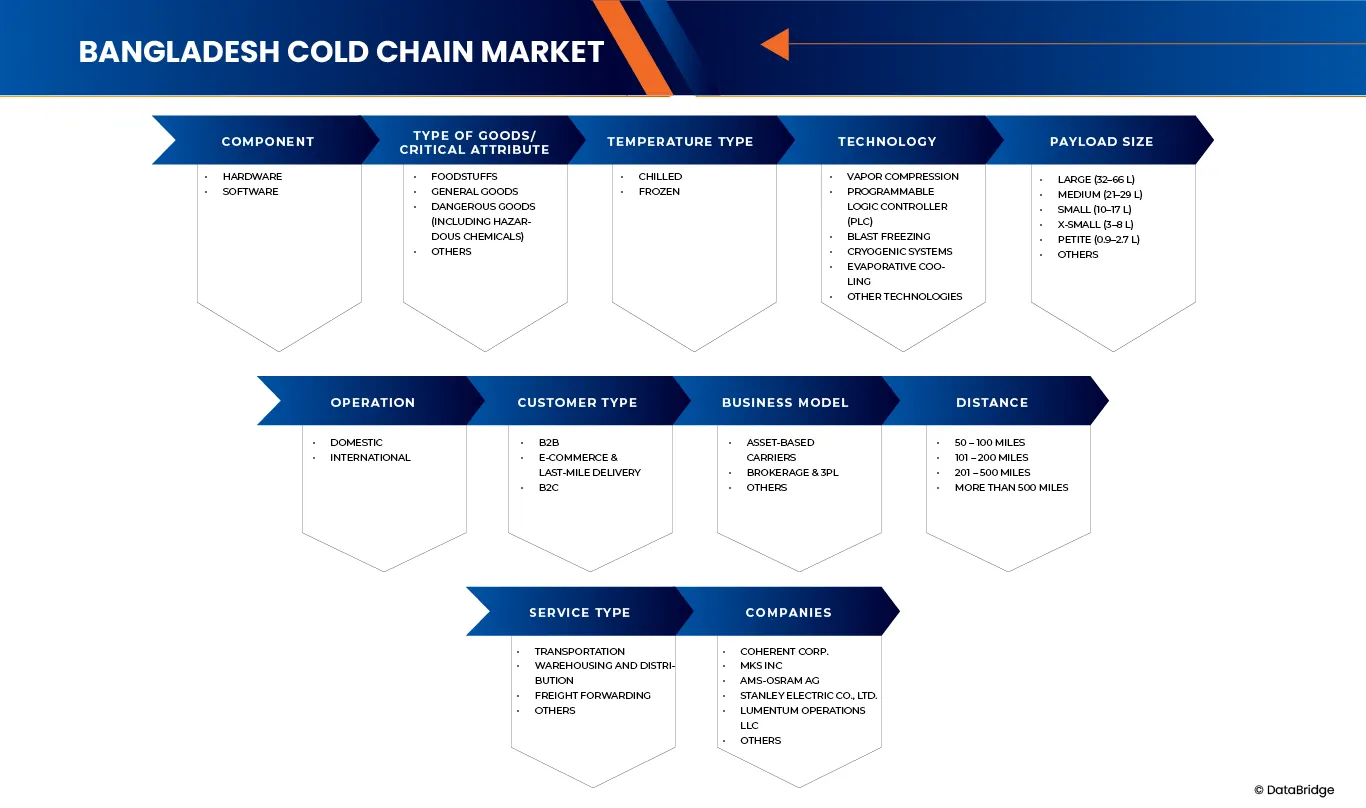
Bangladesh Cold Chain Market is categorized into ten notable segments which are based on Components, Service Type, Type of Goods/Critical Attribute, Temperature Type, Technology, Payload Size, Operation, Customer Type, Business Model, Distance.
- By components
On the basis of components, the Bangladesh Cold Chain Market is divided into hardware and software segments. In 2026, the hardware segment is expected to dominate the market with 77.99% market share and is expected to reach USD 1,600,774.90 thousand by 2033, growing with the highest CAGR of 8.3% in the forecast period of 2026 to 2033 .
- By service type
On the basis of service type, the Bangladesh Cold Chain Market is segmented into transportation, warehousing and distribution, freight forwarding, others. In 2026, the transportation segment is expected to dominate the market with 44.61% market share and is expected to reach USD 923,402.80 thousand by 2033, growing with the highest CAGR of 8.4% in the forecast period of 2026 to 2033.
- By Type of Goods/Critical Attribute
On the basis of Type of Goods/Critical Attribute, the Bangladesh Cold Chain Market is segmented into Foodstuffs, General Goods, Dangerous Goods (including hazardous chemicals), others. . In 2026, the Foodstuffs segment is expected to dominate the market with 58.28% market share and is expected to reach USD 1,211,747.34 thousand by 2033, growing with the highest CAGR of 8.5% in the forecast period of 2026 to 2033..
- By Temperature Type
On the basis of Temperature Type, the Bangladesh Cold Chain Market is segmented into Chilled, Frozen. In 2026, the Chilled is expected to dominate the market with 58.31% market share and is expected to reach USD 1,201,748.33 thousand by 2033, growing with the highest CAGR of 8.3% in the forecast period of 2026 to 2033.
- By Technology
On the basis of Technology, the Bangladesh Cold Chain Market is segmented into Vapor Compression, Programmable Logic Controller (PLC), Blast Freezing, Cryogenic Systems, Evaporative Cooling, Other. In 2026, Vapor Compression is expected to dominate the market with 41.39% market share and is expected to reach USD 868,525.87 thousand by 2033, growing with the highest CAGR of 8.6% in the forecast period of 2026 to 2033.
- By Payload Size
On the basis of Payload Size, the Bangladesh Cold Chain Market is segmented into Large (32–66 L), Medium (21–29 L), Small (10–17 L), X-Small (3–8 L), Petite (0.9–2.7 L), Others In 2026, the Large (32–66 L) segment is expected to dominate the market with 33.64% market share and is expected to reach USD 703,917.33 thousand by 2033, growing with the highest CAGR of 8.6% in the forecast period of 2026 to 2033.
- By Operation
On the basis of Operation, the Bangladesh Cold Chain Market is segmented into Domestic, International. In 2026, the Domestic segment is expected to dominate the market with 69.67%market share and is expected to reach USD 1,442,073.76 thousand by 2033, growing with the highest CAGR of 8.4% in the forecast period of 2026 to 2033
- By Business Model
On the basis of Business Model, the Bangladesh Cold Chain Market is segmented into Asset-Based Carriers, Brokerage & 3PL, Others. In 2026, the Asset-Based Carriers segment is expected to dominate the market with 61.47% market share and is expected to reach USD 1,261,709.96 thousand by 2033, growing with the highest CAGR of 8.3% in the forecast period of 2026 to 2033
- By Distance
On the basis of Distance, the Bangladesh Cold Chain Market is segmented into 50 – 100 Miles, 101 – 200 Miles, 201 – 500 Miles, More Than 500 Miles. In 2026, the 50 – 100 Miles segment is expected to dominate the market with 41.31% market share and is expected to reach USD 856,096.62 thousand by 2033, growing with the highest CAGR of 8.4% in the forecast period of 2026 to 2033
The Major Market Leaders Operating in the Market Are:
- Yusen Logistics Global Management Co., Ltd. (Japan)
- Transcom Limited (Bangladesh)
- Bangladesh Limited (Nippon Express Holdings) (Bangladesh)
- Bcl Cold Storage Limited (India)
- Nabil Cold Storage (Bangladesh)
- MAYEKAWA MFG. CO., LTD. (Japan)
- AK Cold Storage & Engineering (Bangladesh)
- Tritech (Bangladesh)
- Empire Group (Bangladesh)
- N.M Group Bangladesh (Bangladesh)
- J & Y Group (Bangladesh)
- SS Freight Bangladesh (Bangladesh)
- Transmove (Bangladesh)
- Younus Group (Bangladesh)
- Nazrul Transport Agency (Bangladesh)
- CAPTAINS GROUP Agency (Bangladesh)
- Earnest Engineering Works Ltd. (Bangladesh)
- Alhaj Group of Industries (Bangladesh)
- Badal And Company (Bangladesh)
- DREAMCO EXPRESS PAKISTAN PVT LTD (Bangladesh)
- CONVEYOR GROUP (Bangladesh)
Latest Developments in Bangladesh Cold Chain Market
- In August 2025, the United States announced support for expanding Bangladesh’s temperature-controlled logistics network, focusing on new cold-storage facilities and improved refrigerated transport capacity to reduce post-harvest food losses and strengthen agricultural supply chains.
- In July 2025, cold-storage operators in Bangladesh urged the government to include potatoes in its national food-assistance program, emphasizing the critical role of cold-chain infrastructure in enhancing food security and requesting policy incentives to reduce equipment and operational costs.
- In June 2025, the government, together with international development partners, proposed major investments in potato seed and onion bulb cold-storage units under a public-private partnership model. The initiative aims to expand rural cold-chain capacity, improve seed preservation, and support resilient agricultural production.
- In May 2025, a nationwide capacity assessment revealed that Bangladesh has approximately 2.7 million metric tonnes of existing cold-storage capacity, highlighting a significant shortfall relative to actual demand. The report stressed the need for additional facilities and enhanced refrigerated transport to reduce spoilage and improve farm-to-market efficiency.
- • In April 2025, private sector cold-chain players expanded their refrigerated trucking fleets and integrated logistics services to support the growing demand from modern retail, pharmaceuticals, frozen foods, and export-oriented industries. Market analysts estimated steady growth for the Bangladesh cold-chain market, driven by rising urban consumption and modernization of supply chains.

- Interactive Data Analysis Dashboard
- Company Analysis Dashboard for high growth potential opportunities
- Research Analyst Access for customization & queries
- Competitor Analysis with Interactive dashboard
- Latest News, Updates & Trend analysis
- Harness the Power of Benchmark Analysis for Comprehensive Competitor Tracking
Table of Content
1 INTRODUCTION
1.1 OBJECTIVES OF THE STUDY
1.2 MARKET DEFINITION
1.3 OVERVIEW OF BANGLADESH COLD CHAIN MARKET
1.4 LIMITATIONS
1.5 MARKETS COVERED
2 MARKET SEGMENTATION
2.1 MARKETS COVERED
2.2 GEOGRAPHICAL SCOPE
2.3 YEARS CONSIDERED FOR THE STUDY
2.4 CURRENCY AND APPLICATION
2.5 DBMR TRIPOD DATA VALIDATION MODEL
2.6 MULTIVARIATE MODELLING
2.7 PRIMARY INTERVIEWS WITH KEY OPINION LEADERS
2.8 DBMR MARKET POSITION GRID
2.9 DBMR VENDOR SHARE ANALYSIS
2.1 MARKET END USER INDUSTRY COVERAGE GRID
2.11 SECONDARY SOURCES
2.12 ASSUMPTIONS
3 EXECUTIVE SUMMARY
4 PREMIUM INSIGHTS
4.1 PORTER’S FIVE FORCES
4.1.1 THREAT OF NEW ENTRANTS
4.1.2 BARGAINING POWER OF SUPPLIERS
4.1.3 BARGAINING POWER OF BUYERS
4.1.4 THREAT OF SUBSTITUTE PRODUCTS
4.1.5 INDUSTRY RIVALRY
4.2 VALUE CHAIN ANALYSIS
4.3 NEW BUSINESS AND EMERGING BUSINESS REVENUE OPPORTUNITIES IN THE BANGLADESH COLD CHAIN MARKET
4.4 PENETRATION AND GROWTH PROSPECT MAPPING OF THE BANGLADESH COLD CHAIN MARKET
4.5 COMPANY EVALUATION QUADRANT
4.6 COMPANY COMPARATIVE ANALYSIS
4.7 COMPANY SERVICE PLATFORM MATRIX
4.8 TECHNOLOGY ANALYSIS
5 TARIFF & ITS ANALYSIS
5.1 OVERVIEW OF RELEVANT TARIFFS
5.2 TRADE POLICIES INFLUENCING THE MARKET
5.2.1 TARIFF LEVELS & IMPORT DUTIES
5.2.2 RECENT / PROSPECTIVE POLICY SHIFTS
5.3 COST IMPACT ON STAKEHOLDERS
5.3.1 FOR COLD-CHAIN OPERATORS / INVESTORS
5.3.2 FOR PRODUCERS / FARMERS / AGRO-SUPPLIERS:
5.3.3 FOR CONSUMERS & END-MARKETS (DOMESTIC + EXPORT):
5.4 SUPPLY CHAIN DISRUPTIONS
5.5 STRATEGIC RESPONSE BY OEM
6 REGULATORY STANDARDS
7 MARKET OVERVIEW
7.1 DRIVERS
7.1.1 GROWING DEMAND FOR PROCESSED, FROZEN & TEMPERATURE-SENSITIVE FOOD PRODUCTS
7.1.2 EXPANSION OF PHARMACEUTICAL & VACCINE DISTRIBUTIONE
7.2 RESTRIANTS
7.2.1 HIGH INFRASTRUCTURE & ENERGY COSTS
7.2.2 DEPENDENCE ON IMPORTED REFRIGERATION TECHNOLOGY
7.3 OPPORTUNITY
7.3.1 INTEGRATED 3PL COLD‑CHAIN LOGISTICS SERVICES
7.3.2 RAPID GROWTH OF E-COMMERCE, Q-COMMERCE & MODERN RETAIL
7.4 CHALLENGES
7.4.1 UNDERDEVELOPED ROAD LOGISTICS NETWORK
7.4.2 RECENT TARIFF CHANGES & POLITICAL INSTABILITY
8 BANGLADESH COLD CHAIN MARKET, BY COMPONENT.
8.1 OVERVIEW
8.2 BANGLADESH COLD CHAIN MARKET, BY COMPONENT, 2018-2033 (USD THOUSAND)
8.2.1 HARDWARE
8.2.2 SOFTWARE
8.3 BANGLADESH HARDWARE IN COLD CHAIN MARKET, BY TYPE, 2018-2033 (USD THOUSAND)
8.3.1 SENSORS
8.3.2 DATA LOGGERS
8.3.3 GPS DEVICES
8.3.4 TELEMATICS & TELEMETRY DEVICES
8.3.5 NETWORKING DEVICES
8.3.6 RFID DEVICES
8.3.7 OTHERS
8.4 BANGLADESH SENSOR IN COLD CHAIN MARKET, BY TYPE, 2018-2033 (USD THOUSAND)
8.4.1 TEMPERATURE SENSORS
8.4.2 HUMIDITY SENSORS
8.4.3 MOISTURE SENSORS
8.4.4 OTHERS
8.5 BANGLADESH SOFTWARE IN COLD CHAIN MARKET, BY TYPE, 2018-2033 (USD THOUSAND)
8.5.1 ON-PREMISES
8.5.2 CLOUD
8.6 BANGLADESH SOFTWARE IN COLD CHAIN MARKET, BY ORGANIZATION SIZE, 2018-2033 (USD THOUSAND)
8.6.1 LARGE ORGANIZATION SIZE
8.6.2 SMALL & MEDIUM ORGANIZATION SIZE
9 BANGLADESH COLD CHAIN MARKET, BY TYPE OF GOODS/CRITICAL ATTRIBUTE.
9.1 OVERVIEW
9.2 BANGLADESH COLD CHAIN MARKET, BY TYPE OF GOODS/CRITICAL ATTRIBUTE, 2018-2033 (USD THOUSAND)
9.2.1 FOODSTUFFS
9.2.2 GENERAL GOODS
9.2.3 DANGEROUS GOODS (INCLUDING HAZARDOUS CHEMICALS)
9.2.4 OTHERS
9.3 BANGLADESH FOODSTUFFS IN COLD CHAIN MARKET, BY TYPE, 2018-2033 (USD THOUSAND)
9.3.1 REFRIGERATED TRANSPORT WITH REFRIGERATION
9.3.2 REFRIGERATED TRANSPORT WITH FREEZING
10 BANGLADESH COLD CHAIN MARKET, BY TEMPERATURE TYPE.
10.1 OVERVIEW
10.2 BANGLADESH COLD CHAIN MARKET, BY TEMPERATURE TYPE, 2018-2033 (USD THOUSAND)
10.2.1 CHILLED
10.2.2 FROZEN
11 BANGLADESH COLD CHAIN MARKET, BY COMPONENT.
11.1 OVERVIEW
11.2 BANGLADESH COLD CHAIN MARKET, BY TECHNOLOGY, 2018-2033 (USD THOUSAND)
11.2.1 VAPOR COMPRESSION
11.2.2 PROGRAMMABLE LOGIC CONTROLLER (PLC)
11.2.3 BLAST FREEZING
11.2.4 CRYOGENIC SYSTEMS
11.2.5 EVAPORATIVE COOLING
11.2.6 OTHER TECHNOLOGIES
12 BANGLADESH COLD CHAIN MARKET, BY PAYLOAD SIZE.
12.1 OVERVIEW
12.2 BANGLADESH COLD CHAIN MARKET, BY PAYLOAD SIZE, 2018-2033 (USD THOUSAND)
12.2.1 LARGE (32–66 L)
12.2.2 MEDIUM (21–29 L)
12.2.3 SMALL (10–17 L)
12.2.4 X-SMALL (3–8 L)
12.2.5 PETITE (0.9–2.7 L)
12.2.6 OTHERS
12.3 BANGLADESH COLD CHAIN MARKET, BY OPERATION, 2018-2033 (USD THOUSAND)
13 BANGLADESH COLD CHAIN MARKET, BY OPERATION.
13.1 OVERVIEW
13.1.1 DOMESTIC
13.1.2 INTERNATIONAL
13.2 BANGLADESH COLD CHAIN MARKET, BY CUSTOMER TYPE, 2018-2033 (USD THOUSAND)
14 BANGLADESH COLD CHAIN MARKET, BY CUSTOMER TYPE.
14.1 OVERVIEW
14.2 B2B
14.3 E-COMMERCE & LAST-MILE DELIVERY
14.4 B2C
15 BANGLADESH COLD CHAIN MARKET, BY BUSINESS MODEL
15.1 OVERVIEW
15.2 BANGLADESH COLD CHAIN MARKET, BY BUSINESS MODEL, 2018-2033 (USD THOUSAND)
15.2.1 ASSET-BASED CARRIERS
15.2.2 BROKERAGE & 3PL
15.2.3 OTHERS
16 BANGLADESH COLD CHAIN MARKET, BY DISTANCE.
16.1 OVERVIEW
16.2 BANGLADESH COLD CHAIN MARKET, BY DISTANCE, 2018-2033 (USD THOUSAND)
16.2.1 50 – 100 MILES
16.2.2 101 – 200 MILES
16.2.3 201 – 500 MILES
16.2.4 MORE THAN 500 MILES
16.3 BANGLADESH COLD CHAIN MARKET, BY SERVICE TYPE, 2018-2033 (USD THOUSAND)
17 BANGLADESH COLD CHAIN MARKET, BY SERVICE TYPE.
17.1 OVERVIEW
17.1.1 TRANSPORTATION
17.1.2 WAREHOUSING AND DISTRIBUTION
17.1.3 FREIGHT FORWARDING
17.1.4 OTHERS
17.2 BANGLADESH TRANSPORTATION IN COLD CHAIN MARKET, BY TYPE, 2018-2033 (USD THOUSAND)
17.2.1 ROAD
17.2.2 SEA
17.2.3 RAILWAY
17.2.4 AIR
17.2.5 WATERWAYS (INLAND / RIVER TRANSPORT)
17.3 BANGLADESH ROAD IN COLD CHAIN MARKET, BY TYPE OF CARRIER, 2018-2033 (USD THOUSAND)
17.3.1 FULL TRUCKLOAD (FTL)
17.3.2 SPECIALIZED FREIGHT
17.3.3 LESS THAN TRUCKLOAD (LTL)
17.3.4 PARTIAL TRUCKLOAD (PTL)
17.4 BANGLADESH ROAD IN COLD CHAIN MARKET, BY VEHICLE TYPE, 2018-2033 (USD THOUSAND)
17.4.1 LIGHT COMMERCIAL VEHICLE (LCV)
17.4.2 MEDIUM COMMERCIAL VEHICLE (MCV)
17.4.3 HEAVY COMMERCIAL VEHICLE (HCV)
17.5 BANGLADESH ROAD IN COLD CHAIN MARKET, BY TRUCK TYPE, 2018-2033 (USD THOUSAND)
17.5.1 REFRIGERATED TRUCK
17.5.2 TANKER TRUCK
17.5.3 BOX TRUCKS
17.5.4 FLATBEDS TRUCK
17.6 BANGLADESH REFRIGERATED TRUCK IN COLD CHAIN MARKET, BY TRANSPORT PRODUCT, 2018-2033 (USD THOUSAND)
17.6.1 FOOD
17.6.2 PERISHABLE GOODS
17.6.3 MEDICAL SUPPLIES
17.6.4 BEVERAGES
17.6.5 NON-PERISHABLE GOODS
17.6.6 OTHERS
17.7 BANGLADESH PERISHABLE GOODS IN COLD CHAIN MARKET, BY TYPE, 2018-2033 (USD THOUSAND)
17.7.1 FRUITS
17.7.2 VEGETABLES
17.7.3 SEAFOOD
17.7.4 MEAT
17.7.5 OTHERS
17.8 BANGLADESH MEDICAL SUPPLIES IN COLD CHAIN MARKET, BY TYPE, 2018-2033 (USD THOUSAND)
17.8.1 VACCINES
17.8.2 PHARMACEUTICALS
17.8.3 BLOOD BANKS
17.8.4 OTHERS
17.9 BANGLADESH BEVERAGES IN COLD CHAIN MARKET, BY TYPE, 2018-2033 (USD THOUSAND)
17.9.1 NON-ALCOHOLIC BEVERAGES
17.9.2 ALCOHOLIC BEVERAGES
17.1 BANGLADESH NON-ALCOHOLIC BEVERAGES IN COLD CHAIN MARKET, BY TYPE, 2018-2033 (USD THOUSAND)
17.10.1 JUICE BASED BEVERAGES
17.10.2 CARBONATED BEVERAGES
17.10.3 TEA
17.10.4 COFFEE
17.11 BANGLADESH CARBONATED BEVERAGES IN COLD CHAIN MARKET, BY TYPE, 2018-2033 (USD THOUSAND)
17.11.1 SPORTS & ENERGY BEVERAGE
17.11.2 CBD INFUSED RTD BEVERAGES
17.11.3 OTHERS
17.12 BANGLADESH ALCOHOLIC BEVERAGES IN COLD CHAIN MARKET, BY TYPE, 2018-2033 (USD THOUSAND)
17.12.1 BEER
17.12.2 SPIRITS
17.12.3 WINE
17.13 BANGLADESH NON-PERISHABLE GOODS IN COLD CHAIN MARKET, BY TYPE, 2018-2033 (USD THOUSAND)
17.13.1 FRUITS
17.13.2 VEGETABLES
17.13.3 SEAFOOD
17.13.4 MEAT
17.13.5 OTHERS
17.14 BANGLADESH TANKER TRUCK IN COLD CHAIN MARKET, BY TYPE, 2018-2033 (USD THOUSAND)
17.14.1 LIQUID TANKERS
17.14.2 DRY BULK TANKERS
17.15 BANGLADESH TANKER TRUCK IN COLD CHAIN MARKET, BY TRANSPORT PRODUCT, 2018-2033 (USD THOUSAND)
17.15.1 MILK
17.15.2 JUICES (BEVERAGES)
17.15.3 CHEMICALS
17.15.4 GASES
17.15.5 FUEL
17.15.6 OTHERS
17.16 BANGLADESH GASES IN COLD CHAIN MARKET, BY TYPE, 2018-2033 (USD THOUSAND)
17.16.1 OXYGEN
17.16.2 NITROGEN (LIQUID NITROGEN)
17.16.3 LPG (LIQUEFIED PETROLEUM GAS)
17.16.4 LIQUEFIED BUTANE GAS
17.16.5 HELIUM
17.16.6 PROPANE
17.16.7 OTHERS
17.17 BANGLADESH FUEL IN COLD CHAIN MARKET, BY TYPE, 2018-2033 (USD THOUSAND)
17.17.1 DIESEL
17.17.2 PETROL
17.18 BANGLADESH TANKER TRUCK IN COLD CHAIN MARKET, BY CATEGORY, 2018-2033 (USD THOUSAND)
17.18.1 REFRIGERATED
17.18.2 NON-REFRIGERATED
17.19 BANGLADESH TANKER TRUCK IN COLD CHAIN MARKET, BY ISOLATION, 2018-2033 (USD THOUSAND)
17.19.1 INSULATED
17.19.2 NON-INSULATED
17.2 BANGLADESH TANKER TRUCK IN COLD CHAIN MARKET, BY PRESSURIZED, 2018-2033 (USD THOUSAND)
17.20.1 NON-PRESSURIZED
17.20.2 PRESSURIZED
17.21 BANGLADESH WATERWAYS (INLAND / RIVER TRANSPORT) IN COLD CHAIN MARKET, BY TYPE, 2018-2033 (USD THOUSAND)
17.21.1 FOOD & PERISHABLES
17.21.2 FISHERIES & SEAFOOD
17.21.3 MEDICAL SUPPLIES & VACCINES
17.21.4 OTHERS
17.22 BANGLADESH WAREHOUSING AND DISTRIBUTION IN COLD CHAIN MARKET, BY TYPE, 2018-2033 (USD THOUSAND)
17.22.1 OFF GRID
17.22.2 ON-GRID
17.23 BANGLADESH OFF GRID IN COLD CHAIN MARKET, BY TYPE, 2018-2033 (USD THOUSAND)
17.23.1 SOLAR CHILLERS
17.23.2 MILK COOLERS
17.23.3 SOLAR POWERED COLD BOXES
17.23.4 OTHERS
17.24 BANGLADESH ON-GRID IN COLD CHAIN MARKET, BY TYPE, 2018-2033 (USD THOUSAND)
17.24.1 WALK-IN COOLERS
17.24.2 WALK-IN FREEZERS
17.24.3 DEEP FREEZERS
17.24.4 ICE-LINED REFRIGERATORS (ILRS)
18 BANGLADESH COLD CHAIN MARKET
18.1 COMPANY SHARE ANALYSIS: U.S.
19 SWOT ANALYSIS
20 COMAPANY PROFILES
20.1 YUSEN LOGISTICS GLOBAL MANAGEMENT CO., LTD.
20.1.1 COMPANY SNAPSHOT
20.1.2 PRODUCT PORTFOLIO
20.1.3 RECENT DEVELOPMENT
20.2 TRANSCOM LIMITED
20.2.1 COMPANY SNAPSHOT
20.2.2 PRODUCT PORTFOLIO
20.2.3 RECENT DEVELOPMENT
20.3 NIPPON EXPRESS HOLDINGS
20.3.1 COMPANY SNAPSHOT
20.3.2 REVENUE ANALYSIS
20.3.3 PRODUCT PORTFOLIO
20.3.4 RECENT DEVELOPMENT
20.4 BCL COLD STORAGE LIMITED
20.4.1 COMPANY SNAPSHOT
20.4.2 PRODUCT PORTFOLIO
20.4.3 RECENT DEVELOPMENT
20.5 NABIL GROUP OF INDUSTRIES
20.5.1 COMPANY SNAPSHOT
20.5.2 PRODUCT PORTFOLIO
20.5.3 RECENT DEVELOPMENT
20.6 AK COLD STORAGE & ENGINEERING.
20.6.1 COMPANY SNAPSHOT
20.6.2 PRODUCT PORTFOLIO
20.6.3 RECENT DEVELOPMENT
20.7 ALHAJ GROUP OF INDUSTRIES
20.7.1 COMPANY SNAPSHOT
20.7.2 PRODUCT PORTFOLIO
20.7.3 RECENT DEVELOPMENT
20.8 BADAL AND COMPANY
20.8.1 COMPANY SNAPSHOT
20.8.2 PRODUCT PORTFOLIO
20.8.3 RECENT DEVELOPMENT
20.9 CAPTAINS GROUP
20.9.1 COMPANY SNAPSHOT
20.9.2 PRODUCT PORTFOLIO
20.9.3 RECENT DEVELOPMENT
20.1 CONVEYOR GROUP
20.10.1 COMPANY SNAPSHOT
20.10.2 PRODUCT PORTFOLIO
20.10.3 RECENT DEVELOPMENT
20.11 DREAMCO EXPRESS
20.11.1 COMPANY SNAPSHOT
20.11.2 PRODUCT PORTFOLIO
20.11.3 RECENT DEVELOPMENT
20.12 EARNEST
20.12.1 COMPANY SNAPSHOT
20.12.2 PRODUCT PORTFOLIO
20.12.3 RECENT DEVELOPMENTS
20.13 EMPIRE GROUP
20.13.1 COMPANY SNAPSHOT
20.13.2 PRODUCT PORTFOLIO
20.13.3 RECENT DEVELOPMENT
20.14 J & Y GROUP
20.14.1 COMPANY SNAPSHOT
20.14.2 PRODUCT PORTFOLIO
20.14.3 RECENT DEVELOPMENT
20.15 MAYEKAWA MFG. CO., LTD.
20.15.1 COMPANY SNAPSHOT
20.15.2 PRODUCT PORTFOLIO
20.15.3 RECENT DEVELOPMENT
20.16 N.M GROUP BANGLADESH
20.16.1 COMPANY SNAPSHOT
20.16.2 PRODUCT PORTFOLIO
20.16.3 RECENT DEVELOPMENTS
20.17 NAZRUL TRANSPORT
20.17.1 COMPANY SNAPSHOT
20.17.2 PRODUCT PORTFOLIO
20.17.3 RECENT DEVELOPMENT
20.18 SS FREIGHT BANGLADESH
20.18.1 COMPANY SNAPSHOT
20.18.2 PRODUCT PORTFOLIO
20.18.3 RECENT DEVELOPMENT
20.19 TRANSMOVE
20.19.1 COMPANY SNAPSHOT
20.19.2 PRODUCT PORTFOLIO
20.19.3 RECENT DEVELOPMENT
20.2 TRITECH
20.20.1 COMPANY SNAPSHOT
20.20.2 PRODUCT PORTFOLIO
20.20.3 RECENT DEVELOPMENT
20.21 YOUNUS GROUP
20.21.1 COMPANY SNAPSHOT
20.21.2 PRODUCT PORTFOLIO
20.21.3 RECENT DEVELOPMENTS
21 QUESTIONNAIRE
22 RELATED REPORTS
List of Table
TABLE 1 TECHNOLOGY MATRIX
TABLE 2 TARIFFS BY HS CODE
TABLE 3 BANGLADESH COLD CHAIN MARKET, BY COMPONENT, 2018-2033 (USD THOUSAND)
TABLE 4 BANGLADESH HARDWARE IN COLD CHAIN MARKET, BY TYPE, 2018-2033 (USD THOUSAND)
TABLE 5 BANGLADESH SENSOR IN COLD CHAIN MARKET, BY TYPE, 2018-2033 (USD THOUSAND)
TABLE 6 BANGLADESH SOFTWARE IN COLD CHAIN MARKET, BY TYPE, 2018-2033 (USD THOUSAND)
TABLE 7 BANGLADESH SOFTWARE IN COLD CHAIN MARKET, BY ORGANIZATION SIZE, 2018-2033 (USD THOUSAND)
TABLE 8 BANGLADESH COLD CHAIN MARKET, BY TYPE OF GOODS/CRITICAL ATTRIBUTE, 2018-2033 (USD THOUSAND)
TABLE 9 BANGLADESH FOODSTUFFS IN COLD CHAIN MARKET, BY TYPE, 2018-2033 (USD THOUSAND)
TABLE 10 BANGLADESH COLD CHAIN MARKET, BY TEMPERATURE TYPE, 2018-2033 (USD THOUSAND)
TABLE 11 BANGLADESH COLD CHAIN MARKET, BY TECHNOLOGY, 2018-2033 (USD THOUSAND)
TABLE 12 BANGLADESH COLD CHAIN MARKET, BY PAYLOAD SIZE, 2018-2033 (USD THOUSAND)
TABLE 13 BANGLADESH COLD CHAIN MARKET, BY OPERATION, 2018-2033 (USD THOUSAND)
TABLE 14 BANGLADESH COLD CHAIN MARKET, BY CUSTOMER TYPE, 2018-2033 (USD THOUSAND)
TABLE 15 BANGLADESH COLD CHAIN MARKET, BY BUSINESS MODEL, 2018-2033 (USD THOUSAND)
TABLE 16 BANGLADESH COLD CHAIN MARKET, BY DISTANCE, 2018-2033 (USD THOUSAND)
TABLE 17 BANGLADESH COLD CHAIN MARKET, BY SERVICE TYPE, 2018-2033 (USD THOUSAND)
TABLE 18 BANGLADESH TRANSPORTATION IN COLD CHAIN MARKET, BY TYPE, 2018-2033 (USD THOUSAND)
TABLE 19 BANGLADESH ROAD IN COLD CHAIN MARKET, BY TYPE OF CARRIER, 2018-2033 (USD THOUSAND)
TABLE 20 BANGLADESH ROAD IN COLD CHAIN MARKET, BY VEHICLE TYPE, 2018-2033 (USD THOUSAND)
TABLE 21 BANGLADESH ROAD IN COLD CHAIN MARKET, BY TRUCK TYPE, 2018-2033 (USD THOUSAND)
TABLE 22 BANGLADESH REFRIGERATED TRUCK IN COLD CHAIN MARKET, BY TRANSPORT PRODUCT, 2018-2033 (USD THOUSAND)
TABLE 23 BANGLADESH PERISHABLE GOODS IN COLD CHAIN MARKET, BY TYPE, 2018-2033 (USD THOUSAND)
TABLE 24 BANGLADESH MEDICAL SUPPLIES IN COLD CHAIN MARKET, BY TYPE, 2018-2033 (USD THOUSAND)
TABLE 25 BANGLADESH BEVERAGES IN COLD CHAIN MARKET, BY TYPE, 2018-2033 (USD THOUSAND)
TABLE 26 BANGLADESH NON-ALCOHOLIC BEVERAGES IN COLD CHAIN MARKET, BY TYPE, 2018-2033 (USD THOUSAND)
TABLE 27 BANGLADESH CARBONATED BEVERAGES IN COLD CHAIN MARKET, BY TYPE, 2018-2033 (USD THOUSAND)
TABLE 28 BANGLADESH ALCOHOLIC BEVERAGES IN COLD CHAIN MARKET, BY TYPE, 2018-2033 (USD THOUSAND)
TABLE 29 BANGLADESH NON-PERISHABLE GOODS IN COLD CHAIN MARKET, BY TYPE, 2018-2033 (USD THOUSAND)
TABLE 30 BANGLADESH TANKER TRUCK IN COLD CHAIN MARKET, BY TYPE, 2018-2033 (USD THOUSAND)
TABLE 31 BANGLADESH TANKER TRUCK IN COLD CHAIN MARKET, BY TRANSPORT PRODUCT, 2018-2033 (USD THOUSAND)
TABLE 32 BANGLADESH GASES IN COLD CHAIN MARKET, BY TYPE, 2018-2033 (USD THOUSAND)
TABLE 33 BANGLADESH FUEL IN COLD CHAIN MARKET, BY TYPE, 2018-2033 (USD THOUSAND)
TABLE 34 BANGLADESH TANKER TRUCK IN COLD CHAIN MARKET, BY CATEGORY, 2018-2033 (USD THOUSAND)
TABLE 35 BANGLADESH TANKER TRUCK IN COLD CHAIN MARKET, BY ISOLATION, 2018-2033 (USD THOUSAND)
TABLE 36 BANGLADESH TANKER TRUCK IN COLD CHAIN MARKET, BY PRESSURIZED, 2018-2033 (USD THOUSAND)
TABLE 37 BANGLADESH WATERWAYS (INLAND / RIVER TRANSPORT) IN COLD CHAIN MARKET, BY TYPE, 2018-2033 (USD THOUSAND)
TABLE 38 BANGLADESH WAREHOUSING AND DISTRIBUTION IN COLD CHAIN MARKET, BY TYPE, 2018-2033 (USD THOUSAND)
TABLE 39 BANGLADESH OFF GRID IN COLD CHAIN MARKET, BY TYPE, 2018-2033 (USD THOUSAND)
TABLE 40 BANGLADESH ON-GRID IN COLD CHAIN MARKET, BY TYPE, 2018-2033 (USD THOUSAND)
List of Figure
FIGURE 1 BANGLADESH COLD CHAIN MARKET: SEGMENTATION
FIGURE 2 BANGLADESH COLD CHAIN MARKET: DATA TRIANGULATION
FIGURE 3 BANGLADESH COLD CHAIN MARKET: DROC ANALYSIS
FIGURE 4 BANGLADESH COLD CHAIN MARKET: GLOBAL VS REGIONAL ANALYSIS
FIGURE 5 BANGLADESH COLD CHAIN MARKET: COMPANY RESEARCH ANALYSIS
FIGURE 6 BANGLADESH COLD CHAIN MARKET: INTERVIEW DEMOGRAPHICS
FIGURE 7 BANGLADESH COLD CHAIN MARKET: DBMR MARKET POSITION GRID
FIGURE 8 BANGLADESH COLD CHAIN MARKET: VENDOR SHARE ANALYSIS
FIGURE 9 BANGLADESH COLD CHAIN MARKET: MARKET END USER INDUSTRY COVERAGE GRID…
FIGURE 10 EXECUTIVE SUMMARY
FIGURE 11 STRATEGIC DECISIONS
FIGURE 12 TWO SEGMENTS COMPRISE THE BANGLADESH COLD CHAIN, BY COMPONENTS (2025)
FIGURE 13 BANGLADESH COLD CHAIN MARKET: SEGMENTATION
FIGURE 14 GROWING DEMAND FOR PROCESSED, FROZEN & TEMPERATURE-SENSITIVE FOOD PRODUCTS EXPECTED TO DRIVE THE BANGLADESH COLD CHAIN MARKET IN THE FORECAST PERIOD OF 2026 TO 2033
FIGURE 15 COMPONENTS SEGMENT IS EXPECTED TO ACCOUNT FOR THE LARGEST SHARE OF THE BANGLADESH COLD CHAIN MARKET IN 2026 & 2033
FIGURE 16 PORTER’S FIVE FORCES
FIGURE 17 FIGURE 1 COMPANY EVALUATION QUADRANT
FIGURE 18 DROC ANALYSIS
FIGURE 19 BANGLADESH COLD CHAIN MARKET, BY PRODUCT, 2025
FIGURE 20 BANGLADESH COLD CHAIN MARKET, BY TYPE OF GOODS/CRITICAL ATTRIBUTE, 2025..
FIGURE 21 BANGLADESH COLD CHAIN MARKET, BY TEMPERATURE TYPE, 2025
FIGURE 22 BANGLADESH COLD CHAIN MARKET, BY PRODUCT, 2025
FIGURE 23 BANGLADESH COLD CHAIN MARKET, BY PAYLOAD SIZE, 2025
FIGURE 24 BANGLADESH COLD CHAIN MARKET, BY OPERATION, 2025
FIGURE 25 BANGLADESH COLD CHAIN MARKET, BY CUSTOMER TYPE, 2025
FIGURE 26 BANGLADESH COLD CHAIN MARKET, BY BUSINESS MODEL, 2025
FIGURE 27 BANGLADESH COLD CHAIN MARKET, BY DISTANCE, 2025
FIGURE 28 BANGLADESH COLD CHAIN MARKET, BY SERVICE TYPE, 2025
FIGURE 29 BANGLADESH COLD CHAIN MARKET: COMPANY SHARE 2025 (%)

Data collection and base year analysis are done using data collection modules with large sample sizes. The stage includes obtaining market information or related data through various sources and strategies. It includes examining and planning all the data acquired from the past in advance. It likewise envelops the examination of information inconsistencies seen across different information sources. The market data is analysed and estimated using market statistical and coherent models. Also, market share analysis and key trend analysis are the major success factors in the market report. To know more, please request an analyst call or drop down your inquiry.
The key research methodology used by DBMR research team is data triangulation which involves data mining, analysis of the impact of data variables on the market and primary (industry expert) validation. Data models include Vendor Positioning Grid, Market Time Line Analysis, Market Overview and Guide, Company Positioning Grid, Patent Analysis, Pricing Analysis, Company Market Share Analysis, Standards of Measurement, Global versus Regional and Vendor Share Analysis. To know more about the research methodology, drop in an inquiry to speak to our industry experts.
Data Bridge Market Research is a leader in advanced formative research. We take pride in servicing our existing and new customers with data and analysis that match and suits their goal. The report can be customized to include price trend analysis of target brands understanding the market for additional countries (ask for the list of countries), clinical trial results data, literature review, refurbished market and product base analysis. Market analysis of target competitors can be analyzed from technology-based analysis to market portfolio strategies. We can add as many competitors that you require data about in the format and data style you are looking for. Our team of analysts can also provide you data in crude raw excel files pivot tables (Fact book) or can assist you in creating presentations from the data sets available in the report.













