


Bangladesh Trucking Market Size
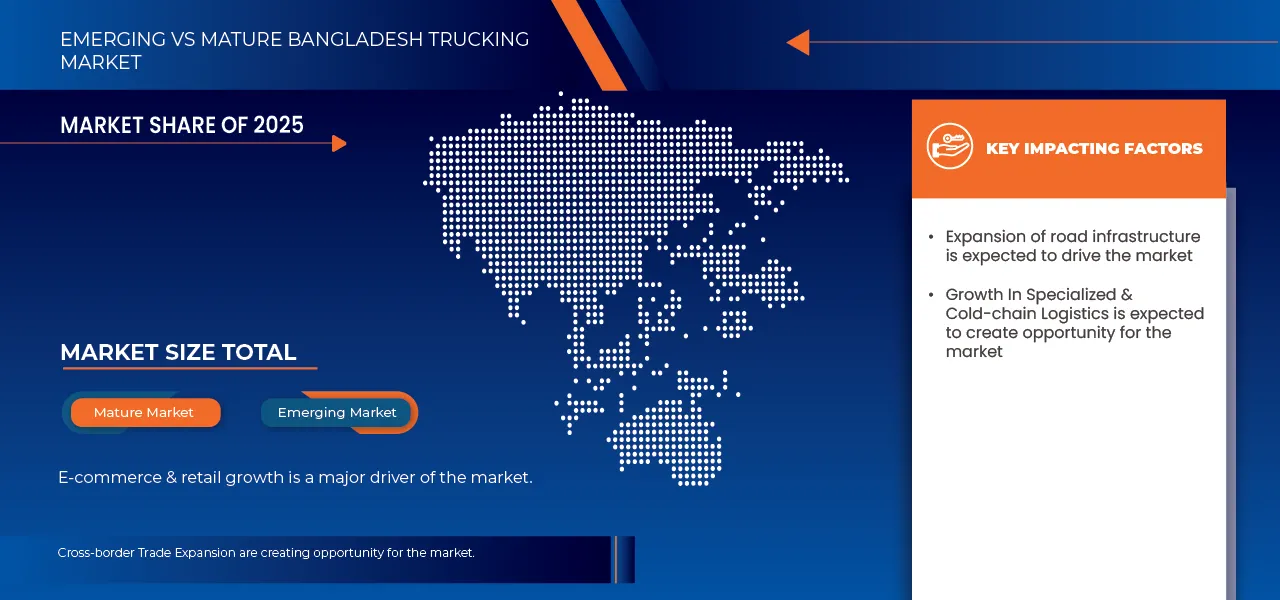
- The Bangladesh Trucking Market size was valued at USD 20.24 billion in 2025 and is expected to reach USD 51.82 billion by 2033, at a CAGR of 6.1% during the forecast period 2026-2033.
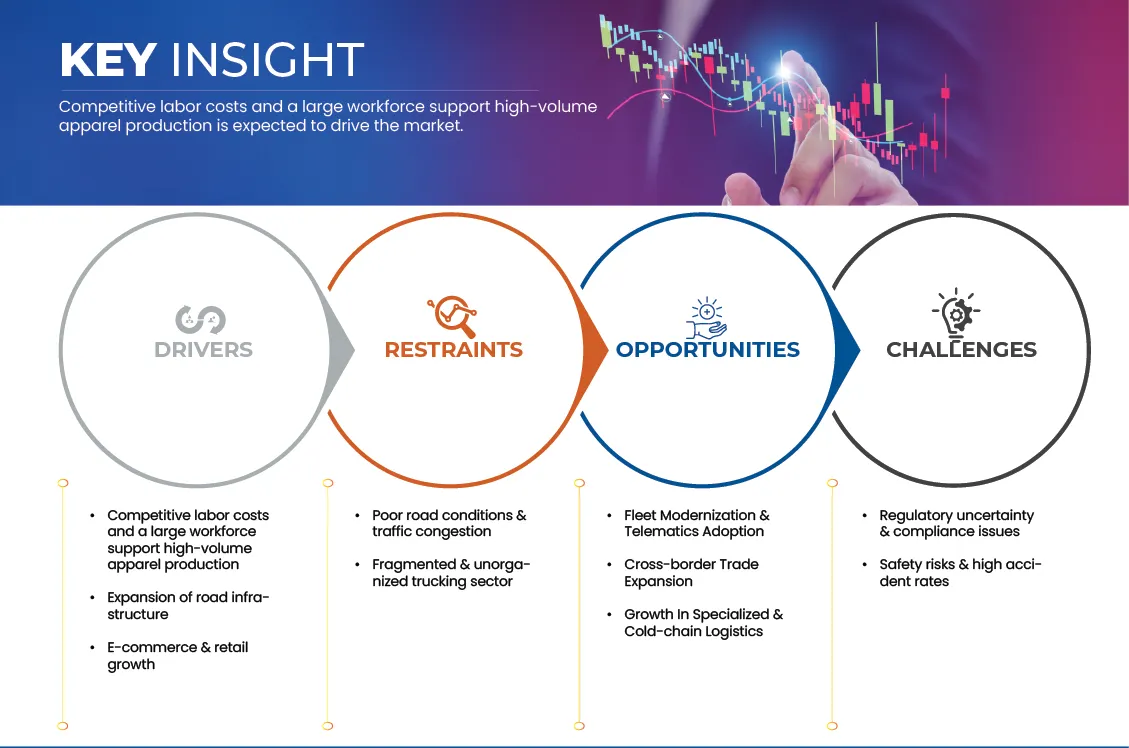
- The growth of the Trucking Market is primarily driven by Competitive Labor Costs And A Large Workforce Support High-Volume Apparel Production
Bangladesh Trucking Market Analysis
- Rising activity in manufacturing, FMCG, textiles, construction, and agriculture is increasing demand for road freight across the country.
- Government investments in highways, bridges, and regional connectivity corridors (e.g., Padma Bridge, Dhaka–Chattogram upgrades) support faster and more reliable trucking operations.
- Congested urban centers and suboptimal rural road networks increase transit times and operation costs.
- Growing demand for GPS, route optimization, fleet management software, and fuel-efficiency tools creates scope for digital transformation.
- Inconsistent enforcement of transport regulations, overloading rules, and licensing standards complicate operations.
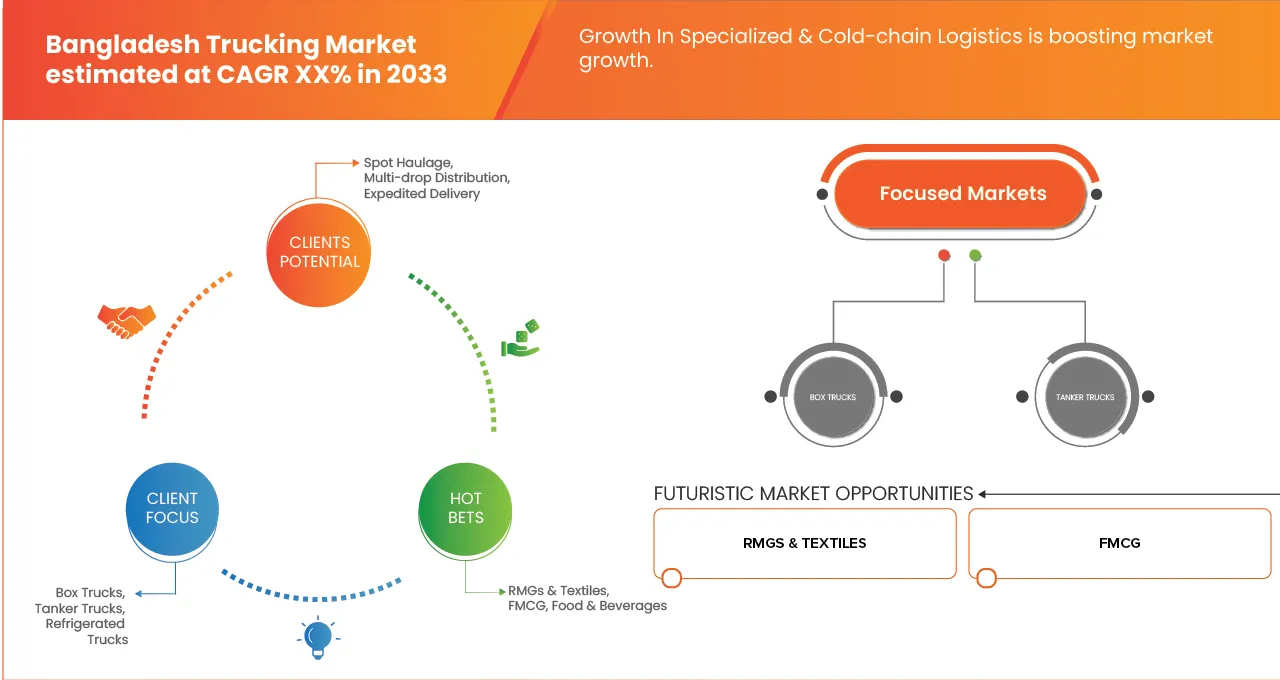
- The Spot Haulage segment is expected to dominate the Bangladesh Trucking Market with the largest market share of 48.81% in 2026, primarily due to the rising short-term, on-demand freight needs driven by Bangladesh’s expanding retail, construction, and agricultural sectors. Businesses increasingly prefer flexible, pay-per-trip trucking instead of long contracts, especially SMEs with fluctuating shipment volumes.
Report Scope and Bangladesh Trucking Market Segmentation
|
Attributes |
Bangladesh Trucking Product Key Market Insights |
|
Segments Covered |
|
|
Countries Covered |
|
|
Key Market Players |
|
|
Market Opportunities |
|
|
Value Added Data Infosets |
In addition to the insights on market scenarios such as market value, growth rate, segmentation, geographical coverage, and major players, the market reports curated by the Data Bridge Market Research also include depth expert analysis, patient epidemiology, pipeline analysis, pricing analysis, and regulatory framework |
Bangladesh Trucking Market Trends
“Competitive Labor Costs and a Large Workforce Support High-Volume Apparel Production”
- Bangladesh’s industrial landscape has expanded rapidly over the last decade, supported by rising domestic manufacturing, large-scale construction activity, and growth in regional trade. This transformation has significantly increased the movement of raw materials, intermediate goods, and finished products across economic corridors, strengthening trucking demand nationwide. From steel and cement to FMCG, agro-products, and pharmaceuticals, industries now operate with higher production capacities and tighter delivery schedules—making trucking an essential component of supply-chain continuity and inland logistics efficiency.
- The country’s accelerating industrialization is closely tied to the expansion of economic zones, industrial parks, and logistics hubs. These zones attract investments from both domestic and foreign manufacturers, creating concentrated clusters of production activity that depend heavily on frequent truck-based transportation. As factories continue to spread across districts such as Gazipur, Narayanganj, Chattogram, Cumilla, and Rajshahi, the volume of inter-district cargo movement has risen sharply, driving sustained demand for medium- and heavy-duty trucks. This shift has also encouraged fleet owners to diversify vehicle types and increase capacity to meet growing freight requirements.
- Moreover, improvements in inland connectivity—supported by landmark infrastructure projects such as the Padma Bridge, upgraded national highways, and new express routes—have enabled faster, more reliable cargo movement. Reduced travel time between major industrial belts has allowed manufacturers to scale production and widen distribution networks. As travel efficiency improves, companies across construction, consumer goods, and agriculture are increasingly relying on trucking to streamline their supply chains, minimize delays, and meet market-driven lead-time expectations.
- The growth of domestic consumption further reinforces this trend. Urbanization has expanded rapidly in cities like Dhaka, Chattogram, Gazipur, and Sylhet, driving stronger demand for household goods, packaged foods, electronics, and construction materials. As retailers and distributors adapt to rising consumption, the frequency and volume of deliveries to warehouses, wholesale markets, and retail stores have increased substantially. This expanding domestic trade ecosystem directly strengthens the operational load on the trucking sector, making it one of the primary beneficiaries of Bangladesh’s evolving economic structure.
- In March 2024, a Bangladesh Planning Commission briefing highlighted that domestic freight movement grew steadily due to rising industrial production and expanding economic zones, leading to higher trucking utilization across major corridors.
- In August 2024, the Ministry of Industries reported that new manufacturing investments in consumer goods and construction materials significantly increased inter-district cargo demand, particularly along the Dhaka–Chattogram and Dhaka–Khulna routes.
- In January 2025, a logistics market review by the Bangladesh Freight Forwarders Association (BAFFA) noted that improved connectivity from key infrastructure projects has enhanced trucking efficiency and supported higher domestic trade volumes
- Bangladesh’s expanding industrial output and growing domestic trade are not just economic milestones—they are structural forces reshaping the country’s logistics backbone. As production scales up and distribution networks become more complex, the reliance on efficient trucking services intensifies. This sustained industrial momentum positions “Growing Domestic Trade & Industrialization” as one of the most influential drivers of growth in the Bangladesh trucking market
Bangladesh Trucking Market Dynamics
Driver
“Expansion of Road Infrastructure”
- Bangladesh’s road infrastructure has undergone significant improvement over the past decade, fundamentally enhancing the efficiency, reliability, and overall performance of the trucking sector. Major national highways, expressways, and bridge networks have been expanded or upgraded, enabling faster transit across key industrial and commercial corridors. These improvements have reduced travel times, minimized congestion, and supported the uninterrupted flow of goods—factors that collectively strengthen the country’s trucking-dependent logistics ecosystem.
- One of the most transformative developments has been the strategic modernization of national highways linking major economic hubs such as Dhaka, Chattogram, Khulna, Sylhet, and Rajshahi. As these highways become wider, smoother, and better managed, trucking operators are able to complete more trips within shorter timeframes, helping reduce operational costs and enhance delivery reliability. Such improvements also allow fleet owners to deploy more efficient route planning, increase truck utilization, and manage tighter turnaround cycles, benefiting industries with time-sensitive cargo needs.
- The completion of landmark projects such as the Padma Bridge has dramatically reshaped connectivity between the central and southwestern regions of the country. Previously dependent on lengthy ferry crossings, freight transport through the region now moves with significantly greater ease, enabling faster distribution of agricultural commodities, construction materials, and industrial goods. This improved access has also stimulated investment in new industrial zones, storage facilities, and logistics hubs in these regions, further increasing the demand for trucking services.
- In addition, ongoing construction of expressways, elevated roads, and improved feeder routes is gradually integrating remote districts with major urban markets. The modernization of regional road networks has been particularly beneficial for agro-based industries, allowing farmers and distributors to transport perishables more efficiently to processing centers and urban wholesale markets. With reduced risks of spoilage and faster market access, trucking has become a critical enabler of agricultural trade expansion.
- Government policies have also emphasized the development of economic corridors connecting industrial belts with seaports and land ports. Enhanced connectivity to Chattogram Port, Mongla Port, and the Payra Port development zone has strengthened export-oriented and import-dependent freight flows. As these ports expand capacity and introduce more logistics-friendly infrastructure, trucking operators benefit from smoother cargo-handling operations and improved road-port linkages.
- For instance,In July 2024, the Roads and Highways Department (RHD) reported that upgrades to the Dhaka–Chattogram Highway had reduced average freight transit time by nearly one-third, significantly boosting trucking throughput along the country’s busiest industrial corridor.
- In October 2024, the Ministry of Road Transport and Bridges highlighted that new expressway and regional connectivity projects under the National Integrated Infrastructure Development Plan were designed to support higher cargo mobility and reduce bottlenecks across major trade routes.
- In January 2025, a logistics assessment by the Bangladesh Bridge Authority (BBA) emphasized that the Padma Bridge had increased freight movement by enabling uninterrupted truck access between Dhaka and 21 southwestern districts, directly stimulating trucking demand.
- Bangladesh’s expanding road infrastructure is not only an enabler of smoother transportation—it serves as a strategic driver of national logistics transformation. As travel efficiency improves and industrial hubs become more interconnected, reliance on trucking continues to deepen. These sustained infrastructure advancements firmly position “Expansion of Road Infrastructure” as one of the most influential drivers powering the growth of the Bangladesh trucking market.
Restraint/Challenge
“Poor Road Conditions & Traffic Congestion”
- Bangladesh’s trucking industry continues to face operational inefficiencies due to persistent road infrastructure limitations and chronic traffic congestion across major transport corridors. While key highways and national routes have improved over the years, a large portion of secondary and regional roads remain narrow, uneven, or poorly maintained. These conditions significantly slow freight movement, increase vehicle wear and tear, and raise operational expenses for transport operators—ultimately affecting overall logistics performance and delivery reliability.
- The challenge is especially prominent in urban and peri-urban centers where industrial and commercial activities are concentrated. Cities such as Dhaka, Gazipur, Chattogram, and Narayanganj frequently experience severe traffic congestion, driven by high population density, limited road-width capacity, and mixed traffic patterns involving buses, cars, rickshaws, and non-motorized vehicles. For trucking operators, navigating these congestion hotspots results in unpredictable transit times, longer waiting periods at entry points, and delays in both inbound and outbound deliveries. These disruptions not only increase fuel consumption but also reduce fleet productivity, making it difficult for companies to adhere to time-sensitive supply-chain commitments.
- Congestion at key logistics touchpoints further compounds the problem. Entry points around ports, industrial zones, and wholesale markets frequently experience bottlenecks due to limited parking bays, inadequate traffic management, and high-volume vehicle clustering. Such delays can extend loading and unloading times substantially, affecting supply-chain efficiency for manufacturing, retail, and export-oriented businesses. As a result, truck operators often face reduced daily trip counts and higher operational costs, which ultimately translate into elevated freight charges for end users.
- While various infrastructure developments are underway, the gap between freight growth and road capacity expansion remains wide. This imbalance places continuous pressure on trucking operations, forcing companies to invest more in maintenance, driver overtime, and contingency routing—all of which reduce profitability. Poor road conditions and persistent congestion therefore represent a structural challenge that slows logistics modernization and weakens transport reliability across Bangladesh.
- For instance,In January 2024, a transport review by the Local Government Engineering Department (LGED) highlighted that nearly one-fourth of regional roads required major repairs, contributing to frequent freight delays and higher vehicle maintenance costs for trucking operators.
- In September 2024, the Dhaka Transport Coordination Authority (DTCA) reported that peak-hour congestion in Dhaka and Gazipur increased average truck transit time by over 40%, significantly disrupting daily logistics schedules.
- In February 2025, a logistics assessment by the Bangladesh Road Transport Authority (BRTA) indicated that limited truck access and road-width constraints near industrial belts continued to create delivery backlogs, reducing freight efficiency during high-demand periods.
- Bangladesh’s road-condition challenges and chronic congestion remain structural barriers to efficient freight movement. As freight volumes increase with industrial and commercial expansion, these issues continue to constrain trucking reliability, raise operational costs, and hinder overall logistics performance. Consequently, “Poor Road Conditions & Traffic Congestion” stands as one of the most critical restraints affecting the growth and efficiency of the Bangladesh trucking market
Bangladesh Trucking Market Scope
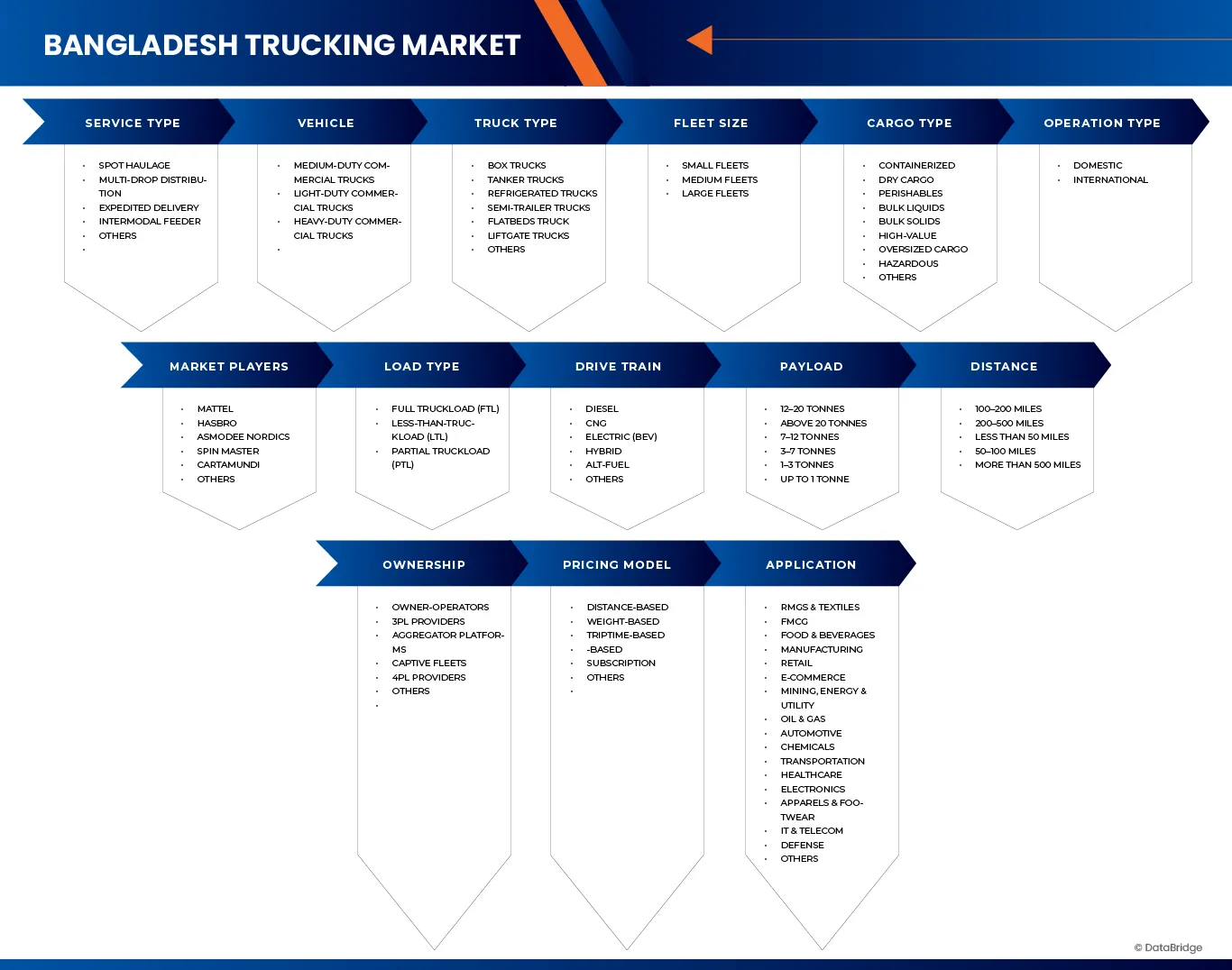
The Bangladesh Trucking Market is categorized into fifteen notable segments based on Service Type, Vehicle, Truck Type, Load Type, Drive Train, Payload, Distance, Ownership, Fleet Size, Cargo Type, Operation Type, Pricing Model, Application, Contract Type, End Use
- By Service Type
Based on service type, the Bangladesh trucking market is segmented into Spot Haulage, Multi-drop Distribution, Expedited Delivery, Intermodal Feeder, Others. In 2026, Spot Haulage segment is expected to dominate the Bangladesh Trucking Market with 48.81% market share and is expected to reach USD 25.77 billion by 2033, growing with the CAGR of 6.4% in the forecast period 2026 to 2033.
- By Vehicle
Based on vehicle, the Bangladesh trucking market is segmented into Medium-Duty Commercial Trucks, Light-Duty Commercial Trucks, Heavy-Duty Commercial Trucks. In 2026, Medium-Duty Commercial Trucks segment is expected to dominate the Bangladesh Trucking Market with 52.79% market share and is expected to reach USD 27.78 billion by 2033, growing with the CAGR of 6.3% in the forecast period 2026 to 2033.
- By Truck Type
Based on Truck Type, the Bangladesh trucking market is segmented into Box Trucks, Tanker Trucks, Refrigerated Trucks, Semi-Trailer Trucks, Flatbeds Truck, Liftgate Trucks, Others. In 2026, Box Trucks segment is expected to dominate the Bangladesh Trucking Market with 32.33% market share and is expected to reach USD 17.41 billion by 2033, growing with the CAGR of 6.7% in the forecast period 2026 to 2033.
- By Load Type
Based on Load Type, the Bangladesh trucking market is segmented into Full Truckload (FTL), Less‑Than‑Truckload (LTL), Partial Truckload (PTL). In 2026, Full Truckload (FTL) segment is expected to dominate the Bangladesh Trucking Market with 56.49% market share and is expected to reach USD 28.47 billion by 2033, growing with the CAGR of 5.7% in the forecast period 2026 to 2033.
- By Drive Train
Based on Drive Train, the Bangladesh trucking market is segmented into Diesel, CNG, Electric (BEV), Hybrid, Alt‑Fuel, Others. In 2026, Standard Malt segment is expected to dominate the Bangladesh Trucking Market with 74.18% market share and is expected to reach USD 38.67 billion by 2033, growing with the CAGR of 6.2% in the forecast period 2026 to 2033.
- By Payload
Based on Payload, , the Bangladesh trucking market is segmented into 12–20 tonnes, Above 20 tonnes, 7–12 tonnes, 3–7 tonnes, 1–3 tonnes, Up to 1 tonne. In 2026, 12–20 tonnes segment is expected to dominate the Bangladesh Trucking Market with 25.76% market share and is expected to reach USD 13.98 billion by 2033, growing with the CAGR of 6.8% in the forecast period 2026 to 2033.
- By Distance
Based on Payload, , the Bangladesh trucking market is segmented into 100–200 miles, 200–500 miles, Less than 50 miles, 50–100 miles, More than 500 miles. In 2026, 100–200 miles segment is expected to dominate the Bangladesh Trucking Market with 28.24% market share and is expected to reach USD 15.02 billion by 2033, growing with the CAGR of 6.5% in the forecast period 2026 to 2033.
- By Ownership
Based on Ownership, the Bangladesh trucking market is segmented into Owner-Operators, 3PL Providers, Aggregator Platforms, Captive Fleets, 4PL Providers, Others. In 2026, Owner-Operators segment is expected to dominate the Bangladesh Trucking Market with 45.26% market share and is expected to reach USD 23.56 billion by 2033, growing with the CAGR of 6.2% in the forecast period 2026 to 2033.
- By Fleet Size
Based on fleet size, the Bangladesh trucking market is segmented into Small Fleets, Medium Fleets, Large Fleets. In 2026, Small Fleets segment is expected to dominate the Bangladesh Trucking Market with 52.87% market share and is expected to reach USD 28.11 billion by 2033, growing with the CAGR of 6.5% in the forecast period 2026 to 2033.
- By Cargo Type
Based on Cargo Type, the Bangladesh trucking market is segmented into Containerized, Dry Cargo, Perishables, Bulk Liquids, Bulk Solids, High-Value, Oversized Cargo, Hazardous, Others. In 2026, Containerized segment is expected to dominate the Bangladesh Trucking Market with 39.30% market share and is expected to reach USD 21.01 billion by 2033, growing with the CAGR of 6.6% in the forecast period 2026 to 2033.
- By Operation Type
Based on Operation Type, the Bangladesh trucking market is segmented into Domestic, International. In 2026, Domestic segment is expected to dominate the Bangladesh Trucking Market with 85.64% market share and is expected to reach USD 44.28 billion by 2033, growing with the CAGR of 6.0% in the forecast period 2026 to 2033.
- By Pricing Model
Based on Pricing Model, the Bangladesh trucking market is segmented into Distance-Based, Weight-Based, Trip-Based, Time-Based, Subscription, Others. In 2026, Distance-Based segment is expected to dominate the Bangladesh Trucking Market with 55.10% market share and is expected to reach USD 28.45 billion by 2033, growing with the CAGR of 6.0% in the forecast period 2026 to 2033.
- By Application
Based on Application, the Bangladesh trucking market is segmented into RMGs & Textiles, FMCG, Food & Beverages, Manufacturing, Retail, E-Commerce, Mining, Energy & Utility Oil & Gas, Automotive, Chemicals, Transportation, Healthcare, Electronics, Apparels & Footwear, IT & Telecom, Defense, Others. In 2026, RMGs & Textiles segment is expected to dominate the Bangladesh Trucking Market with 22.27% market share and is expected to reach USD 11.67 billion by 2033, growing with the CAGR of 6.3% in the forecast period 2026 to 2033.
- By Contract Type
Based on Contract Type, the Bangladesh trucking market is segmented into Private Fleet Trucking, For-Hire Trucking, Dedicated Contract Carriage (DCC). In 2026, Private Fleet Trucking segment is expected to dominate the Bangladesh Trucking Market with 52.87% market share and is expected to reach USD 28.09 billion by 2033, growing with the CAGR of 6.5% in the forecast period 2026 to 2033
- By End Use
Based on End Use, the Bangladesh trucking market is segmented into B2B (Business-to-Business), B2C (Business-to-Consumer). In 2026, B2B (Business-to-Business) segment is expected to dominate the Bangladesh Trucking Market with 85.73% market share and is expected to reach USD 28.09 billion by 2033, growing with the CAGR of 6.2% in the forecast period 2026 to 2033
Bangladesh Trucking Market Share
The Bangladesh Trucking Market is primarily led by well-established companies, including:
- DHL (Germany)
- Kuehne+Nagel (Switzerland)
- DSV (Denmark)
- Nippon Express Holdings (Japan)
- Pathao Ltd. (Bangladesh)
- Truck Lagbe (Bangladesh)
- Obhai Solutions Limited (Bangladesh)
- Titas Transport Agency (Bangladesh)
- Loop (Bangladesh)
- Homebound (Bangladesh)
- Reliable Logistics Service (Bangladesh)
- Fleet Freight (Bangladesh)
- A H Khan & Company Limited (Bangladesh)
- Faraji Logistics (Bangladesh)
- WAC Bangladesh Limited (Bangladesh)
Latest Developments in Bangladesh Trucking Market
- In June 2025, DHL has partnered with Daimler Truck and hylane to introduce 30 fully electric Mercedes-Benz eActros 600 trucks under a “transport-as-a-service” model to enhance parcel-center transportation in Germany. The collaboration supports DHL’s sustainability goals by reducing emissions, improving energy efficiency, and integrating advanced electric trucking technology into daily logistics operations. This initiative strengthens DHL’s shift toward greener, more efficient long-haul road transport solutions.
- In May 2025, Kuehne+Nagel has recently entered a lead-logistics provider agreement with Evonik across Asia-Pacific (China, India, Southeast Asia, etc.), managing ~70,000 air, sea, and road shipments annually under an integrated transport-management framework.
- In March 2023, A H Khan & Company Ltd. marked a key milestone in its growth by receiving ISO 9001:2015 and ISO 28000:2007 certifications, formally recognizing its commitment to quality management and secure supply chain operations. The certification ceremony was held at Dhaka Club, reflecting the company’s strengthened focus on operational excellence and global standards. This achievement enhances its credibility in the logistics sector and supports its vision of expanding services with greater reliability, transparency, and international competitiveness.
- In November 2024, Fox Parcel announced a complete solution for Pakistani online sellers to expand their e-commerce business in Bangladesh without needing a local business license. The company offers two main options: direct shipping from Pakistan with customs and delivery handled by Fox Parcel, or cost-effective production in India or China with import, fulfillment, and returns management services in Bangladesh. Additional support includes localized Bengali-speaking customer service, safe storage, professional packing, reliable delivery, cash-on-delivery options, and optional visa guidance for in-person meetings. With end-to-end logistics and fulfillment solutions, Fox Parcel enables online sellers, digital marketing experts, and e-commerce entrepreneurs to access the rapidly growing Bangladeshi market while minimizing costs and operational barriers.

- Interactive Data Analysis Dashboard
- Company Analysis Dashboard for high growth potential opportunities
- Research Analyst Access for customization & queries
- Competitor Analysis with Interactive dashboard
- Latest News, Updates & Trend analysis
- Harness the Power of Benchmark Analysis for Comprehensive Competitor Tracking
Table of Content
1 INTRODUCTION
1.1 OBJECTIVES OF THE STUDY
1.2 MARKET DEFINITION
1.3 OVERVIEW OF BANGLADESH TRUCKING MARKET
1.4 CURRENCY AND PRICING
1.5 LIMITATIONS
1.6 MARKETS COVERED
2 MARKET SEGMENTATION
2.1 MARKETS COVERED
2.2 GEOGRAPHICAL SCOPE
2.3 YEARS CONSIDERED FOR THE STUDY
2.4 DBMR TRIPOD DATA VALIDATION MODEL
2.5 PRIMARY INTERVIEWS WITH KEY OPINION LEADERS
2.6 DBMR MARKET POSITION GRID
2.7 VENDOR SHARE ANALYSIS
2.8 MULTIVARIATE MODELING
2.9 OFFERING TIMELINE CURVE
2.1 MARKET END-USER COVERAGE GRID
2.11 SECONDARY SOURCES
2.12 ASSUMPTIONS
3 EXECUTIVE SUMMARY
4 PREMIUM INSIGHTS
4.1 PORTERS FIVE FORCES ANALYSIS
4.2 IMPORT & EXPORT DATA
4.2.1 STRATEGIC DEVELOPMENT
4.2.2 TECHNOLOGY IMPLEMENTATION PROCESS
4.2.2.1 CHALLENGES
4.2.2.2 INHOUSE IMPLEMENTATION / OUTSOURCED (THIRD-PARTY) IMPLEMENTATION
4.2.3 CUSTOMER BASE
4.2.4 SERVICE POSITIONING
4.2.5 CUSTOMER FEEDBACK / RATING (B2B)
4.2.6 APPLICATION REACH
4.2.7 SERVICE PLATFORM MATRIX
4.3 INDUSTRY ANALYSIS & FUTURISTIC SCENARIO
4.4 FUTURISTIC SCENARIO (2025–2040)
4.5 LIST OF PROJECTS
4.5.1 MAJOR ROAD & CORRIDOR PROJECTS
4.5.1.1 WESTERN ECONOMIC CORRIDOR & REGIONAL ENHANCEMENT (WECARE)
4.5.1.2 ACCESS PROGRAM (BANGLADESH COMPONENT) – TRADE & TRANSPORT CONNECTIVITY
4.5.1.3 RURAL CONNECTIVITY IMPROVEMENT PROJECT (RCIP)
4.5.1.4 SASEC ROAD CONNECTIVITY PROJECTS
4.5.1.5 RAMPURA–AMULIA–DEMRA (RAD) PPP TOLL ROAD
4.5.2 PORT, ICD, AND LOGISTICS INFRASTRUCTURE PROJECTS
4.5.2.1 BAY TERMINAL / BAY CONTAINER TERMINAL (CHATTOGRAM)
4.5.2.2 PATENGA CONTAINER TERMINAL (PCT)
4.5.2.3 DHIRASRAM INLAND CONTAINER DEPOT (ICD)
4.5.2.4 KHANPUR INLAND CONTAINER TERMINAL (ICT)
4.5.2.5 MULTIMODAL LOGISTICS HUBS – KAMALAPUR & DHAKA AIRPORT AREA
4.5.2.6 HALISHAHAR ICD (CHATTOGRAM)
4.5.2.7 LAND PORT & BORDER LOGISTICS UPGRADES
4.5.3 POLICY & GREEN FREIGHT–RELEVANT PROGRAMS
4.5.3.1 NATIONAL LOGISTICS POLICY INITIATIVES & ROAD MASTER PLANNING
4.5.3.2 GREEN FREIGHT PROGRAMS
4.5.3.3 MUJIB CLIMATE PROSPERITY PLAN – TRANSPORT COMPONENTS
4.5.4 DIGITAL TRUCKING, FREIGHT TECHNOLOGY & MARKET PLATFORMS
4.5.4.1 TRUCK LAGBE
4.5.4.2 OTHER DIGITAL LOGISTICS PLATFORMS
4.6 NEW BUSINESS AND EMERGING BUSINESS'S REVENUE OPPORTUNITIES
4.6.1 TECHNOLOGY-DRIVEN OPPORTUNITIES
4.6.1.1 DIGITAL FREIGHT MARKETPLACES (LOAD-MATCHING PLATFORMS)
4.6.1.2 TELEMATICS & FLEET MANAGEMENT SOLUTIONS
4.6.1.3 ELECTRONIC TOLLING, SMART ROUTING & AUTOMATED COMPLIANCE TOOLS
4.7 LOGISTICS SERVICE EXPANSION OPPORTUNITIES
4.7.1 EXPRESS CARGO & TIME-DEFINITE TRUCKING
4.7.1.1 COLD CHAIN TRUCKING (REEFER LOGISTICS)
4.7.1.2 E-COMMERCE MIDDLE-MILE & LAST-MILE HEAVY VEHICLE DISTRIBUTION
4.7.1.3 CONTRACT LOGISTICS FOR RMG & MANUFACTURING SECTOR
4.7.2 FLEET-RELATED & ASSET-BASED OPPORTUNITIES
4.7.2.1 FLEET LEASING & TRUCK-AS-A-SERVICE (TAAS)
4.7.2.2 TRUCK REFURBISHMENT & RE-MANUFACTURING WORKSHOPS
4.7.2.3 MULTI-AXLE HEAVY TRAILER FLEET BUSINESSES
4.7.3 INFRASTRUCTURE & ECOSYSTEM OPPORTUNITIES
4.7.3.1 PRIVATE LOGISTIC PARKS / TRUCK TERMINALS / INLAND CONTAINER DEPOTS (ICDS)
4.7.3.2 ROADSIDE SERVICES & MOBILITY CENTERS
4.7.3.3 GREEN LOGISTICS SERVICES
4.7.4 INDUSTRY-SPECIFIC EMERGING OPPORTUNITIES
4.7.4.1 RETAIL & FMCG DISTRIBUTION NETWORKS OUTSOURCING
4.7.4.2 AGRICULTURE SUPPLY CHAIN MODERNIZATION
4.7.4.3 CONTAINERIZED DOMESTIC FREIGHT
4.7.5 FINANCIAL & ANCILLARY SERVICE OPPORTUNITIES
4.7.5.1 FINTECH-ENABLED TRUCKING FINANCE
4.7.5.2 INSURANCE PRODUCTS FOR TRUCKING
4.7.5.3 DIESEL & FUEL OPTIMIZATION BUSINESS
4.8 PENETRATION AND GROWTH PROSPECT MAPPING
4.9 REGIONAL MARKET OVERVIEW
4.1 TECHNOLOGY ANALYSIS
4.10.1 VEHICLE & POWERTRAIN TECHNOLOGIES
4.10.2 TELEMATICS & FLEET CONNECTIVITY
4.10.3 DRIVER & SAFETY TECHNOLOGIES
4.10.4 DIGITAL FREIGHT & LOGISTICS PLATFORMS
4.10.5 ADJACENT & ECOSYSTEM TECHNOLOGIES
4.10.6 TECHNOLOGY ADOPTION OUTLOOK
4.11 TRUCK FLEET SIZE OF MAJOR PLAYERS
4.12 USED CASES & ITS ANALYSIS
5 TARIFF REVISIONS AND THEIR IMPACT ON THE AUTOMOTIVE INDUSTRY
5.1 TARIFF STRUCTURES
5.1.1 GLOBAL VS. REGIONAL TARIFF STRUCTURES
5.1.2 UNITED STATES: AUTOMOTIVE TARIFF POLICIES
5.1.3 BANGLADESH: CROSS-BORDER TARIFF REGULATIONS, REIMBURSEMENT POLICIES
5.1.4 BANGLADESH: GOVERNMENT-IMPOSED TARIFFS ON AUTOMOTIVE COMPONENTS
5.2 IMPACT ON AUTOMAKERS
5.2.1 INCREASED PRODUCTION COSTS
5.2.2 SUPPLY CHAIN DISRUPTIONS
5.2.3 SHIFT IN MANUFACTURING FOOTPRINT
5.2.4 COMPETITIVE DISADVANTAGE
5.2.5 INCREASED INVESTMENT IN DOMESTIC PRODUCTION
5.3 IMPACT ON SUPPLIERS
5.3.1 COST PRESSURES
5.3.2 REDUCED DEMAND
5.3.3 SUPPLY CHAIN VULNERABILITY
5.4 IMPACT ON CONSUMERS
5.4.1 HIGHER VEHICLE PRICE
5.4.2 REDUCED AVAILABILITY OF OPTIONS
5.4.3 INCREASED MAINTENANCE COSTS
5.5 THE FUTURE OF AUTOMOTIVE TRADE
5.5.1 ONGOING TRADE NEGOTIATIONS
5.5.2 TECHNOLOGICAL ADVANCEMENTS
5.5.3 GEOPOLITICAL FACTORS
5.5.4 FOCUS ON DOMESTIC PRODUCTION
6 REGULATORY STANDARDS
6.1 NATIONAL REGULATORY FRAMEWORK
6.1.1 PRIMARY TRANSPORT LAWS & OVERSIGHT
6.1.2 VEHICLE FITNESS & INSPECTION
6.1.3 1DRIVER LICENSING & WORK-TIME RULES
6.1.3.1 ROAD SAFETY & SPEED REGULATIONS
6.1.4 AXLE-LOAD & OVERLOADING CONTROL
6.1.5 MANDATORY MOTOR INSURANCE
6.2 ENVIRONMENTAL & EMISSION STANDARDS
6.2.1 VEHICLE EMISSION RULES
6.2.2 FUEL QUALITY MEASURES
6.3 DANGEROUS GOODS & SPECIAL CARGO
6.3.1 HAZARDOUS GOODS TRANSPORT
6.3.2 OVERSIZE / OVERWEIGHT CARGO
6.4 TRADE & CROSS-BORDER TRUCKING REGULATIONS
6.4.1 CUSTOMS & TRANSIT REQUIREMENTS
6.4.2 ELECTRONIC DOCUMENTATION
6.5 INDUSTRY COMPLIANCE SYSTEM
6.6 LABOUR & OCCUPATIONAL SAFETY
6.7 REGULATORY GAPS & MARKET IMPLICATIONS
7 MARKET OVERVIEW
7.1 DRIVERS
7.1.1 COMPETITIVE LABOR COSTS AND A LARGE WORKFORCE SUPPORT HIGH-VOLUME APPAREL PRODUCTION
7.1.2 EXPANSION OF ROAD INFRASTRUCTURE
7.1.3 E-COMMERCE & RETAIL GROWTH
7.2 RESTRAINTS
7.2.1 POOR ROAD CONDITIONS & TRAFFIC CONGESTION
7.2.2 FRAGMENTED & UNORGANIZED TRUCKING SECTOR
7.3 OPPORTUNITIES
7.3.1 FLEET MODERNIZATION & TELEMATICS ADOPTION
7.3.2 CROSS-BORDER TRADE EXPANSION
7.3.3 GROWTH IN SPECIALIZED & COLD-CHAIN LOGISTICS
7.4 CHALLENGES
7.4.1 REGULATORY UNCERTAINTY & COMPLIANCE ISSUES
7.4.2 SAFETY RISKS & HIGH ACCIDENT RATES
8 BANGLADESH TRUCKING MARKET, BY SERVICE TYPE.
8.1 OVERVIEW
8.2 BANGLADESH TRUCKING MARKET, BY SERVICE TYPE, 2018-2033 (USD THOUSAND)
8.3 SPOT HAULAGE
8.4 MULTI-DROP DISTRIBUTION
8.5 EXPEDITED DELIVERY
8.6 INTERMODAL FEEDER
8.7 OTHERS
9 BANGLADESH TRUCKING MARKET, BY VEHICLE
9.1 OVERVIEW
9.2 BANGLADESH TRUCKING MARKET, BY VEHICLE TYPE, 2018-2033 (USD THOUSAND)
9.3 MEDIUM-DUTY COMMERCIAL TRUCKS
9.4 LIGHT-DUTY COMMERCIAL TRUCKS
9.5 HEAVY-DUTY COMMERCIAL TRUCKS
10 BANGLADESH TRUCKING MARKET, BY TRUCK TYPE.
10.1 OVERVIEW
10.2 BANGLADESH TRUCKING MARKET, BY TRUCK TYPE, 2018-2033 (USD THOUSAND)
10.3 BOX TRUCKS
10.4 TANKER TRUCKS
10.5 REFRIGERATED TRUCKS
10.6 SEMI-TRAILER TRUCKS
10.7 FLATBEDS TRUCK
10.8 LIFTGATE TRUCKS
10.9 OTHERS
10.1 BANGLADESH BOX TRUCK IN TRUCKING MARKET, BY TRANSPORT PRODUCT, 2018-2033 (USD THOUSAND)
10.10.1 LAST-MILE DELIVERIES (E-COMMERCE)
10.10.2 FOOD DELIVERY
10.10.3 HOME APPLIANCES & FURNITURE
10.10.4 OTHERS
10.11 BANGLADESH TANKER TRUCK IN TRUCKING MARKET, BY TYPE, 2018-2033 (USD THOUSAND)
10.11.1 LIQUID TANKERS
10.11.2 DRY BULK TANKERS
10.12 BANGLADESH TANKER TRUCK IN TRUCKING MARKET, BY TRANSPORT PRODUCT, 2018-2033 (USD THOUSAND)
10.12.1 FUEL
10.12.2 CHEMICALS
10.12.3 MILK
10.12.4 JUICES
10.12.5 OTHERS
10.13 BANGLADESH FUEL IN TRUCKING MARKET, BY TYPE, 2018-2033 (USD THOUSAND)
10.13.1 DIESEL
10.13.2 PETROL
10.13.3 GASES (LPG/PROPANE/BUTANE/N₂/O₂/HE)
10.14 BANGLADESH GASES IN TRUCKING, BY TYPE, 2018-2033 (USD THOUSAND)
10.14.1 LPG
10.14.2 PROPANE
10.14.3 LIQUEFIED BUTANE
10.14.4 NITROGEN
10.14.5 OXYGEN
10.14.6 HELIUM
10.15 BANGLADESH TANKER TRUCK IN TRUCKING MARKET, BY PRESSURIZATION, 2018-2033 (USD THOUSAND)
10.15.1 NON-PRESSURIZED
10.15.2 PRESSURIZED
10.16 BANGLADESH TANKER TRUCK IN TRUCKING MARKET, BY REFRIGERATION, 2018-2033 (USD THOUSAND)
10.16.1 NON-REFRIGERATED
10.16.2 REFRIGERATED
10.17 BANGLADESH TANKER TRUCK IN TRUCKING MARKET, BY INSULATION, 2018-2033 (USD THOUSAND)
10.17.1 NON-INSULATED
10.17.2 INSULATED
10.18 BANGLADESH REFRIGERATED TRUCK IN TRUCKING MARKET, BY TRANSPORT PRODUCT, 2018-2033 (USD THOUSAND)
10.18.1 FOOD
10.18.2 PERISHABLE GOODS
10.18.3 MEDICAL SUPPLIES
10.18.4 BEVERAGES
10.18.5 OTHERS
10.19 BANGLADESH PERISHABLE GOODS IN TRUCKING MARKET, BY TYPE, 2018-2033 (USD THOUSAND)
10.19.1 MEAT
10.19.2 FRUITS
10.19.3 VEGETABLES
10.19.4 SEAFOOD
10.19.5 OTHERS
10.2 BANGLADESH MEDICAL SUPPLIES IN TRUCKING MARKET, BY TYPE, 2018-2033 (USD THOUSAND)
10.20.1 PHARMACEUTICALS
10.20.2 VACCINES
10.20.3 BLOOD BANKS
10.20.4 OTHERS
10.21 BANGLADESH BEVERAGES IN TRUCKING MARKET, BY TYPE, 2018-2033 (USD THOUSAND)
10.21.1 CARBONATED BEVERAGES
10.21.2 JUICE-BASED
10.21.3 SPORTS & ENERGY DRINKS
10.21.4 TEA
10.21.5 COFFEE
10.21.6 OTHERS
10.22 BANGLADESH FLATBEDS TRUCK IN TRUCKING MARKET, BY TRANSPORT PRODUCT, 2018-2033 (USD THOUSAND)
10.22.1 CONSTRUCTION MATERIALS
10.22.2 MACHINERY
10.22.3 SCRAP METAL
10.22.4 CARS
10.22.5 OTHER RECYCLABLES
11 BANGLADESH TRUCKING MARKET, BY LOAD TYPE.
11.1 OVERVIEW
11.2 BANGLADESH TRUCKING MARKET, BY LOAD TYPE, 2018-2033 (USD THOUSAND)
11.3 FULL TRUCKLOAD (FTL)
11.4 LESS‑THAN‑TRUCKLOAD (LTL)
11.5 PARTIAL TRUCKLOAD (PTL)
12 BANGLADESH TRUCKING MARKET, BY DRIVE TRAIN.
12.1 OVERVIEW
12.2 BANGLADESH TRUCKING MARKET, BY DRIVE TRAIN, 2018-2033 (USD THOUSAND)
12.3 DIESEL
12.4 CNG
12.5 ELECTRIC (BEV)
12.6 HYBRID
12.7 ALT‑FUEL
12.8 OTHERS
13 BANGLADESH TRUCKING MARKET, BY PAYLOAD.
13.1 OVERVIEW
13.2 BANGLADESH TRUCKING MARKET, BY PAYLOAD, 2018-2033 (USD THOUSAND)
13.3 12–20 TONNES
13.4 ABOVE 20 TONNES
13.5 7–12 TONNES
13.6 3–7 TONNES
13.7 1–3 TONNES
13.8 UP TO 1 TONNE
14 BANGLADESH TRUCKING MARKET, BY DISTANCE.
14.1 OVERVIEW
14.2 BANGLADESH TRUCKING MARKET, BY DISTANCE, 2018-2033 (USD THOUSAND)
14.3 100–200 MILES
14.4 200–500 MILES
14.5 LESS THAN 50 MILES
14.6 50–100 MILES
14.7 MORE THAN 500 MILES
15 BANGLADESH TRUCKING MARKET, BY OWNERSHIP.
15.1 OVERVIEW
15.2 BANGLADESH TRUCKING MARKET, BY OWNERSHIP, 2018-2033 (USD THOUSAND)
15.3 OWNER-OPERATORS
15.4 3PL PROVIDERS
15.5 AGGREGATOR PLATFORMS
15.6 CAPTIVE FLEETS
15.7 4PL PROVIDERS
15.8 OTHERS
16 BANGLADESH TRUCKING MARKET, BY FLEET SIZE.
16.1 OVERVIEW
16.2 BANGLADESH TRUCKING MARKET, BY FLEET SIZE, 2018-2033 (USD THOUSAND)
16.3 SMALL FLEETS
16.4 MEDIUM FLEETS
16.5 LARGE FLEETS
17 BANGLADESH TRUCKING MARKET, BY CARGO TYPE.
17.1 OVERVIEW
17.2 BANGLADESH TRUCKING MARKET, BY CARGO TYPE, 2018-2033 (USD THOUSAND)
17.3 CONTAINERIZED
17.4 DRY CARGO
17.5 PERISHABLES
17.6 BULK LIQUIDS
17.7 BULK SOLIDS
17.8 HIGH-VALUE
17.9 OVERSIZED CARGO
17.1 HAZARDOUS
17.11 OTHERS
18 BANGLADESH READY MADE GARMENTS MARKET, BY OPERATION TYPE.
18.1 OVERVIEW
18.2 BANGLADESH TRUCKING MARKET, BY OPERATION TYPE, 2018-2033 (USD THOUSAND)
18.3 DOMESTIC
18.4 INTERNATIONAL
19 BANGLADESH TRUCKING MARKET, BY PRICING MODEL.
19.1 OVERVIEW
19.2 BANGLADESH TRUCKING MARKET, BY PRICING MODEL, 2018-2033 (USD THOUSAND)
19.3 DISTANCE-BASED
19.4 WEIGHT-BASED
19.5 TRIP-BASED
19.6 TIME-BASED
19.7 SUBSCRIPTION
19.8 OTHERS
20 BANGLADESH TRUCKING MARKET, BY APPLICATION.
20.1 OVERVIEW
20.2 BANGLADESH TRUCKING MARKET, BY APPLICATION, 2018-2033 (USD THOUSAND)
20.3 RMGS & TEXTILES
20.4 FMCG
20.5 FOOD & BEVERAGES
20.6 MANUFACTURING
20.7 RETAIL
20.8 E-COMMERCE
20.9 MINING, ENERGY & UTILITY
20.1 OIL & GAS
20.11 AUTOMOTIVE
20.12 CHEMICALS
20.13 TRANSPORTATION
20.14 HEALTHCARE
20.15 ELECTRONICS
20.16 APPARELS & FOOTWEAR
20.17 IT & TELECOM
20.18 DEFENSE
20.19 OTHERS
20.2 BANGLADESH RMGS & TEXTILES IN TRUCKING MARKET, BY SERVICE TYPE, 2018-2033 (USD THOUSAND)
20.20.1 SPOT HAULAGE
20.20.2 MULTI-DROP DISTRIBUTION
20.20.3 EXPEDITED DELIVERY
20.20.4 INTERMODAL FEEDER
20.20.5 OTHERS
20.21 BANGLADESH FMCG IN TRUCKING MARKET, BY SERVICE TYPE, 2018-2033 (USD THOUSAND)
20.21.1 SPOT HAULAGE
20.21.2 MULTI-DROP DISTRIBUTION
20.21.3 EXPEDITED DELIVERY
20.21.4 INTERMODAL FEEDER
20.21.5 OTHERS
20.22 BANGLADESH FOOD & BEVERAGES IN TRUCKING MARKET, BY SERVICE TYPE, 2018-2033 (USD THOUSAND)
20.22.1 SPOT HAULAGE
20.22.2 MULTI-DROP DISTRIBUTION
20.22.3 EXPEDITED DELIVERY
20.22.4 INTERMODAL FEEDER
20.22.5 OTHERS
20.23 BANGLADESH MANUFACTURING IN TRUCKING MARKET, BY SERVICE TYPE, 2018-2033 (USD THOUSAND)
20.23.1 SPOT HAULAGE
20.23.2 MULTI-DROP DISTRIBUTION
20.23.3 EXPEDITED DELIVERY
20.23.4 INTERMODAL FEEDER
20.23.5 OTHERS
20.24 BANGLADESH RETAIL IN TRUCKING MARKET, BY SERVICE TYPE, 2018-2033 (USD THOUSAND)
20.24.1 SPOT HAULAGE
20.24.2 MULTI-DROP DISTRIBUTION
20.24.3 EXPEDITED DELIVERY
20.24.4 INTERMODAL FEEDER
20.24.5 OTHERS
20.25 BANGLADESH E-COMMERCE IN TRUCKING MARKET, BY SERVICE TYPE, 2018-2033 (USD THOUSAND)
20.25.1 SPOT HAULAGE
20.25.2 MULTI-DROP DISTRIBUTION
20.25.3 EXPEDITED DELIVERY
20.25.4 INTERMODAL FEEDER
20.25.5 OTHERS
20.26 BANGLADESH MINING, ENERGY & UTILITY IN TRUCKING MARKET, BY SERVICE TYPE, 2018-2033 (USD THOUSAND)
20.26.1 SPOT HAULAGE
20.26.2 MULTI-DROP DISTRIBUTION
20.26.3 EXPEDITED DELIVERY
20.26.4 INTERMODAL FEEDER
20.26.5 OTHERS
20.27 BANGLADESH OIL & GAS IN TRUCKING MARKET, BY SERVICE TYPE, 2018-2033 (USD THOUSAND)
20.27.1 SPOT HAULAGE
20.27.2 MULTI-DROP DISTRIBUTION
20.27.3 EXPEDITED DELIVERY
20.27.4 INTERMODAL FEEDER
20.27.5 OTHERS
20.28 BANGLADESH AUTOMOTIVE IN TRUCKING MARKET, BY SERVICE TYPE, 2018-2033 (USD THOUSAND)
20.28.1 SPOT HAULAGE
20.28.2 MULTI-DROP DISTRIBUTION
20.28.3 EXPEDITED DELIVERY
20.28.4 INTERMODAL FEEDER
20.28.5 OTHERS
20.29 BANGLADESH CHEMICALS IN TRUCKING MARKET, BY SERVICE TYPE, 2018-2033 (USD THOUSAND)
20.29.1 SPOT HAULAGE
20.29.2 MULTI-DROP DISTRIBUTION
20.29.3 EXPEDITED DELIVERY
20.29.4 INTERMODAL FEEDER
20.29.5 OTHERS
20.3 BANGLADESH TRANSPORTATION IN TRUCKING MARKET, BY SERVICE TYPE, 2018-2033 (USD THOUSAND)
20.30.1 SPOT HAULAGE
20.30.2 MULTI-DROP DISTRIBUTION
20.30.3 EXPEDITED DELIVERY
20.30.4 INTERMODAL FEEDER
20.30.5 OTHERS
20.31 BANGLADESH HEALTHCARE IN TRUCKING MARKET, BY SERVICE TYPE, 2018-2033 (USD THOUSAND)
20.31.1 SPOT HAULAGE
20.31.2 MULTI-DROP DISTRIBUTION
20.31.3 EXPEDITED DELIVERY
20.31.4 INTERMODAL FEEDER
20.31.5 OTHERS
20.32 BANGLADESH ELECTRONICS IN TRUCKING MARKET, BY SERVICE TYPE, 2018-2033 (USD THOUSAND)
20.32.1 SPOT HAULAGE
20.32.2 MULTI-DROP DISTRIBUTION
20.32.3 EXPEDITED DELIVERY
20.32.4 INTERMODAL FEEDER
20.32.5 OTHERS
20.33 BANGLADESH APPARELS & FOOTWEAR IN TRUCKING MARKET, BY SERVICE TYPE, 2018-2033 (USD THOUSAND)
20.33.1 SPOT HAULAGE
20.33.2 MULTI-DROP DISTRIBUTION
20.33.3 EXPEDITED DELIVERY
20.33.4 INTERMODAL FEEDER
20.33.5 OTHERS
20.34 BANGLADESH IT & TELECOM IN TRUCKING MARKET, BY SERVICE TYPE, 2018-2033 (USD THOUSAND)
20.34.1 SPOT HAULAGE
20.34.2 MULTI-DROP DISTRIBUTION
20.34.3 EXPEDITED DELIVERY
20.34.4 INTERMODAL FEEDER
20.34.5 OTHERS
20.35 BANGLADESH DEFENSE IN TRUCKING MARKET, BY SERVICE TYPE, 2018-2033 (USD THOUSAND)
20.35.1 SPOT HAULAGE
20.35.2 MULTI-DROP DISTRIBUTION
20.35.3 EXPEDITED DELIVERY
20.35.4 INTERMODAL FEEDER
20.35.5 OTHERS
21 BANGLADESH TRUCKING MARKET, BY CONTRACT TYPE.
21.1 OVERVIEW
21.2 BANGLADESH TRUCKING MARKET, BY CONTRACT TYPE, 2018-2033 (USD THOUSAND)
21.3 PRIVATE FLEET TRUCKING
21.4 FOR-HIRE TRUCKING
21.5 DEDICATED CONTRACT CARRIAGE (DCC)
22 BANGLADESH TRUCKING MARKET, BY END USE.
22.1 OVERVIEW
22.2 BANGLADESH TRUCKING MARKET, BY END USE, 2018-2033 (USD THOUSAND)
22.3 B2B (BUSINESS-TO-BUSINESS)
22.4 B2C (BUSINESS-TO-CONSUMER)
23 BANGLADESH TRUCKING MARKET: COMPANY LANDSCAPE
23.1 COMPANY SHARE ANALYSIS: BANGLADESH
24 SWOT ANALYSIS
25 COMPANY PROFILE
25.1 DHL
25.1.1 COMPANY SNAPSHOT
25.1.2 REVENUE ANALYSIS
25.1.3 PRODUCT PORTFOLIO
25.1.4 RECENT DEVELOPMENT
25.2 KUEHNE+NAGEL
25.2.1 COMPANY SNAPSHOT
25.2.2 REVENUE ANALYSIS
25.2.3 PRODUCT PORTFOLIO
25.2.4 RECENT DEVELOPMENT
25.3 DSV
25.3.1 COMPANY SNAPSHOT
25.3.2 PRODUCT PORTFOLIO
25.3.3 RECENT DEVELOPMENT
25.4 NIPPON EXPRESS HOLDINGS
25.4.1 COMPANY SNAPSHOT
25.4.2 REVENUE ANALYSIS
25.4.3 PRODUCT PORTFOLIO
25.4.4 RECENT DEVELOPMENT
25.5 PATHAO LTD
25.5.1 COMPANY SNAPSHOT
25.5.2 PRODUCT PORTFOLIO
25.5.3 RECENT DEVELOPMENT
25.6 2C SHIPPING
25.6.1 COMPANY SNAPSHOT
25.6.2 PRODUCT PORTFOLIO
25.6.3 RECENT DEVELOPMENTS
25.7 3I LOGISTICS PVT. LTD.
25.7.1 COMPANY SNAPSHOT
25.7.2 PRODUCT PORTFOLIO
25.7.3 RECENT DEVELOPMENT
25.8 A H KHAN & COMPANY LIMITED
25.8.1 COMPANY SNAPSHOT
25.8.2 PRODUCT PORTFOLIO
25.8.3 RECENT DEVELOPMENTS
25.9 ABC FREIGHT FORWARDING & SHIPPING LTD.
25.9.1 COMPANY SNAPSHOT
25.9.2 PRODUCT PORTFOLIO
25.9.3 RECENT DEVELOPMENTS
25.1 AGILITY GLOBAL.
25.10.1 COMPANY SNAPSHOT
25.10.2 PRODUCT PORTFOLIO
25.10.3 RECENT DEVELOPMENT
25.11 AN EJOGAJOG LIMITED SERVICE.
25.11.1 COMPANY SNAPSHOT
25.11.2 PRODUCT PORTFOLIO
25.11.3 RECENT DEVELOPMENT
25.12 APT MERCHANT SHIPPING LINE LTD.
25.12.1 COMPANY SNAPSHOT
25.12.2 PRODUCT PORTFOLIO
25.12.3 RECENT DEVELOPMENTS
25.13 ATLAS LOGISTICS LTD (ATLAS LOGISTICS BANGLADESH(PVT). LTD)
25.13.1 COMPANY SNAPSHOT
25.13.2 PRODUCT PORTFOLIO
25.13.3 RECENT DEVELOPMENT
25.14 CEVA LOGISTICS
25.14.1 COMPANY SNAPSHOT
25.14.2 PRODUCT PORTFOLIO
25.14.3 RECENT DEVELOPMENT
25.15 COSMOS LOGISTICS
25.15.1 COMPANY SNAPSHOT
25.15.2 PRODUCT PORTFOLIO
25.15.3 RECENT DEVELOPMENT
25.16 CROWN LOGISTICS LTD.
25.16.1 COMPANY SNAPSHOT
25.16.2 PRODUCT PORTFOLIO
25.16.3 RECENT DEVELOPMENT
25.17 EUR SERVICE (BD) LTD.
25.17.1 COMPANY SNAPSHOT
25.17.2 PRODUCT PORTFOLIO
25.17.3 RECENT DEVELOPMENTS
25.18 EXPEDITORS INTERNATIONAL OF WASHINGTON, INC.
25.18.1 COMPANY SNAPSHOT
25.18.2 REVENUE ANALYSIS
25.18.3 PRODUCT PORTFOLIO
25.18.4 RECENT DEVELOPMENT
25.19 FARAJI LOGISTICS
25.19.1 COMPANY SNAPSHOT
25.19.2 PRODUCT PORTFOLIO
25.19.3 RECENT DEVELOPMENT
25.2 FAREAST LOGISTICS BD LTD
25.20.1 COMPANY SNAPSHOT
25.20.2 PRODUCT PORTFOLIO
25.20.3 RECENT DEVELOPMENT
25.21 FLEET FREIGHT
25.21.1 COMPANY SNAPSHOT
25.21.2 PRODUCT PORTFOLIO
25.21.3 RECENT DEVELOPMENT
25.22 FOX PARCEL
25.22.1 COMPANY SNAPSHOT
25.22.2 PRODUCT PORTFOLIO
25.22.3 RECENT DEVELOPMENT
25.23 FREIGHT OPTIONS LTD
25.23.1 COMPANY SNAPSHOT
25.23.2 PRODUCT PORTFOLIO
25.23.3 RECENT DEVELOPMENT
25.24 GEODIS
25.24.1 COMPANY SNAPSHOT
25.24.2 PRODUCT PORTFOLIO
25.24.3 RECENT DEVELOPMENT
25.25 HOMEBOUND
25.25.1 COMPANY SNAPSHOT
25.25.2 PRODUCT PORTFOLIO
25.25.3 RECENT DEVELOPMENT
25.26 KM GROUP
25.26.1 COMPANY SNAPSHOT
25.26.2 PRODUCT PORTFOLIO
25.26.3 RECENT DEVELOPMENTS
25.27 LOOP.
25.27.1 COMPANY SNAPSHOT
25.27.2 PRODUCT PORTFOLIO
25.27.3 RECENT DEVELOPMENT
25.28 M&M TRANSPORT AGENCY
25.28.1 COMPANY SNAPSHOT
25.28.2 PRODUCT PORTFOLIO
25.28.3 RECENT DEVELOPMENT
25.29 M/S. JAMUNA TRANSPORT AGENCY
25.29.1 COMPANY SNAPSHOT
25.29.2 PRODUCT PORTFOLIO
25.29.3 RECENT DEVELOPMENT
25.3 NATIONAL CARRIERS CORPORATION
25.30.1 COMPANY SNAPSHOT
25.30.2 PRODUCT PORTFOLIO
25.30.3 RECENT DEVELOPMENT
25.31 NAVANA LOGISTICS LTD
25.31.1 COMPANY SNAPSHOT
25.31.2 PRODUCT PORTFOLIO
25.31.3 RECENT DEVELOPMENT
25.32 OBHAI SOLUTIONS LIMITED
25.32.1 COMPANY SNAPSHOT
25.32.2 PRODUCT PORTFOLIO
25.32.3 RECENT DEVELOPMENT
25.33 ORIENT OVERSEAS CONTAINER LINE LIMITED
25.33.1 COMPANY SNAPSHOT
25.33.2 REVENUE ANALYSIS
25.33.3 PRODUCT PORTFOLIO
25.33.4 RECENT DEVELOPMENT
25.34 RELIABLE LOGISTICS SERVICE
25.34.1 COMPANY SNAPSHOT
25.34.2 PRODUCT PORTFOLIO
25.34.3 RECENT DEVELOPMENT
25.35 RK FREIGHT LTD
25.35.1 COMPANY SNAPSHOT
25.35.2 PRODUCT PORTFOLIO
25.35.3 RECENT DEVELOPMENT
25.36 SCAN GLOBAL LOGISTICS
25.36.1 COMPANY SNAPSHOT
25.36.2 PRODUCT PORTFOLIO
25.36.3 RECENT DEVELOPMENT
25.37 SEKO LOGISTICS
25.37.1 COMPANY SNAPSHOT
25.37.2 PRODUCT PORTFOLIO
25.37.3 RECENT DEVELOPMENT
25.38 SINOBEN GROUP
25.38.1 COMPANY SNAPSHOT
25.38.2 PRODUCT PORTFOLIO
25.38.3 RECENT DEVELOPMENT
25.39 SOFTECH (NISSHIN TRANS CONSOLIDATOR BD LTD)
25.39.1 COMPANY SNAPSHOT
25.39.2 PRODUCT PORTFOLIO
25.39.3 RECENT DEVELOPMENT
25.4 SUMMIT ALLIANCE PORT LIMITED
25.40.1 COMPANY SNAPSHOT
25.40.2 REVENUE ANALYSIS
25.40.3 PRODUCT PORTFOLIO
25.40.4 RECENT DEVELOPMENT
25.41 TITAS TRANSPORT AGENCY
25.41.1 COMPANY SNAPSHOT
25.41.2 PRODUCT PORTFOLIO
25.41.3 RECENT DEVELOPMENTS
25.42 TLI (TRANSPORTATION LOGISTICS INT'L BANGLADESH LTD.)
25.42.1 COMPANY SNAPSHOT
25.42.2 PRODUCT PORTFOLIO
25.42.3 RECENT DEVELOPMENT
25.43 TOWER FREIGHT LOGISTICS LIMITED.
25.43.1 COMPANY SNAPSHOT
25.43.2 PRODUCT PORTFOLIO
25.43.3 RECENT DEVELOPMENT
25.44 TRANSWORLD SHIPPING LIMITED
25.44.1 COMPANY SNAPSHOT
25.44.2 PRODUCT PORTFOLIO
25.44.3 RECENT DEVELOPMENT
25.45 TRUCK LAGBE LIMITED
25.45.1 COMPANY SNAPSHOT
25.45.2 PRODUCT PORTFOLIO
25.45.3 RECENT DEVELOPMENTS
25.46 URANUS FREIGHT LOGISTICS LTD
25.46.1 COMPANY SNAPSHOT
25.46.2 PRODUCT PORTFOLIO
25.46.3 RECENT DEVELOPMENTS
25.47 VISCO LOGISTICS BANGLADESH LTD
25.47.1 COMPANY SNAPSHOT
25.47.2 PRODUCT PORTFOLIO
25.47.3 RECENT DEVELOPMENT
25.48 WAC BANGLADESH LIMITED
25.48.1 COMPANY SNAPSHOT
25.48.2 PRODUCT PORTFOLIO
25.48.3 RECENT DEVELOPMENT
25.49 YUSEN LOGISTICS GLOBAL MANAGEMENT CO., LTD.
25.49.1 COMPANY SNAPSHOT
25.49.2 PRODUCT PORTFOLIO
25.49.3 RECENT DEVELOPMENT
26 QUESTIONNAIRE
27 RELATED REPORTS
List of Table
TABLE 1 COMPANY COMPARATIVE ANALYSIS
TABLE 2 COMPANY SERVICE PLATFORM MATRIX
TABLE 3 TRUCK/FLEET SIZE OF MAJOR PLAYERS
TABLE 4 USED CASE ANALYSIS
TABLE 5 GLOBAL VS REGIONAL TARIFF STRUCTURES
TABLE 6 BANGLADESH TRUCKING MARKET, BY SERVICE TYPE, 2018-2033 (USD THOUSAND)
TABLE 7 BANGLADESH TRUCKING MARKET, BY VEHICLE TYPE, 2018-2033 (USD THOUSAND)
TABLE 8 BANGLADESH TRUCKING MARKET, BY TRUCK TYPE, 2018-2033 (USD THOUSAND)
TABLE 9 BANGLADESH BOX TRUCK IN TRUCKING MARKET, BY TRANSPORT PRODUCT, 2018-2033 (USD THOUSAND)
TABLE 10 BANGLADESH TANKER TRUCK IN TRUCKING MARKET, BY TYPE, 2018-2033 (USD THOUSAND)
TABLE 11 BANGLADESH TANKER TRUCK IN TRUCKING MARKET, BY TRANSPORT PRODUCT, 2018-2033 (USD THOUSAND)
TABLE 12 BANGLADESH FUEL IN TRUCKING MARKET, BY TYPE, 2018-2033 (USD THOUSAND)
TABLE 13 BANGLADESH GASES IN TRUCKING, BY TYPE, 2018-2033 (USD THOUSAND)
TABLE 14 BANGLADESH TANKER TRUCK IN TRUCKING MARKET, BY PRESSURIZATION, 2018-2033 (USD THOUSAND)
TABLE 15 BANGLADESH TANKER TRUCK IN TRUCKING MARKET, BY REFRIGERATION, 2018-2033 (USD THOUSAND)
TABLE 16 BANGLADESH TANKER TRUCK IN TRUCKING MARKET, BY INSULATION, 2018-2033 (USD THOUSAND)
TABLE 17 BANGLADESH REFRIGERATED TRUCK IN TRUCKING MARKET, BY TRANSPORT PRODUCT, 2018-2033 (USD THOUSAND)
TABLE 18 BANGLADESH PERISHABLE GOODS IN TRUCKING MARKET, BY TYPE, 2018-2033 (USD THOUSAND)
TABLE 19 BANGLADESH MEDICAL SUPPLIES IN TRUCKING MARKET, BY TYPE, 2018-2033 (USD THOUSAND)
TABLE 20 BANGLADESH BEVERAGES IN TRUCKING MARKET, BY TYPE, 2018-2033 (USD THOUSAND)
TABLE 21 BANGLADESH FLATBEDS TRUCK IN TRUCKING MARKET, BY TRANSPORT PRODUCT, 2018-2033 (USD THOUSAND)
TABLE 22 BANGLADESH TRUCKING MARKET, BY LOAD TYPE, 2018-2033 (USD THOUSAND)
TABLE 23 BANGLADESH TRUCKING MARKET, BY DRIVE TRAIN, 2018-2033 (USD THOUSAND)
TABLE 24 BANGLADESH TRUCKING MARKET, BY PAYLOAD, 2018-2033 (USD THOUSAND)
TABLE 25 BANGLADESH TRUCKING MARKET, BY DISTANCE, 2018-2033 (USD THOUSAND)
TABLE 26 BANGLADESH TRUCKING MARKET, BY OWNERSHIP, 2018-2033 (USD THOUSAND)
TABLE 27 BANGLADESH TRUCKING MARKET, BY FLEET SIZE, 2018-2033 (USD THOUSAND)
TABLE 28 BANGLADESH TRUCKING MARKET, BY CARGO TYPE, 2018-2033 (USD THOUSAND)
TABLE 29 BANGLADESH TRUCKING MARKET, BY OPERATION TYPE, 2018-2033 (USD THOUSAND)
TABLE 30 BANGLADESH TRUCKING MARKET, BY PRICING MODEL, 2018-2033 (USD THOUSAND)
TABLE 31 BANGLADESH TRUCKING MARKET, BY APPLICATION, 2018-2033 (USD THOUSAND)
TABLE 32 BANGLADESH RMGS & TEXTILES IN TRUCKING MARKET, BY SERVICE TYPE, 2018-2033 (USD THOUSAND)
TABLE 33 BANGLADESH FMCG IN TRUCKING MARKET, BY SERVICE TYPE, 2018-2033 (USD THOUSAND)
TABLE 34 BANGLADESH FOOD & BEVERAGES IN TRUCKING MARKET, BY SERVICE TYPE, 2018-2033 (USD THOUSAND)
TABLE 35 BANGLADESH MANUFACTURING IN TRUCKING MARKET, BY SERVICE TYPE, 2018-2033 (USD THOUSAND)
TABLE 36 BANGLADESH RETAIL IN TRUCKING MARKET, BY SERVICE TYPE, 2018-2033 (USD THOUSAND)
TABLE 37 BANGLADESH E-COMMERCE IN TRUCKING MARKET, BY SERVICE TYPE, 2018-2033 (USD THOUSAND)
TABLE 38 BANGLADESH MINING, ENERGY & UTILITY IN TRUCKING MARKET, BY SERVICE TYPE, 2018-2033 (USD THOUSAND)
TABLE 39 BANGLADESH OIL & GAS IN TRUCKING MARKET, BY SERVICE TYPE, 2018-2033 (USD THOUSAND)
TABLE 40 BANGLADESH AUTOMOTIVE IN TRUCKING MARKET, BY SERVICE TYPE, 2018-2033 (USD THOUSAND)
TABLE 41 BANGLADESH CHEMICALS IN TRUCKING MARKET, BY SERVICE TYPE, 2018-2033 (USD THOUSAND)
TABLE 42 BANGLADESH TRANSPORTATION IN TRUCKING MARKET, BY SERVICE TYPE, 2018-2033 (USD THOUSAND)
TABLE 43 BANGLADESH HEALTHCARE IN TRUCKING MARKET, BY SERVICE TYPE, 2018-2033 (USD THOUSAND)
TABLE 44 BANGLADESH ELECTRONICS IN TRUCKING MARKET, BY SERVICE TYPE, 2018-2033 (USD THOUSAND)
TABLE 45 BANGLADESH APPARELS & FOOTWEAR IN TRUCKING MARKET, BY SERVICE TYPE, 2018-2033 (USD THOUSAND)
TABLE 46 BANGLADESH IT & TELECOM IN TRUCKING MARKET, BY SERVICE TYPE, 2018-2033 (USD THOUSAND)
TABLE 47 BANGLADESH DEFENSE IN TRUCKING MARKET, BY SERVICE TYPE, 2018-2033 (USD THOUSAND)
TABLE 48 BANGLADESH TRUCKING MARKET, BY CONTRACT TYPE, 2018-2033 (USD THOUSAND)
TABLE 49 BANGLADESH TRUCKING MARKET, BY END USE, 2018-2033 (USD THOUSAND)
List of Figure
FIGURE 1 BANGLADESH TRUCKING MARKET: SEGMENTATION
FIGURE 2 BANGLADESH TRUCKING MARKET: DATA TRIANGULATION
FIGURE 3 BANGLADESH TRUCKING MARKET: DROC ANALYSIS
FIGURE 4 BANGLADESH TRUCKING MARKET: GLOBAL VS REGIONAL MARKET ANALYSIS
FIGURE 5 BANGLADESH TRUCKING MARKET: COMPANY RESEARCH ANALYSIS
FIGURE 6 BANGLADESH TRUCKING MARKET: INTERVIEW DEMOGRAPHICS
FIGURE 7 BANGLADESH TRUCKING MARKET: DBMR MARKET POSITION GRID
FIGURE 8 BANGLADESH TRUCKING MARKET: VENDOR SHARE ANALYSIS
FIGURE 9 BANGLADESH TRUCKING MARKET: MULTIVARIATE MODELING
FIGURE 10 BANGLADESH TRUCKING MARKET: SERVICE TYPE TIMELINE CURVE
FIGURE 11 BANGLADESH TRUCKING MARKET: END-USER COVERAGE GRID
FIGURE 12 BANGLADESH TRUCKING MARKET: SEGMENTATION
FIGURE 13 FIVE SEGMENTS COMPRISE THE BANGLADESH TRUCKING MARKET, BY SERVICE TYPE (2025)
FIGURE 14 BANGLADESH TRUCKING MARKET: EXECUTIVE SUMMARY
FIGURE 15 STRATEGIC DECISIONS
FIGURE 16 COMPETITIVE LABOR COSTS AND A LARGE WORKFORCE SUPPORT HIGH-VOLUME APPAREL PRODUCTION IS EXPECTED TO DRIVE THE BANGLADESH TRUCKING MARKET DURING THE FORECAST PERIOD OF 2026 TO 2033
FIGURE 17 SPOT HAULAGE SEGMENT IS EXPECTED TO ACCOUNT FOR THE LARGEST SHARE OF THE BANGLADESH TRUCKING MARKET IN 2026 & 2033
FIGURE 18 DROC
FIGURE 19 BANGLADESH TRUCKING MARKET, BY SERVICE TYPE, 2025
FIGURE 20 BANGLADESH TRUCKING MARKET, BY VEHICLE, 2025
FIGURE 21 BANGLADESH TRUCKING MARKET, BY TRUCK TYPE, 2025
FIGURE 22 BANGLADESH TRUCKING MARKET, BY LOAD TYPE, 2025
FIGURE 23 BANGLADESH TRUCKING MARKET, BY DIESEL, 2025
FIGURE 24 BANGLADESH TRUCKING MARKET, BY PAYLOAD, 2025
FIGURE 25 BANGLADESH TRUCKING MARKET, BY DISTANCE, 2025
FIGURE 26 BANGLADESH TRUCKING MARKET, BY OWNERSHIP, 2025
FIGURE 27 BANGLADESH TRUCKING MARKET, BY FLEET SIZE, 2025
FIGURE 28 BANGLADESH TRUCKING MARKET, BY CARGO TYPE, 2025
FIGURE 29 BANGLADESH READY-MADE GARMENTS MARKET, BY OPERATION TYPE, 2025
FIGURE 30 BANGLADESH TRUCKING MARKET, BY PRICING MODEL, 2025
FIGURE 31 BANGLADESH TRUCKING MARKET, BY APPLICATION, 2025
FIGURE 32 BANGLADESH TRUCKING MARKET, BY CONTRACT TYPE, 2025
FIGURE 33 BANGLADESH TRUCKING MARKET, BY END USE, 2025
FIGURE 34 BANGLADESH TRUCKING MARKET: COMPANY SHARE 2025 (%)

Bangladesh Trucking Market, Supply Chain Analysis and Ecosystem Framework
To support market growth and help clients navigate the impact of geopolitical shifts, DBMR has integrated in-depth supply chain analysis into its Bangladesh Trucking Market research reports. This addition empowers clients to respond effectively to global changes affecting their industries. The supply chain analysis section includes detailed insights such as Bangladesh Trucking Market consumption and production by country, price trend analysis, the impact of tariffs and geopolitical developments, and import and export trends by country and HSN code. It also highlights major suppliers with data on production capacity and company profiles, as well as key importers and exporters. In addition to research, DBMR offers specialized supply chain consulting services backed by over a decade of experience, providing solutions like supplier discovery, supplier risk assessment, price trend analysis, impact evaluation of inflation and trade route changes, and comprehensive market trend analysis.
Data collection and base year analysis are done using data collection modules with large sample sizes. The stage includes obtaining market information or related data through various sources and strategies. It includes examining and planning all the data acquired from the past in advance. It likewise envelops the examination of information inconsistencies seen across different information sources. The market data is analysed and estimated using market statistical and coherent models. Also, market share analysis and key trend analysis are the major success factors in the market report. To know more, please request an analyst call or drop down your inquiry.
The key research methodology used by DBMR research team is data triangulation which involves data mining, analysis of the impact of data variables on the market and primary (industry expert) validation. Data models include Vendor Positioning Grid, Market Time Line Analysis, Market Overview and Guide, Company Positioning Grid, Patent Analysis, Pricing Analysis, Company Market Share Analysis, Standards of Measurement, Global versus Regional and Vendor Share Analysis. To know more about the research methodology, drop in an inquiry to speak to our industry experts.
Data Bridge Market Research is a leader in advanced formative research. We take pride in servicing our existing and new customers with data and analysis that match and suits their goal. The report can be customized to include price trend analysis of target brands understanding the market for additional countries (ask for the list of countries), clinical trial results data, literature review, refurbished market and product base analysis. Market analysis of target competitors can be analyzed from technology-based analysis to market portfolio strategies. We can add as many competitors that you require data about in the format and data style you are looking for. Our team of analysts can also provide you data in crude raw excel files pivot tables (Fact book) or can assist you in creating presentations from the data sets available in the report.













