


3-Chloro-2-Hydroxypropyl Trimethylammonium Chloride (CHPTAC) Market Size
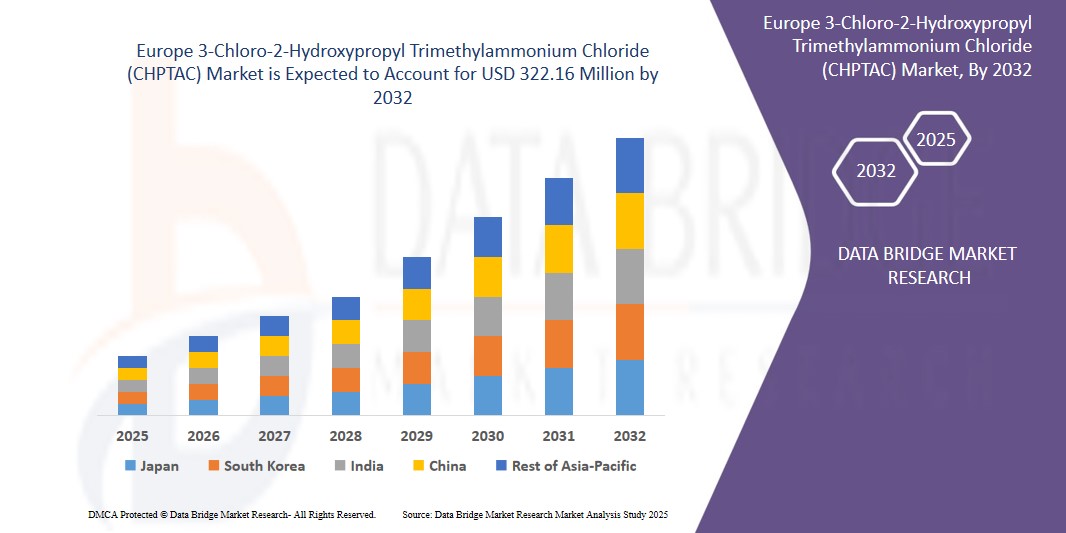
- The Europe 3-Chloro-2-Hydroxypropyl Trimethylammonium Chloride (CHPTAC) Market size was valued at USD 211.06 Million in 2024 and is expected to reach USD 322.16 Million by 2032, at a CAGR of 4.8% during the forecast period
- The market growth is largely fueled by increasing demand for high-performance water treatment chemicals, expanding textile and paper industries in Europe, rising awareness about environmental sustainability, and technological advancements in CHPTAC production enhancing efficiency and product quality.
- Furthermore, rapid industrialization, growing population-driven demand for clean water, and expanding end-use sectors such as cosmetics and personal care contribute significantly to market expansion. Additionally, supportive government regulations and investments in infrastructure development further drive the Europe CHPTAC market growth.
3-Chloro-2-Hydroxypropyl Trimethylammonium Chloride (CHPTAC) Market Analysis
- The Europe CHPTAC market is experiencing steady growth driven by rising demand from the paper and textile industries, where CHPTAC improves product quality and durability, alongside increased use in water treatment applications to meet environmental standards.
- Rapid industrialization and urbanization in the region fuel demand across key end-use sectors, while technological advancements and growing awareness about sustainable chemical products further accelerate market expansion and adoption of CHPTAC in various applications..
- Germany dominates the 3-Chloro-2-Hydroxypropyl Trimethylammonium Chloride (CHPTAC) market with the largest revenue share of 35% in 2025, driven by its advanced chemical manufacturing infrastructure, strong demand from paper and textile industries, and ongoing investments in sustainable production technologies.
- The Germany is expected to be the fastest-growing market for 3-Chloro-2-Hydroxypropyl Trimethylammonium Chloride (CHPTAC), driven by rapid industrialization, expanding paper and textile manufacturing sectors, increasing demand for efficient water treatment solutions, government initiatives promoting sustainable chemicals, and rising investments in research and development for advanced applications.
- 65% in H₂O segment is expected to dominate the market with a 42% share in 2025, driven by its high efficiency, ease of handling, and widespread application across industrial sectors.
Report Scope and 3-Chloro-2-Hydroxypropyl Trimethylammonium Chloride (CHPTAC) Market Segmentation
|
Attributes |
3-Chloro-2-Hydroxypropyl Trimethylammonium Chloride (CHPTAC) Key Market Insights |
|
Segments Covered |
|
|
Countries Covered |
Europe
|
|
Key Market Players |
|
|
Market Opportunities |
|
|
Value Added Data Infosets |
In addition to the insights on market scenarios such as market value, growth rate, segmentation, geographical coverage, and major players, the market reports curated by the Data Bridge Market Research also include in-depth expert analysis, pricing analysis, brand share analysis, consumer survey, demography analysis, supply chain analysis, value chain analysis, raw material/consumables overview, vendor selection criteria, PESTLE Analysis, Porter Analysis, and regulatory framework. |
3-Chloro-2-Hydroxypropyl Trimethylammonium Chloride (CHPTAC) Market Trends
“Rising demand in water treatment applications”
- CHPTAC is widely used to modify starches into cationic forms that act as coagulant aids in water treatment, improving the removal of suspended solids, reducing turbidity, and enhancing overall filtration efficiency in both municipal and industrial wastewater systems.
- Due to its ability to significantly reduce chemical consumption and sludge volume, CHPTAC-modified agents offer a cost-effective alternative to traditional water treatment chemicals, making it highly attractive for large-scale treatment plants seeking to optimize operational expenses.
- With increasing environmental regulations on water discharge and effluent quality, CHPTAC helps treatment facilities meet compliance by improving pollutant removal efficiency, thus supporting industries in adhering to environmental safety standards and avoiding potential regulatory penalties.
- CHPTAC-modified polymers are compatible with a variety of treatment technologies and systems, including sedimentation, flotation, and membrane filtration, enabling seamless integration across different industrial sectors such as paper, textile, and chemical manufacturing.
- The use of CHPTAC in water treatment supports sustainability by enabling more effective recovery of water and valuable materials from industrial effluents, aligning with circular economy principles and promoting eco-friendly operational practices.
3-Chloro-2-Hydroxypropyl Trimethylammonium Chloride (CHPTAC) Market Dynamics
Driver
“Increasing industrial demand for efficient cationic agents in processing”
- Cationic agents like CHPTAC improve binding and retention in paper manufacturing, leading to stronger paper quality and reduced raw material waste, which boosts overall process efficiency and reduces production costs in the paper industry.
- In textile processing, cationic agents enhance dye fixation and fabric softness, resulting in better colorfastness and fabric feel. This increases demand as manufacturers aim for higher-quality textiles with improved durability and aesthetics.
- Industries use cationic agents to improve coagulation and flocculation in wastewater treatment, enabling faster sedimentation and clearer water discharge, which is critical for meeting stringent environmental regulations and reducing treatment costs.
- The push for eco-friendly and sustainable industrial processes drives demand for cationic agents that reduce chemical usage and waste generation, helping companies achieve greener production goals and comply with environmental standards.
- Cationic agents like CHPTAC find applications beyond paper and textiles, including personal care, oil recovery, and mining, leading to diverse industrial demand due to their multifunctional properties that enhance performance in various processing techniques.
Restraint/Challenge
“High production costs limit widespread adoption of CHPTAC chemicals”
- The production of CHPTAC relies on costly raw materials and specialized reagents, which significantly increase manufacturing expenses, making it less competitive compared to alternative chemicals and limiting its adoption, especially among small and medium-sized enterprises with tight budgets.
- CHPTAC synthesis involves complex chemical reactions that require high energy input and stringent process controls, leading to elevated operational costs. These high energy demands contribute to the overall expensive production, hindering widespread use in price-sensitive markets.
- Due to the technical challenges in scaling CHPTAC production efficiently, manufacturers face higher per-unit costs. This limited scalability restricts supply availability, causing price volatility and deterring large-scale industrial adoption across various sectors.
- Strict environmental regulations governing chemical manufacturing add compliance-related expenses such as waste treatment and emissions control during CHPTAC production, raising operational costs and discouraging manufacturers from expanding production capacity or investing in new facilities.
- Lower-cost alternatives with acceptable performance often compete with CHPTAC in several applications. The higher cost of CHPTAC, driven by its production expenses, makes industries hesitant to switch, slowing market penetration despite its superior properties.
3-Chloro-2-Hydroxypropyl Trimethylammonium Chloride (CHPTAC) Market Scope
The market is segmented on the basis of type and end-user.
- By Type
The 65% in H2O segment dominates the 3-Chloro-2-Hydroxypropyl Trimethylammonium Chloride (CHPTAC) market with a 42% revenue share in 2025, driven by its superior solubility, ease of handling, cost-effectiveness, and wide applicability in water treatment, textile, and paper industries, supporting efficient and sustainable processing.
The 65% in H2O segment is anticipated to witness the fastest growth rate of 5.2% CAGR from 2025 to 2032, fueled by increasing demand for environmentally friendly water treatment chemicals, expanding textile and paper industries, and growing emphasis on sustainable manufacturing processes globally.
- By End-User
The paper segment held the largest market revenue share in 2025, driven by the growing demand for enhanced paper strength and quality, increasing use of cationic starches derived from CHPTAC, expanding packaging industry, and the need for sustainable, eco-friendly additives to improve paper manufacturing efficiency.
The paper segment is expected to witness the fastest CAGR from 2025 to 2032, driven by rising demand for sustainable and high-quality paper products, increased adoption of CHPTAC-based cationic starch for improved paper strength, growing packaging needs, and advancements in eco-friendly paper manufacturing technologies worldwide.
3-Chloro-2-Hydroxypropyl Trimethylammonium Chloride (CHPTAC) Market Regional Analysis
- Germany dominates the 3-Chloro-2-Hydroxypropyl Trimethylammonium Chloride (CHPTAC) market with the largest revenue share of35% in 2025, driven by its vast industrial base, expanding paper and textile manufacturing sectors, increasing investments in water treatment infrastructure, rapid urbanization, and growing demand for eco-friendly and high-performance chemical additives.
- Increasing investments in water treatment infrastructure, driven by urbanization and environmental regulations, are boosting CHPTAC demand. The region’s growing shift toward eco-friendly and sustainable chemical solutions aligns with rising regulatory pressures and the need for cleaner, more efficient industrial processes.
- Europe benefits from a vast industrial base, especially in paper and textile manufacturing, where CHPTAC is widely used. Continuous industrial expansion and modernization efforts are increasing the demand for high-performance, cost-effective chemical additives across these sectors.
3-Chloro-2-Hydroxypropyl Trimethylammonium Chloride (CHPTAC) Market Share
The 3-Chloro-2-Hydroxypropyl Trimethylammonium Chloride (CHPTAC) industry is primarily led by well-established companies, including:
- Dow Chemical Company (U.S.)
- Sachem Inc. (U.S.)
- SKW Quab Chemicals Inc. (U.S.)
- Kemira Oyj (Finland)
- Dongying J&M Chemical Co., Ltd. (China)
- Shandong Tiancheng Chemical Co., Ltd. (China)
- Lotte Fine Chemical (South Korea)
- Yanzhou Tiancheng Chemical Co., Ltd. (China)
- Gujarat Alkalies and Chemicals Ltd. (India)
- Zibo Aoerte Chemical Co., Ltd. (China)
- Chemigate Ltd. (Finland)
- DKS Co. Ltd. (Japan)
- BASF SE (Germany)
- Hangzhou Guancha Chemical Co., Ltd. (China)
- Hefei TNJ Chemical Industry Co., Ltd. (China)
Latest Developments in Europe 3-Chloro-2-Hydroxypropyl Trimethylammonium Chloride (CHPTAC) Market
- In April 2024, BASF SE announced a collaboration with a leading Asian textile manufacturer to develop CHPTAC-based eco-friendly textile treatments. This partnership aims to produce sustainable fabrics with enhanced durability and reduced environmental impact.
- In March 2024, Samsung Fine Chemicals launched a new CHPTAC formulation tailored for the paper industry, enhancing paper strength and printability. This product targets the growing demand for high-quality paper products in the region.
- In February 2024, Sachem Inc. partnered with a major water treatment company in Asia to supply CHPTAC for advanced wastewater treatment solutions, aiming to improve water purification efficiency and meet stringent environmental regulations..
- In January 2024, Yanzhou Tiancheng Chemicals Co. Ltd. expanded its CHPTAC production capacity in China to meet the increasing demand from the textile and paper industries, ensuring a stable supply chain for regional clients.
- In December 2023, Dongying J&M Chemical Co. Ltd. collaborated with a Southeast Asian personal care brand to develop CHPTAC-based hair care products, focusing on enhancing product performance and catering to the rising demand for premium personal care items.

- Interactive Data Analysis Dashboard
- Company Analysis Dashboard for high growth potential opportunities
- Research Analyst Access for customization & queries
- Competitor Analysis with Interactive dashboard
- Latest News, Updates & Trend analysis
- Harness the Power of Benchmark Analysis for Comprehensive Competitor Tracking
Europe 3 Chloro 2 Hydroxypropyl Trimethylammonium Chloride Chptac Market, Supply Chain Analysis and Ecosystem Framework
To support market growth and help clients navigate the impact of geopolitical shifts, DBMR has integrated in-depth supply chain analysis into its Europe 3 Chloro 2 Hydroxypropyl Trimethylammonium Chloride Chptac Market research reports. This addition empowers clients to respond effectively to global changes affecting their industries. The supply chain analysis section includes detailed insights such as Europe 3 Chloro 2 Hydroxypropyl Trimethylammonium Chloride Chptac Market consumption and production by country, price trend analysis, the impact of tariffs and geopolitical developments, and import and export trends by country and HSN code. It also highlights major suppliers with data on production capacity and company profiles, as well as key importers and exporters. In addition to research, DBMR offers specialized supply chain consulting services backed by over a decade of experience, providing solutions like supplier discovery, supplier risk assessment, price trend analysis, impact evaluation of inflation and trade route changes, and comprehensive market trend analysis.
Data collection and base year analysis are done using data collection modules with large sample sizes. The stage includes obtaining market information or related data through various sources and strategies. It includes examining and planning all the data acquired from the past in advance. It likewise envelops the examination of information inconsistencies seen across different information sources. The market data is analysed and estimated using market statistical and coherent models. Also, market share analysis and key trend analysis are the major success factors in the market report. To know more, please request an analyst call or drop down your inquiry.
The key research methodology used by DBMR research team is data triangulation which involves data mining, analysis of the impact of data variables on the market and primary (industry expert) validation. Data models include Vendor Positioning Grid, Market Time Line Analysis, Market Overview and Guide, Company Positioning Grid, Patent Analysis, Pricing Analysis, Company Market Share Analysis, Standards of Measurement, Global versus Regional and Vendor Share Analysis. To know more about the research methodology, drop in an inquiry to speak to our industry experts.
Data Bridge Market Research is a leader in advanced formative research. We take pride in servicing our existing and new customers with data and analysis that match and suits their goal. The report can be customized to include price trend analysis of target brands understanding the market for additional countries (ask for the list of countries), clinical trial results data, literature review, refurbished market and product base analysis. Market analysis of target competitors can be analyzed from technology-based analysis to market portfolio strategies. We can add as many competitors that you require data about in the format and data style you are looking for. Our team of analysts can also provide you data in crude raw excel files pivot tables (Fact book) or can assist you in creating presentations from the data sets available in the report.













