




Europe Anti Money Laundering Software Market
Market Size in USD Million
CAGR :
% 
 USD
489.08 Million
USD
1,465.17 Million
2025
2033
USD
489.08 Million
USD
1,465.17 Million
2025
2033
 Forecast Period Forecast Period |
2026 –2033 |
 Market Size (Base Year) Market Size (Base Year) |
USD 489.08 Million |
 Market Size (Forecast Year) Market Size (Forecast Year) |
USD 1,465.17 Million |
 CAGR CAGR |
% |
| Major Markets Players |
|
Europe Anti-Money Laundering Software Market Size
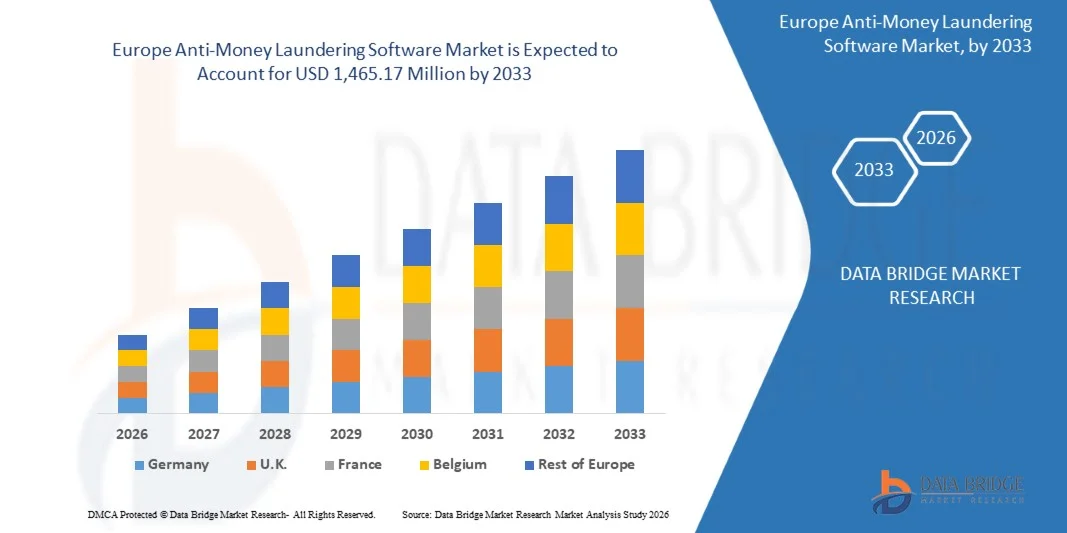
- The Europe anti-money laundering software market size was valued at USD 489.08 million in 2025 and is expected to reach USD 1,465.17 million by 2033, at a CAGR of 14.70% during the forecast period
- The market growth is largely fuelled by the increasing regulatory pressure on financial institutions to comply with stringent AML directives and prevent financial crimes such as fraud, terrorism financing, and money laundering activities
- Rising adoption of advanced technologies such as artificial intelligence, machine learning, and big data analytics is further accelerating market expansion by enabling real-time transaction monitoring, risk assessment, and improved detection accuracy
Europe Anti-Money Laundering Software Market Analysis
- The market is witnessing strong growth due to the continuous evolution of regulatory frameworks such as EU AML directives, which are compelling organizations to upgrade their compliance infrastructure and invest in sophisticated AML solutions
- Increasing digital transactions, expansion of online banking, and cross-border financial activities are creating a higher risk of financial crimes, thereby driving the demand for robust AML software solutions across banks, fintech companies, and other financial institutions
- Germany anti-money laundering software market captured the largest revenue share in 2025 within Europe, fueled by the country’s strong regulatory environment and advanced financial infrastructure. Financial institutions are increasingly adopting sophisticated AML solutions to comply with strict EU directives and national regulations
- U.K. is expected to witness the highest compound annual growth rate (CAGR) in the Europe anti-money laundering software market due to rapid expansion of digital banking and fintech ecosystem, rising regulatory scrutiny, increasing cross-border transactions, and growing adoption of AI-driven AML solutions
- The solution segment held the largest market revenue share in 2025 driven by the increasing need for comprehensive AML platforms that enable real-time transaction monitoring, risk assessment, and regulatory compliance. These solutions are widely adopted by financial institutions to automate detection processes, reduce manual intervention, and enhance operational efficiency across compliance functions
Report Scope and Europe Anti-Money Laundering Software Market Segmentation
|
Attributes |
Europe Anti-Money Laundering Software Key Market Insights |
|
Segments Covered |
|
|
Countries Covered |
Europe
|
|
Key Market Players |
• NICE Actimize (U.K.) |
|
Market Opportunities |
• Increasing Adoption Of AI-Driven Compliance Solutions |
|
Value Added Data Infosets |
In addition to the market insights such as market value, growth rate, market segments, geographical coverage, market players, and market scenario, the market report curated by the Data Bridge Market Research team includes in-depth expert analysis, import/export analysis, pricing analysis, production consumption analysis, and pestle analysis. |
Europe Anti-Money Laundering Software Market Trends
“Rising Adoption of Advanced Analytics and Regulatory Compliance Solutions”
• The increasing complexity of financial crimes and the growing need for real-time monitoring are significantly shaping the Europe anti-money laundering software market, as financial institutions are adopting advanced analytics, artificial intelligence, and machine learning technologies to enhance detection capabilities. AML software solutions are gaining traction due to their ability to automate compliance processes, identify suspicious transactions, and reduce operational risks without compromising efficiency. This trend is strengthening adoption across banks, fintech companies, and regulatory bodies, encouraging continuous innovation in intelligent compliance systems
• Increasing awareness regarding financial transparency, fraud prevention, and regulatory compliance has accelerated the demand for AML software across Europe. Financial institutions and organizations are actively seeking robust solutions to comply with evolving AML directives and avoid heavy penalties, prompting companies to invest in technologically advanced platforms. This has also led to collaborations between software providers and financial institutions to improve system integration, data accuracy, and risk management capabilities
• Digital transformation and the rapid growth of online banking and payment platforms are influencing purchasing decisions, with organizations emphasizing scalable, cloud-based AML solutions and automated compliance frameworks. These factors are helping companies strengthen risk mitigation strategies and improve operational efficiency, while also driving the adoption of integrated compliance ecosystems. Vendors are increasingly promoting their solutions through strategic partnerships and digital platforms to enhance market presence and customer reach
• For instance, in 2024, NICE Actimize and SAS Institute expanded their AML solution portfolios across Europe by integrating AI-driven monitoring and fraud detection capabilities. These developments were introduced in response to rising regulatory scrutiny and increasing financial crime risks, with deployment across banking and financial service sectors. The solutions were also positioned as scalable and compliance-ready platforms, enhancing operational efficiency and customer trust
• While demand for AML software is growing, sustained market expansion depends on continuous innovation, integration capabilities, and cost-effective deployment models. Vendors are focusing on enhancing interoperability, improving data management systems, and developing flexible solutions that balance regulatory compliance, performance, and scalability for broader adoption
Europe Anti-Money Laundering Software Market Dynamics
Driver
“Growing Regulatory Pressure and Digital Financial Transactions”
• Rising regulatory requirements and stringent AML directives across Europe are major drivers for the anti-money laundering software market. Financial institutions are increasingly adopting AML solutions to comply with evolving regulations, reduce financial crime risks, and maintain transparency in operations. This trend is also driving investment in advanced technologies to improve detection accuracy and streamline compliance processes
• Expanding digital transactions, online banking, and cross-border financial activities are significantly influencing market growth. AML software helps monitor high volumes of transactions, detect anomalies, and ensure regulatory compliance, enabling organizations to manage risks effectively. The rapid shift towards digital financial ecosystems further reinforces the need for robust AML solutions
• Banks, fintech firms, and financial service providers are actively promoting AML software adoption through digital transformation initiatives, strategic collaborations, and technology upgrades. These efforts are supported by increasing concerns over fraud, cybercrime, and money laundering activities, encouraging organizations to strengthen their compliance infrastructure and risk management frameworks
• For instance, in 2023, FICO and Oracle reported increased deployment of AML solutions across European financial institutions. This expansion followed rising regulatory compliance requirements and growing demand for real-time monitoring systems, driving operational efficiency and improving fraud detection rates. Both companies also emphasized advanced analytics and cloud integration to enhance performance and scalability
• Although regulatory and digital trends support growth, wider adoption depends on seamless integration with existing systems, cost optimization, and efficient data management. Investment in advanced analytics, cloud infrastructure, and regulatory technology will be critical for meeting compliance requirements and maintaining competitive advantage
Restraint/Challenge
“High Implementation Costs and Data Complexity”
• The high cost associated with implementing and maintaining AML software solutions remains a key challenge, particularly for small and medium-sized financial institutions. Complex system integration, infrastructure requirements, and ongoing maintenance contribute to elevated costs. In addition, frequent regulatory updates require continuous system upgrades, further increasing operational expenses
• Data complexity and management challenges also impact market growth, as AML systems require handling large volumes of structured and unstructured data from multiple sources. Ensuring data accuracy, consistency, and real-time processing can be difficult, limiting system efficiency. This also creates barriers for organizations lacking advanced data management capabilities
• Integration challenges with legacy systems and existing IT infrastructure can slow down adoption across financial institutions. Many organizations face difficulties in aligning new AML solutions with their current operational frameworks, leading to delays and increased implementation time. Companies must invest in system compatibility and technical expertise to ensure smooth deployment
• For instance, in 2024, financial institutions across countries such as Germany and Italy reported challenges related to high implementation costs and complex data integration while deploying AML solutions from vendors such as Temenos and Experian. These issues also resulted in delays in deployment and increased operational burden, affecting adoption rates
• Overcoming these challenges will require cost-effective deployment models, enhanced data management systems, and improved integration capabilities. Collaboration between technology providers, financial institutions, and regulatory bodies can help streamline implementation processes and unlock long-term growth potential. Furthermore, focusing on scalable cloud-based solutions and user-friendly interfaces will be essential for wider adoption across the Europe AML software market
Europe Anti-Money Laundering Software Market Scope
The Europe anti-money laundering software market is segmented on the basis of offering, function, deployment mode, enterprise size, gambling type, application, and gambling entity.
• By Offering
On the basis of offering, the market is segmented into solution and services. The solution segment held the largest market revenue share in 2025 driven by the increasing need for comprehensive AML platforms that enable real-time transaction monitoring, risk assessment, and regulatory compliance. These solutions are widely adopted by financial institutions to automate detection processes, reduce manual intervention, and enhance operational efficiency across compliance functions.
The services segment is expected to witness the fastest growth rate from 2026 to 2033, driven by the rising demand for consulting, integration, and support services. Organizations are increasingly relying on service providers to ensure seamless deployment, customization, and maintenance of AML systems, enabling better compliance management and system optimization.
• By Function
On the basis of function, the market is segmented into compliance management, currency transaction reporting, customer identity management, transaction monitoring, and others. The transaction monitoring segment held the largest market revenue share in 2025 driven by the growing need to track and analyze high volumes of financial transactions in real time. This function plays a critical role in detecting suspicious activities, reducing fraud risks, and ensuring adherence to regulatory standards.
The customer identity management segment is expected to witness the fastest growth rate from 2026 to 2033, driven by increasing emphasis on KYC (Know Your Customer) regulations and identity verification processes. Organizations are investing in advanced identity management solutions to enhance customer onboarding, reduce identity fraud, and strengthen compliance frameworks.
• By Deployment Mode
On the basis of deployment mode, the market is segmented into cloud and on-premises. The on-premises segment held the largest market revenue share in 2025 due to higher control over data security, customization capabilities, and regulatory requirements in sensitive financial environments. Many large institutions prefer on-premises solutions to maintain data privacy and ensure compliance with strict regional regulations.
The cloud segment is expected to witness the fastest growth rate from 2026 to 2033, driven by scalability, cost efficiency, and ease of deployment. Cloud-based AML solutions enable real-time updates, remote accessibility, and integration with advanced analytics tools, making them increasingly popular among financial institutions and fintech companies.
• By Enterprise Size
On the basis of enterprise size, the market is segmented into large enterprises and small & medium enterprises. The large enterprises segment held the largest market revenue share in 2025 driven by their substantial financial resources and higher exposure to regulatory scrutiny. These organizations invest heavily in advanced AML systems to manage complex transaction volumes and ensure compliance across global operations.
The small & medium enterprises segment is expected to witness the fastest growth rate from 2026 to 2033, driven by increasing awareness of regulatory compliance and rising adoption of cost-effective AML solutions. SMEs are gradually implementing scalable platforms to mitigate risks and comply with evolving regulatory requirements.
• By Gambling Type
On the basis of gambling type, the market is segmented into lottery, sports betting, bingo, raffles/pools, and casino. The casino segment held the largest market revenue share in 2025 driven by high transaction volumes and increased risk of money laundering activities within casino operations. AML software is widely used to monitor transactions, detect suspicious behavior, and ensure compliance with regulatory standards in this segment.
The sports betting segment is expected to witness the fastest growth rate from 2026 to 2033, driven by the rapid expansion of online betting platforms and increasing regulatory oversight. The need to monitor digital transactions and prevent financial crimes is accelerating the adoption of AML solutions in this segment.
• By Application
On the basis of application, the market is segmented into offline/land based and live entertainment/online. The offline/land based segment held the largest market revenue share in 2025 driven by established infrastructure and traditional financial systems that require strong compliance mechanisms. AML solutions are extensively used in physical financial institutions and land-based gambling entities to monitor transactions and ensure regulatory adherence.
The live entertainment/online segment is expected to witness the fastest growth rate from 2026 to 2033, driven by the increasing shift toward digital platforms and online financial services. The surge in online transactions and virtual platforms has heightened the need for real-time monitoring and fraud detection solutions.
• By Gambling Entity
On the basis of gambling entity, the market is segmented into organizations, sole trader/partnership, and others. The organizations segment held the largest market revenue share in 2025 driven by the presence of large-scale operators with high transaction volumes and strict regulatory obligations. These entities require advanced AML systems to ensure compliance and manage risks effectively.
The sole trader/partnership segment is expected to witness the fastest growth rate from 2026 to 2033, driven by increasing regulatory focus on smaller operators and the need for affordable compliance solutions. Adoption of simplified and scalable AML tools is enabling these entities to meet compliance requirements and enhance operational transparency.
Europe Anti-Money Laundering Software Market Regional Analysis
- The Germany anti-money laundering software market captured the largest revenue share in 2025 within Europe, fueled by the country’s strong regulatory environment and advanced financial infrastructure. Financial institutions are increasingly adopting sophisticated AML solutions to comply with strict EU directives and national regulations
- The presence of major banks and financial service providers, along with high transaction volumes, is driving demand for real-time monitoring and risk management systems
- In addition, Germany’s focus on data security, digitalization, and regulatory compliance is significantly contributing to the expansion of the AML software market
U.K. Anti-Money Laundering Software Market Insight
The U.K. anti-money laundering software market is expected to witness the fastest growth rate from 2026 to 2033, driven by the rapid expansion of digital banking, fintech innovation, and increasing regulatory scrutiny. Financial institutions are prioritizing the adoption of advanced AML technologies to enhance fraud detection and ensure compliance with evolving regulations. The growing volume of online transactions and cross-border financial activities is further accelerating the demand for real-time monitoring solutions. Moreover, the U.K.’s strong fintech ecosystem and continuous investment in advanced analytics and AI-driven compliance tools are significantly supporting market growth.
Europe Anti-Money Laundering Software Market Share
The Europe anti-money laundering software industry is primarily led by well-established companies, including:
• NICE Actimize (U.K.)
• FICO (U.K.)
• SAS Institute (U.K.)
• BAE Systems (U.K.)
• Experian (Ireland)
• Temenos (Switzerland)
• Fenergo (Ireland)
• Featurespace (U.K.)
• ComplyAdvantage (U.K.)
• LexisNexis Risk Solutions (U.K.)
• FinScan (U.K.)
• Eastnets (Netherlands)
• IMTF (Switzerland)
• Tookitaki (U.K.)
• Feedzai (Portugal)
SKU-
Get online access to the report on the World's First Market Intelligence Cloud

- Interactive Data Analysis Dashboard
- Company Analysis Dashboard for high growth potential opportunities
- Research Analyst Access for customization & queries
- Competitor Analysis with Interactive dashboard
- Latest News, Updates & Trend analysis
- Harness the Power of Benchmark Analysis for Comprehensive Competitor Tracking
Research Methodology
Data collection and base year analysis are done using data collection modules with large sample sizes. The stage includes obtaining market information or related data through various sources and strategies. It includes examining and planning all the data acquired from the past in advance. It likewise envelops the examination of information inconsistencies seen across different information sources. The market data is analysed and estimated using market statistical and coherent models. Also, market share analysis and key trend analysis are the major success factors in the market report. To know more, please request an analyst call or drop down your inquiry.
The key research methodology used by DBMR research team is data triangulation which involves data mining, analysis of the impact of data variables on the market and primary (industry expert) validation. Data models include Vendor Positioning Grid, Market Time Line Analysis, Market Overview and Guide, Company Positioning Grid, Patent Analysis, Pricing Analysis, Company Market Share Analysis, Standards of Measurement, Global versus Regional and Vendor Share Analysis. To know more about the research methodology, drop in an inquiry to speak to our industry experts.
Customization Available
Data Bridge Market Research is a leader in advanced formative research. We take pride in servicing our existing and new customers with data and analysis that match and suits their goal. The report can be customized to include price trend analysis of target brands understanding the market for additional countries (ask for the list of countries), clinical trial results data, literature review, refurbished market and product base analysis. Market analysis of target competitors can be analyzed from technology-based analysis to market portfolio strategies. We can add as many competitors that you require data about in the format and data style you are looking for. Our team of analysts can also provide you data in crude raw excel files pivot tables (Fact book) or can assist you in creating presentations from the data sets available in the report.












