


Europe Atomic Spectroscopy Market Size
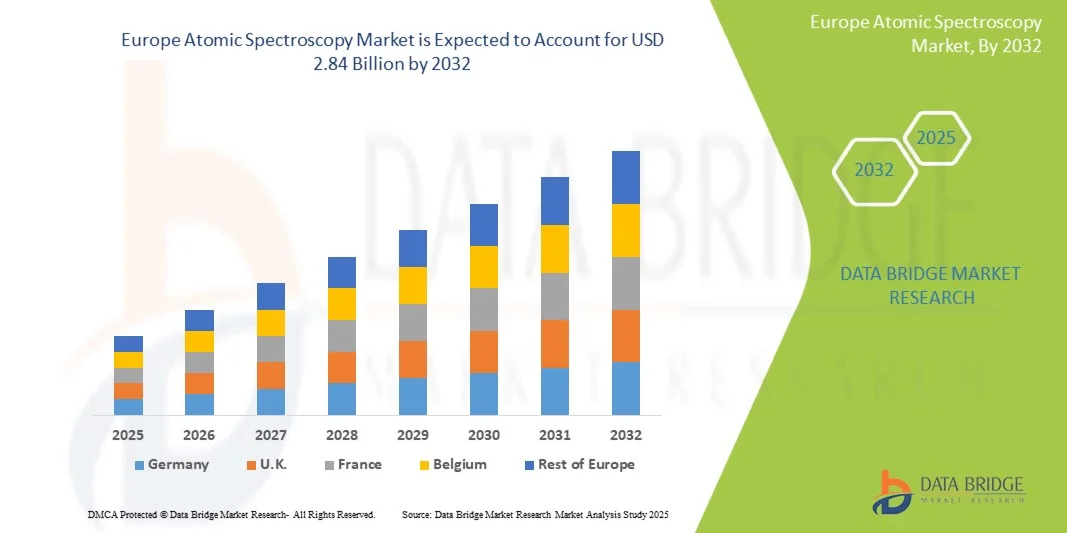
- The Europe atomic spectroscopy market size was valued at USD 1.86 billion in 2024 and is expected to reach USD 2.84 billion by 2032, at a CAGR of 5.40% during the forecast period
- The market growth is largely fueled by the growing adoption of advanced analytical techniques and technological progress in laboratory instrumentation, leading to increased precision and efficiency in elemental analysis across various industries
- Furthermore, rising demand for accurate, sensitive, and high-throughput analytical solutions in environmental testing, pharmaceuticals, food safety, and petrochemical industries is driving the adoption of atomic spectroscopy technologies. These converging factors are accelerating the uptake of atomic spectroscopy solutions, thereby significantly boosting the market’s growth in Europe
Europe Atomic Spectroscopy Market Analysis
- Atomic Spectroscopy market is witnessing robust growth, driven by increasing adoption of advanced analytical techniques in pharmaceuticals, environmental monitoring, food & beverage, and industrial quality control. The rising demand for precise, sensitive, and high-throughput instrumentation is further accelerating market expansion
- The growth of the market is primarily fueled by stringent regulatory requirements, technological advancements in atomic spectroscopy instruments, and increasing investments in research and development across Europe. The adoption of automated and high-performance analytical platforms is supporting this trend
- Germany dominated the Europe atomic spectroscopy market with the largest revenue share of 36.4% in 2024, supported by its strong chemical and pharmaceutical industries, well-established research infrastructure, and widespread use of advanced spectroscopy instruments in industrial and academic laboratories
- France is expected to be the fastest-growing country in the Europe atomic spectroscopy market during the forecast period, driven by the expansion of analytical laboratories, increasing adoption of high-throughput and automated spectroscopy solutions, and rising demand for environmental and food safety testing
- The instruments segment dominated the Europe atomic spectroscopy market with a 47.5% revenue share in 2024, driven by the high adoption of multi-element analyzers, ICP spectrometers, and integrated laboratory platforms across research and industrial laboratories
Report Scope and Europe Atomic Spectroscopy Market Segmentation
|
Attributes |
Europe Atomic Spectroscopy Key Market Insights |
|
Segments Covered |
|
|
Countries Covered |
Europe
|
|
Key Market Players |
|
|
Market Opportunities |
|
|
Value Added Data Infosets |
In addition to the insights on market scenarios such as market value, growth rate, segmentation, geographical coverage, and major players, the market reports curated by the Data Bridge Market Research also include in-depth expert analysis, pricing analysis, brand share analysis, consumer survey, demography analysis, supply chain analysis, value chain analysis, raw material/consumables overview, vendor selection criteria, PESTLE Analysis, Porter Analysis, and regulatory framework. |
Europe Atomic Spectroscopy Market Trends
Rising Adoption Driven by Accuracy, Efficiency, and Integration
- A significant and accelerating trend in the Europe atomic spectroscopy market is the growing integration of advanced detection and analysis technologies with laboratory workflows. This integration is enhancing the accuracy, reproducibility, and efficiency of elemental and molecular analyses across research, industrial, and diagnostic applications
- For instance, modern ICP-MS and ICP-OES instruments allow simultaneous multi-element detection with high sensitivity and precision, enabling laboratories to handle complex sample matrices efficiently. Similarly, XRF and AAS systems are increasingly being integrated with automated sample handling and data processing solutions to streamline routine analyses
- The integration of advanced spectroscopic instruments with laboratory information management systems (LIMS) and software analytics supports data-driven decision-making and reduces manual intervention. This allows researchers and technicians to focus on interpretation and high-value tasks rather than repetitive operational steps
- The seamless incorporation of atomic spectroscopy systems with upstream and downstream laboratory processes facilitates a more cohesive workflow, improving throughput and minimizing errors. Users can manage multiple instruments, track sample processing, and generate standardized reports through centralized interfaces
- This trend towards more precise, efficient, and interconnected laboratory instrumentation is reshaping expectations for analytical performance in Europe. Consequently, companies such as Agilent Technologies and PerkinElmer are developing next-generation atomic spectroscopy solutions with enhanced automation, high sensitivity, and improved user-friendliness
- The demand for high-performance, integrated atomic spectroscopy systems is growing rapidly across research institutes, pharmaceutical labs, and industrial laboratories, as organizations increasingly prioritize efficiency, reproducibility, and compliance with stringent analytical standards
Europe Atomic Spectroscopy Market Dynamics
Driver
Growing Need Due to Increasing Demand for Accurate and High-Throughput Analysis
- The increasing demand for precise, sensitive, and high-throughput analytical techniques across pharmaceuticals, environmental monitoring, food & beverage, and industrial applications is a significant driver for the heightened adoption of atomic spectroscopy instruments
- For instance, in April 2024, PerkinElmer announced the launch of an advanced inductively coupled plasma optical emission spectrometer (ICP-OES), designed to deliver higher sensitivity and faster analysis times, which is expected to further propel growth in the European Atomic Spectroscopy market during the forecast period
- As laboratories and research institutions increasingly require robust and reliable instrumentation for elemental and chemical analysis, atomic spectroscopy systems provide high accuracy, reproducibility, and compatibility with automated workflows, positioning them as essential tools in analytical chemistry
- Furthermore, regulatory compliance and stringent quality standards in pharmaceuticals, food safety, and environmental testing are driving the need for instruments capable of rapid, precise, and multi-element analysis, fueling market expansion
- The versatility of atomic spectroscopy instruments, including atomic absorption spectrometers, ICP-OES, and ICP-MS systems, allows users to conduct diverse analyses, enhancing productivity and meeting the growing analytical demands of various European industries
Restraint/Challenge
High Initial Cost and Maintenance Requirements
- The relatively high initial investment required for advanced atomic spectroscopy systems, along with recurring costs for maintenance, consumables, and skilled personnel, poses a challenge for some laboratories and small enterprises in adopting these technologies
- For instance, mid-sized research labs and contract testing organizations may delay procurement of state-of-the-art instruments due to budget constraints, despite the need for enhanced analytical capabilities
- Addressing these challenges through cost-effective service plans, leasing models, and user-friendly instrument designs is crucial for wider adoption. Companies such as Agilent Technologies and Thermo Fisher Scientific are emphasizing modular systems and automated workflows to reduce operational complexity and cost burdens
- While the price of instruments remains high, the benefits of faster analysis, higher throughput, and improved accuracy make atomic spectroscopy systems indispensable for research, regulatory compliance, and industrial quality control
- Overcoming these financial and operational barriers through flexible financing options, simplified maintenance, and training programs will be vital for sustaining growth in the European Atomic Spectroscopy market over the forecast period
Europe Atomic Spectroscopy Market Scope
The market is segmented on the basis of type, technology, application, distribution channel, and end user.
• By Type
On the basis of type, the atomic spectroscopy market is segmented into instruments, Inductively Coupled Plasma (ICP) spectrometers, and others. The instruments segment dominated the market with a 47.5% revenue share in 2024, driven by the high adoption of multi-element analyzers, ICP spectrometers, and integrated laboratory platforms across research and industrial laboratories. Instruments are critical for achieving reproducibility, precise detection, and high throughput, making them indispensable in pharmaceutical, environmental, and food testing applications. Advanced instruments provide robust performance, long lifespan, and integration with data management systems, further supporting their leading position. Ongoing investments in laboratory automation and increasing demand for high-accuracy elemental analysis continue to strengthen this segment. The segment’s market dominance is supported by widespread institutional adoption in Europe and continuous product innovations from key players.
The ICP spectrometers segment is expected to witness the fastest CAGR of 10.2% from 2025 to 2032, fueled by the rising demand for trace-level elemental analysis in environmental, pharmaceutical, and petrochemical industries. ICP systems offer high sensitivity, low detection limits, and rapid multi-element analysis, which makes them suitable for high-throughput workflows. Growing regulatory requirements for contamination and quality control testing, coupled with the need for efficient analytical processes, are driving adoption. Increasing focus on research in life sciences and materials science further accelerates growth. Laboratories are also adopting compact ICP systems that combine automation and real-time monitoring, enhancing efficiency and productivity.
• By Technology
On the basis of technology, the atomic spectroscopy market is segmented into Atomic Absorption Spectroscopy (AAS), X-Ray Fluorescence (XRF), X-Ray Diffraction (XRD), ICP-OES, ICP-MS, elemental analyzers, and others. The ICP-MS segment dominated the market with a 38.6% revenue share in 2024, owing to its ultra-sensitive detection capabilities, ability to analyze multiple elements simultaneously, and suitability for trace metal detection in complex matrices. ICP-MS is widely used in environmental testing, pharmaceuticals, and food safety applications due to its accuracy and reproducibility. Continuous advancements in detector technology, automation, and software integration further strengthen its market position. The segment’s dominance is also supported by stringent regulatory standards in Europe requiring high-precision analysis.
The ICP-OES segment is expected to witness the fastest CAGR of 9.8% from 2025 to 2032, driven by growing adoption in industrial chemistry, environmental monitoring, and geological applications. ICP-OES offers rapid multi-element analysis with relatively lower operational costs, making it attractive for high-volume testing labs. Rising industrialization, stricter environmental regulations, and the need for efficient quality control processes further propel its growth. Increasing integration with automation and real-time data analytics systems enhances productivity and accuracy, attracting both research and industrial end users.
• By Application
On the basis of application, the atomic spectroscopy market is segmented into food and beverage testing, pharmaceutical, industrial chemistry, environmental testing, geological sciences, petrochemical, academics, and others. The pharmaceutical segment dominated with a 34.7% revenue share in 2024, driven by stringent regulatory requirements for quality control, safety testing, and elemental impurity profiling. Pharmaceutical laboratories increasingly rely on atomic spectroscopy for ensuring compliance with ICH guidelines, detecting trace metals, and supporting drug development pipelines. The growing focus on biologics, personalized medicine, and biomarker research further strengthens adoption. High precision, reproducibility, and validated protocols of spectroscopy systems make them critical in pharmaceutical applications.
The environmental testing segment is expected to witness the fastest CAGR of 10.5% from 2025 to 2032, fueled by increasing regulatory mandates for water, air, and soil quality monitoring across Europe. Rising industrialization and urbanization have elevated the need for trace-level elemental detection in environmental matrices. Adoption of automated and portable spectroscopy systems allows rapid and accurate testing, supporting compliance with EU environmental directives. Laboratories are also leveraging integrated data management solutions to enhance reporting efficiency. The trend toward sustainable industrial practices and environmental safety regulations continues to drive growth in this segment.
• By Distribution Channel
On the basis of distribution channel, the atomic spectroscopy market is segmented into direct tenders and retail. The direct tenders segment dominated the market with a 61.2% share in 2024, primarily driven by large-scale procurement by government agencies, research institutions, and industrial laboratories that require advanced atomic spectroscopy solutions. These end users often prefer direct purchase agreements to obtain customized instrumentation tailored to their specific testing and analytical needs, along with dedicated after-sales support, training, and maintenance services. Strategic collaborations, long-term contracts, and bulk procurement arrangements between suppliers and end users further enhance adoption of high-end instrumentation. Additionally, the direct tenders model ensures reliable supply chains, streamlined procurement processes, and compliance with regulatory and quality standards, reinforcing its dominance in the European market.
The retail segment is expected to witness the fastest CAGR of 8.9% from 2025 to 2032, fueled by growing demand from smaller laboratories, academic institutions, and startup ventures. Retail channels provide rapid access to consumables, bench-top instruments, and entry-level atomic spectroscopy systems, enabling laboratories with limited budgets to implement essential testing and research operations efficiently. The convenience of online and offline retail platforms allows users to quickly procure equipment and consumables, supporting the expansion of research programs and analytical activities. Increasing adoption of compact, cost-effective spectroscopy systems and growing awareness of laboratory automation further accelerate growth in this segment.
• By End User
On the basis of end user, the atomic spectroscopy market is segmented into laboratories, universities, manufacturing facilities, and government agencies. The laboratories segment dominated with a 42.8% revenue share in 2024, driven by widespread adoption of atomic spectroscopy systems for routine testing, quality control, and research and development activities. Laboratories benefit from high-throughput capabilities, precise and reproducible measurements, and integration with software analytics platforms that enhance operational efficiency and data management. Both commercial and academic laboratories rely on advanced instruments to comply with stringent regulatory standards and maintain consistent testing quality, further supporting dominance.
The universities segment is expected to witness the fastest CAGR of 9.6% from 2025 to 2032, fueled by increased investment in modern research infrastructure, expansion of chemistry, material science, and environmental programs, and growing demand for hands-on training on cutting-edge spectroscopy instruments. Universities are increasingly collaborating with industry partners and participating in government-funded research initiatives, driving adoption of high-performance atomic spectroscopy systems. The rising focus on academic research, development of new analytical methods, and the need to prepare students for careers in scientific and industrial sectors further contribute to the segment’s rapid growth.
Europe Atomic Spectroscopy Market Regional Analysis
- The Europe atomic spectroscopy market is projected to expand at a substantial CAGR throughout the forecast period, primarily driven by the rising demand for precise, high-throughput, and reliable elemental analysis across industries such as pharmaceuticals, chemicals, food & beverages, environmental monitoring, and research laboratories
- Germany dominated the Europe atomic spectroscopy market with the largest revenue share of 36.4% in 2024, supported by its strong chemical and pharmaceutical industries, well-established research infrastructure, and widespread use of advanced spectroscopy instruments in industrial and academic laboratories
- France is expected to be the fastest-growing country in the Europe atomic spectroscopy market during the forecast period, driven by the expansion of analytical laboratories, increasing adoption of high-throughput and automated spectroscopy solutions, and rising demand for environmental and food safety testing
Germany Atomic Spectroscopy Market Insight
The Germany atomic spectroscopy market is expected to expand at a considerable CAGR during the forecast period, fueled by the country’s robust chemical and pharmaceutical industries, advanced research infrastructure, and widespread use of spectroscopy instruments in both industrial and academic laboratories. Germany dominated the European market with the largest revenue share of 36.4% in 2024, supported by significant investments in laboratory automation, analytical instrumentation, and quality control systems. The strong focus on innovation and sustainability in analytical workflows continues to strengthen Germany’s leadership in the market.
France Atomic Spectroscopy Market Insight
The France atomic spectroscopy market is expected to be the fastest-growing country in the European Atomic Spectroscopy market during the forecast period, driven by the rapid expansion of analytical laboratories, increasing adoption of automated and high-throughput spectroscopy systems, and rising demand for environmental, food safety, and industrial quality testing. The country’s growing investments in research and analytical infrastructure, along with heightened regulatory requirements, are fueling the uptake of advanced spectroscopy instruments, positioning France as a key emerging market in Europe.
Europe Atomic Spectroscopy Market Share
The atomic spectroscopy industry is primarily led by well-established companies, including:
- Agilent Technologies Inc. (U.S.)
- PerkinElmer (U.S.)
- Thermo Fisher Scientific, Inc. (U.S.)
- Shimadzu Corporation (Japan)
- Bruker (U.S.)
- Analytik Jena AG (Germany)
- HORIBA, Ltd. (Japan)
- Hitachi High-Tech Corporation (Japan)
- Rigaku Corporation (Japan)
- SPECTRO Analytical Instruments GmbH (Germany)
- JASCO Corporation (Japan)
- Anton Paar GmbH (Austria)
- Elementar Analysensysteme GmbH (Germany)
- Malvern Panalytical Ltd. (U.K.)
- Oxford Instruments plc (U.K.)
Latest Developments in Europe Atomic Spectroscopy Market
- In October 2024, Thermo Fisher Scientific introduced the iCAP MX Series ICP-MS, designed to simplify trace element analysis with inductively coupled plasma mass spectrometry. This new series aims to provide laboratories with efficient and reliable solutions for elemental analysis, enhancing productivity and data quality in various applications
- In October 2024, Thermo Fisher Scientific launched new ICP-MS instruments, including the iCAP MX Series, to simplify trace element analysis with inductively coupled plasma mass spectrometry. These instruments aim to provide laboratories with efficient and reliable solutions for elemental analysis, enhancing productivity and data quality in various applications

- Interactive Data Analysis Dashboard
- Company Analysis Dashboard for high growth potential opportunities
- Research Analyst Access for customization & queries
- Competitor Analysis with Interactive dashboard
- Latest News, Updates & Trend analysis
- Harness the Power of Benchmark Analysis for Comprehensive Competitor Tracking
Data collection and base year analysis are done using data collection modules with large sample sizes. The stage includes obtaining market information or related data through various sources and strategies. It includes examining and planning all the data acquired from the past in advance. It likewise envelops the examination of information inconsistencies seen across different information sources. The market data is analysed and estimated using market statistical and coherent models. Also, market share analysis and key trend analysis are the major success factors in the market report. To know more, please request an analyst call or drop down your inquiry.
The key research methodology used by DBMR research team is data triangulation which involves data mining, analysis of the impact of data variables on the market and primary (industry expert) validation. Data models include Vendor Positioning Grid, Market Time Line Analysis, Market Overview and Guide, Company Positioning Grid, Patent Analysis, Pricing Analysis, Company Market Share Analysis, Standards of Measurement, Global versus Regional and Vendor Share Analysis. To know more about the research methodology, drop in an inquiry to speak to our industry experts.
Data Bridge Market Research is a leader in advanced formative research. We take pride in servicing our existing and new customers with data and analysis that match and suits their goal. The report can be customized to include price trend analysis of target brands understanding the market for additional countries (ask for the list of countries), clinical trial results data, literature review, refurbished market and product base analysis. Market analysis of target competitors can be analyzed from technology-based analysis to market portfolio strategies. We can add as many competitors that you require data about in the format and data style you are looking for. Our team of analysts can also provide you data in crude raw excel files pivot tables (Fact book) or can assist you in creating presentations from the data sets available in the report.













