


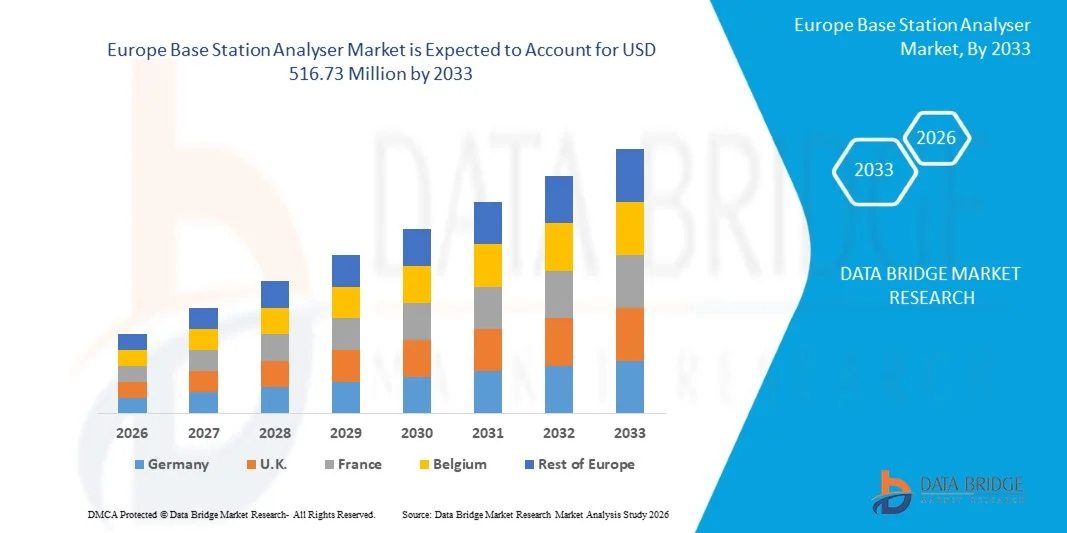
What is the Europe Base Station Analyser Market Size and Growth Rate?
- The Europe base station analyser market size was valued at USD 347.09 million in 2025 and is expected to reach USD 516.73 million by 2033, at a CAGR of 5.10% during the forecast period
- The increasing demand of telecom sector is boosting the growth of the market. Europe region has witnessed high growth in adoption of base station analyser due upcoming start-ups in China, India, Japan and other countries. Late adoption by defense sector in the region has allowed demography to achieve highest growth rate
What are the Major Takeaways of Base Station Analyser Market?
- The base station analyzer market is witnessing steady growth due to increasing network complexity and rising demand for accurate signal diagnostics across modern telecom infrastructures
- Manufacturers are focusing on compact, multi-functional analyzers that offer real-time testing, which is helping operators maintain signal quality and reduce network downtime
- In Germany, the Base Station Analyser market dominated the Europe region with a 42.87% revenue share in 2025, driven by extensive urban infrastructure upgrades, highway and bridge rehabilitation, and modernization of industrial facilities
- In Spain, the Base Station Analyser market is projected to record the fastest CAGR of 11.58% in Europe from 2026 to 2033, driven by urban redevelopment, transport network expansion, and maintenance of aging civil and industrial infrastructure
- The Handheld/Portable segment dominated the market with an estimated 53.6% share in 2025, driven by ease of transport, rapid deployment, and suitability for field testing, site inspections, and troubleshooting across urban and remote locations
Report Scope and Base Station Analyser Market Segmentation
|
Attributes |
Base Station Analyser Key Market Insights |
|
Segments Covered |
|
|
Countries Covered |
Europe
|
|
Key Market Players |
|
|
Market Opportunities |
|
|
Value Added Data Infosets |
In addition to the insights on market scenarios such as market value, growth rate, segmentation, geographical coverage, and major players, the market reports curated by the Data Bridge Market Research also include in-depth expert analysis, pricing analysis, brand share analysis, consumer survey, demography analysis, supply chain analysis, value chain analysis, raw material/consumables overview, vendor selection criteria, PESTLE Analysis, Porter Analysis, and regulatory framework. |
What is the Key Trend in the Base Station Analyser Market?
“Increasing Shift Toward High-Performance, Sustainable, and Rapid-Curing Base Station Analysers”
- The base station analyser market is experiencing growing adoption of advanced, fast-curing, polymer- and fiber-reinforced materials designed for enhanced structural stability, reduced project downtime, and longer service life in infrastructure repair and maintenance
- Manufacturers are introducing eco-friendly, low-shrinkage, high-adhesion, and sulfate-resistant repair mortars that provide superior workability, corrosion resistance, and durability across industrial, commercial, and residential applications
- Rising emphasis on sustainable construction with recycled aggregates, low-carbon cements, and VOC-free formulations is promoting environmentally conscious adoption worldwide
- For instance, companies such as Sika, MAPEI, Saint-Gobain Weber, Fosroc, and MC-Bauchemie are developing rapid-curing, high-strength mortars with improved bonding, corrosion protection, and long-term performance for bridges, tunnels, buildings, and industrial infrastructure
- Increasing demand for infrastructure maintenance, preventive repairs, and aging building restoration is driving usage across the U.S., Europe, and Europe
- As aging infrastructure continues to require durable and efficient repair solutions, Base Station Analysers will remain critical for sustainable construction and reduced lifecycle costs
What are the Key Drivers of Base Station Analyser Market?
- Growing global investments in infrastructure refurbishment, including highways, bridges, tunnels, and industrial facilities, are significantly boosting demand for Base Station Analysers
- For instance, in 2025, Sika, MAPEI, and Fosroc expanded their portfolios of polymer-modified, fiber-reinforced mortars to support large-scale rehabilitation projects across Europe and Europe
- Rising awareness of structural durability, corrosion prevention, and long-term asset protection is encouraging adoption of high-performance repair materials with superior compressive strength and bonding properties
- Technological innovations, such as nano-modified cementitious systems, crack-resistant formulations, and low-carbon mortars, are improving repair efficiency and lifespan
- Increased construction in urban redevelopment, industrial upgrades, and smart city projects further strengthens market growth
- Supported by stricter quality standards, extended lifecycles for aging structures, and sustainable construction initiatives, the Base Station Analyser market is projected to experience robust long-term expansion
Which Factor is Challenging the Growth of the Base Station Analyser Market?
- High costs of premium mortars, specialty additives, and skilled installation limit adoption among small contractors and low-budget projects
- During 2024–2025, rising prices of cement, polymers, silica, and other high-performance fillers increased production costs for several global brands
- Technical issues such as improper surface preparation, incorrect mixing, and flawed application can compromise structural integrity, increasing the need for trained labor
- Limited awareness regarding material durability, compatibility standards, and testing protocols in developing markets slows adoption
- Competition from low-cost, unbranded, and substandard repair materials creates pricing pressure and reduces differentiation for certified solutions
- To overcome these challenges, companies are emphasizing training programs, cost-effective formulations, advanced application tools, and awareness initiatives to expand global adoption of high-quality Base Station Analysers
How is the Base Station Analyser Market Segmented?
The market is segmented on the basis of product type, functionality, solution, network, connectivity, and end-user.
• By Product Type
On the basis of product type, the market is segmented into Handheld/Portable and Benchtop analysers. The Handheld/Portable segment dominated the market with an estimated 53.6% share in 2025, driven by ease of transport, rapid deployment, and suitability for field testing, site inspections, and troubleshooting across urban and remote locations. Portable analysers provide real-time signal measurement, versatile connectivity support, and quick setup, making them the preferred choice for network engineers and field technicians.
The Benchtop segment is expected to grow at the fastest CAGR from 2026 to 2033, supported by increasing adoption in laboratory environments, telecom R&D centers, and high-precision calibration facilities requiring advanced functionality, multi-band analysis, and deep data capture capabilities.
• By Functionality
The Base Station Analyser market is segmented into Spectrum Analysers, Cable and Antenna Analysers, Power Meters, Signal Analysers, GPS Receivers, Channel Scanners, and Others. The Spectrum Analyser segment dominated the market with a 41.2% share in 2025, owing to its crucial role in frequency monitoring, interference detection, and compliance testing.
The Channel Scanner segment is projected to grow at the fastest CAGR from 2026 to 2033, driven by rising deployment of multi-band, multi-operator networks and the need for rapid channel assessment in LTE, 5G, and upcoming network architectures.
• By Solution
On the basis of solution, the market is segmented into Installation, Maintenance, Optimization, and Expansion. The Maintenance segment dominated with 45.7% market share in 2025, fueled by frequent inspection, calibration, and repair of base station infrastructure to ensure consistent network uptime.
The Optimization segment is expected to register the fastest growth from 2026 to 2033, as telecom operators increasingly invest in network performance enhancement, traffic management, and spectrum efficiency, especially with LTE and 5G NR rollout.
• By Network
The market is classified into GSM, LTE, 5G “New Radio” (NR), and CDMA networks. LTE dominated the market with a 39.8% share in 2025, driven by widespread global adoption and upgrades of legacy networks.
The 5G NR segment is projected to grow at the fastest CAGR during 2026–2033, supported by massive deployment of 5G infrastructure, ultra-low latency requirements, and expansion into smart cities, IoT connectivity, and industrial automation applications.
• By Connectivity
The Base Station Analyser market is segmented into Bluetooth, Wi-Fi, and Others. Wi-Fi dominated the market with a 48.1% share in 2025, due to its extensive use in indoor and outdoor network testing, signal quality measurement, and interference detection.
The Bluetooth segment is expected to grow at the fastest CAGR from 2026 to 2033, fueled by increasing adoption of low-power IoT devices, connected wearables, and short-range communication solutions requiring precise signal analysis in commercial and industrial deployments.
• By End-User
The base station analyser market is segmented into IT and Telecommunication, Semiconductor and Electronics, Aerospace and Defense, and Others. The IT and Telecommunication segment dominated with a 44.5% share in 2025, driven by network expansion, maintenance, and optimization needs across global telecom operators.
The Semiconductor and Electronics segment is expected to grow at the fastest CAGR during 2026–2033, supported by rising use of base station analysers in R&D labs, chipset validation, 5G testing, and high-frequency component characterization.
Which Region Holds the Largest Share of the Base Station Analyser Market?
- In Germany, the Base Station Analyser market dominated the Europe region with a 42.87% revenue share in 2025, driven by extensive urban infrastructure upgrades, highway and bridge rehabilitation, and modernization of industrial facilities
- Rising adoption of high-performance polymer-modified, cementitious, and epoxy-based mortars for structural repair ensures durability and long-term safety. Government initiatives supporting smart cities, sustainable construction, and preventive maintenance further strengthen market demand
- Advanced mechanized application techniques and innovations in fiber-reinforced and rapid-setting formulations are widely deployed across commercial and public sector projects, consolidating Germany’s leadership in the Europe Base Station Analyser market
France Base Station Analyser Market Insight
In France, stable demand is supported by aging infrastructure, seismic reinforcement regulations, and extensive restoration of public buildings, rail networks, and urban bridges. High-performance structural mortars, including cementitious and polymer-modified repair materials, are preferred for crack resistance and long-term durability. Adoption of machine-applied and sprayed repair methods increases project efficiency. Premium-grade epoxy mortars and fiber-reinforced formulations are increasingly used in industrial facilities, heritage buildings, and coastal infrastructure, ensuring continuous market growth.
U.K. Base Station Analyser Market Insight
In the U.K., the Base Station Analyser market is driven by large-scale urban redevelopment, residential construction, and government-led infrastructure restoration. High adoption of epoxy-based and fiber-reinforced mortars supports rehabilitation of bridges, highways, and industrial facilities. Mechanized application methods, rapid-setting repair solutions, and eco-friendly formulations improve operational efficiency. Rising focus on sustainable infrastructure, preventive maintenance, and regulatory compliance reinforces long-term demand. Continuous product innovation by domestic and international manufacturers strengthens the U.K.’s position as a key contributor in the Europe Base Station Analyser market.
Italy Base Station Analyser Market Insight
In Italy, the market is supported by historical infrastructure restoration, industrial facility upgrades, and aging residential and commercial structures. Cementitious, polymer-modified, and fast-setting epoxy mortars are widely used to ensure structural safety, crack resistance, and long-lasting performance. Mechanized spraying and flow-applied techniques improve project efficiency for bridges, highways, and heritage buildings. Increasing investment in smart city projects, seismic-resistant construction, and eco-friendly repair solutions accelerates adoption, making Italy an important growth market in Europe.
Spain Base Station Analyser Market Insight (Fastest-Growing Country)
In Spain, the Base Station Analyser market is projected to record the fastest CAGR of 11.58% in Europe from 2026 to 2033, driven by urban redevelopment, transport network expansion, and maintenance of aging civil and industrial infrastructure. Adoption of high-strength, fiber-reinforced, and rapid-setting repair mortars ensures durability and structural resilience. Mechanized application, ready-to-use solutions, and sustainable materials improve operational efficiency. Government-backed infrastructure programs, coastal and seismic protection projects, and rising private construction investments further enhance market penetration, positioning Spain as a high-growth contributor to the Europe Base Station Analyser market.
Which are the Top Companies in Base Station Analyser Market?
The base station analyser industry is primarily led by well-established companies, including:
- RIGOL TECHNOLOGIES, Co. Ltd. (China)
- Keysight Technologies (U.S.)
- Good Will Instrument Co., Ltd. (Taiwan)
- Tektronix, Inc. (U.S.)
- Rohde & Schwarz (Germany)
- Anritsu (Japan)
- Bird (U.S.)
- Savitri Telecom Services (India)
- HUBER+SUHNER (Switzerland)
- VIAVI Solutions Inc. (U.S.)
- B&K Precision Corporation (U.S.)
- Narda Safety Test Solutions (Germany)
- Saluki Technology (China)
What are the Recent Developments in Global Base Station Analyser Market?
- In October 2020, Keysight Technologies, Inc, announced a new high-performance 5G base station test solution, based on Keysight's S9130A 5G Performance Multi-Band Vector Transceiver (VXT), that enables network equipment manufacturers (NEMs) and small cell vendors to accelerate validation of mmWave products according to the latest 3GPP specifications

- Interactive Data Analysis Dashboard
- Company Analysis Dashboard for high growth potential opportunities
- Research Analyst Access for customization & queries
- Competitor Analysis with Interactive dashboard
- Latest News, Updates & Trend analysis
- Harness the Power of Benchmark Analysis for Comprehensive Competitor Tracking
Europe Base Station Analyser Market, Supply Chain Analysis and Ecosystem Framework
To support market growth and help clients navigate the impact of geopolitical shifts, DBMR has integrated in-depth supply chain analysis into its Europe Base Station Analyser Market research reports. This addition empowers clients to respond effectively to global changes affecting their industries. The supply chain analysis section includes detailed insights such as Europe Base Station Analyser Market consumption and production by country, price trend analysis, the impact of tariffs and geopolitical developments, and import and export trends by country and HSN code. It also highlights major suppliers with data on production capacity and company profiles, as well as key importers and exporters. In addition to research, DBMR offers specialized supply chain consulting services backed by over a decade of experience, providing solutions like supplier discovery, supplier risk assessment, price trend analysis, impact evaluation of inflation and trade route changes, and comprehensive market trend analysis.
Data collection and base year analysis are done using data collection modules with large sample sizes. The stage includes obtaining market information or related data through various sources and strategies. It includes examining and planning all the data acquired from the past in advance. It likewise envelops the examination of information inconsistencies seen across different information sources. The market data is analysed and estimated using market statistical and coherent models. Also, market share analysis and key trend analysis are the major success factors in the market report. To know more, please request an analyst call or drop down your inquiry.
The key research methodology used by DBMR research team is data triangulation which involves data mining, analysis of the impact of data variables on the market and primary (industry expert) validation. Data models include Vendor Positioning Grid, Market Time Line Analysis, Market Overview and Guide, Company Positioning Grid, Patent Analysis, Pricing Analysis, Company Market Share Analysis, Standards of Measurement, Global versus Regional and Vendor Share Analysis. To know more about the research methodology, drop in an inquiry to speak to our industry experts.
Data Bridge Market Research is a leader in advanced formative research. We take pride in servicing our existing and new customers with data and analysis that match and suits their goal. The report can be customized to include price trend analysis of target brands understanding the market for additional countries (ask for the list of countries), clinical trial results data, literature review, refurbished market and product base analysis. Market analysis of target competitors can be analyzed from technology-based analysis to market portfolio strategies. We can add as many competitors that you require data about in the format and data style you are looking for. Our team of analysts can also provide you data in crude raw excel files pivot tables (Fact book) or can assist you in creating presentations from the data sets available in the report.













