


What is Europe Biodegradable Film Market Size and Growth Rate ?
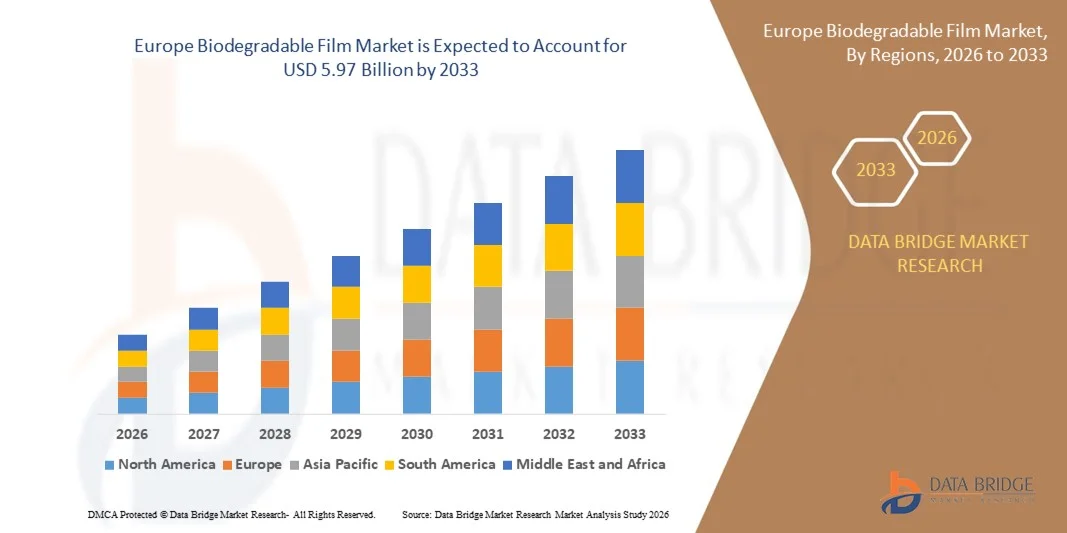
- As per Data Bridge Market Research Analysis the Europe biodegradable film market size was valued at USD 4.01 billion in 2025 and is expected to reach USD 5.97 billion by 2033, at a CAGR of 5.10% during the forecast period
- The market growth is largely fuelled by the rising demand for sustainable packaging solutions across food, agriculture, and consumer goods applications
- Increasing regulatory pressure to reduce single-use plastics and promote eco-friendly materials is significantly accelerating adoption.
Market Size & Forecast
- Europe Market Value (2025): USD 4.01 Billion
- Expected Market Value (2033): USD 5.97 Billion
- Forecast CAGR (2026–2033): 5.10%
What are the Major Takeaways of Europe Biodegradable Film Market ?
- The market is witnessing strong momentum as industries shift toward circular economy practices and prioritize compostable and bio-based materials to meet sustainability targets
- In addition, continuous innovation in raw materials and processing techniques is enhancing performance parity with conventional plastic films, improving cost competitiveness and long-term market viability
- Germany dominated the biodegradable film market with the largest revenue share in 2025, driven by strong environmental regulations, high adoption of sustainable packaging solutions, and early implementation of circular economy practices
- U.K. is expected to witness the highest compound annual growth rate (CAGR) in the Europe biodegradable film market due to increasing demand for sustainable packaging, rising corporate sustainability initiatives, growing adoption of biodegradable films in food and consumer goods packaging, and supportive government policies promoting eco-friendly materials
- The starch blends segment held the largest market share in 2025 driven by its cost-effectiveness, wide raw material availability, and balanced biodegradability properties. Starch blend films are extensively used in packaging and agricultural applications due to their flexibility, ease of processing, and compatibility with existing film manufacturing technologies.
Report Scope and Europe Biodegradable Film Market Segmentation
|
Attributes |
Europe Biodegradable Film Key Market Insights |
|
Segments Covered |
|
|
Countries Covered |
Europe
|
|
Key Market Players |
|
|
Market Opportunities |
|
|
Value Added Data Infosets |
In addition to the insights on market scenarios such as market value, growth rate, segmentation, geographical coverage, and major players, the market reports curated by the Data Bridge Market Research also include import export analysis, production capacity overview, production consumption analysis, price trend analysis, climate change scenario, supply chain analysis, value chain analysis, raw material/consumables overview, vendor selection criteria, PESTLE Analysis, Porter Analysis, and regulatory framework. |
What are the Key Trends in Europe Biodegradable Film Market ?
Rise of Sustainable Packaging Adoption in Biodegradable Films
- The growing shift toward sustainable packaging solutions is transforming the biodegradable film market by encouraging the replacement of conventional plastic films with eco-friendly alternatives. These films help reduce environmental impact while supporting compostability and recyclability goals across multiple packaging applications. Their adoption is also aligned with corporate sustainability targets and circular economy initiatives across packaging value chains
- The rising demand for environmentally responsible packaging in food, agriculture, and consumer goods sectors is accelerating the adoption of biodegradable films. Companies are increasingly integrating these materials to meet sustainability commitments and respond to stricter plastic reduction norms. This shift is also helping brands enhance environmental credibility and comply with evolving packaging guidelines
- Improvements in material formulation and processing technologies are enhancing the functional performance of biodegradable films. Better strength, flexibility, and barrier properties are expanding their use across diverse packaging formats without compromising product protection. These advancements are supporting wider acceptance across both primary and secondary packaging applications
- For instance, several food and consumer goods manufacturers have reported reductions in plastic waste generation after shifting to biodegradable film packaging solutions. This transition has supported sustainability targets while maintaining packaging efficiency and product safety. It has also helped companies reduce dependency on fossil-based plastics
- While sustainability-driven adoption is strengthening market growth, long-term impact depends on continued material innovation, scalable manufacturing, and cost optimization. Ensuring consistent quality and reliable supply remains essential to ensure wider commercial acceptance across industries
Europe Biodegradable Film Market Dynamics
Driver
Increasing Environmental Regulations and Rising Consumer Preference for Eco-Friendly Packaging
- The tightening of environmental regulations on single-use plastics is pushing industries to prioritize biodegradable films as a viable alternative. Regulatory frameworks aimed at reducing plastic pollution are accelerating investments in bio-based and compostable film technologies. These measures are creating a favorable environment for sustainable packaging adoption
- Consumers are increasingly conscious of the environmental impact of packaging waste, prompting brands to adopt biodegradable film solutions. This shift is encouraging manufacturers to redesign packaging strategies around sustainable materials. Growing preference for eco-friendly products is reinforcing demand across retail and food service sectors
- Supportive initiatives from regulatory bodies and industry organizations are strengthening market momentum. Certification programs, sustainability standards, and awareness initiatives are helping accelerate adoption across end-use sectors. These efforts are also improving transparency and trust in biodegradable packaging claims
- For instance, the implementation of plastic reduction policies has led to a noticeable increase in demand for biodegradable films across food packaging and agricultural applications. Companies are responding by expanding production capacity and investing in sustainable material innovation. This trend is contributing to steady market expansion
- While regulatory pressure and consumer awareness are driving the market, maintaining consistent material quality and compliance with compostability standards remains critical. Managing production costs and supply stability is also essential to ensure sustained growth and long-term adoption
Restraint/Challenge
Higher Production Costs and Performance Limitations Compared to Conventional Plastic Films
- The higher production cost of biodegradable films compared to conventional plastic films remains a key challenge for market growth. Bio-based raw materials and specialized processing requirements often increase overall manufacturing expenses. This cost gap can limit adoption among price-sensitive end users
- In certain applications, biodegradable films face performance limitations such as lower moisture resistance or reduced mechanical durability. These challenges restrict their use in high-demand packaging environments requiring extended shelf life. Performance trade-offs can slow substitution of traditional plastic films
- Market adoption is further constrained by limited end-of-life processing infrastructure. Inadequate composting and waste segregation systems can reduce the practical environmental benefits of biodegradable films. This gap affects confidence among manufacturers and brand owners
- For instance, industry stakeholders have highlighted cost constraints and performance trade-offs as major barriers to large-scale substitution. These limitations often delay investment decisions and restrict penetration into mass-market packaging segments. Overcoming these issues remains a priority for technology developers
- While material technologies continue to advance, addressing cost competitiveness and performance consistency remains essential. Alignment with waste management systems and disposal standards is also crucial to unlock the full potential of the biodegradable film market
Europe Biodegradable Film Market Scope
The market is segmented on the basis of type, product type, crop type, and application
- By Type
On the basis of type, the Europe biodegradable film market is segmented into PLA, starch blends, biodegradable polyester, PHA, soy-based, cellulose-based, lignin-based, and others. The starch blends segment held the largest market share in 2025 driven by its cost-effectiveness, wide raw material availability, and balanced biodegradability properties. Starch blend films are extensively used in packaging and agricultural applications due to their flexibility, ease of processing, and compatibility with existing film manufacturing technologies.
The PLA segment is expected to witness the fastest growth rate from 2026 to 2033 due to increasing demand for bio-based and compostable materials. PLA films offer good transparency and strength, making them suitable for food packaging and consumer goods applications while aligning with sustainability and regulatory compliance goals.
- By Product Type
On the basis of product type, the Europe biodegradable film market is segmented into oxo-biodegradable and hydro-biodegradable. The hydro-biodegradable segment accounted for the largest revenue share in 2025 due to its ability to decompose naturally through microbial activity without leaving microplastic residues. These films are widely preferred in applications requiring genuine biodegradability and compostability.
The oxo-biodegradable segment is expected to witness the fastest growth rate from 2026 to 2033 supported by its lower production cost and similarity to conventional plastic films. However, growth remains moderate due to increasing scrutiny over degradation efficiency and environmental impact.
- By Crop Type
Based on crop type, the Europe biodegradable film market is segmented into fruits & vegetables, grains & oilseeds, flowers & plants, and others. The fruits & vegetables segment dominated the market in 2025 owing to extensive use of biodegradable mulch films and packaging films to improve yield quality and reduce plastic waste. These films support moisture retention and soil health while minimizing post-harvest losses.
The flowers & plants segment is anticipated to witness notable growth from 2026 to 2033 due to rising adoption of biodegradable films in nurseries and landscaping. These films help improve plant growth cycles and reduce labor costs associated with film removal.
- By Application
On the basis of application, the Europe biodegradable film market is segmented into food packaging, agriculture & horticulture, cosmetic & personal care products, industrial packaging, and others. The food packaging segment held the largest market share in 2025 driven by strong demand for sustainable packaging solutions and growing emphasis on reducing plastic waste. Biodegradable films are increasingly used for fresh produce, bakery items, and ready-to-eat foods.
The agriculture & horticulture segment is expected to witness the fastest growth rate from 2026 to 2033 during the forecast period due to rising adoption of biodegradable mulch and greenhouse films. These films support sustainable farming practices and help reduce long-term soil contamination caused by conventional plastics.
Europe Biodegradable Film Market Regional Analysis
- Germany dominated the biodegradable film market with the largest revenue share in 2025, driven by strong environmental regulations, high adoption of sustainable packaging solutions, and early implementation of circular economy practices
- Manufacturers and end users in the country place strong emphasis on reducing plastic waste, supporting the widespread use of biodegradable films across food packaging, agriculture, and industrial applications
- This dominance is further supported by advanced recycling and composting infrastructure, high consumer awareness regarding eco-friendly materials, and continuous investments in bio-based material innovation, positioning biodegradable films as a preferred packaging solution
U.K. Biodegradable Film Market Insight
The U.K. biodegradable film market is expected to witness the fastest growth rate from 2026 to 2033, fueled by rising sustainability commitments and increasing pressure to reduce single-use plastics. Businesses are actively shifting toward biodegradable and compostable packaging to align with environmental targets and evolving consumer preferences. The growing adoption of sustainable packaging in food, personal care, and retail sectors, combined with supportive policy initiatives and corporate sustainability goals, is significantly accelerating market growth. In addition, increasing investments in eco-friendly packaging technologies are strengthening long-term demand for biodegradable films.
Europe Biodegradable Film Market Share
The Europe biodegradable film industry is primarily led by well-established companies, including:
- BASF SE (Germany)
- Novamont S.p.A. (Italy)
- TotalEnergies Corbion (Netherlands)
- NatureWorks Europe (Netherlands)
- FKuR Kunststoff GmbH (Germany)
- Taghleef Industries (Luxembourg)
- Futamura Group (U.K.)
- Walki Group (Finland)
- Sphere Group (France)
- Innovia Films (U.K.)

- Interactive Data Analysis Dashboard
- Company Analysis Dashboard for high growth potential opportunities
- Research Analyst Access for customization & queries
- Competitor Analysis with Interactive dashboard
- Latest News, Updates & Trend analysis
- Harness the Power of Benchmark Analysis for Comprehensive Competitor Tracking
Europe Biodegradable Film Market, Supply Chain Analysis and Ecosystem Framework
To support market growth and help clients navigate the impact of geopolitical shifts, DBMR has integrated in-depth supply chain analysis into its Europe Biodegradable Film Market research reports. This addition empowers clients to respond effectively to global changes affecting their industries. The supply chain analysis section includes detailed insights such as Europe Biodegradable Film Market consumption and production by country, price trend analysis, the impact of tariffs and geopolitical developments, and import and export trends by country and HSN code. It also highlights major suppliers with data on production capacity and company profiles, as well as key importers and exporters. In addition to research, DBMR offers specialized supply chain consulting services backed by over a decade of experience, providing solutions like supplier discovery, supplier risk assessment, price trend analysis, impact evaluation of inflation and trade route changes, and comprehensive market trend analysis.
Data collection and base year analysis are done using data collection modules with large sample sizes. The stage includes obtaining market information or related data through various sources and strategies. It includes examining and planning all the data acquired from the past in advance. It likewise envelops the examination of information inconsistencies seen across different information sources. The market data is analysed and estimated using market statistical and coherent models. Also, market share analysis and key trend analysis are the major success factors in the market report. To know more, please request an analyst call or drop down your inquiry.
The key research methodology used by DBMR research team is data triangulation which involves data mining, analysis of the impact of data variables on the market and primary (industry expert) validation. Data models include Vendor Positioning Grid, Market Time Line Analysis, Market Overview and Guide, Company Positioning Grid, Patent Analysis, Pricing Analysis, Company Market Share Analysis, Standards of Measurement, Global versus Regional and Vendor Share Analysis. To know more about the research methodology, drop in an inquiry to speak to our industry experts.
Data Bridge Market Research is a leader in advanced formative research. We take pride in servicing our existing and new customers with data and analysis that match and suits their goal. The report can be customized to include price trend analysis of target brands understanding the market for additional countries (ask for the list of countries), clinical trial results data, literature review, refurbished market and product base analysis. Market analysis of target competitors can be analyzed from technology-based analysis to market portfolio strategies. We can add as many competitors that you require data about in the format and data style you are looking for. Our team of analysts can also provide you data in crude raw excel files pivot tables (Fact book) or can assist you in creating presentations from the data sets available in the report.













