


Europe Bladder Disorders Market Overview
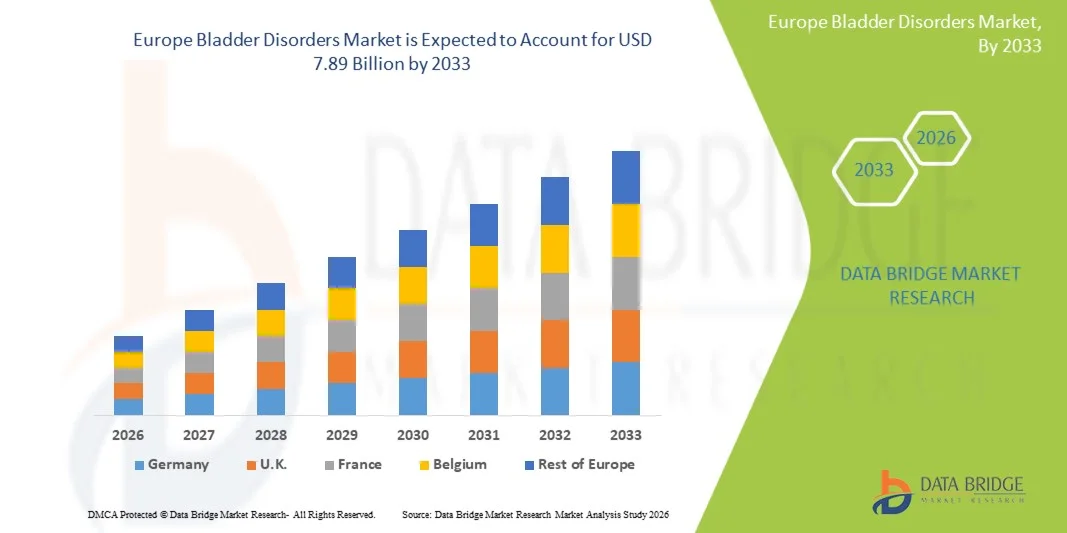
The Europe bladder disorders market was valued at USD 3.50 billion in 2025 and is projected to reach USD 7.89 billion by 2033, growing at a CAGR of 10.70% from 2026 to 2033. The market is witnessing steady growth driven by the rising prevalence of urinary incontinence, overactive bladder, urinary tract infections, and neurogenic bladder conditions, alongside increasing awareness regarding early diagnosis and treatment options across the region.
The growing geriatric population, which is more susceptible to bladder dysfunction and related urological conditions, is significantly contributing to market expansion. In addition, advancements in minimally invasive treatment procedures, neuromodulation therapies, bladder monitoring technologies, and pharmaceutical innovations are improving patient outcomes and encouraging wider adoption of bladder disorder management solutions. Favorable healthcare infrastructure, increasing healthcare expenditure, and supportive reimbursement policies in several European countries are further accelerating market growth, while ongoing research activities and the introduction of novel therapies continue to strengthen the regional treatment landscape.
Key Market Trends & Insights
- Germany dominated the Europe bladder disorders market with the largest revenue share of 24.87% in 2025, supported by its advanced healthcare infrastructure, high diagnosis rates, and strong adoption of innovative urology treatments.
- The Urinary Incontinence segment led the market with a 38.64% share in 2025, driven by its high prevalence among the aging population and women across Europe.
- Spain is expected to be the fastest-growing country at a CAGR of 6.8% from 2026 to 2033, fueled by an aging population, increasing healthcare investments, and rising awareness regarding bladder health and treatment accessibility.
- Overactive Bladder are the fastest-growing type, projected to register a CAGR of 6.9%, reflecting the surge in diagnosis rates and increasing awareness regarding bladder dysfunction.
- The Medication segment dominated the treatment type category with a 47.82% revenue share in 2025, led by its widespread use as the first-line treatment option for various bladder disorders.
- Urodynamic Testing accounted for 29.76% of the market, preferred by its ability to provide comprehensive assessment of bladder and urinary tract function.
- The Bladder Ultrasound segment is the fastest-growing diagnosis category, with a CAGR of 7.0%, driven by its non-invasive nature and increasing availability across healthcare settings.
Market Size & Forecast
- Global Market Value (2025): USD 3.50 Billion
- Expected Market Value (2033): USD Billion
- Forecast CAGR (2026–2033): 10.70%
- Leading Country in 2025: Germany
- Fastest Growing Country: Spain
Report Scope and Europe Bladder Disorders Market Segmentation
|
Attributes |
Europe Bladder Disorders Key Market Insights |
|
Segments Covered |
|
|
Countries Covered |
Europe · Germany · France · U.K. · Netherlands · Switzerland · Belgium · Russia · Italy · Spain · Turkey · Rest of Europe |
|
Key Market Players |
· B. Braun SE (Germany) · Coloplast A/S (Denmark) · Hollister Incorporated (U.S.) · Convatec Group PLC (U.K.) · Teleflex Incorporated (U.S.) · Boston Scientific Corporation (U.S.) · Medtronic (Ireland) · BD (U.S.) · Cook (U.S.) · Laborie Medical Technologies Corp. (Canada) · Astellas Pharma Inc. (Japan) · Pierre Fabre Médicament (France) · UroMems (France) · UroPharma Limited (U.K.) · Hisamitsu Pharmaceutical Co., Inc. (Japan) · Sumitomo Pharma Co., Ltd. (Japan) · Viatris Inc. (U.S.) · Wellspect HealthCare (Sweden) · BlueWind Medical Ltd. (Israel) · Flowstim Technology (France) |
|
Market Opportunities |
· Expanding adoption of sacral neuromodulation and tibial nerve stimulation therapies · Growing demand for home-based bladder monitoring and digital health solutions · Increasing investment in regenerative medicine and next-generation biologic therapies |
|
Value Added Data Infosets |
In addition to the insights on market scenarios such as market value, growth rate, segmentation, geographical coverage, and major players, the market reports curated by the Data Bridge Market Research also include in-depth expert analysis, patient epidemiology, pipeline analysis, pricing analysis, and regulatory framework. |
Europe Bladder Disorders Market Trends
Trend: Rising Adoption of Minimally Invasive Bladder Disorder Treatments
Healthcare providers across Europe are increasingly adopting minimally invasive treatment options for bladder disorders to improve patient outcomes, reduce hospital stays, and minimize procedure-related complications. Technologies such as sacral neuromodulation, tibial nerve stimulation, and intravesical botulinum toxin injections are gaining traction for managing overactive bladder and urinary incontinence. Growing patient preference for less invasive interventions, combined with advancements in urological devices and treatment protocols, is encouraging wider clinical adoption across hospitals and specialty urology centers throughout the region.
For instance, in June 2024, the European Association of Urology continued to promote evidence-based guidance supporting minimally invasive therapies for overactive bladder, reflecting the growing acceptance of these treatment approaches across European healthcare systems.
Europe Bladder Disorders Market Dynamics
Key Market Driver: Growing Prevalence of Aging-Related Bladder Disorders
The rapidly aging population across Europe has created substantial demand for bladder disorder diagnosis and treatment services, as older adults are more susceptible to urinary incontinence, overactive bladder, and neurogenic bladder conditions. Healthcare providers, urology specialists, and long-term care facilities are expanding their focus on bladder health management to address increasing patient volumes. This demographic trend is driving demand for advanced diagnostics, pharmaceutical therapies, and innovative treatment technologies, supporting sustained market growth throughout the region. For instance, in March 2024, Eurostat reported continued growth in Europe’s elderly population, reinforcing the need for expanded healthcare services targeting age-related urological and bladder health conditions.
Key Restraint/Challenge: Underdiagnosis and Social Stigma Associated with Bladder Conditions
A significant restraint in the Europe bladder disorders market is the persistent underdiagnosis of bladder-related conditions due to social stigma, embarrassment, and delayed medical consultation among affected individuals. Many patients avoid seeking treatment despite experiencing symptoms, resulting in disease progression and reduced treatment effectiveness. Limited awareness regarding available therapies and reluctance to discuss bladder health concerns continue to hinder timely diagnosis and treatment adoption, particularly among elderly populations and underserved communities.
For instance, ongoing findings highlighted by European urology organizations during 2024 emphasized that a considerable proportion of individuals with urinary incontinence remain untreated due to stigma and lack of awareness, reflecting a key challenge for market expansion.
Key Market Opportunity: Expansion of Digital Health and Remote Bladder Monitoring Solutions
The integration of digital health technologies in bladder disorder management presents a significant market opportunity. Connected monitoring devices, mobile health applications, and remote patient management platforms enable continuous symptom tracking, treatment adherence monitoring, and personalized care delivery. The growing adoption of telehealth services and data-driven healthcare models is improving access to bladder care while supporting early intervention strategies. These innovations are creating new growth opportunities for healthcare providers, medical device manufacturers, and digital health companies across Europe.
For instance, in 2024, several European healthcare systems expanded digital care initiatives for chronic disease management, supporting broader adoption of remote monitoring technologies that can be applied to bladder disorder diagnosis and long-term patient management.
Europe Bladder Disorders Market Scope
The Europe bladder disorders market is segmented on the basis of type, treatment type, diagnosis, end user, and distribution channel.
- By Type
On the basis of type, the Europe bladder disorders market is segmented into cystitis, urinary incontinence, overactive bladder, interstitial cystitis, and bladder cancer. The Urinary Incontinence segment dominated the market with a 38.64% share in 2025, owing to its high prevalence among the aging population and women across Europe. The condition is becoming increasingly common due to factors such as obesity, neurological disorders, and post-menopausal complications. Growing awareness campaigns and improved diagnosis rates are contributing to higher treatment adoption. Pharmaceutical therapies, pelvic floor rehabilitation programs, and minimally invasive procedures are widely utilized for management. Healthcare providers are also emphasizing early intervention to reduce long-term complications and improve quality of life. The increasing availability of advanced treatment options continues to support the segment’s leading position in the regional market.
The Overactive Bladder segment is projected to register the fastest growth at a CAGR of 6.9% from 2026 to 2033, driven by rising diagnosis rates and increasing awareness regarding bladder dysfunction. The condition affects a significant portion of the elderly population and individuals with neurological disorders. Advancements in neuromodulation therapies and botulinum toxin treatments are improving patient outcomes and encouraging treatment adoption. Growing acceptance of minimally invasive interventions is further supporting market expansion. Increasing healthcare expenditure and access to specialized urology services are also contributing to growth. Continuous research into innovative treatment approaches is expected to strengthen the segment throughout the forecast period.
- By Treatment Type
On the basis of treatment type, the Europe bladder disorders market is segmented into surgery, medication, and non-surgical treatments. The Medication segment dominated the market with a 47.82% share in 2025, driven by its widespread use as the first-line treatment option for various bladder disorders. Medications offer convenient symptom management and are readily available across hospital and retail pharmacy networks. Continuous development of improved drug formulations with enhanced efficacy and safety profiles is supporting market demand. Physicians frequently prescribe pharmacological therapies before considering invasive interventions. Increasing diagnosis rates and growing patient awareness are also contributing to higher prescription volumes. The segment continues to benefit from strong clinical acceptance and broad reimbursement coverage in several European countries.
The Non-Surgical segment is anticipated to witness the fastest growth at a CAGR of 7.2% from 2026 to 2033, supported by increasing demand for minimally invasive and conservative treatment approaches. Therapies such as pelvic floor muscle training, neuromodulation, and behavioral interventions are gaining popularity among patients and healthcare providers. These options reduce procedural risks while improving long-term symptom control. Technological advancements in neuromodulation devices are enhancing treatment effectiveness and accessibility. Growing preference for outpatient care and reduced recovery times is further accelerating adoption. The expanding focus on patient-centered treatment strategies continues to create growth opportunities for this segment.
- By Diagnosis
On the basis of diagnosis, the Europe bladder disorders market is segmented into urinalysis, cystoscopy, urodynamic testing, bladder ultrasound, imaging tests, and others. The Urodynamic Testing segment accounted for the largest market share of 29.76% in 2025 owing to its ability to provide comprehensive assessment of bladder and urinary tract function. It is widely used for diagnosing complex bladder disorders and evaluating treatment effectiveness. Healthcare professionals rely on these tests to obtain detailed physiological information that cannot be captured through basic diagnostic procedures. Increasing prevalence of urinary incontinence and overactive bladder is driving testing volumes across Europe. Improvements in diagnostic equipment accuracy and patient comfort are supporting adoption. The growing emphasis on precise diagnosis and personalized treatment planning further strengthens the segment’s leadership.
The Bladder Ultrasound segment is expected to experience the fastest growth at a CAGR of 7.0% from 2026 to 2033 due to its non-invasive nature and increasing availability across healthcare settings. Ultrasound technology enables rapid assessment of bladder volume, residual urine levels, and structural abnormalities. The procedure is safe, cost-effective, and suitable for repeated evaluations. Technological advancements are improving image quality and diagnostic reliability. Growing preference for minimally invasive diagnostic techniques is accelerating utilization among healthcare providers. Expanding use in outpatient clinics and community healthcare facilities is also contributing to strong segment growth.
- By End User
On the basis of end user, the Europe bladder disorders market is segmented into hospitals, clinics, ambulatory surgery centers, and others. The Hospitals segment dominated the market with a 51.38% share in 2025, supported by the availability of advanced diagnostic infrastructure and specialized urology departments. Hospitals manage a large volume of bladder disorder patients requiring comprehensive diagnostic and therapeutic services. They also offer access to multidisciplinary healthcare teams and advanced surgical interventions when necessary. Strong reimbursement frameworks and established referral networks contribute to higher patient inflow. Continuous investment in healthcare infrastructure further enhances treatment capabilities. The segment remains the primary setting for diagnosis and management of complex bladder conditions.
The Ambulatory Surgery Centers segment is projected to grow at the fastest rate with a CAGR of 6.8% from 2026 to 2033 due to increasing demand for cost-effective and minimally invasive treatment procedures. These facilities provide shorter waiting times and reduced hospitalization costs compared to traditional hospital settings. Advances in surgical techniques are enabling a broader range of bladder disorder procedures to be performed on an outpatient basis. Patients increasingly prefer these centers because of convenience and faster recovery periods. Healthcare systems are also encouraging outpatient treatment models to optimize resource utilization. Growing acceptance of same-day procedures is expected to accelerate segment expansion.
- By Distribution Channel
On the basis of distribution channel, the Europe bladder disorders market is segmented into direct and retail. The Direct segment dominated the market with a 63.54% share in 2025 owing to strong procurement channels between healthcare institutions and pharmaceutical or medical device manufacturers. Hospitals and specialty clinics often purchase products directly to ensure consistent supply and better pricing arrangements. This distribution model supports efficient delivery of prescription medications, diagnostic equipment, and treatment devices. Large healthcare providers benefit from long-term supplier agreements and streamlined inventory management. Increasing demand for specialized bladder disorder therapies further supports direct procurement activities. The segment continues to maintain a significant share due to its operational efficiency and reliability.
The Retail segment is expected to witness the fastest growth at a CAGR of 6.6% from 2026 to 2033, driven by expanding access to bladder disorder medications and supportive care products through retail pharmacy networks. Growing patient preference for convenient purchasing options is increasing product availability across community pharmacies. Retail channels are also benefiting from rising awareness and self-management of chronic bladder conditions. Improvements in pharmacy services and patient counseling are enhancing treatment adherence. The expansion of digital pharmacy platforms is further supporting product accessibility. Increasing demand for outpatient and home-based care solutions is expected to strengthen growth prospects for this segment.
Europe Bladder Disorders Market Regional Analysis
Germany dominated the Europe bladder disorders market with the largest revenue share of 24.87% in 2025, supported by its advanced healthcare infrastructure, high diagnosis rates, and strong adoption of innovative urology treatments. The country also benefits from strong reimbursement policies, widespread access to specialized urology services, and growing adoption of advanced diagnostic and minimally invasive treatment technologies. Increasing prevalence of urinary incontinence, overactive bladder, and age-related urological conditions continues to drive demand across healthcare settings. Rising healthcare expenditure, ongoing clinical research activities, and expanding availability of innovative therapies further strengthen Germany’s leadership position within the European bladder disorders market.
The Germany Bladder Disorders Market Insight
The Germany bladder disorders market is witnessing steady growth due to the rising prevalence of urinary incontinence, overactive bladder, and other chronic urological conditions. The country’s advanced healthcare infrastructure, strong reimbursement framework, and widespread availability of specialized urology services are driving demand for diagnostic and treatment solutions. In addition, increasing adoption of minimally invasive therapies, neuromodulation technologies, and advanced diagnostic systems is supporting market expansion. Growing awareness regarding bladder health and the increasing elderly population are further accelerating treatment adoption across healthcare settings.
U.K. Bladder Disorders Market Insight
The U.K. bladder disorders market is experiencing steady growth, supported by increasing awareness of bladder health conditions and rising demand for advanced treatment solutions. Growing adoption of minimally invasive procedures, expanding access to specialist urology services, and continuous improvements in diagnostic technologies are contributing to market development. Furthermore, government initiatives promoting early diagnosis and improved patient care are supporting treatment uptake. The increasing burden of age-related bladder disorders and strong healthcare system capabilities continue to drive market growth across the country.
France Bladder Disorders Market Insight
The France bladder disorders market is expanding steadily due to rising prevalence of urinary tract disorders and increasing demand for effective diagnosis and treatment options. Healthcare providers are increasingly adopting advanced imaging systems, urodynamic testing technologies, and innovative therapeutic approaches to improve patient outcomes. Growing awareness campaigns and strong healthcare reimbursement mechanisms are encouraging timely diagnosis and treatment. In addition, increasing investment in healthcare modernization and urology research is further supporting market growth throughout France.
Spain Bladder Disorders Market Insight
The Spain bladder disorders market is witnessing notable growth due to the increasing prevalence of urinary incontinence, overactive bladder, and other age-related urological conditions. The country's expanding elderly population, improving access to specialized healthcare services, and rising awareness regarding bladder health are driving demand for diagnosis and treatment solutions. Healthcare providers are increasingly adopting minimally invasive procedures, neuromodulation therapies, and advanced diagnostic technologies to improve patient outcomes. In addition, supportive public healthcare infrastructure and growing investment in urology care are contributing to market expansion. The increasing focus on early diagnosis and effective disease management continues to strengthen Spain’s position as one of the fastest-growing bladder disorders markets in Europe.
Europe Bladder Disorders Market Share
The Europe bladder disorders industry is primarily led by well-established companies, including:
- Braun SE (Germany)
- Coloplast A/S (Denmark)
- Hollister Incorporated (U.S.)
- Convatec Group PLC (U.K.)
- Teleflex Incorporated (U.S.)
- Boston Scientific Corporation (U.S.)
- Medtronic (Ireland)
- BD (U.S.)
- Cook (U.S.)
- Laborie Medical Technologies Corp. (Canada)
- Astellas Pharma Inc. (Japan)
- Pierre Fabre Médicament (France)
- UroMems (France)
- UroPharma Limited (U.K.)
- Hisamitsu Pharmaceutical Co., Inc. (Japan)
- Sumitomo Pharma Co., Ltd. (Japan)
- Viatris Inc. (U.S.)
- Wellspect HealthCare (Sweden)
- BlueWind Medical Ltd. (Israel)
- Flowstim Technology (France)
Latest Developments in Europe Bladder Disorders Market
- In February 2025, UroMems, a France-based medical technology company, announced successful results from its first-ever female clinical feasibility study of the UroActive smart implant for stress urinary incontinence. The study demonstrated that the entire treatment cohort achieved the six-month primary endpoints, highlighting the potential of the automated artificial urinary sphincter to improve continence management. The results support the advancement of innovative implantable therapies for patients with severe urinary incontinence and reinforce Europe’s position as a hub for next-generation bladder disorder technologies
- In June 2024, UroMems announced the completion of a €44 million Series C financing round to support pivotal European clinical trials of its UroActive system for stress urinary incontinence. The funding is being used to accelerate large-scale clinical studies and regulatory activities in Europe and other key markets. The development reflects growing investment in advanced bladder disorder treatments and the increasing focus on innovative implantable solutions for urinary dysfunction
- In April 2024, BlueWind Medical announced the publication of positive OASIS pivotal trial results for its Revi™ System, an implantable tibial neuromodulation therapy for urge urinary incontinence. The study demonstrated strong safety and efficacy outcomes, with a significant proportion of patients achieving meaningful reductions in incontinence episodes. The results strengthen the clinical evidence supporting neuromodulation as an effective treatment option for overactive bladder and urinary incontinence across Europe
- In February 2024, UroMems reported successful six-month outcomes for the first female patient implanted with its UroActive smart artificial urinary sphincter in France. The milestone demonstrated the device’s potential to provide personalized treatment for women suffering from stress urinary incontinence and marked an important advancement in bladder disorder management. The achievement also expanded the clinical evidence base supporting future commercialization efforts in Europe
- In September 2023, UroMems announced completion of enrollment in its first-in-man clinical study evaluating the UroActive System for stress urinary incontinence. The study enrolled patients in leading French hospitals and represented a significant step toward broader European clinical validation of the technology. The successful enrollment milestone supported preparation for larger pivotal studies and demonstrated continued progress in developing innovative solutions for chronic bladder disorders

- Interactive Data Analysis Dashboard
- Company Analysis Dashboard for high growth potential opportunities
- Research Analyst Access for customization & queries
- Competitor Analysis with Interactive dashboard
- Latest News, Updates & Trend analysis
- Harness the Power of Benchmark Analysis for Comprehensive Competitor Tracking
Data collection and base year analysis are done using data collection modules with large sample sizes. The stage includes obtaining market information or related data through various sources and strategies. It includes examining and planning all the data acquired from the past in advance. It likewise envelops the examination of information inconsistencies seen across different information sources. The market data is analysed and estimated using market statistical and coherent models. Also, market share analysis and key trend analysis are the major success factors in the market report. To know more, please request an analyst call or drop down your inquiry.
The key research methodology used by DBMR research team is data triangulation which involves data mining, analysis of the impact of data variables on the market and primary (industry expert) validation. Data models include Vendor Positioning Grid, Market Time Line Analysis, Market Overview and Guide, Company Positioning Grid, Patent Analysis, Pricing Analysis, Company Market Share Analysis, Standards of Measurement, Global versus Regional and Vendor Share Analysis. To know more about the research methodology, drop in an inquiry to speak to our industry experts.
Data Bridge Market Research is a leader in advanced formative research. We take pride in servicing our existing and new customers with data and analysis that match and suits their goal. The report can be customized to include price trend analysis of target brands understanding the market for additional countries (ask for the list of countries), clinical trial results data, literature review, refurbished market and product base analysis. Market analysis of target competitors can be analyzed from technology-based analysis to market portfolio strategies. We can add as many competitors that you require data about in the format and data style you are looking for. Our team of analysts can also provide you data in crude raw excel files pivot tables (Fact book) or can assist you in creating presentations from the data sets available in the report.












