


Body Composition Analyzers Market Size
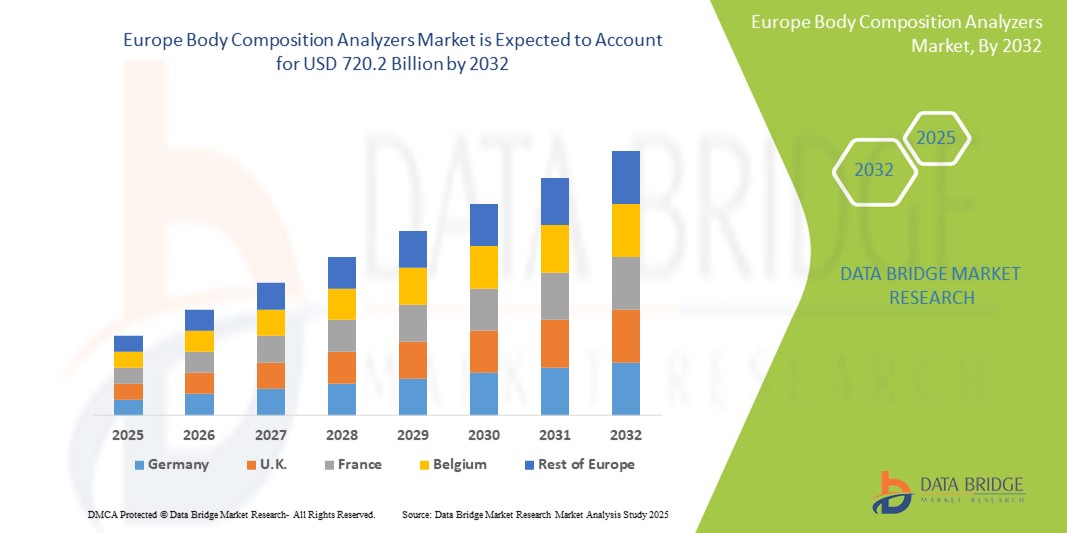
- The Europe Body Composition Analyzers market size was valued at USD 345.6 million in 2024 and is expected to reach USD 720.2 million by 2032, at a CAGR of 9.6% during the forecast period
- The market growth is largely fueled by heightened awareness regarding health and wellness, the rising prevalence of obesity and related health conditions (such as diabetes and cardiovascular diseases), and the increasing trend towards personalized fitness and tailored nutrition plans across Europe.
- Furthermore, continuous technological advancements, including improved accuracy, portability, and integration with mobile apps and health management software, are driving market expansion. These converging factors are accelerating the adoption of body composition analyzers, thereby significantly boosting the industry's growth.
Body Composition Analyzers Market Analysis
- Body Composition Analyzers market comprises various devices used to measure the ratio of fat and fat-free mass (muscle, water, bone, minerals) in the human body. These analyzers are integral tools for health monitoring, fitness assessment, and disease prevention, providing crucial data for personalized health and nutrition plans. Technologies include Bio-impedance Analyzers (BIA), Dual Energy X-ray Absorptiometry (DEXA), Skinfold Calipers, Air Displacement Plethysmography (ADP), and Hydrostatic Weighing Equipment.
- he escalating demand for body composition analyzers is primarily fueled by the increasing focus on preventive healthcare, the growing popularity of sports and fitness activities, and the rising need for effective monitoring of body composition changes for health management.
- Germany dominates the Body Composition Analyzers market in Europe, holding the largest revenue share of 28.5% in 2025, supported by the country’s advanced diagnostic infrastructure, strong penetration of health and wellness programs, and a rapidly aging population. The country’s proactive focus on obesity prevention, metabolic health management, and elderly care has fueled adoption in hospitals, sports clinics, and rehabilitation centers.
- Germany is also expected to be the fastest-growing country in the Europe Body Composition Analyzers market during the forecast period, driven by increased health screening initiatives, integration of digital health platforms, and rising demand for at-home monitoring devices. Additionally, strategic partnerships between healthcare providers and fitness technology companies are enhancing the availability of advanced analyzers to a broader population base.
- Bio Impedance Analyzers, are expected to dominate the Europe Body Composition Analyzers market with a market share of 29.2% in 2025, accounting for the largest market share due to their non-invasive nature, affordability, portability, and wide application across fitness centers, wellness programs, and clinical nutrition. Continued enhancements in multi-frequency BIA technology and connectivity with health tracking apps further support their growing adoption across both healthcare and consumer segments.
Report Scope and Body Composition Analyzers Market Segmentation
|
Attributes |
Body Composition Analyzers Key Market Insights |
|
Segments Covered |
|
|
Countries Covered |
Europe
|
|
Key Market Players |
|
|
Market Opportunities |
|
|
Value Added Data Infosets |
In addition to the insights on market scenarios such as market value, growth rate, segmentation, geographical coverage, and major players, the market reports curated by the Data Bridge Market Research also include in-depth expert analysis, pricing analysis, brand share analysis, consumer survey, demography analysis, supply chain analysis, value chain analysis, raw material/consumables overview, vendor selection criteria, PESTLE Analysis, Porter Analysis, and regulatory framework. |
Body Composition Analyzers Market Trends
“Integration with mobile apps and health management software”
- Integration of Smart Technologies and Enhanced User Experience: A significant and accelerating trend in the Europe Body Composition Analyzers market is the increasing integration of smart technologies, such as Bluetooth and Wi-Fi connectivity, and mobile applications. This evolution is significantly enhancing user engagement, data management, and the overall user experience.
- For instance, modern body composition analyzers often connect seamlessly with smartphones and health management software, allowing users to track changes in muscle mass, body fat, and hydration levels over time. This connectivity provides real-time data, trend analysis, and personalized insights, enabling precise adjustments in diet and training programs.
- The development of more sophisticated algorithms and sensors is leading to higher accuracy and reproducibility of measurements. This is crucial for both individual users and healthcare professionals who monitor patient health or athlete performance.
- The market is also witnessing a trend towards miniaturization and portability, making devices more accessible for home users and for on-site consultations by fitness professionals.
- This trend towards more intelligent, connected, and user-friendly body composition analyzers is fundamentally reshaping how individuals and professionals approach health monitoring and personalized wellness in Europe
Body Composition Analyzers Market Dynamics
Driver
“Heightened awareness regarding health and wellness”
- Rising Health Awareness and Prevalence of Obesity: The increasing awareness about health and fitness among the European population, coupled with the rising prevalence of obesity and related health conditions (such as diabetes and cardiovascular diseases), is a significant driver for the heightened demand for body composition analyzers
- For instance, over half of the adult population in many OECD countries, including those in Europe, are overweight, and a significant portion are obese. This high prevalence necessitates the monitoring of body composition for effective health management and preventive care
- European countries have high healthcare expenditure with a strong emphasis on preventive care, leading to increased adoption of body composition analyzers by healthcare providers. The incorporation of body composition analysis in regular health check-ups is becoming more common.
- The burgeoning fitness industry and increasing membership in health clubs and wellness centers across Europe are also propelling market growth, as these facilities increasingly offer body composition analysis services.
- The aging population in Europe, at higher risk for sarcopenia and osteoporosis, further underlines the need for regular health monitoring using these devices
Restraint/Challenge
“High cost of advanced analyzers (e.g., DEXA)”
- High Cost and Inconsistency in Readings: The high cost of advanced body composition analyzers, particularly those using DEXA or advanced imaging technologies, coupled with potential inconsistencies in readings from different devices, presents a significant challenge to widespread market adoption.
- For instance, the prohibitive cost of DEXA scanners can limit their accessibility to larger segments of the population, especially in lower-income regions or smaller clinics. This restricts market potential and adoption rates, as both consumers and healthcare providers may be hesitant to invest in costly equipment.
- Variability in accuracy and the lack of standardized protocols across different body composition analyzer technologies can lead to inconsistent results, making it difficult for users and healthcare providers to rely on the measurements for clinical decisions. This issue can undermine trust in these devices.
- Additionally, low penetration of advanced healthcare devices in some developing countries within Europe, coupled with underdeveloped healthcare infrastructure and lower awareness, can hinder market growth.
- Stringent regulatory frameworks regarding the use of body composition analyzers also add to the complexity for manufacturers.
Body Composition Analyzers Market Scope
The market is segmented on the basis product type, Compartment Model Type and end user.
- By Product
On the basis of Product, the Body Composition Analyzers Market is into Bio Impedance Analyzers, Dual Energy X-Ray Absorptiometry (DXA), Skinfold Caliper, Air Displacement Plethysmography (ADP), and Others. The Bio Impedance Analyzers segment is expected to dominate the market with the largest revenue share of 29.2% 2025 owing to their affordability, portability, ease of use, and widespread application across fitness centers, wellness programs, and clinical nutrition practices. These devices offer rapid, non-invasive assessments and are increasingly integrated with digital health platforms, making them highly accessible in both professional and consumer settings.
The Air Displacement Plethysmography (ADP) segment is anticipated to witness the fastest growth rate of 5.2% from 2025 to 2032, driven by growing adoption in clinical research and pediatric healthcare due to its high accuracy and safety. ADP systems are gaining popularity in sports medicine, geriatrics, and academic institutions where precision in body composition analysis is critical. Technological enhancements and miniaturization are further contributing to its market expansion.
- By Compartment Model Type
On the basis of Compartment Model Type, the Body Composition Analyzers market is segmented into Two-Compartment Model, Three-Compartment Model, and Multi-Compartment Models. The Two-Compartment Model held the largest market revenue share in 2025 due to its simplicity, cost-effectiveness, and suitability for routine use in fitness and wellness environments. These models divide the body into fat mass and fat-free mass, providing a practical approach to body composition monitoring for general health assessments.
The Multi-Compartment Models is expected to witness the fastest CAGR from 2025 to 2032, as they offer superior accuracy by evaluating additional body compartments such as bone mineral content, intracellular water, and extracellular water. This model is gaining traction in advanced clinical diagnostics, research institutions, and elite sports organizations where detailed body composition profiling is essential for treatment planning and performance optimization.
- By End users
On the basis of end users, the Body Composition Analyzers market is segmented into Health Fitness Clubs, Hospitals and Clinics, Academy, and Others. The Hospitals and Clinics segment accounted for the largest market revenue share in 2024, due to increasing clinical applications of body composition analyzers in managing obesity, malnutrition, sarcopenia, and metabolic disorders. The integration of body composition analysis into routine diagnostics and patient monitoring protocols in public and private hospitals across Germany, France, and Italy is further strengthening this segment’s dominance.
The Health Fitness Clubs segment is expected to witness the fastest CAGR from 2025 to 2032, supported by the growing trend of personalized fitness, wellness tracking, and preventive health programs. Fitness centers and gyms across the UK, Spain, and Nordic countries are increasingly adopting smart body analyzers to offer value-added services such as customized workout and nutrition plans. The growing influence of digital health ecosystems and wearable integration is accelerating adoption in this segment.
Body Composition Analyzers Market Regional Analysis
- Germany dominates the Europe Body Composition Analyzers market, capturing the largest revenue share of 28.5% in 2025, driven by its advanced healthcare infrastructure, strong focus on preventive care, and high adoption of fitness and wellness technologies. The country's increasing burden of obesity and chronic lifestyle diseases has accelerated the demand for accurate body composition monitoring in clinical and non-clinical settings.
- Germany’s leadership is further reinforced by widespread integration of body composition analyzers into hospital systems, sports medicine clinics, and rehabilitation centers. Major manufacturers and digital health startups are actively launching innovative devices—such as multi-frequency BIA systems and portable analyzers—tailored for professional and consumer use.
- In addition, Germany benefits from a robust ecosystem of academic research and public health initiatives targeting aging-related health risks, such as sarcopenia and osteoporosis. This environment supports the clinical validation and deployment of advanced models like DXA and multi-compartment body composition systems across research institutions and university hospitals.
France Body Composition Analyzers Market Insight
The France Body Composition Analyzers market is projected to grow at a significant CAGR during the forecast period, supported by rising awareness of health and wellness, strong government initiatives targeting obesity, and expanding use of diagnostic tools in public health campaigns. France's national nutrition and physical activity programs have elevated the importance of body composition analysis in both medical and lifestyle contexts. The country's hospital networks are increasingly incorporating DXA and ADP technologies for assessing body fat, lean mass, and bone density—particularly among the elderly and patients with chronic conditions. France is also investing in smart health technologies, with wellness apps and connected devices driving demand for home-based and portable analyzers. Additionally, collaborations between healthcare providers, academic institutions, and sports science organizations are fostering innovation in precision health monitoring. Regulatory support and data privacy frameworks further facilitate the deployment of digital body composition solutions in fitness and clinical settings.
U.K. Body Composition Analyzers Market Insight
The U.K. Body Composition Analyzers market is poised for robust growth, driven by NHS initiatives to promote preventive care, manage obesity, and address the rise in lifestyle-related diseases such as diabetes and cardiovascular conditions. The country’s aging population and focus on community-based healthcare have increased the demand for non-invasive, portable body composition tools in both public and private sectors. Despite economic and regulatory transitions post-Brexit, the U.K. continues to align with global medical standards and remains a key importer of advanced health technologies. Fitness clubs, wellness centers, and private clinics across the U.K. are rapidly adopting BIA and connected smart analyzers to support customized wellness programs. Further, academic research hubs and institutions like Public Health England are promoting evidence-based use of body composition data for population health management. The country’s strong digital infrastructure, along with increasing integration of analyzers into telehealth platforms, is expanding market reach across both urban and rural populations.
Body Composition Analyzers Market Share
The Body Composition Analyzers industry is primarily led by well-established companies, including:
- InBody Co., Ltd. (South Korea)
- Tanita Corporation (Japan)
- Omron Corporation (Japan)
- Hologic, Inc. (U.S.)
- GE Healthcare (U.S.)
- seca GmbH & Co. Kg (Germany)
- Bodystat Limited (U.K.)
- COSMED Srl (Italy)
- RJL Systems, Inc. (U.S.)
- SELVAS Healthcare (Selvas AI, Inc.) (South Korea)
- Beurer GmbH (Germany)
- LAICA S.p.A (Italy)
- AKERN (Italy)
- ImpediMed Ltd (Australia)
- ImpediMed Inc (U.S.)
- Withings (France)
Latest Developments in Europe Body Composition Analyzers Market
- In March 2024, InBody introduced the InBody 380, an advanced body composition analyzer designed for fitness and wellness professionals. It offers precise body measurements, supporting personalized health plans and reflecting increasing demand for accurate, accessible body composition analysis in the wellness industry.
- In March 2023, Bauerfeind AG launched smart ankle braces in Europe, featuring embedded sensors that monitor movement and deliver real-time feedback. This innovation highlights a broader healthcare trend toward wearable, integrated health monitoring technologies aimed at improving mobility, therapy outcomes, and performance.

- Interactive Data Analysis Dashboard
- Company Analysis Dashboard for high growth potential opportunities
- Research Analyst Access for customization & queries
- Competitor Analysis with Interactive dashboard
- Latest News, Updates & Trend analysis
- Harness the Power of Benchmark Analysis for Comprehensive Competitor Tracking
Data collection and base year analysis are done using data collection modules with large sample sizes. The stage includes obtaining market information or related data through various sources and strategies. It includes examining and planning all the data acquired from the past in advance. It likewise envelops the examination of information inconsistencies seen across different information sources. The market data is analysed and estimated using market statistical and coherent models. Also, market share analysis and key trend analysis are the major success factors in the market report. To know more, please request an analyst call or drop down your inquiry.
The key research methodology used by DBMR research team is data triangulation which involves data mining, analysis of the impact of data variables on the market and primary (industry expert) validation. Data models include Vendor Positioning Grid, Market Time Line Analysis, Market Overview and Guide, Company Positioning Grid, Patent Analysis, Pricing Analysis, Company Market Share Analysis, Standards of Measurement, Global versus Regional and Vendor Share Analysis. To know more about the research methodology, drop in an inquiry to speak to our industry experts.
Data Bridge Market Research is a leader in advanced formative research. We take pride in servicing our existing and new customers with data and analysis that match and suits their goal. The report can be customized to include price trend analysis of target brands understanding the market for additional countries (ask for the list of countries), clinical trial results data, literature review, refurbished market and product base analysis. Market analysis of target competitors can be analyzed from technology-based analysis to market portfolio strategies. We can add as many competitors that you require data about in the format and data style you are looking for. Our team of analysts can also provide you data in crude raw excel files pivot tables (Fact book) or can assist you in creating presentations from the data sets available in the report.













