


Europe Cardiac Rhythm Management Market Size
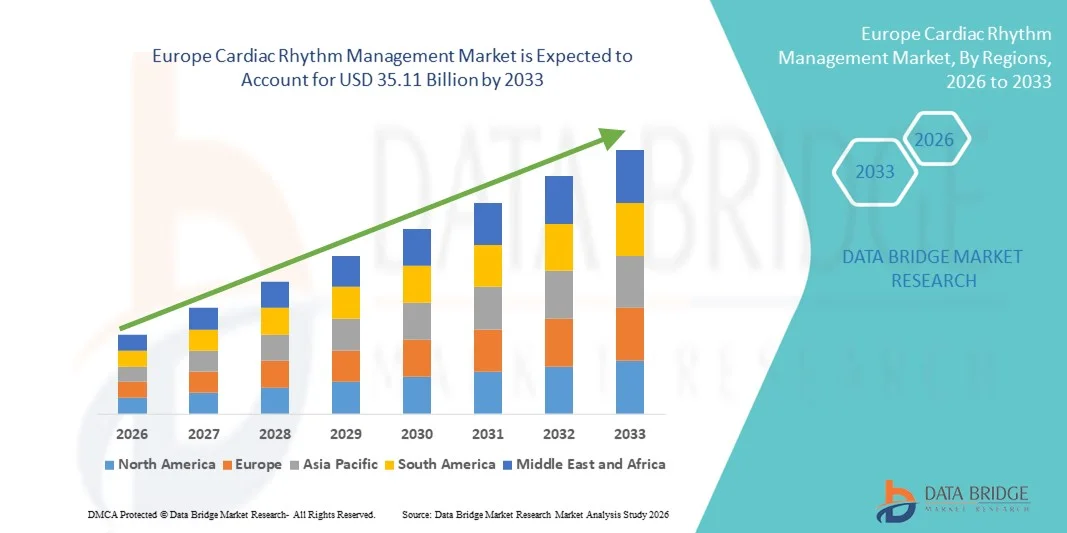
- The Europe cardiac rhythm management market size was valued at USD 25.50 billion in 2025 and is expected to reach USD 35.11 billion by 2033, at a CAGR of 4.08% during the forecast period
- The market growth is largely fueled by the rising global prevalence of cardiovascular diseases, increasing incidence of arrhythmias, and the growing geriatric population, leading to higher demand for advanced cardiac monitoring and rhythm management solutions across hospitals and specialty cardiac centers
- Furthermore, rising patient awareness, expanding access to minimally invasive procedures, and continuous technological advancements such as MRI-compatible pacemakers, leadless pacemakers, implantable cardioverter defibrillators (ICDs), and remote cardiac monitoring systems are establishing cardiac rhythm management devices as essential components of modern cardiac care. These converging factors are accelerating the adoption of Cardiac Rhythm Management solutions, thereby significantly boosting overall market growth
Europe Cardiac Rhythm Management Market Analysis
- Cardiac rhythm management (CRM) devices, including pacemakers, implantable cardioverter defibrillators (ICDs), and cardiac resynchronization therapy (CRT) systems, are increasingly vital components of modern cardiovascular care across hospitals and specialty cardiac centers due to their ability to continuously monitor, regulate, and restore abnormal heart rhythms, thereby improving survival rates and quality of life
- The escalating demand for cardiac rhythm management devices is primarily fueled by the rising global burden of cardiovascular diseases, growing prevalence of arrhythmias, expanding geriatric population, and increasing preference for minimally invasive and technologically advanced implantable cardiac solutions with remote monitoring capabilities
- The U.K. dominated the cardiac rhythm management market with the largest revenue share of 27.6% in 2025, characterized by advanced healthcare infrastructure, strong reimbursement frameworks, high awareness regarding early cardiac intervention, and the presence of established cardiac specialty centers driving consistent implantation volumes
- Germany is expected to be the fastest growing country in the cardiac rhythm management market during the forecast period, supported by rising cardiovascular disease incidence, increasing adoption of advanced MRI-compatible and leadless pacemakers, favorable healthcare expenditure, and growing investments in digital cardiac monitoring technologies
- The pacemakers segment held the largest market revenue share of 44.5% in 2025, driven by the increasing incidence of bradycardia and heart block conditions
Report Scope and Cardiac Rhythm Management Market Segmentation
|
Attributes |
Cardiac Rhythm Management Key Market Insights |
|
Segments Covered |
|
|
Countries Covered |
Europe
|
|
Key Market Players |
|
|
Market Opportunities |
|
|
Value Added Data Infosets |
In addition to the insights on market scenarios such as market value, growth rate, segmentation, geographical coverage, and major players, the market reports curated by the Data Bridge Market Research also include in-depth expert analysis, patient epidemiology, pipeline analysis, pricing analysis, and regulatory framework. |
Europe Cardiac Rhythm Management Market Trends
Enhanced Adoption of Advanced and Remote Monitoring Technologies
- A significant and accelerating trend in the Cardiac Rhythm Management market is the increasing adoption of advanced implantable devices integrated with remote patient monitoring and digital health platforms. This technological advancement is enhancing clinical efficiency, improving patient outcomes, and enabling continuous cardiac monitoring outside hospital settings
- For instance, in January 2023, Medtronic plc announced U.S. FDA approval for its Aurora EV-ICD (Extravascular Implantable Cardioverter Defibrillator) system and Epsila EV MRI SureScan defibrillation lead, designed to provide life-saving defibrillation therapy while avoiding placement of leads inside the heart
- The integration of remote monitoring capabilities in implantable cardiac devices allows physicians to track arrhythmias, device performance, and patient health metrics in real time. This reduces the need for frequent in-clinic visits and enables early detection of complications. Companies are increasingly incorporating Bluetooth connectivity and smartphone-based applications to streamline data transmission between patients and healthcare providers
- Advancements in miniaturization, battery longevity, MRI compatibility, and enhanced data analytics are further transforming pacemakers, implantable cardioverter defibrillators (ICDs), and cardiac resynchronization therapy (CRT) devices. These innovations are improving patient comfort while ensuring long-term therapeutic effectiveness
- The trend toward digital cardiology ecosystems, including AI-supported arrhythmia detection and cloud-based monitoring platforms, is reshaping treatment pathways and strengthening the overall value proposition of cardiac rhythm management solutions
- The demand for technologically advanced cardiac rhythm management systems is rising across hospitals, ambulatory surgical centers, and home-care settings, driven by the need for proactive and personalized cardiac care
Europe Cardiac Rhythm Management Market Dynamics
Driver
Rising Prevalence of Cardiovascular Diseases and Aging Population
- The increasing global burden of cardiovascular diseases (CVDs), including atrial fibrillation, heart failure, and bradycardia, is a major driver fueling demand for cardiac rhythm management devices. The growing geriatric population, which is more susceptible to cardiac arrhythmias, further supports market expansion
- For instance, in August 2022, Abbott announced FDA approval for its Aveir™ single-chamber (VR) leadless pacemaker, designed to provide minimally invasive pacing therapy with retrievability and long-term performance advantages
- Lifestyle-related risk factors such as obesity, hypertension, diabetes, and sedentary habits are contributing to a surge in arrhythmia cases worldwide. As diagnosis rates increase due to improved screening and awareness, the need for effective rhythm management solutions continues to growth
- Furthermore, improvements in healthcare infrastructure, expanded reimbursement coverage in developed regions, and growing investments in cardiac care facilities are supporting device adoption. Emerging economies are also witnessing increased implantation procedures due to rising healthcare spending and improved access to advanced cardiac therapies
- The clinical shift toward minimally invasive procedures and outpatient cardiac interventions is further propelling the uptake of leadless pacemakers and next-generation ICDs
Restraint/Challenge
High Device Costs and Procedural Risks
- The high cost of implantable cardiac rhythm management devices and associated surgical procedures remains a significant challenge, particularly in low- and middle-income countries. Device implantation requires specialized facilities and skilled electrophysiologists, increasing overall treatment expenses
- For instance, the implantation of advanced devices such as cardiac resynchronization therapy defibrillators (CRT-D) can involve substantial upfront costs, limiting accessibility in cost-sensitive markets
- Potential complications, including lead dislodgement, infection, device malfunction, or the need for revision surgeries, may deter some patients and healthcare providers from opting for device-based therapy. Although technological improvements have reduced complication rates, procedural risks remain a clinical concern
- Strict regulatory approval processes and post-market surveillance requirements can also delay product launches and increase development costs for manufacturers
- Addressing affordability barriers, enhancing device safety profiles, and expanding reimbursement frameworks will be critical to sustaining long-term growth in the cardiac rhythm management market
Europe Cardiac Rhythm Management Market Scope
The market is segmented on the basis of CM type, CRM type, and end-user.
- By CM Type
On the basis of CM type, the Cardiac Rhythm Management market is segmented into ECG devices, implantable loop recorders (ILR), mobile cardiac telemetry devices (MCT), event monitors, cardiac output monitoring devices (COM), and smart ECG monitors. The ECG devices segment dominated the largest market revenue share of 36.8% in 2025, driven by its widespread use as a primary diagnostic tool for detecting arrhythmias and other cardiac abnormalities. ECG systems are extensively utilized across hospitals, clinics, and diagnostic centers due to their accuracy, non-invasive nature, and cost-effectiveness. Rising prevalence of cardiovascular diseases globally significantly supports segment growth. Technological advancements such as portable and wireless ECG systems enhance accessibility and patient comfort. Increasing geriatric population further drives demand for routine cardiac monitoring. Integration with digital health records improves workflow efficiency in healthcare settings. Strong adoption in emergency departments also strengthens revenue contribution. Continuous product innovation and expansion of point-of-care testing ensure sustained dominance of ECG devices in 2025.
The mobile cardiac telemetry (MCT) devices segment is anticipated to witness the fastest growth rate of 22.6% CAGR from 2026 to 2033, fueled by the rising demand for continuous real-time cardiac monitoring. MCT devices enable remote monitoring and rapid detection of irregular heart rhythms, improving early intervention rates. Growing adoption of telehealth services significantly accelerates segment expansion. These devices offer enhanced patient mobility compared to traditional monitoring systems. Increasing awareness regarding outpatient cardiac monitoring further supports growth. Technological improvements in wireless connectivity and cloud-based data analysis strengthen reliability. Healthcare providers increasingly prefer MCT for high-risk cardiac patients. Rising investments in remote patient monitoring infrastructure contribute to rapid adoption. As healthcare shifts toward home-based and preventive care models, MCT devices are expected to grow at the fastest pace during the forecast period.
- By CRM Type
On the basis of CRM type, the Cardiac Rhythm Management market is segmented into defibrillators, pacemakers, and cardiac resynchronization therapy (CRT) devices. The pacemakers segment held the largest market revenue share of 44.5% in 2025, driven by the increasing incidence of bradycardia and heart block conditions. Pacemakers remain the standard treatment for managing slow heart rhythms and are widely implanted across aging populations. Advancements in leadless pacemakers and MRI-compatible devices further boost segment growth. High procedural success rates and established reimbursement frameworks support widespread adoption. Growing awareness about early diagnosis of conduction disorders also strengthens demand. Continuous innovation focusing on battery longevity and device miniaturization enhances patient outcomes. Strong presence of major medical device manufacturers sustains market leadership. As cardiovascular disease prevalence rises globally, pacemakers continue to dominate the CRM segment in 2025.
The cardiac resynchronization therapy (CRT) devices segment is expected to witness the fastest CAGR of 21.9% from 2026 to 2033, driven by increasing cases of heart failure worldwide. CRT devices improve ventricular coordination and significantly enhance quality of life for patients with advanced heart conditions. Growing clinical evidence supporting CRT efficacy accelerates adoption. Technological advancements enabling remote monitoring capabilities further contribute to growth. Increasing preference for combination devices integrating defibrillation and resynchronization features strengthens segment potential. Expanding healthcare infrastructure in emerging economies supports procedural volumes. Favorable reimbursement policies in developed markets further encourage implantation rates. Rising awareness among cardiologists regarding early CRT intervention boosts uptake. As heart failure cases continue to increase, CRT devices are projected to expand at the fastest rate during the forecast period.
- By End-User
On the basis of end-user, the Cardiac Rhythm Management market is segmented into hospitals, clinics and cardiac centers, ambulatory surgical centers, and others. The hospitals segment accounted for the largest market revenue share of 52.3% in 2025, driven by the high volume of cardiac procedures performed in hospital settings. Hospitals are equipped with advanced infrastructure and skilled cardiologists required for device implantation and monitoring. Complex CRM procedures such as pacemaker and defibrillator implantation are primarily conducted in tertiary care facilities. Strong patient inflow for emergency cardiac conditions further strengthens segment dominance. Availability of reimbursement coverage in hospital settings supports revenue growth. Continuous technological upgrades in hospital cardiac departments enhance procedural efficiency. Rising investments in specialized cardiac units contribute to segment expansion. The hospitals segment continues to lead due to comprehensive care capabilities and established healthcare networks.
The ambulatory surgical centers segment is projected to witness the fastest CAGR of 23.4% from 2026 to 2033, driven by the increasing shift toward cost-effective outpatient procedures. Advancements in minimally invasive implantation techniques support treatment in ambulatory settings. Patients increasingly prefer shorter hospital stays and faster recovery times. Ambulatory centers offer reduced procedural costs compared to traditional hospitals. Growing healthcare expenditure optimization initiatives further boost demand. Improved safety standards and regulatory approvals encourage adoption. Rising number of specialized cardiac outpatient centers strengthens growth potential. Technological integration for remote monitoring enhances post-procedure follow-up efficiency. As healthcare systems focus on decentralization and value-based care, ambulatory surgical centers are expected to grow at the fastest rate during the forecast period.
Europe Cardiac Rhythm Management Market Regional Analysis
- The Europe cardiac rhythm management market is projected to expand at a substantial CAGR throughout the forecast period, primarily driven by the rising prevalence of cardiovascular diseases and the growing geriatric population across the region. Increasing demand for advanced cardiac monitoring and implantable rhythm management devices is significantly supporting market growth
- Favorable reimbursement frameworks and strong public healthcare systems across European countries are encouraging early diagnosis and treatment of arrhythmias and heart failure. Technological advancements such as MRI-compatible pacemakers, leadless devices, and remote monitoring solutions are further accelerating adoption. The region is witnessing growing integration of digital health platforms with cardiac rhythm management devices, enhancing patient monitoring and clinical outcomes
- In addition, increased investments in healthcare infrastructure and cardiac specialty centers are strengthening procedural volumes. Europe continues to demonstrate strong demand across hospitals, cardiac centers, and ambulatory facilities, supporting steady market expansion during the forecast period
U.K. Cardiac Rhythm Management Market Insight
The U.K. cardiac rhythm management market dominated the Cardiac Rhythm Management market with the largest revenue share of 27.6% in 2025, characterized by advanced healthcare infrastructure and well-established cardiac care pathways. The country benefits from strong reimbursement frameworks that support implantation of pacemakers, defibrillators, and cardiac resynchronization therapy devices. High awareness regarding early cardiac intervention and preventive cardiology significantly contributes to procedural volumes. The presence of established cardiac specialty centers and experienced electrophysiologists strengthens device adoption. Increasing screening programs for arrhythmias and heart failure further enhance early diagnosis rates. The integration of remote monitoring technologies within the National Health Service (NHS) supports continuous patient management. Technological innovation and rapid regulatory approvals also facilitate faster adoption of advanced CRM devices. Rising elderly population and growing cardiovascular burden continue to drive consistent demand, maintaining the U.K.’s leading position in the European market.
Germany Cardiac Rhythm Management Market Insight
Germany cardiac rhythm management market is expected to be the fastest growing country in the Cardiac Rhythm Management market during the forecast period, supported by rising cardiovascular disease incidence and expanding aging demographics. The country is projected to register a significant CAGR, driven by increasing adoption of advanced MRI-compatible and leadless pacemakers. Germany’s strong healthcare expenditure and technologically advanced hospital infrastructure encourage early integration of innovative cardiac devices. Growing investments in digital cardiac monitoring technologies and telecardiology platforms further accelerate market growth. The presence of leading medical device manufacturers enhances product availability and clinical research activities. Favorable reimbursement policies and high procedural standards also support consistent implantation rates. In addition, increasing awareness regarding minimally invasive cardiac procedures boosts patient acceptance. With continued emphasis on innovation and digital health integration, Germany is positioned as the fastest growing market for cardiac rhythm management in Europe during the forecast period.
Europe Cardiac Rhythm Management Market Share
The Cardiac Rhythm Management industry is primarily led by well-established companies, including:
- Medtronic (Ireland)
- Abbott (U.S.)
- Boston Scientific Corporation (U.S.)
- BIOTRONIK SE & Co. KG (Germany)
- LivaNova PLC (U.K.)
- MicroPort Scientific Corporation (China)
- Koninklijke Philips N.V. (Netherlands)
- GE HealthCare Technologies Inc. (U.S.)
- Nihon Kohden Corporation (Japan)
- Asahi Kasei Corporation (Japan)
- Lepu Medical Technology (Beijing) Co., Ltd. (China)
- Zoll Medical Corporation (U.S.)
- Progetti S.r.l. (Italy)
- Osypka Medical GmbH (Germany)
- Shenzhen Mindray Bio-Medical Electronics Co., Ltd. (China)
Latest Developments in Europe Cardiac Rhythm Management Market
- In January 2024, MicroPort CRM, a leading developer of cardiac rhythm management devices headquartered in France, received CE mark approvals in Europe for its new TALENTIA and ENERGYA ranges of implantable cardiac defibrillators (ICDs) and cardiac resynchronization therapy with defibrillation (CRT-D) devices, featuring Bluetooth® connectivity and an advanced tablet programmer interface to support remote monitoring and enhanced clinical workflows
- In March 2024, Abbott Laboratories announced that it had secured CE mark approval in Europe for its Assert-IQ insertable cardiac monitor (ICM), a Bluetooth-enabled device with extended battery life options up to six years, designed to continuously monitor heart rhythms and detect arrhythmias, significantly improving long-term remote cardiac monitoring capabilities
- In April 2024, MicroPort CRM officially launched the TALENTIA and ENERGYA ICD and CRT-D devices in Europe, including the first successful implantation of the TALENTIA™ 4LV CRT-D SonR system at Hospital Universitario Central de Asturias in Spain, demonstrating real-world clinical use of advanced Bluetooth-enabled implantable CRM technologies
- In June 2024, Koninklijke Philips N.V. introduced its new Cardiac Workstation platform in Europe, an advanced cardiac care system using high-performance algorithms to accelerate ECG data access, analysis, and remote diagnostics, enhancing clinical decision-making for cardiology patients across the region
- In September 2024, Medtronic expanded its CRM product portfolio in European markets by introducing a next-generation leadless pacemaker with integrated remote monitoring capabilities, enabling continuous, high-resolution heart rhythm tracking and reducing the frequency of in-clinic follow-ups for patients with bradyarrhythmias
- In February 2025, Medtronic received CE marking for its Micra AV2 leadless pacemaker in Europe, highlighting an important regulatory milestone with improved atrioventricular synchrony and extended battery life, reflecting ongoing innovation in minimally invasive CRM technologies
- In February 2025, BIOTRONIK, a major German cardiac device manufacturer, announced a strategic shift toward digital health and remote patient monitoring solutions, focusing on AI-driven CRM platforms and connected care, while divesting its vascular intervention business to further strengthen CRM innovations across Europe

- Interactive Data Analysis Dashboard
- Company Analysis Dashboard for high growth potential opportunities
- Research Analyst Access for customization & queries
- Competitor Analysis with Interactive dashboard
- Latest News, Updates & Trend analysis
- Harness the Power of Benchmark Analysis for Comprehensive Competitor Tracking
Data collection and base year analysis are done using data collection modules with large sample sizes. The stage includes obtaining market information or related data through various sources and strategies. It includes examining and planning all the data acquired from the past in advance. It likewise envelops the examination of information inconsistencies seen across different information sources. The market data is analysed and estimated using market statistical and coherent models. Also, market share analysis and key trend analysis are the major success factors in the market report. To know more, please request an analyst call or drop down your inquiry.
The key research methodology used by DBMR research team is data triangulation which involves data mining, analysis of the impact of data variables on the market and primary (industry expert) validation. Data models include Vendor Positioning Grid, Market Time Line Analysis, Market Overview and Guide, Company Positioning Grid, Patent Analysis, Pricing Analysis, Company Market Share Analysis, Standards of Measurement, Global versus Regional and Vendor Share Analysis. To know more about the research methodology, drop in an inquiry to speak to our industry experts.
Data Bridge Market Research is a leader in advanced formative research. We take pride in servicing our existing and new customers with data and analysis that match and suits their goal. The report can be customized to include price trend analysis of target brands understanding the market for additional countries (ask for the list of countries), clinical trial results data, literature review, refurbished market and product base analysis. Market analysis of target competitors can be analyzed from technology-based analysis to market portfolio strategies. We can add as many competitors that you require data about in the format and data style you are looking for. Our team of analysts can also provide you data in crude raw excel files pivot tables (Fact book) or can assist you in creating presentations from the data sets available in the report.













