


What is the Europe Cocoa Products Market Size and Growth Rate?
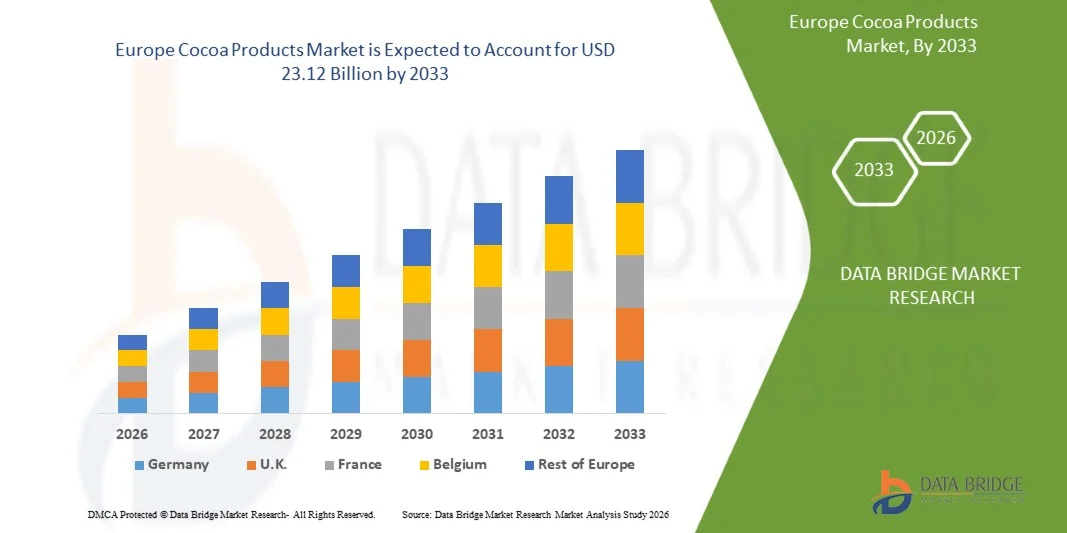
- As per Data Bridge Market Research analysis, the Europe cocoa products market was valued at USD 14.40 billion in 2025 and is projected to reach USD 23.12 billion by 2033, growing at a CAGR of 6.10% from 2026 to 2033.
- The market is experiencing consistent growth driven by rising awareness regarding the health benefits of cocoa, increasing demand for cocoa and chocolate from confectionery manufacturers, and the extensive use of cocoa products such as cocoa liquor, cocoa butter, and cocoa powder in food and beverage applications.
- The increasing consumption of chocolate and bakery products, combined with the growing use of cocoa powder as a flavoring ingredient in beverages, prepared cake mixes, chocolate milk, syrups, toppings, and cookies, is supporting the adoption of cocoa products across Europe. Cocoa products are also being utilized in personal care and cosmetics, dietary supplements, and other applications, further contributing to market expansion.
Market Size & Forecast
- Market Value (2025): USD 14.40 Billion
- Expected Market Value (2033): USD 23.12 Billion
- Forecast CAGR (2026–2033): 6.10%
- Leading Country in 2025: Germany
- Fastest Growing Country: Poland
What are the Major Takeaways of the Europe Cocoa Products Market?
- Germany dominated the Europe cocoa products market with the largest revenue share of 34.63% in 2025, supported by increasing demand for vegan and plant-based cocoa-based products and the country's established chocolate and confectionery industry.
- Poland is expected to be the fastest-growing region at a CAGR of 5.47% from 2026 to 2033, fueled by growing demand across food & beverages, confectionery, bakery, and other cocoa-based applications.
- The forastero cocoa segment led the market with a 82.91% share in 2025, driven by its high yield, resilience, consistent quality, and suitability for large-scale production.
- Trinitario cocoa are the fastest-growing type of coca, projected to register a CAGR of 5.3%, reflecting the surge in consumer demand for premium and specialty chocolates with nuanced flavor profiles.
- The cocoa powder & cake segment dominated the product type category with a 35.06% revenue share in 2025, led by its extensive use across food and beverage applications.
- Inorganic accounted for 93.07% of the market share in 2025, preferred by established conventional cocoa supply chains and large-scale production capabilities.
- The food & beverages segment is the fastest-growing application category, with a CAGR of 8.50%, driven by increasing demand for cocoa-based confectionery, bakery products, beverages, and other food applications.
Report Scope and Europe Cocoa Products Market Segmentation
|
Attributes |
Europe Cocoa Products Key Market Insights |
|
Segments Covered |
|
|
Countries Covered |
Europe
|
|
Key Market Players |
|
|
Market Opportunities |
|
|
Value Added Data Infosets |
In addition to the insights on market scenarios such as market value, growth rate, segmentation, geographical coverage, and major players, the market reports curated by the Data Bridge Market Research also include in-depth expert analysis, pricing analysis, brand share analysis, consumer survey, demography analysis, supply chain analysis, value chain analysis, raw material/consumables overview, vendor selection criteria, PESTLE Analysis, Porter Analysis, and regulatory framework. |
What is the Key Trend in the Europe Cocoa Products Market?
- The rising demand for premium, organic, and sustainably sourced cocoa products is reshaping the European market, as consumers increasingly seek higher-quality, ethical, and transparent cocoa and chocolate products.
- For instance, in February 2025, CBI reported that functional chocolates enriched with ingredients such as fibre, vitamins, or probiotics experienced an 18% annual increase in product launches across Europe in 2024, highlighting the growing shift toward health-oriented and functional cocoa products.
- The growing popularity of single-origin, specialty, and fine-flavour cocoa is creating opportunities for premium product positioning, particularly as European consumers show greater interest in quality, origin, and distinctive flavour profiles.
- Sustainability and traceability are becoming increasingly important purchasing factors, with European buyers placing greater emphasis on certified cocoa, responsible sourcing, deforestation-free supply chains, and transparent production practices.
- Vegan and plant-based cocoa-based products are gaining popularity, while manufacturers are also introducing functional, fortified, low-sugar, and other innovative cocoa formulations to respond to evolving consumer preferences.
- For instance, in April 2025, FoodNavigator reported that plant-based chocolate launches increased by 25%, while Cargill's research found that nearly one-third of European consumers seek healthier versions of their favourite treats, reinforcing the growing trend toward vegan and plant-based cocoa products.
- Health, wellness, and functional benefits are increasingly influencing chocolate and cocoa consumption, with consumer interest expanding toward products containing flavonoids, polyphenols, antioxidants, and other perceived health-promoting compounds.
What are the Key Drivers of the Europe Cocoa Products Market?
- The growing awareness of the health and antioxidant benefits of cocoa is increasing demand for cocoa-rich foods and beverages, particularly products positioned around cardiovascular, wellness, and functional health benefits.
- For instance, in March 2025, CBI reported that European imports of chocolate and other food containing cocoa from developing countries continued to grow, while demand for premium, high-quality, sustainable, and ethically sourced chocolate was increasing across the region.
- The expanding chocolate and confectionery industry is directly supporting cocoa consumption, as cocoa remains the primary raw material for chocolate production and demand continues across diverse consumer segments.
- Increasing demand for premium and artisanal chocolate products is strengthening cocoa consumption, supported by evolving lifestyles, higher consumer interest in quality, and growing preference for distinctive cocoa varieties.
- For instance, in November 2024, University of Birmingham researchers reported that high-flavanol cocoa consumption after a high-fat meal enhanced blood flow and vascular performance for up to 90 minutes, reinforcing research interest in cocoa's potential cardiovascular benefits.
- Expanding applications across beverages, cosmetics, nutraceuticals, and functional foods are broadening cocoa demand, creating additional avenues for cocoa powder, cocoa butter, cocoa liquor, and other cocoa derivatives.
Which Factors are Challenging the Growth of the Europe Cocoa Products Market?
- High and volatile cocoa prices are increasing production costs for European cocoa processors and chocolate manufacturers, creating pressure on margins and consumer affordability.
- For instance, in January 2025, Reuters reported that Barry Callebaut’s first-quarter sales volume declined 2.7% as customers delayed orders and renegotiated prices in response to record-high cocoa costs, demonstrating the pressure that elevated raw-material prices place on European cocoa and chocolate manufacturers.
- Climate change, irregular rainfall, drought, pests, and diseases are affecting cocoa yields in major producing regions, creating supply uncertainty for European manufacturers and importers.
- Stricter sustainability and traceability requirements are increasing compliance complexity for cocoa suppliers, particularly as European regulations require greater transparency throughout cocoa supply chains.
- Rising chocolate prices and cost-of-living pressures can shift consumers toward lower-cost products, potentially limiting demand for premium, organic, and specialty cocoa products.
- Supply-chain dependence on West African cocoa-producing countries exposes European manufacturers to production disruptions, particularly when adverse weather, disease, and low farm productivity affect cocoa availability.
- For instance, in March 2025, the European Commission published its implementing regulation for the EU Deforestation Regulation, requiring cocoa businesses to demonstrate that covered products are deforestation-free and legally produced, increasing traceability and due-diligence requirements across the European cocoa supply chain.
- The increasing complexity of meeting deforestation-free sourcing requirements can create additional operational challenges, requiring companies to strengthen supplier monitoring, farm-level traceability, and due-diligence processes
How is the Europe Cocoa Products Market Segmented?
The Europe cocoa products market is segmented on the basis of type of cocoa, product type, source, application, and distribution channel
- By Type of Cocoa
On the basis of type of cocoa, the Europe cocoa products market is segmented into forastero cocoa, trinitario cocoa, and criollo cocoa. The forastero cocoa segment dominated the market with an 82.91% share in 2025, owing to its high yield, resilience, consistent quality, and suitability for large-scale production. Forastero is widely cultivated and provides manufacturers with a reliable source of cocoa for mass-market applications. Its comparatively lower production costs also make it attractive to large-scale processors and chocolate manufacturers. The variety's resistance to environmental stresses supports greater supply stability compared with more delicate cocoa varieties. Its widespread availability and affordability continue to reinforce its dominant position in the European market.
The trinitario cocoa segment is projected to register the fastest growth at a CAGR of 5.3% during the forecast period driven by rising consumer demand for premium and specialty chocolates with nuanced flavor profiles. Trinitario is a hybrid of Forastero and Criollo, offering a balance between quality and yield. Its distinctive characteristics are attracting artisan chocolatiers and high-end chocolate brands. Growing consumer awareness of unique cocoa origins and flavor differentiation is encouraging greater adoption. The variety is particularly suited to gourmet products and luxury confectionery applications. Increasing demand for premium and differentiated chocolate products is expected to accelerate the growth of Trinitario Cocoa in Europe.
- By Product Type
On the basis of product type, the Europe cocoa products market is segmented into cocoa beans, cocoa butter, cocoa powder & cake, cocoa liquor & paste, cocoa nibs, and others. The cocoa powder & cake segment dominated the market with 35.06% share in 2025, driven by its extensive use across food and beverage applications. Cocoa powder provides concentrated cocoa flavour and is widely used in chocolate, bakery products, beverages, desserts, and prepared food formulations. Its comparatively convenient storage and handling characteristics further support commercial use. Food manufacturers also use cocoa powder as a versatile ingredient in a wide variety of formulations. Increasing consumption of cocoa-flavoured foods and beverages is supporting segment demand. Its broad application base continues to make Cocoa Powder & Cake the leading product category.
The cocoa beans segment is projected to register the fastest growth at 6.1% CAGR during the forecast period, driven by increasing demand for premium and single-origin chocolate products. European consumers are showing greater interest in distinctive cocoa origins, quality, and minimally processed ingredients. Cocoa beans are increasingly used by artisanal and craft chocolate producers seeking greater control over roasting and processing. Growing specialty chocolate production is creating additional demand for higher-quality beans. The expansion of premium cocoa products is also encouraging manufacturers to source differentiated cocoa varieties. These developments are expected to support faster growth of the Cocoa Beans segment across Europe.
- By Source
On the basis of source, the Europe cocoa products market is segmented into inorganic and organic. The inorganic segment dominated the market with 93.07% share in 2025, supported by established conventional cocoa supply chains and large-scale production capabilities. Conventional cocoa is widely available and provides cost advantages for manufacturers serving mass-market applications. Its established cultivation and processing infrastructure enables consistent supply to European processors. The segment is extensively utilized in mainstream chocolate, bakery, beverage, and confectionery production. Established procurement networks also make conventional cocoa easier to source in large volumes. These factors continue to support the dominant position of the Inorganic segment.
The organic segment is projected to witness the fastest growth at 6% CAGR during the forecast period, supported by increasing consumer interest in organic, sustainable, and clean-label food products. European consumers are increasingly attentive to the environmental and ethical characteristics of cocoa production. Organic certification provides manufacturers with an opportunity to differentiate premium cocoa products. Demand for organic chocolate, beverages, bakery products, and other cocoa-based formulations is creating additional opportunities. The segment is also benefiting from growing interest in traceable and responsibly sourced ingredients. Increasing availability of certified organic cocoa is expected to support continued segment expansion.
- By Application
On the basis of application, the Europe cocoa products market is segmented into food & beverages, personal care & cosmetics, dietary supplements, and others. The dietary supplements segment dominated the application category with 37.53% share in 2025, supported by increasing recognition of cocoa's potential antioxidant, mood-enhancing, and cardiovascular benefits. Cocoa contains naturally occurring flavonoids and polyphenols that support its positioning in functional nutrition products. Growing consumer interest in preventive health is increasing demand for functional ingredients. Cocoa-derived ingredients are increasingly incorporated into wellness-oriented formulations and nutritional products. The expansion of health-conscious consumer lifestyles is creating additional opportunities for cocoa ingredients. These factors are supporting the strong position of Dietary Supplements within the European market.
The food & beverages segment is projected to register the fastest growth at 8.50% CAGR from 2026 to 2033, driven by increasing demand for cocoa-based confectionery, bakery products, beverages, and other food applications. Cocoa remains an important ingredient across chocolate and confectionery manufacturing. Growing consumption of cocoa-flavoured beverages and desserts is creating additional demand for cocoa derivatives. The segment is also benefiting from innovation in plant-based and functional food products. Increasing use of cocoa powder, butter, liquor, and nibs across food formulations is broadening application opportunities. These factors are expected to make Food & Beverages the fastest-growing application segment.
- By Distribution Channel
On the basis of distribution channel, the Europe cocoa products market is segmented into direct and indirect. The indirect segment dominated the market with 77.34% share in 2025, supported by established retail, wholesale, and distribution networks throughout Europe. Indirect channels provide manufacturers with broad geographic reach and access to multiple customer groups. Wholesalers, retailers, foodservice operators, and other intermediaries facilitate efficient movement of cocoa products across markets. These networks also provide economies of scale and established logistics capabilities. Increasing availability of cocoa products through supermarkets and other retail outlets further supports the channel. The extensive European distribution infrastructure continues to reinforce the dominance of indirect channels.
The direct segment is projected to register the fastest growth at a CAGR of 7.12% during the forecast period, supported by increasing direct procurement relationships between cocoa processors, manufacturers, and industrial buyers. Direct distribution enables manufacturers to maintain greater control over product quality, pricing, supply volumes, and delivery schedules. Large-scale chocolate and food manufacturers increasingly prefer direct sourcing to secure reliable cocoa supplies and establish long-term supplier relationships. The channel also facilitates customized procurement arrangements according to specific product specifications and production requirements. Increasing emphasis on supply-chain transparency and traceability can further encourage direct relationships between buyers and cocoa suppliers. These factors are expected to support the continued expansion of the Direct distribution channel in the European cocoa products market.
Which Region Holds the Largest Share of the Europe Cocoa Products Market?
- Germany dominated the Europe cocoa products market with the largest revenue share of 34.63% in 2025, supported by increasing demand for vegan and plant-based cocoa-based products and the country's established chocolate and confectionery industry.
- The country has a well-established chocolate industry and extensive distribution infrastructure supporting cocoa-based products. Growing consumer interest in plant-based and premium cocoa products is creating additional opportunities for manufacturers. The presence of established food and confectionery producers also supports continuous utilization of cocoa ingredients. Increasing demand for innovative cocoa-based products is further strengthening the country’s market position.
Germany Cocoa Products Market Insight
The Germany cocoa products market is witnessing strong growth due to the extensive use of cocoa products across industrial applications, particularly chocolate, confectionery, bakery, and beverage manufacturing. The country has a well-established chocolate and food-processing industry that creates consistent demand for cocoa ingredients and derivatives. Increasing consumer interest in vegan and plant-based cocoa products is creating additional opportunities for manufacturers. Germany also benefits from established cocoa-processing and distribution infrastructure across the European market. Growing demand for premium, organic, fair-trade, and sustainably sourced cocoa products is further supporting market development.
Poland Cocoa Products Market Insight
The Poland cocoa products market is expected to witness the fastest growth, supported by increasing demand for cocoa products across food and beverage applications and the expansion of the country's food-processing industry. Cocoa products are increasingly utilized in confectionery, chocolate, bakery, beverages, dairy products, and other food formulations. Growing consumer demand for chocolate and cocoa-based products is creating additional opportunities for cocoa manufacturers and processors. Increasing availability through modern retail and distribution channels is further supporting market accessibility. The market is also benefiting from expanding demand for organic cocoa products and other differentiated cocoa ingredients.
France Cocoa Products Market Insight
The France cocoa products market is supported by strong chocolate and confectionery consumption and an established premium food industry. Cocoa products are widely utilized across chocolate, bakery, desserts, beverages, and other food applications. The country's established reputation for premium and specialty chocolate supports demand for differentiated and high-quality cocoa ingredients. Growing consumer interest in organic, sustainable, and ethically sourced products is creating further opportunities for cocoa suppliers. Increasing innovation in premium and artisanal chocolate products is also supporting demand for specialty cocoa varieties. France's established food-processing and confectionery ecosystem continues to strengthen its position within the European cocoa products market
U.K. Cocoa Products Market Insight
The U.K. cocoa products market is witnessing steady growth due to its mature chocolate and confectionery industry and established retail and food-processing infrastructure. Cocoa products are extensively utilized in chocolate, bakery, beverages, desserts, and other food applications. Rising consumer interest in premium, organic, ethical, and sustainably sourced chocolate is creating opportunities for differentiated cocoa products. The development of specialty and artisanal chocolate is also supporting demand for higher-quality cocoa ingredients. Established supermarket, foodservice, and specialty retail networks provide broad distribution opportunities for cocoa-based products. These factors continue to support the U.K.'s importance within the European cocoa products market.
Which are the Top Companies in Europe Cocoa Products Market?
The Europe cocoa products industry is primarily led by well-established companies, including:
- Barry Callebaut (Switzerland)
- Cargill, Incorporated (U.S.)
- Olam International Limited. (U.K.)
- Puratos (Belgium)
- SUCRES ET DENRÉES (France)
- ECOM Agroindustrial Corp. Limited (Switzerland)
- AAK AB (Sweden)
- Kerry Group plc (Ireland)
- Nestlé (Switzerland)
- Ferrero (Italy)
- Mondelēz International, Inc. (U.S.)
- Mars, Incorporated (U.S.)
- The Hershey Company (U.S.)
- Lindt & Sprüngli (Switzerland)
- Guan Chong Berhad (Malaysia)
- JB Foods Limited (Singapore)
- Walter Matter SA (Switzerland)
- EDELSOURCE (Switzerland)
- Silva Cacao (Belgium)
- Valrhona SAS (France)
What are Latest Developments in Europe Cocoa Products Market?
- In September 2025, Ferrero announced a new initiative to strengthen child protection in cocoa-growing communities in Côte d’Ivoire, focusing on reducing the risks of child labour and addressing the socioeconomic factors behind it. The programme includes actions aimed at strengthening child protection and improving respect for children’s rights in cocoa-producing communities. The initiative forms part of Ferrero’s broader cocoa sustainability strategy covering farmer livelihoods, human rights, and responsible sourcing. This development highlights the increasing focus of European cocoa and chocolate companies on responsible cocoa supply chain
- In July 2024, Nestlé, Mars Wrigley, and Ferrero supported the European Union’s Deforestation Regulation (EUDR) and called for greater guidance to help cocoa and chocolate companies meet the regulation’s due-diligence requirements. The regulation requires companies placing cocoa and other covered commodities on the EU market to demonstrate that their supply chains are not linked to deforestation. The companies described the regulation as an important step toward transforming the cocoa and chocolate sector. The development is increasing the importance of traceability and responsible sourcing throughout Europe’s cocoa products supply chain.
- In October 2022, Mondelēz International announced that it would increase its investment in the Cocoa Life sustainable cocoa programme to USD 1 billion by 2030. The company said the expanded programme would strengthen support for cocoa-growing communities and encourage more sustainable cocoa production. Cocoa Life focuses on farmer livelihoods, community development, and environmental sustainability across cocoa-growing regions. The expansion is particularly relevant to the European cocoa products market because Cocoa Life supplies cocoa to major chocolate brands sold in Europe. The development reinforces the industry's shift toward more sustainable and traceable cocoa sourcing.
- In March 2021, Ferrero announced that it had achieved its commitment to source 100% certified sustainable cocoa beans, following a programme initiated to improve cocoa farmers’ living conditions and encourage sustainable agricultural practices. Ferrero had originally established the commitment in 2011 and subsequently expanded its sustainability requirements to chocolate sourced from third parties. This development strengthened responsible sourcing practices within one of Europe’s major chocolate and confectionery companies and supported the wider transition toward sustainable cocoa products.

- Interactive Data Analysis Dashboard
- Company Analysis Dashboard for high growth potential opportunities
- Research Analyst Access for customization & queries
- Competitor Analysis with Interactive dashboard
- Latest News, Updates & Trend analysis
- Harness the Power of Benchmark Analysis for Comprehensive Competitor Tracking
Europe Cocoa Products Market, Supply Chain Analysis and Ecosystem Framework
To support market growth and help clients navigate the impact of geopolitical shifts, DBMR has integrated in-depth supply chain analysis into its Europe Cocoa Products Market research reports. This addition empowers clients to respond effectively to global changes affecting their industries. The supply chain analysis section includes detailed insights such as Europe Cocoa Products Market consumption and production by country, price trend analysis, the impact of tariffs and geopolitical developments, and import and export trends by country and HSN code. It also highlights major suppliers with data on production capacity and company profiles, as well as key importers and exporters. In addition to research, DBMR offers specialized supply chain consulting services backed by over a decade of experience, providing solutions like supplier discovery, supplier risk assessment, price trend analysis, impact evaluation of inflation and trade route changes, and comprehensive market trend analysis.
Data collection and base year analysis are done using data collection modules with large sample sizes. The stage includes obtaining market information or related data through various sources and strategies. It includes examining and planning all the data acquired from the past in advance. It likewise envelops the examination of information inconsistencies seen across different information sources. The market data is analysed and estimated using market statistical and coherent models. Also, market share analysis and key trend analysis are the major success factors in the market report. To know more, please request an analyst call or drop down your inquiry.
The key research methodology used by DBMR research team is data triangulation which involves data mining, analysis of the impact of data variables on the market and primary (industry expert) validation. Data models include Vendor Positioning Grid, Market Time Line Analysis, Market Overview and Guide, Company Positioning Grid, Patent Analysis, Pricing Analysis, Company Market Share Analysis, Standards of Measurement, Global versus Regional and Vendor Share Analysis. To know more about the research methodology, drop in an inquiry to speak to our industry experts.
Data Bridge Market Research is a leader in advanced formative research. We take pride in servicing our existing and new customers with data and analysis that match and suits their goal. The report can be customized to include price trend analysis of target brands understanding the market for additional countries (ask for the list of countries), clinical trial results data, literature review, refurbished market and product base analysis. Market analysis of target competitors can be analyzed from technology-based analysis to market portfolio strategies. We can add as many competitors that you require data about in the format and data style you are looking for. Our team of analysts can also provide you data in crude raw excel files pivot tables (Fact book) or can assist you in creating presentations from the data sets available in the report.













