


Europe Collagen Market Size
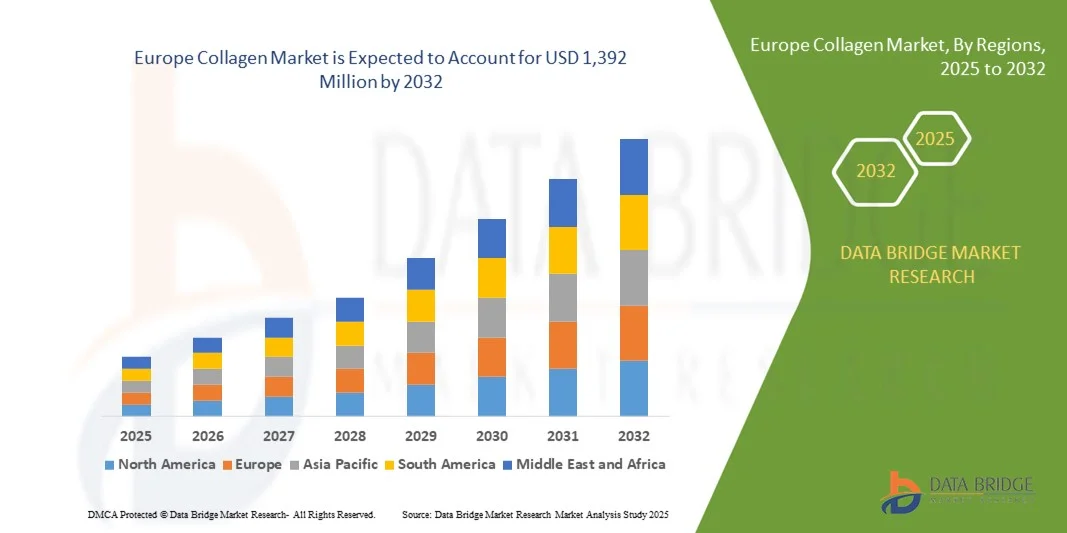
- The Europe collagen market size was valued at USD 949.72 million in 2024 and is expected to reach USD 1,392 million by 2032, at a CAGR of 4.9% during the forecast period
- The market growth is largely fuelled by the rising demand for collagen-based supplements and cosmetics driven by increasing consumer focus on health, beauty, and anti-aging benefits
- Growing applications of collagen in food and beverage formulations, pharmaceuticals, and medical devices are further supporting the market expansion across the region
Europe Collagen Market Analysis
- The Europe collagen market is witnessing significant growth due to heightened awareness regarding nutritional and functional food ingredients. Consumers are increasingly opting for collagen-enriched products to improve skin health, joint flexibility, and overall well-being
- The region’s robust presence of key collagen manufacturers, coupled with ongoing innovations in sustainable and marine-based collagen sources, is enhancing market competitiveness and diversification
- The Germany collagen market dominated in 2024, supported by a strong food and nutraceutical manufacturing base and increasing consumer preference for high-quality, functional ingredients. Manufacturers in Germany are adopting advanced enzymatic hydrolysis processes to develop bioactive collagen peptides with enhanced absorption and efficacy
- U.K. is expected to witness the highest compound annual growth rate (CAGR) in the Europe collagen market due to rising consumer awareness of functional nutrition, the expanding cosmetics and personal care sector, and the increasing adoption of marine and sustainable collagen products
- The gelatine segment held the largest market revenue share in 2024, driven by its extensive use in the food and beverage industry as a gelling, stabilizing, and thickening agent. Its functional versatility and cost-effectiveness make it a preferred choice across confectionery, dairy, and meat processing sectors
Report Scope and Europe Collagen Market Segmentation
|
Attributes |
Europe Collagen Key Market Insights |
|
Segments Covered |
|
|
Countries Covered |
North America
Europe
Asia-Pacific
Middle East and Africa
South America
|
|
Key Market Players |
|
|
Market Opportunities |
|
|
Value Added Data Infosets |
In addition to the insights on market scenarios such as market value, growth rate, segmentation, geographical coverage, and major players, the market reports curated by the Data Bridge Market Research also include in-depth expert analysis, pricing analysis, brand share analysis, consumer survey, demography analysis, supply chain analysis, value chain analysis, raw material/consumables overview, vendor selection criteria, PESTLE Analysis, Porter Analysis, and regulatory framework. |
Europe Collagen Market Trends
Rising Popularity of Marine and Sustainable Collagen Sources
- The growing consumer shift toward marine-derived collagen is transforming the European collagen market, driven by its high bioavailability, sustainability, and suitability for pescatarian and halal diets. The rising awareness of ocean-based proteins as clean-label ingredients is encouraging both manufacturers and consumers to adopt marine collagen for supplements and cosmetics. Moreover, marine collagen is perceived as a safer and cleaner alternative to animal-based sources, aligning with Europe’s growing demand for eco-conscious and ethical products
- The preference for sustainable and traceable collagen sources is prompting producers to explore eco-friendly extraction methods using fish scales and skin by-products. This aligns with the region’s strong environmental consciousness and the circular economy framework promoted by the European Union. Many European firms are also investing in closed-loop systems to minimize waste and ensure full traceability across their supply chains, which enhances brand credibility among sustainability-driven consumers
- In addition, the increasing demand for marine collagen in nutraceutical and personal care products is supported by growing interest in anti-aging and joint health solutions. This has encouraged several European brands to reformulate their product portfolios with natural and marine-based ingredients. The expansion of e-commerce platforms and influencer-driven marketing is further amplifying awareness of collagen’s benefits, making it one of the most sought-after functional ingredients in the region
- For instance, in 2024, Norwegian biotechnology company Geltech introduced a new marine collagen peptide line using zero-waste extraction technology, reducing environmental impact while enhancing collagen purity and absorption rates. The company’s sustainable approach to processing aligns with Europe’s regulatory push for greener production, positioning it as a pioneer in the eco-collagen segment. This innovation is expected to inspire similar product launches across Scandinavia and Western Europe
- While marine collagen continues to gain traction, its market expansion depends on sustainable raw material sourcing, regulatory compliance, and consumer education about its health benefits. Manufacturers are focusing on innovation and eco-certifications to capture the growing demand for sustainable collagen solutions. In the coming years, collaborations between biotechnology firms and cosmetic manufacturers are expected to further enhance product diversity and boost marine collagen adoption across the continent
Europe Collagen Market Dynamics
Driver
Increasing Demand for Collagen in Functional Foods and Nutraceuticals
- The rising consumer focus on health, wellness, and preventive nutrition is driving collagen incorporation into functional foods and beverages. European consumers increasingly associate collagen with benefits such as improved skin elasticity, joint strength, and gut health. The functional food segment is witnessing rapid innovation, with collagen being positioned as a natural and essential ingredient for holistic well-being and daily vitality
- Nutraceutical manufacturers are capitalizing on this trend by launching collagen-infused drinks, protein bars, and supplements targeting beauty-from-within and active lifestyle segments. This diversification is boosting collagen consumption across multiple demographics. Growing participation in fitness and sports activities across Europe has also heightened the use of collagen products for muscle recovery and injury prevention, expanding the ingredient’s role beyond aesthetics
- The region’s aging population, coupled with growing awareness of age-related conditions, is amplifying demand for collagen-enriched nutrition. In particular, type I and type II collagen peptides are being integrated into daily diets to support bone and cartilage health. Governments and health agencies are also promoting balanced nutrition and dietary supplementation, further propelling collagen adoption among older populations
- For instance, in 2023, Nestlé Health Science expanded its Vital Proteins product line in Europe, emphasizing the role of collagen in holistic well-being and active recovery. This move reinforced the brand’s position in the growing functional food market. The company’s success inspired local startups to enter the collagen-based wellness space, intensifying competition and innovation in this segment
- While consumer awareness continues to drive market growth, ongoing innovation, regulatory alignment, and product differentiation remain critical for sustained expansion of the collagen-based nutraceutical sector. The future growth trajectory depends heavily on clinical validation of collagen benefits, improved taste and solubility profiles, and cost-effective formulations that appeal to a wider audience
Restraint/Challenge
High Production Costs and Regulatory Restrictions on Animal-Derived Collagen
- The production of collagen, especially from bovine and porcine sources, involves stringent regulatory scrutiny in Europe to ensure safety, traceability, and ethical compliance. These regulations often increase manufacturing costs and delay product approvals. As a result, many producers are turning to alternative raw materials or recombinant collagen technologies to reduce dependency on animal sources
- Ethical and religious concerns surrounding animal-derived ingredients have limited the acceptance of certain collagen types among specific consumer groups. This has prompted manufacturers to seek alternative plant or marine-based options, which often involve higher processing costs. Furthermore, the growing vegan movement in Europe has pressured companies to invest in plant-based and lab-grown collagen research to capture shifting consumer preferences
- The fluctuating prices of raw materials, coupled with complex purification processes, add to the overall cost burden for collagen manufacturers. These factors can make premium-grade collagen less affordable for small and mid-sized supplement producers. Rising energy costs and inflationary pressures in Europe have further strained production margins, leading some manufacturers to relocate facilities or form joint ventures for cost efficiency
- For instance, in 2023, several collagen manufacturers in Germany and France reported increased operational costs due to stricter European Food Safety Authority (EFSA) standards and sustainability mandates, affecting profit margins and production scalability. Companies have since begun adopting automation and digital tracking systems to meet compliance requirements while improving productivity and quality assurance
- Although regulatory and cost challenges persist, companies are investing in advanced biotechnological extraction methods and ethical sourcing to ensure compliance and maintain competitiveness in the European collagen market. Strategic collaborations with research institutions and government-backed sustainability programs are expected to ease production bottlenecks, paving the way for long-term market stability and innovation
Europe Collagen Market Scope
The Europe collagen market is segmented on the basis of product type, type, form, source, product category, functional, and application.
- By Product Type
On the basis of product type, the Europe collagen market is segmented into gelatine, hydrolysed collagen, native collagen, collagen peptide, and others. The gelatine segment held the largest market revenue share in 2024, driven by its extensive use in the food and beverage industry as a gelling, stabilizing, and thickening agent. Its functional versatility and cost-effectiveness make it a preferred choice across confectionery, dairy, and meat processing sectors.
The hydrolysed collagen segment is expected to witness the fastest growth rate from 2025 to 2032 due to increasing consumer awareness of its high digestibility and bioavailability. Hydrolysed collagen is widely used in dietary supplements, functional beverages, and personal care products, offering benefits for skin, joint, and bone health. Its neutral taste and excellent solubility further enhance its appeal in nutraceutical formulations.
- By Type
On the basis of type, the Europe collagen market is segmented into Type I, Type II, Type III, and Type IV. The Type I collagen segment dominated the market in 2024, primarily due to its strong presence in cosmetic and nutraceutical applications. Type I collagen is known for its skin rejuvenation and anti-aging properties, making it highly sought-after in beauty-from-within and skincare products.
Type II collagen is expected to witness the fastest growth rate from 2025 to 2032, supported by rising demand for joint health supplements and therapeutic formulations. Its ability to promote cartilage regeneration and mobility among the aging population is driving its incorporation into pharmaceutical and nutraceutical products.
- By Form
On the basis of form, the market is segmented into powder and liquid. The powder segment held the largest share in 2024 owing to its longer shelf life, convenience in transportation, and ease of blending into various formulations. Powdered collagen is preferred in food, beverage, and supplement applications due to its stability and flexibility in product formulation.
The liquid segment is expected to witness the fastest growth rate from 2025 to 2032, driven by the rising popularity of ready-to-drink collagen beverages and functional shots. The format’s superior absorption rate and convenience appeal to busy consumers seeking quick nutritional benefits, particularly in fitness and wellness markets.
- By Source
On the basis of source, the Europe collagen market is categorized into bovine, poultry, porcine, marine, and others. The bovine segment accounted for the largest revenue share in 2024 due to its wide availability, high collagen concentration, and strong performance in food and pharmaceutical applications. It remains a cost-effective and stable source for large-scale production.
The marine segment is expected to witness the fastest growth rate from 2025 to 2032, supported by the growing preference for sustainable, clean-label, and pescatarian-friendly collagen. Marine collagen’s superior bioavailability and alignment with ethical consumption trends are boosting its use in beauty, nutraceutical, and premium supplement categories.
- By Product Category
On the basis of product category, the Europe collagen market is divided into GMO and Non-GMO. The Non-GMO segment dominated the market in 2024, driven by the region’s strong preference for natural and ethically sourced ingredients. European consumers increasingly favor transparency and clean-label formulations, supporting the demand for Non-GMO collagen.
The GMO segment is expected to witness the fastest growth rate from 2025 to 2032 as biotechnology advancements enable efficient collagen production with enhanced functionality. These innovations are expected to reduce production costs and improve sustainability in collagen sourcing.
- By Functional
On the basis of functional use, the market is segmented into texture, stabilizer, emulsifier, binding, and others. The texture segment held the largest share in 2024, attributed to collagen’s key role in improving elasticity, firmness, and mouthfeel across various food applications. Its natural protein composition makes it ideal for achieving desired product consistency.
The stabilizer segment is expected to witness the fastest growth rate from 2025 to 2032 due to collagen’s increasing utilization in beverages, dairy, and cosmetics for maintaining structural integrity and product stability. The use of collagen as a multifunctional stabilizer is becoming a key differentiator in premium formulations.
- By Application
On the basis of application, the Europe collagen market is segmented into food products, beverages, nutraceuticals and dietary supplements, cosmetics and personal care, animal feed, laboratory tests, and others. The food products segment accounted for the largest market share in 2024, supported by the growing inclusion of collagen in processed foods, confectionery, and meat alternatives to enhance texture and protein content.
The nutraceuticals and dietary supplements segment is expected to witness the fastest growth rate from 2025 to 2032, fuelled by the increasing demand for collagen-enriched powders, capsules, and drinks. Rising health consciousness, active aging trends, and the popularity of beauty-from-within products are accelerating collagen consumption across the European market.
Europe Collagen Market Regional Analysis
- The Germany collagen market dominated in 2024, supported by a strong food and nutraceutical manufacturing base and increasing consumer preference for high-quality, functional ingredients. Manufacturers in Germany are adopting advanced enzymatic hydrolysis processes to develop bioactive collagen peptides with enhanced absorption and efficacy
- In addition, stringent quality regulations and growing exports of premium collagen-based supplements and skincare formulations are solidifying Germany’s leadership position in the collagen industry
U.K. Collagen Market Insight
The U.K. collagen market is expected to witness the fastest growth rate from 2025 to 2032, driven by surging demand for collagen-infused health, beauty, and wellness products. Consumers are increasingly embracing marine and plant-based collagen alternatives aligned with clean-label and sustainable living trends. Furthermore, continuous innovation by domestic nutraceutical and cosmetic brands, supported by robust online retail channels, is propelling market expansion and strengthening the U.K.’s position as a key growth hub for collagen-based solutions.
Europe Collagen Market Share
The Europe collagen industry is primarily led by well-established companies, including:
- GELITA AG (Germany)
- Rousselot BV (Netherlands)
- Weishardt Group (France)
- Tessenderlo Group NV (Belgium)
- Italgel S.r.l. (Italy)
- Lapi Gelatine S.p.A. (Italy)
- Ewald‑Gelatine GmbH (Germany)
- Collagen Solutions Plc (U.K.)
- PB Gelatins (Belgium)
- Viscofan S.A. (Spain)

- Interactive Data Analysis Dashboard
- Company Analysis Dashboard for high growth potential opportunities
- Research Analyst Access for customization & queries
- Competitor Analysis with Interactive dashboard
- Latest News, Updates & Trend analysis
- Harness the Power of Benchmark Analysis for Comprehensive Competitor Tracking
Europe Collagen Market, Supply Chain Analysis and Ecosystem Framework
To support market growth and help clients navigate the impact of geopolitical shifts, DBMR has integrated in-depth supply chain analysis into its Europe Collagen Market research reports. This addition empowers clients to respond effectively to global changes affecting their industries. The supply chain analysis section includes detailed insights such as Europe Collagen Market consumption and production by country, price trend analysis, the impact of tariffs and geopolitical developments, and import and export trends by country and HSN code. It also highlights major suppliers with data on production capacity and company profiles, as well as key importers and exporters. In addition to research, DBMR offers specialized supply chain consulting services backed by over a decade of experience, providing solutions like supplier discovery, supplier risk assessment, price trend analysis, impact evaluation of inflation and trade route changes, and comprehensive market trend analysis.
Data collection and base year analysis are done using data collection modules with large sample sizes. The stage includes obtaining market information or related data through various sources and strategies. It includes examining and planning all the data acquired from the past in advance. It likewise envelops the examination of information inconsistencies seen across different information sources. The market data is analysed and estimated using market statistical and coherent models. Also, market share analysis and key trend analysis are the major success factors in the market report. To know more, please request an analyst call or drop down your inquiry.
The key research methodology used by DBMR research team is data triangulation which involves data mining, analysis of the impact of data variables on the market and primary (industry expert) validation. Data models include Vendor Positioning Grid, Market Time Line Analysis, Market Overview and Guide, Company Positioning Grid, Patent Analysis, Pricing Analysis, Company Market Share Analysis, Standards of Measurement, Global versus Regional and Vendor Share Analysis. To know more about the research methodology, drop in an inquiry to speak to our industry experts.
Data Bridge Market Research is a leader in advanced formative research. We take pride in servicing our existing and new customers with data and analysis that match and suits their goal. The report can be customized to include price trend analysis of target brands understanding the market for additional countries (ask for the list of countries), clinical trial results data, literature review, refurbished market and product base analysis. Market analysis of target competitors can be analyzed from technology-based analysis to market portfolio strategies. We can add as many competitors that you require data about in the format and data style you are looking for. Our team of analysts can also provide you data in crude raw excel files pivot tables (Fact book) or can assist you in creating presentations from the data sets available in the report.













