


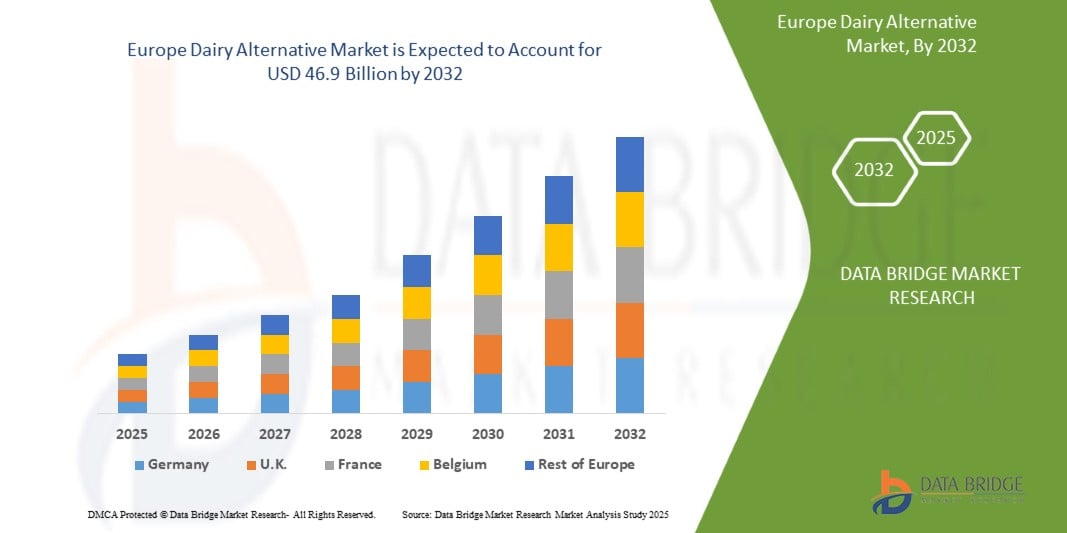
Dairy Alternative Market Size
- The Europe Dairy Alternative Market size was valued at USD 32.77 billion in 2024 and is expected to reach USD 46.9 billion by 2032, at a CAGR of 12.7% during the forecast period
- The growth of the Dairy Alternative Market is driven by several key factors, including the rising consumer demand for plant-based and lactose-free alternatives, increasing awareness of health and wellness benefits, and the growing adoption of sustainable, eco-friendly food products
Dairy Alternative Market Analysis
- The Dairy Alternative Market in Europe is undergoing robust growth, driven by increasing health consciousness, rising lactose intolerance, and growing consumer demand for sustainable food choices. The surge in veganism and flexitarianism across the region is encouraging the adoption of plant-based alternatives such as oat milk, almond milk, soy yogurts, and vegan cheeses. Concerns over animal welfare and the environmental impact of dairy farming are further propelling this shift toward dairy-free options
- European food manufacturers are actively innovating, introducing a wide range of dairy alternatives tailored to meet diverse dietary and ethical preferences. Products formulated to be organic, non-GMO, gluten-free, and allergen-friendly are gaining popularity among consumers. Advances in food technology have enhanced the taste, texture, and nutritional value of dairy alternatives, making them increasingly competitive with traditional dairy products
- Western Europe, particularly countries like Germany, the UK, and France, leads the regional market, owing to high levels of health awareness, strong retail infrastructure, and widespread availability of plant-based products. The demand for clean-label and environmentally responsible options is shaping consumer behavior, prompting major retailers and brands to expand their dairy-free offerings
- Eastern Europe is emerging as a growing market for dairy alternatives, supported by urbanization, increased health awareness, and improved access to plant-based products. While the region is still developing compared to Western Europe, there is notable growth potential driven by shifting dietary patterns and a rising middle class
- Europe’s strong regulatory framework and sustainability initiatives are fostering a supportive environment for dairy alternatives. EU policies promoting plant-based innovation and environmental sustainability are encouraging investments in this sector. With growing interest in reducing carbon footprints and improving animal welfare, the European Dairy Alternative Market is poised to continue its dynamic expansion within the global food landscape
Report Scope and Dairy Alternative Market Segmentation
|
Attributes |
Dairy Alternative Key Market Insights |
|
Segments Covered |
|
|
Countries Covered |
Europe
|
|
Key Market Players |
|
|
Market Opportunities |
|
|
Value Added Data Infosets |
In addition to the insights on market scenarios such as market value, growth rate, segmentation, geographical coverage, and major players, the market reports curated by the Data Bridge Market Research also include import export analysis, production capacity overview, production consumption analysis, price trend analysis, climate change scenario, supply chain analysis, value chain analysis, raw material/consumables overview, vendor selection criteria, PESTLE Analysis, Porter Analysis, and regulatory framework. |
Dairy Alternative Market Trends
Increasing Popularity of Functional and Fortified Dairy Alternatives
- A notable trend in the Dairy Alternative Market is the rising demand for functional and fortified dairy alternatives that offer added health benefits, such as enhanced nutritional profiles, vitamins, and minerals
- Consumers are increasingly looking for plant-based dairy products that not only provide a dairy-free option but also offer additional health benefits, such as calcium, vitamin D, and probiotics, which are commonly found in dairy products
- For instance, plant-based milk alternatives like oat and almond milk are now being fortified with essential nutrients like calcium, vitamin B12, and omega-3 fatty acids to cater to the health-conscious consumer
- This trend is encouraging manufacturers to innovate and develop fortified plant-based dairy products that align with the growing demand for functional foods that support overall well-being and health
Dairy Alternative Market Dynamics
Driver
Rising Popularity of Plant-Based Diets and Protein Alternatives
- As more consumers embrace plant-based lifestyles, the Dairy Alternative Market is experiencing strong growth. Increased awareness about the environmental impact of dairy production, coupled with health concerns, is leading many individuals to seek dairy-free alternatives
- Plant-based dairy alternatives, such as almond milk, oat milk, and coconut yogurt, are becoming staples in the diets of vegans, vegetarians, and flexitarians who are looking for lactose-free, cholesterol-free, and lower-calorie options
- With the rising popularity of these alternatives, dairy brands are innovating to offer plant-based options that closely mimic the texture and taste of traditional dairy, meeting the demands of health-conscious consumers.
For instance:
- Manufacturers are developing more diverse options, such as plant-based cheeses, yogurts, and ice creams, using ingredients like oats, almonds, and cashews, to cater to the growing consumer demand for dairy-free choices
- This shift towards plant-based diets, combined with increasing concerns about sustainability and animal welfare, is driving the adoption of dairy alternatives, fostering growth in the market for plant-based dairy products
Opportunity
Increasing Demand for Sustainable and Eco-Friendly Dairy Alternatives
- The growing consumer awareness of environmental issues, such as climate change and sustainability, is driving a shift towards more eco-friendly food choices, including dairy alternatives
- Plant-based dairy products, such as oat milk, almond milk, and soy yogurt, are considered more sustainable than traditional dairy due to their lower environmental footprint in terms of water usage, land requirements, and greenhouse gas emissions
- As consumers prioritize sustainability, dairy alternative companies are capitalizing on this trend by offering products that align with eco-friendly values and appeal to environmentally conscious consumers
For instance:
- Brands are increasingly focusing on using organic, locally sourced ingredients and adopting environmentally friendly packaging, further enhancing the sustainability of their dairy alternatives
- The demand for plant-based, eco-friendly dairy products presents a significant opportunity for growth in the Dairy Alternative Market, especially as more consumers adopt plant-based and environmentally responsible diets
Restraint/Challenge
High Cost of Production and Raw Materials for Dairy Alternatives
- One of the key restraints in the Dairy Alternative Market is the high cost associated with the production and raw materials used to manufacture dairy alternative products
- The ingredients required for plant-based dairy alternatives, such as almonds, oats, and soybeans, often incur higher production costs compared to traditional dairy products. Additionally, these ingredients may require specialized farming practices and processing methods, further driving up costs
- The complexity of formulating dairy alternatives to match the taste, texture, and nutritional profile of traditional dairy, while ensuring the product remains affordable for consumers, adds another layer of expense for manufacturers
- High production costs can make dairy alternative products less competitive, particularly in markets where consumers are price-sensitive or where dairy alternatives are still considered a premium product
For instance:
- Smaller manufacturers or emerging brands in the dairy alternative space may find it challenging to achieve cost-effective production without sacrificing product quality or price competitiveness, making it difficult for them to scale or compete with larger industry players.
- This cost challenge poses a restraint to market growth, particularly in regions with lower purchasing power or where traditional dairy is deeply ingrained in the local diet
Dairy Alternative Market Scope
The market is segmented on the basis product type, type, formulation, application, nutritive, distribution channel, brand.
|
Segmentation |
Sub-Segmentation |
|
By Product Type |
|
|
By Type |
|
|
By Formulation |
|
|
By Application |
|
|
By Nutritive |
|
|
By Distribution Channel |
|
|
By Brands |
|
In 2025, the soy milk is projected to dominate the market with a largest share in product type segment
In 2025, soy milk is projected to dominate the Europe dairy alternative market with the largest share in the product type segment, accounting for 38.5%. This dominance is attributed to the widespread consumer adoption of soy milk as a plant-based alternative to cow’s milk due to its nutritional profile, including high protein content and versatility in various food and beverage applications
The Food is expected to account for the largest share during the forecast period in application segment
In 2025, the food segment is expected to account for the largest share in the Europe Dairy Alternative Market, with a projected market share of 51.2%. This dominance is driven by the growing consumer preference for clean-label, minimally processed food products and the increasing demand for healthier, natural ingredients in food manufacturing.
Dairy Alternative Market Regional Analysis
Germany is Projected to Register the Highest Growth in the Europe Dairy Alternative Market
- Germany is expected to register the highest growth rate in the Europe Dairy Alternative Market, driven by increasing consumer demand for plant-based, clean-label, and health-oriented food products that align with growing concerns around sustainability, wellness, and animal welfare
- German consumers are rapidly shifting toward vegan, vegetarian, and flexitarian lifestyles, fueling the uptake of dairy alternatives such as oat milk, almond milk, soy-based yogurts, and plant-based cheeses made from pea protein, coconut, and cashew
- The rise in lactose intolerance, dairy sensitivities, and heightened awareness of the environmental impact of livestock farming are contributing significantly to the demand for non-dairy alternatives in the country
- Ongoing product innovation focused on improved taste, nutritional enhancement, and free-from claims (e.g., gluten-free, soy-free, sugar-free) is drawing in a broader consumer base and accelerating category growth in retail and foodservice channels
- Strong support from German supermarkets, discounters, and organic food chains, along with investments by domestic and international food manufacturers, is driving wide-scale distribution and increased visibility of dairy-free products across the market
- As both legacy brands and emerging startups invest in sustainable packaging, local sourcing, and plant-based R&D, Germany is positioned to be a leader in the European Dairy Alternative Market, setting trends that influence consumer behavior and product development across the region
Germany is Projected to Dominate the Europe Dairy Alternative Market
-
Germany is expected to dominate the Europe Dairy Alternative Market, driven by strong consumer preference for plant-based, clean-label, and health-conscious food and beverage products. The country’s progressive food culture and increasing focus on sustainability are accelerating the shift toward non-dairy alternatives
- With a mature retail sector and well-developed food processing infrastructure, Germany leads in the adoption of dairy alternatives such as oat milk, soy milk, almond milk, and plant-based yogurts and cheeses, especially in urban centers with high demand for vegan and organic options
- The rising prevalence of lactose intolerance and dairy-related sensitivities, along with growing ethical concerns related to animal welfare and the environmental impact of traditional dairy farming, is encouraging consumers to switch to plant-based alternatives made from ingredients like pea protein, coconut, rice, and cashew
- The surge in flexitarian, vegan, and vegetarian lifestyles, especially among younger and health-conscious demographics, is creating strong momentum for dairy alternative products across mainstream supermarkets, organic stores, and foodservice channels
- Major food and beverage companies, along with innovative startups, are making significant investments in R&D, product diversification, and sustainability, reinforcing Germany’s position as the leading market for dairy alternatives in Europe and a key driver of plant-based trends across the region
Dairy Alternative Market Share
The market competitive landscape provides details by competitor. Details included are company overview, company financials, revenue generated, market potential, investment in research and development, new market initiatives, global presence, production sites and facilities, production capacities, company strengths and weaknesses, product launch, product width and breadth, application dominance. The above data points provided are only related to the companies' focus related to market.
The Major Market Leaders Operating in the Market Are:
- Danone S.A. (France)
- Nestlé S.A. (Switzerland)
- Oatly Group AB (Sweden)
- Blue Diamond Growers (U.S.)
- The Hain Celestial Group, Inc. (U.S.)
- Califia Farms (U.S.)
- Silk (WhiteWave Foods, a part of Danone) (U.S.)
- Alpro (a subsidiary of Danone) (Belgium)
- So Delicious Dairy Free (U.S.)
- Minor Figures (U.K.)
- Living Harvest Foods, Inc. (U.S.)
- Ripple Foods (U.S.)
- Good Karma Foods (U.S.)
Latest Developments in Europe Dairy Alternative Market
- In May 2025, Danone announced the acquisition of a majority stake in Kate Farms, a U.S.-based producer of plant-based organic nutritional drinks. Founded in 2012 in Santa Barbara, California, Kate Farms specializes in nutritional shakes and formulas for individuals with health conditions and tube feeding requirements. This acquisition aims to expand Danone’s presence in the U.S. medical nutrition market, aligning with the growing demand for plant-based, allergen-free nutritional products
- In May 2025, Danone North America launched a new line of Oikos Protein Shakes specifically targeted at users of GLP-1 drugs such as Ozempic, Wegovy, Mounjaro, and Zepbound. These appetite-suppressing medications are increasingly used to treat obesity and diabetes, driving demand for high-protein, portion-controlled food options. The new Oikos Protein Shakes will be available in May 2025 through major retailers including Amazon, Walmart, Costco, Kroger, and CVS
- In April 2025, Chobani, a leading Greek yogurt producer, announced a $1.2 billion investment to establish its third U.S. dairy processing plant in upstate New York. This expansion is expected to create over 1,000 full-time jobs and responds to increasing demand for its products. The new facility will also support innovation in their product offerings, including dairy alternatives
- In July 2024, California-based startup Savor, supported by Bill Gates, developed a dairy-free butter alternative made through a thermochemical process that builds fat molecules from carbon dioxide, hydrogen, and oxygen. This innovation aims to significantly reduce the environmental impacts associated with traditional livestock farming. The company is currently awaiting regulatory approval and aims to commercialize the product by 2025
- In May 2025, Fairlife, a Coca-Cola Company-owned brand, reported a 25% household penetration in the U.S. The category surged 11.6% in sales and 2.6% in volume terms in the past 6-12 months, according to Circana. This growth indicates a resurgence in consumer preference for lactose-free dairy products, which are increasingly outpacing plant-based alternatives like oat and almond milk in popularity

- Interactive Data Analysis Dashboard
- Company Analysis Dashboard for high growth potential opportunities
- Research Analyst Access for customization & queries
- Competitor Analysis with Interactive dashboard
- Latest News, Updates & Trend analysis
- Harness the Power of Benchmark Analysis for Comprehensive Competitor Tracking
Europe Dairy Alternative Market, Supply Chain Analysis and Ecosystem Framework
To support market growth and help clients navigate the impact of geopolitical shifts, DBMR has integrated in-depth supply chain analysis into its Europe Dairy Alternative Market research reports. This addition empowers clients to respond effectively to global changes affecting their industries. The supply chain analysis section includes detailed insights such as Europe Dairy Alternative Market consumption and production by country, price trend analysis, the impact of tariffs and geopolitical developments, and import and export trends by country and HSN code. It also highlights major suppliers with data on production capacity and company profiles, as well as key importers and exporters. In addition to research, DBMR offers specialized supply chain consulting services backed by over a decade of experience, providing solutions like supplier discovery, supplier risk assessment, price trend analysis, impact evaluation of inflation and trade route changes, and comprehensive market trend analysis.
Data collection and base year analysis are done using data collection modules with large sample sizes. The stage includes obtaining market information or related data through various sources and strategies. It includes examining and planning all the data acquired from the past in advance. It likewise envelops the examination of information inconsistencies seen across different information sources. The market data is analysed and estimated using market statistical and coherent models. Also, market share analysis and key trend analysis are the major success factors in the market report. To know more, please request an analyst call or drop down your inquiry.
The key research methodology used by DBMR research team is data triangulation which involves data mining, analysis of the impact of data variables on the market and primary (industry expert) validation. Data models include Vendor Positioning Grid, Market Time Line Analysis, Market Overview and Guide, Company Positioning Grid, Patent Analysis, Pricing Analysis, Company Market Share Analysis, Standards of Measurement, Global versus Regional and Vendor Share Analysis. To know more about the research methodology, drop in an inquiry to speak to our industry experts.
Data Bridge Market Research is a leader in advanced formative research. We take pride in servicing our existing and new customers with data and analysis that match and suits their goal. The report can be customized to include price trend analysis of target brands understanding the market for additional countries (ask for the list of countries), clinical trial results data, literature review, refurbished market and product base analysis. Market analysis of target competitors can be analyzed from technology-based analysis to market portfolio strategies. We can add as many competitors that you require data about in the format and data style you are looking for. Our team of analysts can also provide you data in crude raw excel files pivot tables (Fact book) or can assist you in creating presentations from the data sets available in the report.













