


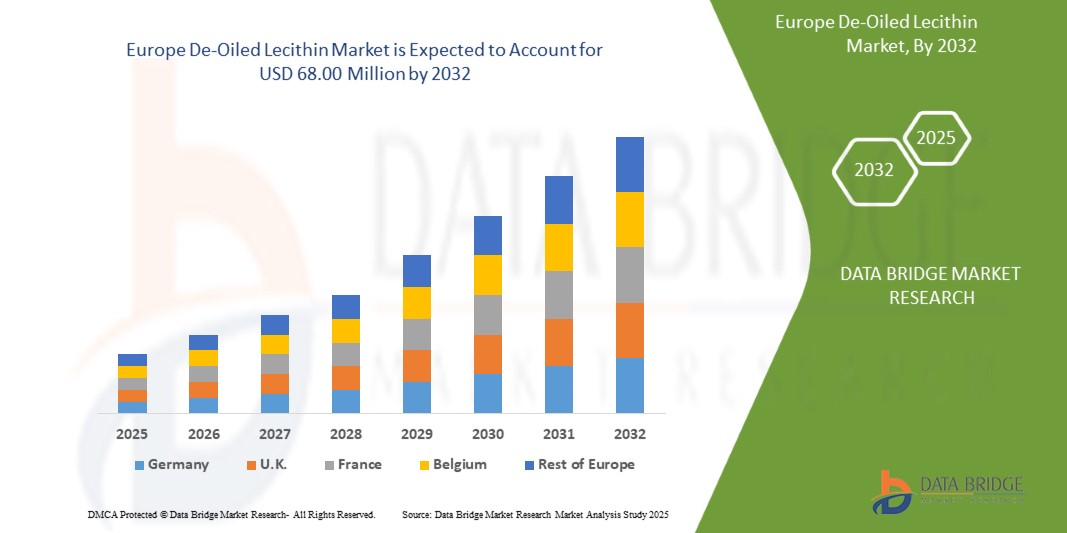
Europe De-Oiled Lecithin Market Size
- The Europe De-Oiled Lecithin Market size was valued at USD 38.78 Million in 2024 and is expected to reach USD 68.00 Million by 2032, at a CAGR of 8.5% during the forecast period
- This growth is driven by factors such as the increasing consumer demand for natural and clean-label ingredients, the expanding applications of de-oiled lecithin across various industries, and the rising awareness of its health benefits
Europe De-Oiled Lecithin Market Analysis
- De-oiled lecithin is enriched with phospholipid compounds and is oil-free. It is basically oil-free or contains negligible amounts of oil and has a high concentration of polyunsaturated fatty acids. Lecithin descaling is available in powder or granule form
- The product comes in powder or granule form that is easy to handle and compactly packaged to facilitate transportation and storage. Highly dispersible powder or granular lecithin offers a competitive advantage over other forms of lecithin available in liquid form.
- Asia-Pacific dominates the Europe De-Oiled Lecithin Market with the largest revenue share of 27.4% in 2024, characterized by region's large agricultural sectors, particularly in countries like China, India, and Japan.
- Asia-Pacific is expected to be the fastest growing region in the Europe De-Oiled Lecithin Market during the forecast period due to rapid industrialization, increasing environmental awareness, and supportive policies
- The non-GMO segment is expected to dominate the Europe De-Oiled Lecithin Market with a market share of 42.3% in 2024, driven by increasing consumer demand for clean-label and organic products
Report Scope and Europe De-Oiled Lecithin Market Segmentation
|
Attributes |
Europe De-Oiled Lecithin Key Market Insights |
|
Segments Covered |
|
|
Countries Covered |
Europe
|
|
Key Market Players |
|
|
Market Opportunities |
|
|
Value Added Data Infosets |
In addition to the insights on market scenarios such as market value, growth rate, segmentation, geographical coverage, and major players, the market reports curated by the Data Bridge Market Research also include in-depth expert analysis, pricing analysis, brand share analysis, consumer survey, demography analysis, supply chain analysis, value chain analysis, raw material/consumables overview, vendor selection criteria, PESTLE Analysis, Porter Analysis, and regulatory framework. |
Europe De-Oiled Lecithin Market Trends
Surging Demand for Clean-Label and Non-GMO Ingredients in Functional Foods
- A significant and accelerating trend in the Europe De-Oiled Lecithin Market is the rising consumer preference for clean-label and non-GMO ingredients, particularly in functional foods and beverages. De-oiled lecithin, known for its superior emulsifying properties and neutral taste, is increasingly utilized in products like bakery items, dairy alternatives, and nutritional supplements. This shift is driven by health-conscious consumers seeking natural and allergen-free additives.
- For instance, in August 2024, Bunge expanded its lecithin product portfolio by launching de-oiled soybean lecithin in both powdered and granulated formats. This innovation caters to the rising demand for clean-label ingredients, offering improved solubility and consistency in various food applications.
- Similarly, in November 2021, Novastell introduced a new range of lecithin granules derived from soy and sunflower, enhancing product availability for food and beverage manufacturers aiming to meet clean-label standards.
- The adoption of de-oiled lecithin aligns with the increasing demand for transparency and health benefits in food ingredients, particularly in sectors like bakery, confectionery, and dietary supplements.
Europe De-Oiled Lecithin Market Dynamics
Driver
Increasing Demand for Natural Food Additives and Growing Consumer Awareness Regarding Clean-Label Products
- The exponential growth of health-conscious consumers and the shift towards natural food additives are major drivers for the Europe De-Oiled Lecithin Market.
- Food manufacturers are investing in natural emulsifiers like de-oiled lecithin to meet consumer demand for clean-label and non-GMO products.
- The need for healthier and transparent ingredient lists in food products has led to increased demand for de-oiled lecithin in various applications, including bakery, confectionery, and dairy alternatives.
- This trend is further supported by the growing emphasis on sustainability and plant-based diets, leading to a higher demand for soy and sunflower-based lecithin products.
Restraint/Challenge
Volatility in Raw Material Prices and Supply Chain Disruptions
- The high dependency on soybean and sunflower crops for lecithin production poses a significant challenge for the market.
- Fluctuations in raw material prices, driven by factors such as weather conditions, geopolitical tensions, and agricultural uncertainties, can impact production costs and market pricing.
- These supply chain disruptions make it difficult for companies to maintain stable production and pricing, posing a challenge for long-term contracts and planning.
- Additionally, the presence of alternative emulsifiers and substitutes in the market, such as synthetic emulsifiers and other plant-based ingredients, poses a challenge to the Europe De-Oiled Lecithin Market.
Europe De-Oiled Lecithin Market Scope
The market is segmented on the basis of type, method of extraction, source, form, and application.
- By Type
On the basis of type, the Europe De-Oiled Lecithin Market is segmented into GMO and Non-GMO. The Non-GMO segment dominates the largest market revenue share of 42.3% in 2025, driven by increasing consumer demand for clean-label and organic products. Non-GMO lecithin is preferred in food and personal care applications due to stringent labeling regulations in North America and Europe. Manufacturers are also promoting Non-GMO certification to enhance brand image and meet regulatory compliance.
The GMO segment is anticipated to witness fastest growth rate of 10.2% from 2025 to 2032, due to its cost-effectiveness and high availability, particularly in developing economies where consumer preferences are price-sensitive and regulatory oversight is relatively less strict.
- By Method Of Extraction
On the basis of method of extraction, the market is segmented into Acetone Extraction, Carbon Dioxide Extraction, and Ultrafiltration Process. The Acetone Extraction segment held the largest market revenue share in 2025, owing to its widespread adoption in industrial-scale production. It offers high purity levels, cost efficiency, and is widely compatible with soy lecithin. This method remains a preferred choice for food and feed applications due to its scalability.
The Ultrafiltration Process segment is expected to witness the fastest CAGR from 2025 to 2032, driven by rising demand for solvent-free and eco-friendly lecithin. This method preserves nutritional integrity and supports applications in organic and baby food sectors.
- By Source
On the basis of source, the market is segmented into Soy, Sunflower, Rapeseed, and Egg. The Soy segment dominates the largest market revenue share of 49.6% in 2025, supported by abundant Europe supply, established processing infrastructure, and versatile application across industries. Soy-based de-oiled lecithin is particularly prominent in feed and processed food products.
The Sunflower segment is anticipated to witness the fastest growth rate of 8.7% from 2025 to 2032, owing to its Non-GMO nature, allergen-free profile, and clean-label appeal. Increased cultivation in Europe and rising consumer preference for allergen-free ingredients are propelling demand.
- By Form
On the basis of form, the Europe De-Oiled Lecithin Market is segmented into Powdered and Granulated. The Powdered segment held the largest market revenue share in 2025, due to its superior dispersion properties, extended shelf life, and suitability for dry mix applications in food, feed, and personal care. It is the preferred form for standardized formulation in nutritional and bakery products.
The Granulated segment is expected to grow at a steady pace, driven by demand in the feed and supplement industries. Its ease of handling and lower dust generation during manufacturing processes support its industrial adoption.
- By Application
On the basis of application, the market is segmented into Food, Feed, Personal Care, Pharmaceuticals, and Others. The Food segment dominates the largest market revenue share of 38.1% in 2025, driven by its role as an emulsifier, stabilizer, and dispersing agent in baked goods, confectionery, and instant products. Clean-label trends and the demand for allergen-free, GMO-free ingredients are boosting adoption.
The Pharmaceuticals segment is anticipated to witness the fastest growth rate of 9.5% from 2025 to 2032, fueled by expanding nutraceutical applications and the role of de-oiled lecithin in liposomal drug delivery systems. Its biocompatibility and natural origin make it suitable for functional and therapeutic formulations.
Europe De-Oiled Lecithin Market Regional Analysis
- Asia-Pacific dominates the Europe De-Oiled Lecithin Market with the largest revenue share of 27.4% in 2024, driven by the region's large agricultural sectors, particularly in countries like China, India, and Japan, which supply raw materials such as soybean and sunflower for lecithin production.
- The growing demand for natural food additives and rising consumer awareness towards clean-label products further bolster market growth in this region.
Europe De-Oiled Lecithin Market Insight
The European Europe De-Oiled Lecithin Market is projected to expand at a substantial CAGR throughout the forecast period, primarily driven by the increasing demand for clean-label and sustainable food products. Countries like Germany, France, and the UK are witnessing a surge in demand for de-oiled lecithin, especially in the food & beverage, pharmaceutical, and personal care industries. The trend towards health and wellness, along with stringent food safety regulations, supports this market expansion.
U.K. Europe De-Oiled Lecithin Market Insight
The U.K. Europe De-Oiled Lecithin Market is anticipated to grow at a noteworthy CAGR during the forecast period, driven by the increasing demand for natural and non-GMO food ingredients, as well as the rising popularity of plant-based diets. The food & beverage industry's focus on clean-label products and the expanding pharmaceutical sector also contribute to this upward trend.
Germany Europe De-Oiled Lecithin Market Insight
The German Europe De-Oiled Lecithin Market is expected to expand at a considerable CAGR during the forecast period, fueled by country's strong industrial base, commitment to sustainability, and emphasis on high-quality food products drive the demand for de-oiled lecithin. Applications in the food & beverage, pharmaceutical, and personal care industries are expanding, further accelerating market growth.
Europe De-Oiled Lecithin Market Share
The De-Oiled Lecithin Industry is primarily led by well-established companies, including:
- ADM (U.S.)
- Clarkson Grain Company (U.S.)
- Cargill, Incorporated (U.S.)
- LECICO GmbH (Germany)
- Lecital (Spain)
- Austrade Inc. (U.S.)
- Stern-Wywiol Gruppe GmbH & Co. KG (Germany)
- DuPont (U.S.)
- GIIAVA (U.S.)
- Bunge Limited (U.S.)
- LASENOR EMUL, S.L. (Spain)
- Amitex Agro Product Pvt. Ltd. (India)
- American Lecithin Company (U.S.)
- Novastell (U.S.)
Latest Developments in Europe De-Oiled Lecithin Market
- In August 2022, Louis Dreyfus Company Agricultural Industries LLC (LDC) announced the opening of its new soy liquid lecithin plant in Claypool, Indiana, US. This plant integrates the production of glycerin biodiesel, and lecithin refining, and soybean processing into one of the largest facilities in the country. It also features a canola oil distribution terminal and a food-grade packaging line
- In June 2021, Bunge Limited and IMCD Group BV signed an agreement allowing IMCD to distribute BungeMaxx lecithin products across multiple European countries. The partnership aims to cater to the growing demand for natural emulsifiers in the European food industry. The agreement facilitates Bunge's expansion into key market segments, enhancing its product reach
- In March 2021, Stern-Wywiol Gruppe launched SternPur SDH-50, a non-GMO and allergen-free emulsifier alternative. The product is designed to meet the demand for clean-label ingredients in plant-based and nutritional supplement products. ternPur SDH-50 enhances the bioavailability of fat-soluble nutrients, offering functional benefits.

- Interactive Data Analysis Dashboard
- Company Analysis Dashboard for high growth potential opportunities
- Research Analyst Access for customization & queries
- Competitor Analysis with Interactive dashboard
- Latest News, Updates & Trend analysis
- Harness the Power of Benchmark Analysis for Comprehensive Competitor Tracking
Europe De Oiled Lecithin Market, Supply Chain Analysis and Ecosystem Framework
To support market growth and help clients navigate the impact of geopolitical shifts, DBMR has integrated in-depth supply chain analysis into its Europe De Oiled Lecithin Market research reports. This addition empowers clients to respond effectively to global changes affecting their industries. The supply chain analysis section includes detailed insights such as Europe De Oiled Lecithin Market consumption and production by country, price trend analysis, the impact of tariffs and geopolitical developments, and import and export trends by country and HSN code. It also highlights major suppliers with data on production capacity and company profiles, as well as key importers and exporters. In addition to research, DBMR offers specialized supply chain consulting services backed by over a decade of experience, providing solutions like supplier discovery, supplier risk assessment, price trend analysis, impact evaluation of inflation and trade route changes, and comprehensive market trend analysis.
Data collection and base year analysis are done using data collection modules with large sample sizes. The stage includes obtaining market information or related data through various sources and strategies. It includes examining and planning all the data acquired from the past in advance. It likewise envelops the examination of information inconsistencies seen across different information sources. The market data is analysed and estimated using market statistical and coherent models. Also, market share analysis and key trend analysis are the major success factors in the market report. To know more, please request an analyst call or drop down your inquiry.
The key research methodology used by DBMR research team is data triangulation which involves data mining, analysis of the impact of data variables on the market and primary (industry expert) validation. Data models include Vendor Positioning Grid, Market Time Line Analysis, Market Overview and Guide, Company Positioning Grid, Patent Analysis, Pricing Analysis, Company Market Share Analysis, Standards of Measurement, Global versus Regional and Vendor Share Analysis. To know more about the research methodology, drop in an inquiry to speak to our industry experts.
Data Bridge Market Research is a leader in advanced formative research. We take pride in servicing our existing and new customers with data and analysis that match and suits their goal. The report can be customized to include price trend analysis of target brands understanding the market for additional countries (ask for the list of countries), clinical trial results data, literature review, refurbished market and product base analysis. Market analysis of target competitors can be analyzed from technology-based analysis to market portfolio strategies. We can add as many competitors that you require data about in the format and data style you are looking for. Our team of analysts can also provide you data in crude raw excel files pivot tables (Fact book) or can assist you in creating presentations from the data sets available in the report.













