


Europe Deep Learning in Machine Vision Market Size
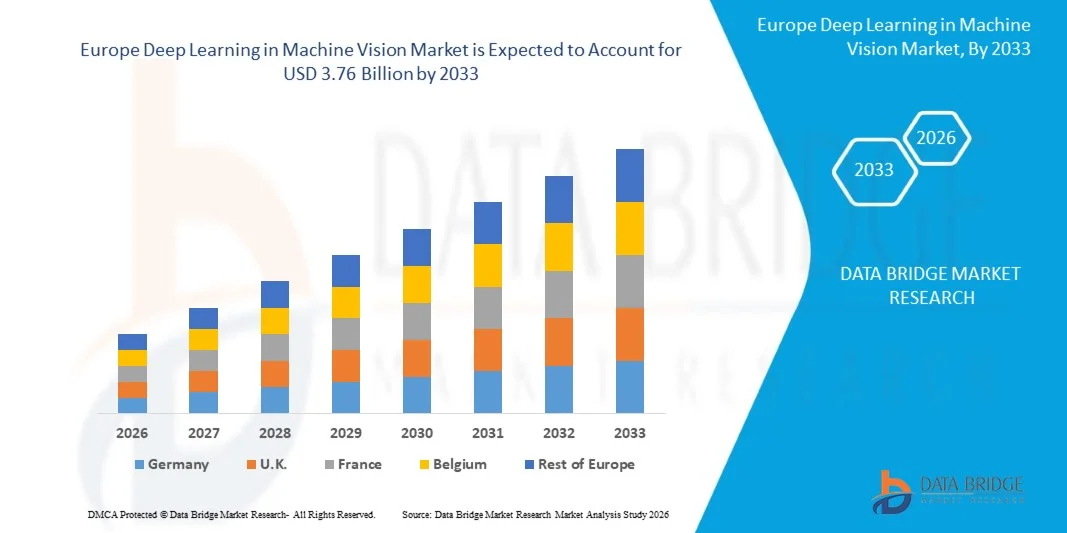
- The Europe Deep Learning in Machine Vision Market size was valued at USD 1.53 billion in 2025 and is expected to reach USD 3.76 billion by 2033, at a CAGR of 11.9% during the forecast period
- The market growth is largely fueled by the increasing adoption of artificial intelligence and deep learning technologies in industrial automation, leading to enhanced efficiency, accuracy, and real-time decision-making across manufacturing and inspection processes
- Furthermore, rising demand for high-precision quality control, predictive maintenance, and automated visual inspection systems is establishing deep learning-based machine vision as a critical component in modern industrial ecosystems. These converging factors are accelerating the adoption of intelligent vision solutions, thereby significantly boosting the market growth
Europe Deep Learning in Machine Vision Market Analysis
- Deep learning in machine vision refers to the use of advanced neural networks to enable machines to interpret, analyze, and make decisions based on visual data such as images and videos. These systems are widely integrated into industrial automation, healthcare diagnostics, surveillance, and robotics to improve accuracy, speed, and operational efficiency
- The escalating demand for deep learning in machine vision is primarily driven by the growing need for automated inspection, real-time analytics, and enhanced defect detection capabilities across industries, coupled with advancements in AI hardware and software technologies that enable more scalable and efficient vision systems
- U.K. dominated the Europe Deep Learning in Machine Vision Market in 2025, due to its strong presence in advanced manufacturing, artificial intelligence research, and high adoption of AI-powered vision systems across industries such as automotive, healthcare, and logistics to enhance operational efficiency and accuracy
- Germany is expected to be the fastest growing country in the Europe Deep Learning in Machine Vision Market during the forecast period due to its strong industrial base, rising adoption of Industry 4.0 technologies, and increasing deployment of AI-driven inspection systems across automotive and manufacturing sectors
- Hardware segment dominated the market with a market share of 49.1% in 2025, due to the increasing deployment of high-performance processors, GPUs, and specialized vision sensors required for deep learning workloads. Organizations invest significantly in advanced hardware infrastructure to enable real-time image processing, high-speed data handling, and accurate inference in industrial environments
Report Scope and Europe Deep Learning in Machine Vision Market Segmentation
|
Attributes |
Deep Learning in Machine Vision Key Market Insights |
|
Segments Covered |
|
|
Countries Covered |
Europe
|
|
Key Market Players |
|
|
Market Opportunities |
|
|
Value Added Data Infosets |
In addition to the insights on market scenarios such as market value, growth rate, segmentation, geographical coverage, and major players, the market reports curated by the Data Bridge Market Research also include in-depth expert analysis, geographically represented company-wise production and capacity, network layouts of distributors and partners, detailed and updated price trend analysis and deficit analysis of supply chain and demand. |
Europe Deep Learning in Machine Vision Market Trends
“Growing Adoption of Real-Time Video Analytics in Machine Vision”
- A significant trend in the Europe Deep Learning in Machine Vision Market is the increasing adoption of real-time video analytics, driven by the need for continuous monitoring, instant decision-making, and enhanced operational visibility across industries. This trend is transforming machine vision systems from static image processors into dynamic, intelligent platforms capable of analyzing streaming data in real time
- For instance, NVIDIA Corporation provides advanced AI-powered video analytics platforms such as NVIDIA Metropolis that enable real-time object detection, traffic monitoring, and industrial inspection. These solutions enhance operational efficiency and support large-scale deployment of intelligent vision systems across smart cities and manufacturing facilities
- The growing use of real-time analytics in surveillance and security applications is enabling faster threat detection, behavior analysis, and incident response. This is strengthening the role of deep learning-based vision systems in critical infrastructure protection and public safety management
- Industries such as automotive and transportation are leveraging real-time video analytics for autonomous navigation, driver assistance systems, and traffic optimization. This is positioning deep learning vision technologies as essential components for next-generation mobility solutions
- The expansion of edge computing is further supporting real-time processing by reducing latency and enabling on-device analysis of visual data. This is enhancing system responsiveness and reducing dependence on centralized cloud infrastructure
- The continuous demand for faster insights, improved accuracy, and scalable deployment of intelligent vision systems is reinforcing this trend. The integration of real-time video analytics is accelerating the transition toward more adaptive, responsive, and automated machine vision applications across industries
Europe Deep Learning in Machine Vision Market Dynamics
Driver
“Increasing Use of Deep Learning for Automated Inspection in Manufacturing”
- The increasing use of deep learning for automated inspection in manufacturing is a major driver of the market, as industries seek higher accuracy, efficiency, and consistency in quality control processes. Deep learning models enable precise defect detection, pattern recognition, and classification, surpassing traditional rule-based vision systems
- For instance, Cognex Corporation offers AI-powered vision systems that utilize deep learning algorithms to identify complex defects and variations in production lines. These systems improve inspection accuracy, reduce false rejects, and enhance overall production efficiency in manufacturing environments
- The rising emphasis on zero-defect manufacturing and product quality assurance is encouraging companies to adopt advanced vision systems. This is driving widespread deployment of deep learning-based inspection solutions across electronics, automotive, and semiconductor industries
- The integration of AI with robotics and industrial automation systems is enabling seamless inspection and decision-making within production workflows. This is improving throughput and minimizing human intervention in repetitive inspection tasks
- The need for real-time quality monitoring, reduced operational costs, and improved productivity continues to reinforce this driver. The adoption of deep learning in automated inspection is playing a critical role in enhancing manufacturing efficiency and competitiveness
Restraint/Challenge
“Data Privacy and Security Concerns in Vision-Based Systems”
- Data privacy and security concerns present a significant challenge in the Europe Deep Learning in Machine Vision Market, as these systems rely heavily on capturing, storing, and analyzing large volumes of visual data. Sensitive information processed through cameras and vision systems raises concerns regarding unauthorized access and misuse
- For instance, European Union enforces strict regulations such as the General Data Protection Regulation (GDPR), which impose stringent requirements on the collection and processing of personal data, including visual content. Compliance with such regulations increases operational complexity and limits unrestricted deployment of vision systems
- The risk of cyberattacks targeting AI-powered vision systems is increasing as these solutions become more connected and integrated with digital infrastructures. This raises concerns about system vulnerabilities and data breaches in critical applications
- Organizations must invest in advanced encryption, secure data storage, and access control mechanisms to protect sensitive visual data. These additional requirements increase implementation costs and complexity for enterprises adopting machine vision technologies
- The growing focus on data protection and regulatory compliance continues to act as a constraint on market growth. Addressing these concerns is essential for building trust and enabling wider adoption of deep learning-based machine vision systems across industries
Europe Deep Learning in Machine Vision Market Scope
The market is segmented on the basis of offering, application, object, and vertical.
• By Offering
On the basis of offering, the Europe Deep Learning in Machine Vision Market is segmented into hardware, software, and services. The hardware segment dominated the largest market revenue share of 49.1% in 2025, driven by the increasing deployment of high-performance processors, GPUs, and specialized vision sensors required for deep learning workloads. Organizations invest significantly in advanced hardware infrastructure to enable real-time image processing, high-speed data handling, and accurate inference in industrial environments. The growing complexity of visual data and the need for faster processing capabilities further strengthen the demand for robust hardware solutions across manufacturing and automation sectors.
The software segment is anticipated to witness the fastest growth rate from 2026 to 2033, fueled by rising adoption of AI-based vision platforms and deep learning algorithms for enhanced analytics and decision-making. Software solutions enable flexibility, scalability, and continuous updates, allowing enterprises to improve model accuracy and deploy new applications without heavy hardware changes. Increasing demand for cloud-based vision software and edge AI platforms is further accelerating adoption across industries seeking cost-efficient and adaptive solutions.
• By Application
On the basis of application, the Europe Deep Learning in Machine Vision Market is segmented into inspection, image analysis, anomaly detection, object classification, object tracking, counting, bar code detection, feature detection, location detection, optical character recognition, face recognition, instance segmentation, and others. The inspection segment dominated the largest market revenue share in 2025, driven by its extensive use in quality assurance and defect detection across manufacturing industries. Deep learning enhances inspection accuracy by identifying subtle defects and variations that traditional systems often miss, thereby improving product quality and reducing waste. The increasing emphasis on automated quality control and zero-defect manufacturing further supports the dominance of inspection applications.
The anomaly detection segment is expected to witness the fastest growth rate from 2026 to 2033, driven by the rising need for predictive maintenance and real-time fault detection in industrial systems. Deep learning models enable early identification of irregular patterns and defects, minimizing downtime and operational losses. Growing adoption in sectors such as electronics and automotive manufacturing is accelerating demand for advanced anomaly detection capabilities.
• By Object
On the basis of object, the Europe Deep Learning in Machine Vision Market is segmented into image and video. The image segment dominated the largest market revenue share in 2025, driven by its widespread use in industrial inspection, medical imaging, and quality analysis applications. Image-based systems require lower computational resources compared to video, making them cost-effective and easier to deploy across various industries. The high accuracy of deep learning models in processing static images further contributes to their strong adoption in precision-critical applications.
The video segment is anticipated to witness the fastest growth rate from 2026 to 2033, fueled by increasing demand for real-time monitoring, surveillance, and dynamic process analysis. Video-based machine vision enables continuous tracking, behavior analysis, and event detection, making it essential for applications such as security, traffic monitoring, and industrial automation. Advancements in edge computing and high-speed data processing are further supporting the rapid growth of video-based solutions.
• By Vertical
On the basis of vertical, the Europe Deep Learning in Machine Vision Market is segmented into electronics, manufacturing, automotive and transportation, food & beverages, aerospace, healthcare, building and material, power, and others. The manufacturing segment dominated the largest market revenue share in 2025, driven by extensive adoption of machine vision systems for automation, quality inspection, and process optimization. Deep learning enables manufacturers to achieve higher precision, reduce defects, and enhance production efficiency, aligning with Industry 4.0 initiatives. The integration of AI-driven vision systems into smart factories further reinforces the segment’s leading position.
The healthcare segment is expected to witness the fastest growth rate from 2026 to 2033, driven by increasing use of deep learning in medical imaging, diagnostics, and patient monitoring. Advanced vision systems assist in detecting diseases, analyzing scans, and improving diagnostic accuracy, thereby enhancing patient outcomes. Growing investments in AI-powered healthcare solutions and the rising need for early disease detection are accelerating the adoption of deep learning in machine vision within the healthcare sector.
Europe Deep Learning in Machine Vision Market Regional Analysis
- U.K. dominated the Europe Deep Learning in Machine Vision Market with the largest revenue share in 2025, driven by its strong presence in advanced manufacturing, artificial intelligence research, and high adoption of AI-powered vision systems across industries such as automotive, healthcare, and logistics to enhance operational efficiency and accuracy
- The country’s well-established technological ecosystem, supported by companies such as Arm Holdings and Darktrace, reinforces consistent demand for deep learning-based machine vision solutions across applications including inspection, surveillance, and data analytics
- Increasing integration of AI-enabled vision technologies, expansion of smart factory initiatives, and growing focus on automation and real-time decision-making strengthen the U.K.’s leading position in the Europe Deep Learning in Machine Vision Market
Germany Europe Deep Learning in Machine Vision Market Insight
Germany is projected to register the fastest CAGR in the Europe Deep Learning in Machine Vision Market during the forecast period, supported by its strong industrial base, rising adoption of Industry 4.0 technologies, and increasing deployment of AI-driven inspection systems across automotive and manufacturing sectors. The country’s emphasis on precision engineering, automation, and digital transformation is accelerating the adoption of deep learning-based vision solutions. Collaborations with companies such as Basler AG and SICK AG are enhancing technological capabilities and expanding application areas. Growing investments in smart manufacturing infrastructure and robotics are positioning Germany as the fastest-growing market in the region during the forecast period.
France Europe Deep Learning in Machine Vision Market Insight
France is expected to witness steady growth during the forecast period, driven by increasing adoption of deep learning-based machine vision systems across automotive, aerospace, and food processing industries to enhance inspection accuracy and production efficiency. Investments in advanced AI technologies, imaging systems, and automation infrastructure support continuous market development. The country’s focus on modernizing industrial operations, integrating intelligent vision solutions, and expanding digital manufacturing platforms reinforces its consistent growth. Increasing deployment of automated quality control and real-time analytics solutions positions France as a stable contributor to the Europe Deep Learning in Machine Vision Market.
Europe Deep Learning in Machine Vision Market Share
The deep learning in machine vision industry is primarily led by well-established companies, including:
- Cognex Corporation (U.S.)
- Intel Corporation (U.S.)
- NATIONAL INSTRUMENTS CORP. (U.S.)
- SICK AG (Germany)
- Datalogic S.p.A. (Italy)
- STEMMER IMAGING AG INH ON (Germany)
- Abto Software (Ukraine)
- Zebra Technologies Corp (U.S.)
- Autonics Corporation (South Korea)
- Basler AG (Germany)
- Euresys (Belgium)
- IDS Imaging Development Systems GmbH (Germany)
- LeewayHertz (U.S.)
- MVTEC SOFTWARE GMBH (Germany)
- Omron Corporation (Japan)
- perClass BV (Netherlands)
- Qualitas Technologies (India)
- RSIP Vision (Israel)
- USS Vision LLC (U.S.)
Latest Developments in Europe Deep Learning in Machine Vision Market
- In January 2025, NVIDIA Corporation strengthened its collaborations with key automotive companies, including Toyota, Aurora, and Continental, to accelerate the development of highly automated and autonomous vehicle fleets. By integrating its advanced AI platforms such as DRIVE and leveraging deep learning-based visual perception systems, NVIDIA is enabling real-time object detection, path planning, and decision-making capabilities for next-generation vehicles. These collaborations focus on enhancing safety, scalability, and deployment efficiency of autonomous systems, positioning NVIDIA at the forefront of AI-powered mobility innovation. This expansion is expected to significantly advance autonomous driving technologies, improving reliability and accelerating commercialization across markets
- In May 2024, Avnet, Inc. introduced the QCS6490 Vision-AI Development Kit to enable engineering teams to quickly prototype high-performance Edge AI-embedded products with multi-camera capabilities. The solution combines hardware acceleration with optimized software frameworks, allowing developers to build and test complex vision-based applications such as smart surveillance, industrial inspection, and robotics. Its energy-efficient architecture ensures reduced power consumption while maintaining high processing performance, making it suitable for edge deployments. This innovation is expected to accelerate time-to-market for AI-enabled vision solutions, driving wider adoption across industrial and commercial sectors
- In May 2024, Microsoft Corporation unveiled GPT-4 Turbo with Vision, a multimodal AI model designed to process both text and image inputs with enhanced efficiency and lower computational cost. The model enables businesses to perform advanced tasks such as contextual image understanding, automated content generation, visual search, and real-time analytics, expanding the scope of AI-driven applications. Its integration with enterprise tools and cloud platforms enhances accessibility and scalability for organizations adopting AI solutions. This development is expected to transform how businesses utilize visual data, improving operational efficiency and enabling more intelligent automation across industries
- In April 2024, Cognex Corporation launched the In-Sight L38 3D Vision System, integrating AI with both 2D and 3D vision technologies to enhance inspection and measurement processes in industrial environments. The system simplifies deployment by reducing the need for complex programming and extensive training datasets, while improving accuracy in detecting defects, measuring dimensions, and identifying features. Its ability to generate high-quality 2D images enriched with 3D data enhances consistency and reliability in quality control processes. This advancement is expected to significantly improve manufacturing efficiency, reduce errors, and support the transition toward fully automated production systems
- In April 2024, IBM introduced the IBM Z IntelliMagic Vision software platform for z/OS, a performance analysis solution designed to optimize enterprise IT infrastructure. The platform leverages advanced analytics, intuitive visual dashboards, and AI-driven insights to help organizations monitor system performance, detect anomalies, and prevent potential failures. Its no-code interface allows IT teams to quickly interpret complex datasets and make informed decisions without extensive technical expertise. This launch highlights IBM’s focus on enhancing system resilience and operational efficiency, enabling enterprises to manage workloads more effectively and ensure continuous performance optimization

- Interactive Data Analysis Dashboard
- Company Analysis Dashboard for high growth potential opportunities
- Research Analyst Access for customization & queries
- Competitor Analysis with Interactive dashboard
- Latest News, Updates & Trend analysis
- Harness the Power of Benchmark Analysis for Comprehensive Competitor Tracking
Europe Deep Learning In Machine Vision Market, Supply Chain Analysis and Ecosystem Framework
To support market growth and help clients navigate the impact of geopolitical shifts, DBMR has integrated in-depth supply chain analysis into its Europe Deep Learning In Machine Vision Market research reports. This addition empowers clients to respond effectively to global changes affecting their industries. The supply chain analysis section includes detailed insights such as Europe Deep Learning In Machine Vision Market consumption and production by country, price trend analysis, the impact of tariffs and geopolitical developments, and import and export trends by country and HSN code. It also highlights major suppliers with data on production capacity and company profiles, as well as key importers and exporters. In addition to research, DBMR offers specialized supply chain consulting services backed by over a decade of experience, providing solutions like supplier discovery, supplier risk assessment, price trend analysis, impact evaluation of inflation and trade route changes, and comprehensive market trend analysis.
Data collection and base year analysis are done using data collection modules with large sample sizes. The stage includes obtaining market information or related data through various sources and strategies. It includes examining and planning all the data acquired from the past in advance. It likewise envelops the examination of information inconsistencies seen across different information sources. The market data is analysed and estimated using market statistical and coherent models. Also, market share analysis and key trend analysis are the major success factors in the market report. To know more, please request an analyst call or drop down your inquiry.
The key research methodology used by DBMR research team is data triangulation which involves data mining, analysis of the impact of data variables on the market and primary (industry expert) validation. Data models include Vendor Positioning Grid, Market Time Line Analysis, Market Overview and Guide, Company Positioning Grid, Patent Analysis, Pricing Analysis, Company Market Share Analysis, Standards of Measurement, Global versus Regional and Vendor Share Analysis. To know more about the research methodology, drop in an inquiry to speak to our industry experts.
Data Bridge Market Research is a leader in advanced formative research. We take pride in servicing our existing and new customers with data and analysis that match and suits their goal. The report can be customized to include price trend analysis of target brands understanding the market for additional countries (ask for the list of countries), clinical trial results data, literature review, refurbished market and product base analysis. Market analysis of target competitors can be analyzed from technology-based analysis to market portfolio strategies. We can add as many competitors that you require data about in the format and data style you are looking for. Our team of analysts can also provide you data in crude raw excel files pivot tables (Fact book) or can assist you in creating presentations from the data sets available in the report.













