


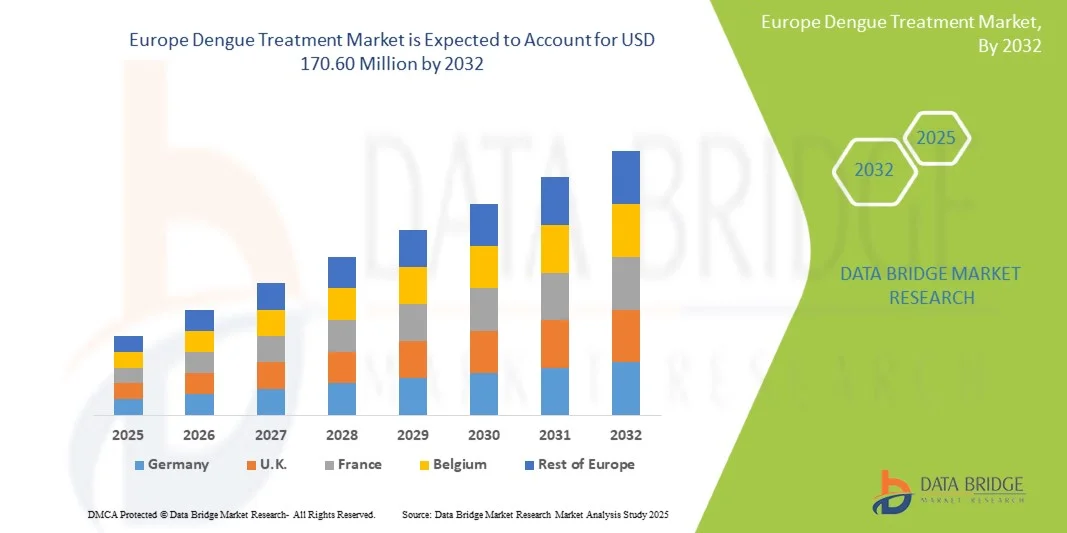
Europe Dengue Treatment Market Size
- The Europe Dengue Treatment Market size was valued at USD 33.64 Million in 2024 and is expected to reach USD 170.60 Million by 2032, at a CAGR of 22.50% during the forecast period
- The market growth is largely fueled by the rising prevalence of dengue fever across tropical and subtropical regions, increasing the demand for effective and accessible treatment options
- Furthermore, growing government initiatives, research in antiviral therapies, and heightened public awareness are accelerating the uptake of dengue treatment solutions, thereby significantly boosting the industry's growth
Europe Dengue Treatment Market Analysis
- The Europe Dengue Treatment Market is witnessing steady growth due to increasing awareness of dengue management, robust healthcare infrastructure, and active government programs targeting vector-borne diseases
- Rising demand for early diagnosis, standardized treatment protocols, and availability of advanced therapies are driving adoption across hospitals and specialty clinics
- Germany dominated the Europe Dengue Treatment Market with the largest revenue share of 32.5% in 2024, supported by high-quality healthcare facilities, early adoption of antiviral medications, and strong participation in clinical trials and research programs
- The U.K. is expected to be the fastest-growing country in Europe for the Europe Dengue Treatment Market during the forecast period, with a CAGR of 7.2%, fueled by increasing awareness of dengue risks, expansion of specialty clinics, and enhanced government initiatives for preventive care and outpatient services
- The Mosquito-to-Human Transmission segment dominated the Europe Dengue Treatment Market with the largest revenue share of 87% in 2024, as it represents the primary route of infection in endemic regions
Report Scope and Europe Dengue Treatment Market Segmentation
|
Attributes |
Europe Dengue Treatment Key Market Insights |
|
Segments Covered |
|
|
Countries Covered |
Europe
|
|
Key Market Players |
|
|
Market Opportunities |
|
|
Value Added Data Infosets |
In addition to the insights on market scenarios such as market value, growth rate, segmentation, geographical coverage, and major players, the market reports curated by the Data Bridge Market Research also include in-depth expert analysis, pricing analysis, brand share analysis, consumer survey, demography analysis, supply chain analysis, value chain analysis, raw material/consumables overview, vendor selection criteria, PESTLE Analysis, Porter Analysis, and regulatory framework. |
Europe Dengue Treatment Market Trends
“Advancements in Vaccine Development and Therapeutics”
- A significant and accelerating trend in the Europe Dengue Treatment Market is the development of next-generation vaccines and antiviral therapeutics aimed at reducing hospitalizations and severe disease outcomes. This includes live-attenuated vaccines and combination therapies targeting multiple dengue virus serotypes
- For instance, in May 2024, Takeda Pharmaceuticals received WHO prequalification for its dengue vaccine, Qdenga (TAK-003), which enables European countries to import and use the vaccine in high-risk traveler populations and during outbreaks
- Pharmaceutical companies are increasingly conducting multicountry clinical trials across Europe to validate efficacy and safety in diverse populations, ensuring rapid regulatory approvals by the European Medicines Agency (EMA)
- The integration of antiviral therapies alongside vaccination programs is a growing trend, providing comprehensive treatment approaches for travelers returning from endemic regions and sporadic outbreaks
- European public health authorities are actively assessing vaccination programs for high-risk communities, highlighting the trend of public-private collaboration to improve accessibility
- Digital health solutions, such as AI-based outbreak prediction tools and telemedicine platforms, are being adopted to monitor dengue outbreaks imported through travelers and optimize treatment administration
- Continuous R&D efforts focus on creating single-dose or longer-lasting vaccines to improve patient compliance and reduce logistical burdens in immunization programs
- Initiatives by organizations such as the European Centre for Disease Prevention and Control (ECDC) emphasize early detection and rapid response, reinforcing the trend toward preventive therapeutics in Europe
- Increased collaboration between European biotech firms and global vaccine manufacturers is accelerating the introduction of novel dengue therapies and improving readiness for outbreak management
Europe Dengue Treatment Market Dynamics
Driver
“Rising Incidence and Imported Dengue Cases”
- The increasing number of imported dengue cases in Europe is driving the demand for vaccines and therapeutic options in hospitals, travel clinics, and public health programs
- For instance, in 2024, France and Spain reported over 1,200 imported dengue cases from travelers returning from endemic regions, creating a need for rapid access to treatment and preventive vaccines
- Climate change and the gradual spread of Aedes mosquitoes in Southern Europe are contributing to an elevated risk of local transmission, further fueling market growth
- Public awareness campaigns highlighting early detection, vaccination benefits, and available treatment options for travelers have resulted in higher patient uptake and timely interventions
- Governments and international organizations are funding research, development, and distribution of dengue vaccines and therapeutics, providing new opportunities for market expansion in Europe
- In 2025, Italy and Portugal reported sporadic autochthonous dengue cases, emphasizing the need for preventive and treatment measures, acting as a market growth driver
- Rising healthcare expenditure in European countries enables broader access to vaccines and antivirals, improving adoption rates
- Expansion of specialized travel and tropical medicine clinics is facilitating faster treatment access and awareness among at-risk populations
- Increasing prevalence of co-infections with other mosquito-borne diseases, such as chikungunya, has intensified the demand for comprehensive dengue therapeutics in Europe
Restraint/Challenge
“Limited Diagnostic Accessibility and High Treatment Costs”
- Limited availability of rapid and accurate dengue diagnostics in certain European travel clinics and rural areas remains a key challenge, delaying early treatment initiation
- For instance, during the 2024 dengue season in Spain, delays in diagnostics due to limited lab capacity led to slower treatment response for imported cases
- Advanced diagnostic kits remain expensive and are often limited to larger hospitals, affecting early detection and treatment outcomes
- Misdiagnosis or delayed diagnosis increases treatment costs and can lead to severe complications, reducing confidence in therapeutic options
- Regulatory and logistical hurdles for importing vaccines or antivirals in certain European countries can delay market access and limit patient coverage
- Addressing these challenges requires investment in affordable diagnostic technologies, governmental support, and improved distribution infrastructure to ensure timely intervention
- High treatment costs, including hospitalization and supportive care, can limit access for uninsured or low-income populations
- Supply chain dependency on a few vaccine manufacturers can lead to temporary shortages, slowing access in outbreak situations
- Limited awareness among healthcare providers in non-endemic European countries can delay proper treatment initiation for imported cases
- Differences in national health policies and reimbursement mechanisms across European countries can hinder consistent adoption of dengue vaccines and therapeutics
Europe Dengue Treatment Market Scope
The market is segmented on the basis of strains, transmission, type, severity, route of administration, mode of purchase, end user, and distribution channel.
• By Strains
On the basis of strains, the Europe Dengue Treatment Market is segmented into DENV-1, DENV-2, DENV-3, DENV-4, and Others. The DENV-2 segment dominated the market with the largest revenue share of 36.8% in 2024, driven by its high prevalence in countries such as Germany, France and U.K. Hospitals and clinics prioritize DENV-2 due to its association with moderate to severe dengue cases. The segment benefits from government health programs promoting early diagnosis and treatment. Clinical guidelines and standardized treatment protocols strengthen hospital adoption. Outpatient and hospital care integration ensures timely therapy administration. R&D programs targeting DENV-2 therapies are active in the region. Urban and semi-urban areas show higher treatment adoption rates. Continuous patient monitoring improves outcomes. Public awareness campaigns emphasize early intervention. Physician training programs reinforce best practices. Hospitals and specialty clinics ensure continuous medication supply and adherence. Government and private collaborations support clinical trials and research.
The DENV-3 segment is expected to witness the fastest CAGR of 8.5% from 2025 to 2032, driven by rising outbreaks and increasing awareness of its clinical complications. Hospitals and specialty clinics are prioritizing DENV-3 due to its link with moderate to severe cases. Ongoing research and development of DENV-3-targeted vaccines and supportive therapies is fueling adoption. Public health initiatives are promoting preventive measures and early treatment. Expansion of diagnostic facilities allows for early detection. Physicians emphasize tailored treatment protocols for DENV-3 infections. Hospitals are ensuring better monitoring for complications. Government programs provide targeted support in outbreak-prone regions. Patient access is increasing in both urban and semi-urban areas. Integration with public health programs strengthens adoption. Clinical guidelines are being updated based on DENV-3 case trends. Community awareness campaigns drive timely hospital and clinic visits. Pharmaceutical R&D continues to improve treatment efficacy and safety.
• By Transmission
On the basis of transmission, the Europe Dengue Treatment Market is segmented into mosquito-to-human transmission and mother-to-child transmission. The mosquito-to-human transmission segment dominated the market with the largest revenue share of 87% in 2024, as it represents the primary route of infection in endemic regions. Vector control programs and community awareness campaigns support hospitals and clinics in managing patient load. Early diagnosis and timely treatment in hospitals ensure better patient outcomes. Standardized clinical guidelines strengthen adoption. Urban and semi-urban populations exhibit higher incidence, driving treatment demand. Hospitals integrate supportive care and parenteral therapies. Physicians emphasize patient monitoring and follow-up. Government health programs and public campaigns reinforce preventive measures. Continuous availability of medications ensures uninterrupted treatment. Specialty clinics support hospital initiatives with outpatient care. Clinical research and case tracking enhance treatment protocols. Hospitals and clinics collaborate to optimize therapy management.
The Mother-to-Child Transmission segment is expected to register the fastest CAGR of 9.2% from 2025 to 2032, fueled by rising awareness of neonatal dengue risks and improvements in maternal healthcare facilities. Prenatal screening programs in hospitals are expanding. Specialty clinics provide follow-up care for newborns at risk. Preventive measures during pregnancy are increasingly adopted. Awareness campaigns educate healthcare providers and patients. Government initiatives target reduction of vertical transmission. Hospitals implement strict neonatal care protocols. Supportive medications and parenteral therapy aid rapid intervention. Physicians provide counseling for expectant mothers in endemic regions. Clinics integrate dengue care with maternal health programs. Early diagnosis and monitoring improve neonatal outcomes. Expansion of outpatient maternal care enhances accessibility. Continuous research and reporting inform clinical guidelines and public health strategy.
• By Type
On the basis of type, the Europe Dengue Treatment Market is segmented into medication, supportive care, vaccination, and others. The Medication segment dominated the market with a revenue share of 54.6% in 2024, driven by the widespread use of antivirals and adjunct therapies. Hospitals and clinics adopt standardized medication protocols. Outpatient care ensures timely administration. Government health programs promote access to medications. Urban and semi-urban adoption is high due to improved healthcare infrastructure. Physician adherence to clinical guidelines strengthens hospital adoption. Continuous R&D improves drug efficacy and safety. Clinical trials support introduction of new therapies. Patient monitoring and follow-up ensure effective outcomes. Insurance programs support medication costs. Public awareness campaigns promote early treatment. Hospitals and specialty clinics ensure consistent medication supply. Integration with supportive care and vaccination programs enhances patient recovery.
The Vaccination segment is expected to witness the fastest CAGR of 12.4% from 2025 to 2032, driven by government immunization programs, multi-serotype next-generation vaccines, and rising community awareness of dengue prevention. Hospitals and clinics prioritize vaccination in endemic regions. Public health campaigns educate communities on vaccine benefits. Expansion of vaccination centers increases accessibility in urban and semi-urban areas. Physicians recommend vaccines for high-risk populations. R&D investment improves efficacy and safety. Government subsidies and insurance programs support vaccine adoption. Awareness of outbreak prevention encourages uptake. Integration of vaccination programs with routine healthcare strengthens coverage. Follow-up and booster doses ensure long-term immunity. Distribution through hospital and retail pharmacies increases reach. Vaccination adoption complements supportive care and medication protocols. Monitoring of vaccine impact informs policy and clinical guidelines.
• By Severity
On the basis of severity, the Europe Dengue Treatment Market is segmented into uncomplicated and severe. The Uncomplicated segment dominated the market with a revenue share of 68% in 2024, as it accounts for the majority of dengue cases. Outpatient management and supportive care are widely adopted. Hospitals and clinics ensure adherence to standardized treatment protocols. Early diagnosis and timely intervention improve patient outcomes. Government health programs promote access to medications. Urban and semi-urban areas show higher adoption rates. Physicians monitor patient recovery and provide follow-up care. Community awareness campaigns support timely hospital visits. Insurance coverage enhances treatment affordability. Clinical guidelines reinforce proper management. Hospital pharmacies ensure medication availability. Integration with other healthcare services strengthens adherence. Hospitals and specialty clinics collaborate for effective management.
The Severe segment is expected to register the fastest CAGR of 10.1% from 2025 to 2032, driven by increasing incidence of dengue hemorrhagic fever and dengue shock syndrome. Hospitals are expanding critical care infrastructure to manage severe cases. Intensive monitoring and combination therapies are increasingly adopted. Physicians emphasize early diagnosis and rapid intervention. Specialty clinics support hospital care through outpatient follow-up. Government health programs provide targeted resources for high-risk patients. Parenteral therapy and advanced supportive care are widely implemented. Standardized hospital protocols ensure consistent treatment. Awareness campaigns encourage timely hospital visits. Expansion of tertiary care facilities improves accessibility. R&D focuses on optimizing treatments for severe dengue. Data collection informs clinical guidelines and policy. Hospitals and clinics collaborate to improve survival rates.
• By Route of Administration
On the basis of route of administration, the Europe Dengue Treatment Market is segmented into oral and parenteral. The Oral segment dominated the market with a revenue share of 62% in 2024, due to widespread use for fever reduction, platelet management, and supportive care. Outpatient treatment ensures compliance. Hospitals and clinics follow standardized guidelines. Government programs promote accessibility. Urban and semi-urban adoption is high. Easy administration supports patient adherence. Insurance coverage enhances affordability. Continuous medication supply ensures uninterrupted therapy. Physicians monitor patient progress and provide counseling. Integration with hospital and specialty clinic services improves outcomes. Clinical protocols guide safe administration. Public awareness campaigns encourage timely treatment. Hospitals and clinics optimize oral therapy for uncomplicated cases.
The Parenteral segment is expected to witness the fastest CAGR of 11.5% from 2025 to 2032, fueled by increasing hospitalizations for severe dengue, expansion of intensive care infrastructure, and adoption of intravenous fluid therapy and injectable antivirals. Hospitals equip critical care units with parenteral capabilities. Physicians emphasize rapid administration to reduce complications. Specialty clinics coordinate outpatient IV therapies. Supportive medications ensure timely intervention for high-risk patients. Government programs provide infrastructure support. Continuous R&D improves safety and efficacy. Tertiary care expansion enhances accessibility. Patient adherence and monitoring improve outcomes. Hospital pharmacies ensure medication supply. Integration with diagnostics enables immediate therapy. Insurance coverage supports inpatient and parenteral care. Clinical guidelines and monitoring strengthen adoption.
• By Mode of Purchase
On the basis of mode of purchase, the Europe Dengue Treatment Market is segmented into prescription and over the counter (OTC). The Prescription segment dominated the market with a revenue share of 77% in 2024, as physician-supervised treatment is essential for safe dengue management. Hospitals and clinics dispense medications directly. Regulatory adherence ensures standardized protocols. Insurance coverage supports affordability. Physician monitoring and follow-up strengthen outcomes. Outpatient and inpatient access improve adherence. Government programs and public health initiatives reinforce prescription use. Urban and semi-urban adoption is high. Standardized dosing reduces complications. Hospital pharmacies provide reliable supply. Specialty clinics support prescription-based care. Clinical guidelines reinforce proper administration. Physician education enhances patient compliance.
The OTC segment is expected to register the fastest CAGR of 9.8% from 2025 to 2032, driven by growing home-based care for uncomplicated dengue, availability of supportive medications without prescription, and expansion of retail and online pharmacy networks. Patients increasingly prefer OTC options for convenience and quick symptom management. Retail pharmacies promote accessibility and awareness. Online platforms enable home delivery and adherence tracking. Public education campaigns inform safe OTC use. Urban and semi-urban populations benefit from increased access. Physician guidance ensures proper self-management. Integration with supportive care enhances outcomes. Digital tools monitor compliance. OTC adoption reduces hospital load. Community health initiatives encourage responsible use. Specialty clinics integrate OTC care with outpatient management. Growing confidence in self-managed treatment supports expansion.
• By End User
On the basis of end user, the Europe Dengue Treatment Market is segmented into hospitals, specialty clinics, home healthcare, and others. The Hospitals segment dominated the market with a revenue share of 58% in 2024, due to comprehensive care for dengue patients including medications, supportive care, and parenteral therapy. Critical care units, physician expertise, and standardized protocols support effective management. Government health programs and insurance schemes improve accessibility. Urban and semi-urban adoption is high. Integration with diagnostics ensures early intervention. Hospitals monitor patient adherence and follow-up. Specialty clinics complement hospital care through outpatient services. Research and clinical trials support new therapies. Hospital pharmacies ensure continuous supply. Public awareness campaigns drive timely hospital visits. Tertiary care infrastructure strengthens treatment outcomes. Clinical guidelines reinforce standardized management.
The Specialty Clinics segment is expected to witness the fastest CAGR of 7.5% from 2025 to 2032, fueled by expansion of outpatient services, increased awareness among physicians and patients, and adoption of home-based care programs. Clinics provide oral therapy, monitoring, and follow-up for patients transitioning from hospital care. Urban and semi-urban accessibility improves treatment reach. Physicians integrate dengue care with other outpatient services. Preventive care and patient education reduce disease progression. Collaboration with hospitals ensures continuity of care. Telemedicine and digital monitoring support adherence. Community awareness campaigns drive clinic visits. Clinics stock both prescription and supportive medications. Staff training improves quality of care. Government health program integration ensures coverage. Expansion of specialty clinic networks strengthens market penetration. Clinics play a growing role in managing uncomplicated and moderate dengue cases.
• By Distribution Channel
On the basis of distribution channel, the Europe Dengue Treatment Market is segmented into hospital pharmacies, retail pharmacies, online pharmacies, and others. The Hospital Pharmacies segment dominated the market with a revenue share of 49% in 2024, as it ensures direct access to prescription medications, parenteral therapies, and vaccination programs. Hospitals integrate pharmacies into treatment protocols. Physician-dispensed medications reinforce adoption. Quality control and proper storage ensure efficacy. Government partnerships support subsidized therapies. Uninterrupted medication supply is maintained. Patient counseling and follow-up improve adherence. Urban and semi-urban adoption is high. Integration with diagnostic and clinical services strengthens treatment outcomes. Insurance programs support accessibility. Specialty clinics complement hospital pharmacy services. R&D and clinical trials drive adoption. Public health campaigns reinforce utilization. Continuous supply chains ensure reliable distribution.
The Online Pharmacies segment is expected to register the fastest CAGR of 9.1% from 2025 to 2032, fueled by e-commerce adoption, patient preference for home delivery, digital adherence programs, and wider accessibility in urban and semi-urban regions. Online platforms ensure convenient refills and discreet delivery. Patients on long-term therapy benefit from home delivery and monitoring. Retail and hospital pharmacy collaborations enhance availability. Telemedicine integration improves adherence. Internet penetration drives market growth. Extensive medication variety supports both prescription and OTC needs. Digital tools monitor patient compliance. Urban and semi-urban expansion increases accessibility. Awareness campaigns encourage adoption. Insurance and payment support enhance affordability. Home delivery reduces travel and exposure risk. E-commerce competition promotes wider availability
Europe Dengue Treatment Market Regional Analysis
- Germany dominated the Europe Dengue Treatment Market with the largest revenue share of 32.5% in 2024, supported by high-quality healthcare facilities, early adoption of antiviral medications, and strong participation in clinical trials and research programs
- The U.K. is expected to be the fastest-growing country in Europe for the Europe Dengue Treatment Market during the forecast period, with a CAGR of 7.2%, fueled by increasing awareness of dengue risks, expansion of specialty clinics, and enhanced government initiatives for preventive care and outpatient services
- The region is experiencing significant growth across hospitals, specialty clinics, and home healthcare applications, with dengue treatment services being incorporated into both public health initiatives and private healthcare facilities
Germany Europe Dengue Treatment Market Insight
The Germany Europe Dengue Treatment Market dominated Europe with the largest revenue share of 32.5% in 2024, fueled by high-quality healthcare facilities, early adoption of antiviral medications, and strong participation in clinical trials and research programs. The country’s well-developed infrastructure, combined with robust public health initiatives and emphasis on clinical excellence, supports widespread adoption of dengue treatment in hospitals, specialty clinics, and outpatient settings. Ongoing research, standardized treatment protocols, and collaboration between healthcare providers and pharmaceutical companies strengthen Germany’s leading position in the European market.
U.K. Europe Dengue Treatment Market Insight
The U.K. Europe Dengue Treatment Market is anticipated to grow at a noteworthy CAGR of 7.2% during the forecast period, driven by rising awareness of dengue risks, expansion of specialty clinics, and government initiatives promoting preventive care and outpatient services. Increased patient education, telemedicine adoption, and integration of supportive care programs in urban and semi-urban areas are further boosting market growth.
Europe Dengue Treatment Market Share
The dengue treatment industry is primarily led by well-established companies, including:
- Takeda Pharmaceutical Company Limited (Japan)
- Sanofi S.A. (France)
- Biological E Limited (India)
Latest Developments in Europe Dengue Treatment Market
- In October 2024, the World Health Organization (WHO) launched a comprehensive global strategic plan aimed at reducing the burden of dengue and other Aedes-borne arboviral diseases such as Zika and chikungunya. This initiative underscores the WHO's commitment to combating the rising incidence of these diseases through coordinated international efforts and enhanced surveillance system
- In May 2024, France reported a record number of imported dengue fever cases, with at least 2,666 individuals contracting the disease abroad, particularly from Martinique and Guadeloupe. This surge highlights the growing risk of dengue outbreaks in Europe due to increased travel and the spread of the Aedes albopictus mosquito
- In August 2024, a laboratory in Spain began sterilizing thousands of tiger mosquitoes weekly to combat the spread of dengue and other diseases. Using electron accelerators, approximately 45,000 male mosquitoes are sterilized and released to mate with females, thereby reducing the mosquito population and the transmission of the virus
- In July 2025, the European Centre for Disease Prevention and Control (ECDC) reported four locally transmitted cases of dengue in Europe, specifically in Portugal, Italy, and France. This marks a concerning trend of indigenous transmission of the disease within the region
- In August 2025, the ECDC updated its surveillance data, indicating that over 4 million dengue cases and more than 2,500 dengue-related deaths had been reported globally since the beginning of the year. This underscores the escalating threat of dengue fever and the need for enhanced preventive measures and treatment strategies

- Interactive Data Analysis Dashboard
- Company Analysis Dashboard for high growth potential opportunities
- Research Analyst Access for customization & queries
- Competitor Analysis with Interactive dashboard
- Latest News, Updates & Trend analysis
- Harness the Power of Benchmark Analysis for Comprehensive Competitor Tracking
Data collection and base year analysis are done using data collection modules with large sample sizes. The stage includes obtaining market information or related data through various sources and strategies. It includes examining and planning all the data acquired from the past in advance. It likewise envelops the examination of information inconsistencies seen across different information sources. The market data is analysed and estimated using market statistical and coherent models. Also, market share analysis and key trend analysis are the major success factors in the market report. To know more, please request an analyst call or drop down your inquiry.
The key research methodology used by DBMR research team is data triangulation which involves data mining, analysis of the impact of data variables on the market and primary (industry expert) validation. Data models include Vendor Positioning Grid, Market Time Line Analysis, Market Overview and Guide, Company Positioning Grid, Patent Analysis, Pricing Analysis, Company Market Share Analysis, Standards of Measurement, Global versus Regional and Vendor Share Analysis. To know more about the research methodology, drop in an inquiry to speak to our industry experts.
Data Bridge Market Research is a leader in advanced formative research. We take pride in servicing our existing and new customers with data and analysis that match and suits their goal. The report can be customized to include price trend analysis of target brands understanding the market for additional countries (ask for the list of countries), clinical trial results data, literature review, refurbished market and product base analysis. Market analysis of target competitors can be analyzed from technology-based analysis to market portfolio strategies. We can add as many competitors that you require data about in the format and data style you are looking for. Our team of analysts can also provide you data in crude raw excel files pivot tables (Fact book) or can assist you in creating presentations from the data sets available in the report.












