


Europe Digital Lending Platform Market Overview
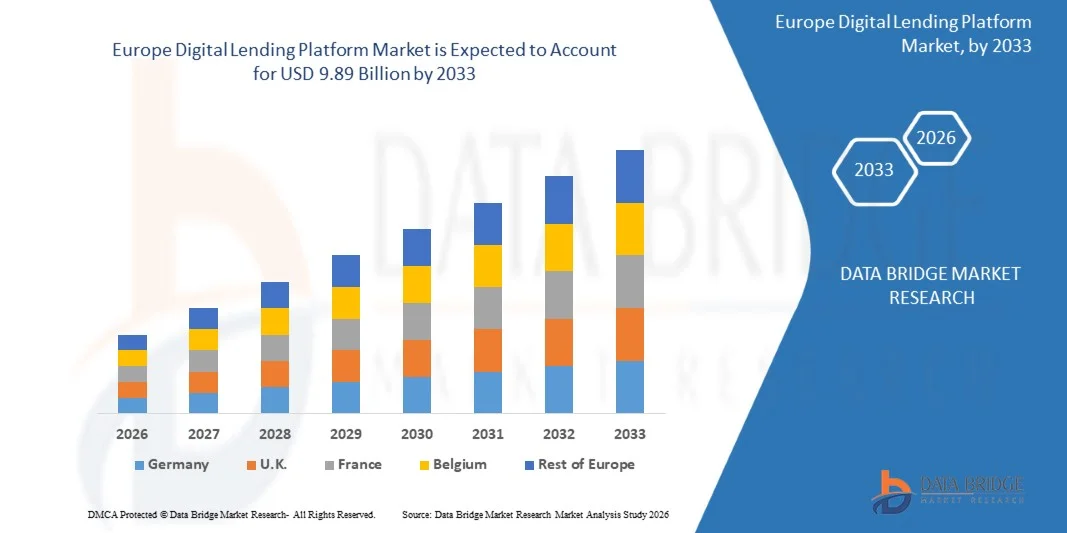
As per Data Bridge Market Research analysis the Europe digital lending platform market was valued at USD 2.46 billion in 2025 and is projected to reach USD 9.89 billion by 2033, growing at a CAGR of 19.00% from 2026 to 2033. The market is experiencing robust growth driven by the increasing digitalization of financial services, rising demand for faster and paperless loan processing, and continuous advancements in artificial intelligence, machine learning, and cloud-based lending technologies. Financial institutions, fintech companies, and non-banking financial companies (NBFCs) are increasingly adopting digital lending platforms to automate loan origination, credit assessment, underwriting, disbursement, and loan servicing, enabling faster approvals, improved operational efficiency, and enhanced customer experience. The growing use of alternative data sources, AI-powered credit scoring, electronic Know Your Customer (e-KYC), and digital identity verification is further improving lending accuracy while expanding financial inclusion.
The increasing penetration of smartphones, internet connectivity, and digital payment ecosystems, coupled with growing consumer preference for remote and contactless financial services, is encouraging banks, credit unions, fintech providers, and lending institutions to invest in advanced digital lending platforms. AI-driven risk assessment tools, automated decision engines, open banking integration, and embedded finance solutions are increasingly replacing traditional manual lending processes by enabling real-time borrower evaluation, personalized loan offerings, fraud detection, regulatory compliance, and seamless loan management. Furthermore, the integration of cloud computing, application programming interfaces (APIs), blockchain technology, and data analytics is further accelerating the adoption of digital lending platform solutions across both developed and emerging markets.
Market Size & Forecast
- Market Value (2025): USD 2.46 Billion
- Expected Market Value (2033): USD 9.89 Billion
- Forecast CAGR (2026–2033): 19.00%
- Leading Region in 2025: K
- Fastest Growing Region: Germany
Key Market Trends & Insights
- The U.K. dominated the Europe digital lending platform market with an estimated revenue share of 28.6% in 2025, driven by the presence of a mature fintech ecosystem, high digital banking penetration, widespread adoption of online lending solutions by consumers and SMEs, supportive regulations from the Financial Conduct Authority (FCA), and the strong presence of leading digital lenders and financial technology companies. The country's advanced financial infrastructure and increasing demand for instant, AI-driven lending solutions continue to strengthen its leadership in the European digital lending platform market.
- The paid segment dominated the market with an estimated 8% share in 2025 owing to the increasing demand for enterprise-grade lending platforms offering advanced automation, AI-driven credit assessment, fraud detection, regulatory compliance, loan servicing, and customer relationship management capabilities.
- Germany is expected to witness the fastest growth in the Europe digital lending platform market, registering an estimated CAGR of 18.9% during 2026–2033, supported by rapid digital transformation across the banking sector, increasing adoption of embedded finance, growing fintech investments, expanding SME demand for digital credit solutions, and favorable government initiatives promoting financial innovation. The rising popularity of cloud-based lending platforms, open banking frameworks, and AI-powered credit assessment technologies is further accelerating market growth across Germany.
- The P2P (peer-to-peer) lenders segment is projected to witness the fastest CAGR of 3% from 2026 to 2033, driven by the growing popularity of alternative lending models that directly connect borrowers with individual and institutional investors through digital platforms.
- The SME finance loan segment is expected to register the fastest CAGR of 1% from 2026 to 2033, driven by increasing demand for digital working capital, business expansion financing, equipment purchases, and cash flow management among small and medium-sized enterprises.
Report Scope and Digital Lending Platform Market Segmentation
|
Attributes |
Digital Lending Platform Key Market Insights |
|
Segments Covered |
|
|
Countries Covered |
Europe
|
|
Key Market Players |
|
|
Market Opportunities |
|
|
Value Added Data Infosets |
In addition to the insights on market scenarios such as market value, growth rate, segmentation, geographical coverage, and major players, the market reports curated by the Data Bridge Market Research also include in-depth expert analysis, geographically represented company-wise production and capacity, network layouts of distributors and partners, detailed and updated price trend analysis and deficit analysis of supply chain and demand. |
Digital Lending Platform Market Trends
Trend: Growing Adoption of AI-Powered Credit Decisioning and Embedded Digital Lending
Banks, fintech companies, and non-banking financial institutions across Europe are increasingly adopting artificial intelligence (AI), machine learning, and embedded finance technologies to streamline digital lending processes and enhance customer experience. AI-powered lending platforms enable financial institutions to automate borrower onboarding, identity verification, credit scoring, fraud detection, loan underwriting, and risk assessment using real-time financial and behavioral data. The rapid implementation of open banking under the revised Payment Services Directive (PSD2), together with cloud computing and API-based lending ecosystems, is accelerating digital loan approvals while reducing operational costs. Embedded lending solutions are also enabling merchants and e-commerce platforms to offer instant financing at the point of sale, expanding access to credit for both consumers and SMEs throughout Europe. For instance, in September 2024, Visa announced the expansion of its partnership with Tink to strengthen open banking-powered lending and financial services across Europe, enabling financial institutions and fintech companies to deliver faster digital lending experiences through secure access to consumer financial data. The initiative reflects the growing adoption of AI-enabled and open banking-based lending solutions across the European financial ecosystem. https://www.tink.com/news/visa-and-tink/
Digital Lending Platform Market Dynamics
Key Market Driver: Rising Adoption of Open Banking and AI-Driven Lending Platforms
The increasing adoption of open banking frameworks, AI-powered underwriting, and digital financial services is a major driver of the Europe digital lending platform market. Financial institutions are increasingly replacing conventional loan processing with automated lending platforms capable of delivering real-time credit decisions, digital document verification, fraud prevention, and personalized loan offerings. The implementation of PSD2 has enabled secure sharing of financial data between banks and licensed third-party providers, significantly improving credit assessment accuracy and accelerating loan approvals. Banks, fintech firms, and alternative lenders are investing heavily in cloud-based lending platforms, predictive analytics, and AI-driven risk management solutions to improve operational efficiency and customer experience. The growing demand for instant consumer loans, digital mortgages, SME financing, and Buy Now, Pay Later (BNPL) solutions is further driving market expansion. In addition, increasing smartphone penetration and digital banking adoption continue supporting the rapid growth of the Europe digital lending platform market. For instance, in June 2024, Revolut launched Revolut Business Instant Access Credit for eligible business customers in selected European markets, enabling SMEs to access flexible digital financing through its app-based banking platform. The launch demonstrates the growing demand for AI-enabled digital lending solutions within Europe's expanding fintech ecosystem.
Key Restraint/Challenge: Stringent Data Privacy Regulations and Rising Cybersecurity Risks
A major challenge facing the Europe digital lending platform market is ensuring compliance with GDPR, financial regulations, and increasingly sophisticated cybersecurity threats. Digital lending platforms process large volumes of sensitive financial information, identity documents, banking records, and transaction histories, making them attractive targets for cyberattacks and financial fraud. Financial institutions must continuously invest in encryption technologies, identity verification systems, fraud detection platforms, and regulatory compliance frameworks to protect customer data and maintain trust. In addition, increasing regulatory scrutiny surrounding AI-based credit decisioning requires greater transparency, explainability, and fairness in automated lending models. These compliance requirements increase implementation costs and operational complexity for lending platform providers operating across multiple European jurisdictions. For instance, in December 2023, the European Union reached political agreement on the AI Act, establishing risk-based requirements for AI systems used in sectors including financial services, with stricter obligations for transparency, governance, and risk management that directly affect AI-powered lending platforms.
Key Market Opportunity: Expansion of Embedded Finance and SME Digital Lending
The rapid expansion of embedded finance, Banking-as-a-Service (BaaS), and SME digital lending presents a significant long-term opportunity for the Europe digital lending platform market. Businesses are increasingly integrating lending capabilities directly into e-commerce platforms, accounting software, enterprise applications, and digital marketplaces, allowing customers to access financing without visiting traditional banks. AI-powered credit assessment, alternative data analytics, and open banking APIs are enabling lenders to provide faster and more accurate loan approvals, particularly for underserved small and medium-sized enterprises. Growing collaboration between fintech companies, traditional banks, payment providers, and cloud technology vendors is accelerating innovation across Europe's lending ecosystem. Continuous investment in embedded finance infrastructure, API-based banking, and digital financial services is expected to create substantial growth opportunities throughout the forecast period. For instance, in January 2024, Mastercard announced the expansion of its Open Finance solutions across Europe to help financial institutions and fintech companies deliver faster, data-driven lending and credit decisioning services using secure consumer-permissioned financial data. The initiative supports the continued evolution of embedded finance and AI-enabled digital lending across the European market.
Digital Lending Platform Market Scope
The digital lending platform market is segmented on the basis of component, deployment model, loan amount size, subscription type, loan type, and vertical.
- By Component
On the basis of component, the global digital lending platform market is segmented into solutions and services. The solutions segment dominated the market with an estimated 69.3% share in 2025 owing to the growing adoption of end-to-end digital lending software by banks, fintech companies, non-banking financial companies (NBFCs), and credit unions. These platforms automate loan origination, borrower onboarding, identity verification, credit scoring, underwriting, document management, and loan servicing through a single integrated platform. The global digital lending platform market is witnessing strong demand for AI-powered decision engines that enable faster loan approvals while improving operational efficiency and reducing processing costs. Financial institutions are increasingly integrating cloud computing, open banking APIs, machine learning, and fraud detection capabilities into lending platforms to enhance customer experience. Growing demand for instant digital loans and embedded finance is further supporting adoption. The expansion of mobile banking and digital financial services continues to strengthen the dominance of software solutions. Continuous innovation in predictive analytics and automated risk assessment is improving lending accuracy. Increasing investment in digital transformation by financial institutions is expected to sustain the leadership of the solutions segment throughout the forecast period.
The services segment is projected to witness the fastest CAGR of 19.2% from 2026 to 2033, driven by increasing demand for consulting, implementation, cloud migration, customization, integration, managed services, and platform maintenance. Financial institutions require specialized expertise to integrate digital lending platforms with existing core banking systems and third-party financial applications. The global digital lending platform market is experiencing rising demand for AI model optimization, cybersecurity consulting, regulatory compliance, and open banking implementation services. Growing adoption among regional banks and fintech startups is accelerating demand for professional support services. Continuous software upgrades and regulatory changes are further increasing service requirements. Financial institutions are increasingly outsourcing platform management to improve efficiency and reduce operational complexity. Expanding cloud adoption is also supporting managed services growth. These factors are expected to accelerate the services segment throughout the forecast period.
- By Deployment Model
On the basis of deployment model, the global digital lending platform market is segmented into on premises and cloud. The cloud segment dominated the market with an estimated 64.8% share in 2025 owing to its scalability, lower infrastructure costs, faster deployment, and seamless integration with digital banking ecosystems. Financial institutions increasingly prefer cloud-based lending platforms because they support real-time credit assessment, remote accessibility, automatic software updates, and enhanced disaster recovery capabilities. The global digital lending platform market continues to benefit from rapid migration toward Software-as-a-Service (SaaS) lending solutions. Cloud deployment enables organizations to launch new digital lending products quickly while maintaining regulatory compliance and operational flexibility. Growing adoption of AI-powered underwriting, open banking APIs, and embedded finance solutions is further strengthening cloud deployment. Banks and fintech firms are leveraging cloud infrastructure to process high loan volumes while maintaining system reliability. Increasing investment by cloud providers is supporting platform innovation. These factors continue to reinforce the dominance of the cloud segment.
The on premises segment is expected to witness the fastest adoption among organizations requiring strict data control in specific regulated environments, registering a CAGR of 16.8% from 2026 to 2033. Large financial institutions handling highly sensitive customer information continue investing in on premises infrastructure to maintain greater control over data security and regulatory compliance. The global digital lending platform market continues to witness demand from organizations operating under strict internal governance policies. Financial institutions prefer customized deployment for complex lending workflows and legacy system integration. Continuous investment in cybersecurity and hybrid IT infrastructure is supporting market expansion. Advanced encryption technologies and secure internal networks further improve adoption. Organizations requiring customized lending environments continue investing in on premises solutions. These factors are expected to support steady growth during the forecast period.
- By Loan Amount Size
On the basis of loan amount size, the global digital lending platform market is segmented into less than USD 7,000, USD 7,001 to USD 20,000, and more than USD 20,001. The USD 7,001 to USD 20,000 segment dominated the market with an estimated 43.9% share in 2025 owing to strong demand for personal loans, education financing, medical expenses, small business funding, and debt consolidation. This loan category represents a balance between affordability for borrowers and manageable lending risk for financial institutions. The global digital lending platform market continues benefiting from increasing digital loan applications within this range because approval processes are highly automated. AI-based credit scoring and alternative data analytics have significantly improved lending efficiency for medium-sized loans. Banks and fintech lenders are expanding flexible repayment options to attract borrowers. Growing digital banking adoption and mobile lending applications are further supporting market growth. Increasing demand among salaried professionals and SMEs continues strengthening this segment. These factors are expected to maintain its dominant position throughout the forecast period.
The more than USD 20,001 segment is projected to register the fastest CAGR of 18.6% from 2026 to 2033, driven by rising digital home loans, business expansion financing, commercial lending, and high-value consumer financing. Financial institutions are increasingly utilizing AI-driven underwriting models to accelerate approval of higher-value loans while improving risk management. The global digital lending platform market is witnessing growing adoption of automated income verification, digital document processing, and predictive credit assessment for large loan amounts. Expanding mortgage digitization and SME financing programs are supporting demand. Growing confidence in digital lending technologies is encouraging borrowers to seek larger loans through online platforms. Financial institutions continue investing in advanced risk assessment capabilities to improve lending accuracy. These developments are expected to significantly accelerate growth within the higher loan value segment during the forecast period.
- By Subscription Type
On the basis of subscription type, the global digital lending platform market is segmented into free and paid. The paid segment dominated the market with an estimated 74.8% share in 2025 owing to the increasing demand for enterprise-grade lending platforms offering advanced automation, AI-driven credit assessment, fraud detection, regulatory compliance, loan servicing, and customer relationship management capabilities. Financial institutions, banks, NBFCs, and fintech companies increasingly prefer paid platforms because they provide enhanced security, dedicated technical support, regular software upgrades, and seamless integration with core banking systems. The global digital lending platform market continues to witness strong investment in subscription-based Software-as-a-Service (SaaS) lending solutions that improve operational efficiency while reducing manual processing. Paid platforms also offer customizable workflows, analytics dashboards, API connectivity, and cloud scalability that support high loan volumes. Increasing regulatory requirements and cybersecurity concerns are encouraging organizations to adopt premium subscription models. Continuous innovation in AI, machine learning, and predictive analytics further strengthens the leadership of the paid segment. These advantages are expected to sustain its dominant position throughout the forecast period.
The free segment is projected to witness the fastest CAGR of 17.5% from 2026 to 2033, driven by the increasing adoption of entry-level digital lending platforms among startups, microfinance institutions, and small fintech companies. Organizations with limited technology budgets are utilizing free platforms to digitize loan origination, borrower management, and document processing before transitioning to premium solutions. The global digital lending platform market is benefiting from the availability of open-source technologies and freemium software models that lower entry barriers for new market participants. Increasing cloud adoption and digital financial inclusion initiatives are further supporting market growth. Many platform providers are introducing free versions with limited functionality to attract new customers and expand their user base. Growing demand from emerging economies and small lending institutions is expected to create significant growth opportunities for the free segment throughout the forecast period.
- By Loan Type
On the basis of loan type, the global digital lending platform market is segmented into automotive loan, SME finance loan, personal loan, home loan, consumer durable, and others. The personal loan segment dominated the market with an estimated 34.7% share in 2025 owing to increasing consumer demand for quick, unsecured financing through fully digital lending platforms. Banks, fintech companies, and NBFCs are increasingly utilizing AI-powered credit assessment, digital identity verification, and automated underwriting to provide instant personal loan approvals. The global digital lending platform market continues to benefit from growing demand for loans supporting education, healthcare, travel, home renovation, and debt consolidation. Mobile banking applications and embedded finance solutions have significantly simplified the borrowing process, enabling consumers to apply for loans anytime and from any location. Financial institutions are also leveraging alternative credit scoring models to improve loan accessibility for underserved populations. Continuous improvements in digital customer onboarding and automated document verification further support market expansion. These factors continue to strengthen the leadership of the personal loan segment.
The SME finance loan segment is expected to register the fastest CAGR of 20.1% from 2026 to 2033, driven by increasing demand for digital working capital, business expansion financing, equipment purchases, and cash flow management among small and medium-sized enterprises. The global digital lending platform market is witnessing growing adoption of AI-powered lending solutions capable of assessing business creditworthiness using real-time financial and transactional data. Open banking technologies, embedded finance, and cloud-based lending platforms are improving access to financing for SMEs that have traditionally faced lending barriers. Governments across several countries are also promoting digital financial inclusion initiatives to improve credit accessibility for small businesses. Increasing partnerships between banks and fintech companies are accelerating innovation in SME lending. These developments are expected to significantly drive growth in the SME finance loan segment throughout the forecast period.
- By Vertical
On the basis of vertical, the global digital lending platform market is segmented into banking, financial services, insurance companies, P2P (peer-to-peer) lenders, credit unions, and saving and loan associations. The banking segment dominated the market with an estimated 46.5% share in 2025 owing to the rapid digital transformation of commercial banks and increasing investments in automated lending technologies. Banks are adopting AI-powered digital lending platforms to streamline loan origination, credit scoring, underwriting, compliance monitoring, and loan servicing while improving operational efficiency and customer satisfaction. The global digital lending platform market continues to benefit from increasing digital banking adoption, open banking implementation, and integration of cloud-based lending solutions with core banking infrastructure. Financial institutions are also leveraging predictive analytics and fraud detection technologies to improve lending accuracy and reduce default risks. Rising demand for instant consumer loans and digital mortgage processing further supports market growth. Continuous regulatory modernization and growing customer preference for digital financial services continue reinforcing the dominance of the banking segment throughout the forecast period.
The P2P (peer-to-peer) lenders segment is projected to witness the fastest CAGR of 21.3% from 2026 to 2033, driven by the growing popularity of alternative lending models that directly connect borrowers with individual and institutional investors through digital platforms. The global digital lending platform market is experiencing increasing demand for P2P lending because these platforms offer faster approvals, competitive interest rates, simplified application processes, and improved financial accessibility. AI-driven risk assessment, blockchain technology, and automated investor matching are improving transparency and operational efficiency across P2P lending ecosystems. Growing financial inclusion initiatives, expanding fintech investments, and increasing smartphone penetration are further supporting market growth. Rising consumer acceptance of non-traditional lending channels is encouraging continued investment in digital lending platforms. These factors are expected to accelerate the growth of the P2P (peer-to-peer) lenders segment during the forecast period.
Digital Lending Platform Market Country Analysis
The U.K. dominated the Europe digital lending platform market with an estimated 28.6% revenue share in 2025, driven by the presence of a mature fintech ecosystem, high digital banking penetration, widespread adoption of online lending solutions by consumers and SMEs, supportive regulations from the Financial Conduct Authority (FCA), and the strong presence of leading digital lenders and financial technology companies. The country's advanced financial infrastructure, increasing demand for instant loan approvals, AI-driven credit assessment, and continuous innovation in embedded finance continue to strengthen its leadership position in the European digital lending platform market.
Germany Digital Lending Platform Market Insight
The Germany digital lending platform market is expected to witness the fastest growth in Europe, registering an estimated CAGR of 18.9% during 2026–2033, supported by rapid digital transformation across the banking sector, increasing adoption of embedded finance, growing fintech investments, expanding SME demand for digital credit solutions, and favorable government initiatives promoting financial innovation. The rising popularity of cloud-based lending platforms, open banking frameworks, AI-powered credit assessment technologies, and automated loan processing solutions is further accelerating market growth across Germany.
Digital Lending Platform Market Share
The digital lending platform industry is primarily led by well-established companies, including:
- Newgen Software Technologies Limited (India)
- Nucleus Software Exports Ltd. (India)
- Finastra (U.K.)
- Temenos Headquarters SA (Switzerland)
- Fiserv, Inc. (U.S.)
- Pegasystems Inc. (U.S.)
- Salesforce, Inc. (U.S.)
- Tata Consultancy Services Limited (India)
- Accenture plc (Ireland)
- Infosys Limited (India)
- Wipro (India)
- L&T Finance Limited (India)
- Mambu (Germany)
- Backbase (Netherlands)
- Intercontinental Exchange, Inc. (U.S.)
- Blend (U.S.)
- Open Lending Corporation (U.S.)
- Biz2X (U.S.)
- TurnKey Lender (U.S.)
Latest Developments in Digital Lending Platform Market
- In January 2021, the Reserve Bank of India (RBI) announced the constitution of a Working Group on Digital Lending, including lending through online platforms and mobile applications, to evaluate digital lending practices, strengthen consumer protection, address data privacy concerns, and recommend an appropriate regulatory framework for the rapidly expanding digital lending ecosystem. This initiative marked a significant step toward establishing responsible and transparent digital lending practices in India
- In June 2021, IndusInd Bank announced the launch of 'IndusEasyCredit', a fully digital lending platform that enables customers to instantly apply for personal loans and credit cards through a completely paperless process. The platform leverages India's digital public infrastructure to streamline loan origination, accelerate approvals, and improve customer convenience, reflecting the banking sector's increasing investment in end-to-end digital lending solutionshttps
- In September 2022, Axis Bank announced the launch of digital lending through the Account Aggregator (AA) Framework, enabling customers to securely share financial information with consent for faster, paperless loan processing. The initiative supports personal loans, auto loans, credit cards, and small business loans while demonstrating the growing adoption of open banking technologies within digital lending platforms
- In June 2024, Salesforce announced the launch of 'Digital Lending for India', a purpose-built loan origination platform developed on Salesforce Financial Services Cloud. The platform enables banks and financial institutions to digitize consumer lending by integrating applicant onboarding, underwriting, KYC verification, document management, and loan disbursement into a unified digital workflow, significantly reducing loan processing time and improving operational efficiency

- Interactive Data Analysis Dashboard
- Company Analysis Dashboard for high growth potential opportunities
- Research Analyst Access for customization & queries
- Competitor Analysis with Interactive dashboard
- Latest News, Updates & Trend analysis
- Harness the Power of Benchmark Analysis for Comprehensive Competitor Tracking
Data collection and base year analysis are done using data collection modules with large sample sizes. The stage includes obtaining market information or related data through various sources and strategies. It includes examining and planning all the data acquired from the past in advance. It likewise envelops the examination of information inconsistencies seen across different information sources. The market data is analysed and estimated using market statistical and coherent models. Also, market share analysis and key trend analysis are the major success factors in the market report. To know more, please request an analyst call or drop down your inquiry.
The key research methodology used by DBMR research team is data triangulation which involves data mining, analysis of the impact of data variables on the market and primary (industry expert) validation. Data models include Vendor Positioning Grid, Market Time Line Analysis, Market Overview and Guide, Company Positioning Grid, Patent Analysis, Pricing Analysis, Company Market Share Analysis, Standards of Measurement, Global versus Regional and Vendor Share Analysis. To know more about the research methodology, drop in an inquiry to speak to our industry experts.
Data Bridge Market Research is a leader in advanced formative research. We take pride in servicing our existing and new customers with data and analysis that match and suits their goal. The report can be customized to include price trend analysis of target brands understanding the market for additional countries (ask for the list of countries), clinical trial results data, literature review, refurbished market and product base analysis. Market analysis of target competitors can be analyzed from technology-based analysis to market portfolio strategies. We can add as many competitors that you require data about in the format and data style you are looking for. Our team of analysts can also provide you data in crude raw excel files pivot tables (Fact book) or can assist you in creating presentations from the data sets available in the report.













