


Dish Antennas Market Size
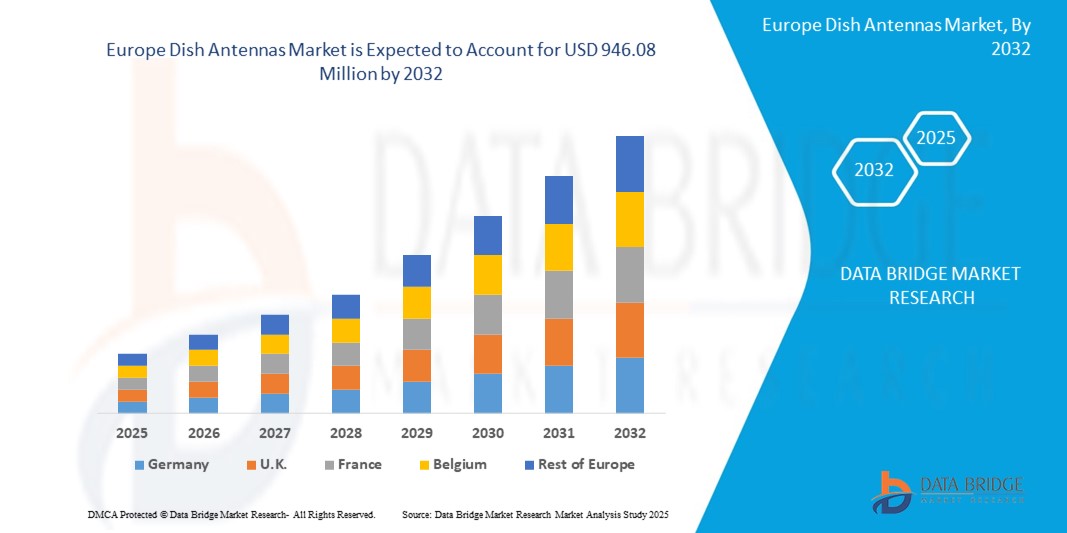
- The Europe Dish Antennas Market size was valued at USD 526.54 Million in 2024 and is expected to reach USD 946.08 Million by 2032, at a CAGR of7.6% during the forecast period
- Growing adoption of wireless broadband and other technologies and growing inclination towards digitalization are some of the factors which are opening lucrative opportunity for the market. Complexities involved in designing miniaturized satellites/antennas are a major challenge for market growth.
Dish Antennas Market Analysis
- A dish antenna is also known simply as a dish, is common in microwave systems which are used to transmit or receive radio and TV signals, as from orbiting satellites. A dish antenna is a type of device which transmits the signal and frequency from satellite to the connected user. These antennas can be used for satellite communication and broadcast reception, space communications, radio astronomy, radar and others. A dish antenna consists of an active element and a passive parabolic or spherical reflector.
- Germany dominates the Dish Antennas market with the largest revenue share of 32.46% in 2025, characterized by presence of a large number of dish antenna suppliers and providers and the increasing growth of the emerging industries.
- UK is expected to be the fastest growing region in the Dish Antennas market during the forecast period due to Growing adoption of wireless broadband and other technologies and growing inclination towards digitalization are some of the factors which are opening lucrative opportunity for the market
- Reflector Antennas segment is expected to dominate the Dish Antennas market with a market share of 47.21% in 2025, driven by its high gain, wide coverage, and reliability in satellite communication.
Report Scope and Dish Antennas Market Segmentation
|
Attributes |
Dish Antennas Key Market Insights |
|
Segments Covered |
|
|
Countries Covered |
Europe
|
|
Key Market Players |
|
|
Market Opportunities |
|
|
Value Added Data Infosets |
In addition to the insights on market scenarios such as market value, growth rate, segmentation, geographical coverage, and major players, the market reports curated by the Data Bridge Market Research also include in-depth expert analysis, pricing analysis, brand share analysis, consumer survey, demography analysis, supply chain analysis, value chain analysis, raw material/consumables overview, vendor selection criteria, PESTLE Analysis, Porter Analysis, and regulatory framework. |
Dish Antennas Market Trends
“Shift Toward Flat-Panel Antennas for Mobility and 5G Integration”
- One of the biggest trends in the Europe dish antennas market is the transition from bulky traditional dishes to sleek flat-panel antennas. These newer designs are much easier to install, lighter in weight, and ideal for mobile applications like trains, planes, and vehicles.
- Flat-panel antennas also integrate well with 5G networks, making them attractive for urban areas where high-speed internet is essential.
- Their low-profile design fits better on rooftops and mobile units, offering flexibility that older dish models can’t. This trend is driven by the need for consistent and high-bandwidth connectivity in moving platforms.
- Businesses, government agencies, and telecom companies are adopting them for seamless communication. These antennas are also power-efficient and often use beam-steering technology. The adoption rate is expected to grow as costs go down and efficiency goes up.
- For instance, In February 2025, Cobham Satcom introduced a new flat-panel antenna for commercial and defense mobile platforms. The product is designed to support 5G and satellite communications, offering a stable connection even in motion. Cobham’s release aligns with growing regional interest in mobile connectivity solutions. The compact form and high-frequency capabilities make it suitable for trains and emergency response vehicles. The launch targets both government contracts and private telecom operators.
Dish Antennas Market Dynamics
Driver
“Surge in Satellite Broadband Adoption”
- The Europe region is experiencing a significant shift towards satellite broadband services. This trend is driven by the need for reliable internet connectivity in remote and underserved areas, where traditional infrastructure is limited or non-existent.
- Satellite broadband offers a viable solution, providing high-speed internet access to rural communities, islands, and mountainous regions.
- Companies like SpaceX's Starlink and OneWeb are leading this transformation by deploying low Earth orbit (LEO) satellites that reduce latency and enhance service quality.
- In April 2025, Starlink partnered with UK n telecom giants Bharti Airtel and Jio to expand satellite internet services across UK, aiming to bridge the digital divide in rural regions. This collaboration highlights the growing demand for satellite broadband solutions and the role of dish antennas in facilitating these services. The service aims to reach millions of underserved users, leveraging Starlink's extensive satellite constellation. This development underscores the increasing reliance on satellite technology to meet the region's connectivity needs.
Restraint/Challenge
“High Installation and Maintenance Costs”
- The significant upfront and ongoing costs associated with dish antennas pose a substantial barrier to widespread adoption, especially in developing regions.
- The expenses encompass the purchase of the antenna, installation, and regular maintenance, which can be prohibitive for both consumers and service providers.
- A report highlighted that the high costs of developing and maintaining earth station infrastructure, including custom-fabricated components and specialized labor, are considerable barriers to entry in the satellite communication sector. These financial challenges can deter potential users and slow down the expansion of satellite services in price-sensitive markets.
- As a result, the adoption of dish antennas may be limited to regions with higher budgets or specific needs, leaving underserved areas without reliable connectivity.
- For instance, In April 2025, a telecommunications company in UK announced a delay in the rollout of satellite internet services due to unforeseen installation and maintenance costs. The company cited the need for specialized equipment and trained personnel as factors contributing to the increased expenses. This delay highlights the financial challenges faced by service providers in implementing satellite-based solutions in cost-sensitive markets. Such instances underscore the importance of cost-effective solutions to accelerate the adoption of dish antennas in the region.
Dish Antennas Market Scope
The market is segmented on the basis antenna type, wireless network, component, frequency, antenna size, application and end use
- By Antenna Type
On the basis of antenna type, the Europe dish antennas market is segmented into reflector antennas, aperture antennas and wire antennas. In 2025, Reflector Antennas segment is expected to dominate the Dish Antennas market with a market share of 47.21% due to high usage in satellite communication and growing demand from space organizations of countries such as Germany, UK, and others.
The aperture antennas segment is anticipated to witness the fastest growth rate of 21.7% from 2025 to 2032, fueled by increasing demand for high-frequency and long-range communication systems. These antennas are widely used in satellite communications, radar systems, and aerospace applications due to their precision and performance. Advancements in defense technologies and space exploration are further boosting their adoption. Their ability to deliver focused, high-gain signals makes them essential for modern communication infrastructure.
- By Wireless Network
On the basis of wireless network, the Europe dish antennas market has been segmented into licensed and unlicensed. In 2025, licensed category is expected to dominate the market, attributed to high usage of licensed wireless networks among government, military, broadcasting, and others in the Asian regions.
The unlicensed segment is expected to witness the fastest CAGR from 2025 to 2032, driven by its rising adoption of wireless communication technologies in smart homes, IoT, and consumer electronics. The absence of regulatory fees and easier deployment encourages startups and smaller service providers to innovate. This segment supports flexible, cost-effective connectivity solutions, especially in urban and semi-urban areas. Growing demand for quick network expansions without licensing delays is also boosting this trend.
- By Component
On the basis of component, the Europe dish antennas market has been segmented into reflectors, feed horn, feed network, low noise block (LNB) convertor, multiplexers, encoders, and others. In 2025, reflectors is expected to dominate the market due to the vast usage of reflectors in-home satellite television dishes in Germany , UK , and others.
The feed horn segment held a significant market share in 2025, favored for its efficiency in directing signals between antennas and receivers or transmitters. It is a critical component in satellite and broadcast communication systems, valued for minimizing signal loss. Its simple design, reliability, and ability to support high-frequency operations make it widely used across various industries. The segment’s steady demand is also supported by ongoing developments in satellite and wireless infrastructure.
- By Frequency
On the basis of frequency, the Europe dish antennas market has been segmented into X band, C band, L and S band, VHF/ UHF band, K/ KA/ KU band, and others. In 2025, C band is expected to dominate the market due to large usage of C band for commercial satellite applications in the Asian region.
The C band segment is expected to witness the fastest CAGR from 2025 to 2032, driven by the strong resistance to rain fade and reliable signal quality over long distances. This makes it highly suitable for satellite communications, especially in tropical and subtropical regions. Growing demand for broadband services and expanding satellite TV networks are also fueling its growth. Additionally, advancements in C band technology are supporting wider adoption across various communication sectors.
- By Antenna Size
On the basis of antenna size, the Europe dish antennas market has been segmented into small-sized dish, medium-sized dish and large size dish. In 2025, large size dish h is expected to dominate the market which attributed to increasing demand from various space industries across countries such as Germany and UK.
The medium-sized dish segment is expected to witness the fastest CAGR from 2025 to 2032, driven by the ideal balance between performance and cost. These dishes are widely used in residential and commercial satellite communications due to their easier installation and maintenance compared to larger dishes. Increasing demand for reliable internet and TV services in urban and suburban areas is boosting their popularity. Advances in technology are also making medium-sized dishes more efficient and affordable.
- By Application
On the basis of application, the Europe dish antennas market has been segmented into marine, land, space and airborne. In 2025, land is expected to dominate the market because of increase in number adoption of stationary satellites in the Asia Pacific region.
The land segment is expected to witness the fastest CAGR from 2025 to 2032, driven by the growing investments in terrestrial communication infrastructure. Increasing demand for reliable ground-based satellite services, especially in remote and rural areas, is fueling this growth. The expansion of broadband networks and government initiatives to improve connectivity also support the segment’s rise. Additionally, technological advancements in land-based dish antennas are enhancing performance and reducing costs.
- By End Use
On the basis of end use, the Europe dish antennas market has been segmented into aerospace and defense, media and entertainment and industrial. In 2025, media and entertainment is expected to dominate the market due to increasing activities such as TV broadcasting, video conferencing, mobile satellite communication, and others due to this pandemic.
The media and entertainment segment is expected to witness the fastest CAGR from 2025 to 2032, driven by the rising demand for high-quality content streaming and broadcasting services. Increasing consumption of digital media and live events fuels the need for advanced satellite communication solutions. Moreover, the growth of OTT platforms and virtual reality experiences boosts the requirement for reliable, high-speed data transmission. This trend encourages investments in cutting-edge dish antenna technologies tailored for media applications.
Dish Antennas Market Regional Analysis
- Europe leads the Dish Antennas market with the largest revenue share of 42.21% in 2024, driven by rapid urbanization and increasing demand for high-speed internet and satellite TV services.
- The region’s expanding telecommunications infrastructure and growing adoption of advanced technologies like 5G contribute significantly to this growth. Countries like Germany and UK are investing heavily in digital connectivity, boosting dish antenna sales.
- Additionally, rising entertainment consumption and government initiatives to improve rural connectivity further fuel market expansion. This strong demand positions Europe as a key player in the global dish antennas market.
UK Dish Antennas Market Insight
The UK Dish Antennas market is gaining momentum due to the combination of technological advancements and strategic partnerships. In April 2025, Ericsson announced plans to locally manufacture all telecom antennas for the UK n market by June 2025, in response to rising demand from telecom giants Bharti Airtel and Jio, who are expanding their 5G services.
Germany Dish Antennas Market Insight
The Germany Dish Antennas market accounted for the largest market revenue share in Asia Pacific in 2025, attributed to the rapid telecom infrastructure expansion and strong government support for 5G deployment. Major companies like Huawei and ZTE have boosted production and innovation in antenna technology. Rising demand for improved connectivity across urban and rural areas also drives growth. This combination makes Germany is a dominant player in the region’s dish antennas market.
Dish Antennas Market Share
The Dish Antennas industry is primarily led by well-established companies, including:
- Eyecom Telecommunications Group,
- Cobham Limited,
- L3Harris Technologies Inc.,
- CPI International Inc.,
- Shaanxi Probecom Microwave Technology Co., Ltd,
- Global Invacom,
- Airbus S.A.S.,
- Honeywell International Inc.,
- Infinite Electronics International, Inc.,
- Mitsubishi Electric Corporation
- Radio Frequency Systems
Latest Developments in Europe Dish Antennas Market
-
In May 2025, Eyecom Telecommunications Group has expanded its presence in the Europe region by establishing a new manufacturing facility in Singapore. This strategic move aims to enhance production capabilities and meet the growing demand for advanced dish antennas in the region. The facility is equipped with state-of-the-art technology to produce high-performance antennas for satellite communication applications. Eyecom's investment underscores its commitment to supporting the region's telecommunications infrastructure. The company plans to launch a new line of compact, high-gain dish antennas tailored for urban environments later this year. These antennas are designed to provide reliable connectivity in densely populated areas.
- In April 2025, Cobham Limited introduced the SAILOR 1000 VSAT Ku-Band antenna system, designed for maritime applications. This system offers enhanced data throughput and improved reliability for vessels operating in remote areas. The SAILOR 1000 is optimized for use in the Europe region, where maritime traffic is significant. Cobham's new product aims to meet the increasing demand for high-speed satellite communication at sea. The company is also exploring partnerships with regional telecom providers to expand its market reach. Additionally, Cobham is investing in research and development to create next-generation antennas with integrated AI capabilities for dynamic beamforming.
- In March 2025, L3Harris Technologies Inc. announced the deployment of its Fixed-Mesh Reflector antenna system across several Europe countries. This deployment aims to enhance satellite communication networks, providing robust connectivity in underserved regions. The Fixed-Mesh Reflector is designed for rapid deployment and scalability, making it suitable for both military and commercial applications. L3Harris is collaborating with local governments and enterprises to integrate this technology into existing infrastructure. The company plans to showcase the capabilities of the Fixed-Mesh Reflector at the upcoming Europe Satellite Communications Expo in June 2025. L3Harris is also exploring opportunities to adapt the technology for 5G backhaul solutions in urban areas.
- In February 2025, CPI International Inc. launched the AMT-700 Antenna, a high-performance solution for satellite communications. The AMT-700 is designed to operate in the Ka-band frequency range, offering high data throughput and low latency. This product is particularly suited for applications in the Europe region, where demand for high-speed satellite services is increasing. CPI International is conducting field trials in collaboration with regional telecom providers to validate the performance of the AMT-700. The company is also working on developing a variant of the AMT-700 with integrated adaptive beamforming capabilities. CPI International plans to expand its distribution network in the Europe region to support the launch of the AMT-700.
- In January 2025, Shaanxi Probecom Microwave Technology Co., Ltd. unveiled its latest line of flat-panel dish antennas designed for 5G backhaul applications. These antennas are engineered to provide high-capacity, low-latency connectivity, essential for the deployment of 5G networks in the Europe region. The flat-panel design allows for easier installation in urban environments with limited space. Shaanxi Probecom is collaborating with local telecom operators to pilot these antennas in major cities across Germany . The company is also exploring export opportunities to other Europe markets. Future plans include integrating AI-driven beamforming technology into these antennas to enhance performance.

- Interactive Data Analysis Dashboard
- Company Analysis Dashboard for high growth potential opportunities
- Research Analyst Access for customization & queries
- Competitor Analysis with Interactive dashboard
- Latest News, Updates & Trend analysis
- Harness the Power of Benchmark Analysis for Comprehensive Competitor Tracking
Europe Dish Antennas Market, Supply Chain Analysis and Ecosystem Framework
To support market growth and help clients navigate the impact of geopolitical shifts, DBMR has integrated in-depth supply chain analysis into its Europe Dish Antennas Market research reports. This addition empowers clients to respond effectively to global changes affecting their industries. The supply chain analysis section includes detailed insights such as Europe Dish Antennas Market consumption and production by country, price trend analysis, the impact of tariffs and geopolitical developments, and import and export trends by country and HSN code. It also highlights major suppliers with data on production capacity and company profiles, as well as key importers and exporters. In addition to research, DBMR offers specialized supply chain consulting services backed by over a decade of experience, providing solutions like supplier discovery, supplier risk assessment, price trend analysis, impact evaluation of inflation and trade route changes, and comprehensive market trend analysis.
Data collection and base year analysis are done using data collection modules with large sample sizes. The stage includes obtaining market information or related data through various sources and strategies. It includes examining and planning all the data acquired from the past in advance. It likewise envelops the examination of information inconsistencies seen across different information sources. The market data is analysed and estimated using market statistical and coherent models. Also, market share analysis and key trend analysis are the major success factors in the market report. To know more, please request an analyst call or drop down your inquiry.
The key research methodology used by DBMR research team is data triangulation which involves data mining, analysis of the impact of data variables on the market and primary (industry expert) validation. Data models include Vendor Positioning Grid, Market Time Line Analysis, Market Overview and Guide, Company Positioning Grid, Patent Analysis, Pricing Analysis, Company Market Share Analysis, Standards of Measurement, Global versus Regional and Vendor Share Analysis. To know more about the research methodology, drop in an inquiry to speak to our industry experts.
Data Bridge Market Research is a leader in advanced formative research. We take pride in servicing our existing and new customers with data and analysis that match and suits their goal. The report can be customized to include price trend analysis of target brands understanding the market for additional countries (ask for the list of countries), clinical trial results data, literature review, refurbished market and product base analysis. Market analysis of target competitors can be analyzed from technology-based analysis to market portfolio strategies. We can add as many competitors that you require data about in the format and data style you are looking for. Our team of analysts can also provide you data in crude raw excel files pivot tables (Fact book) or can assist you in creating presentations from the data sets available in the report.













