


Dry Eye Syndrome Treatment Market Size
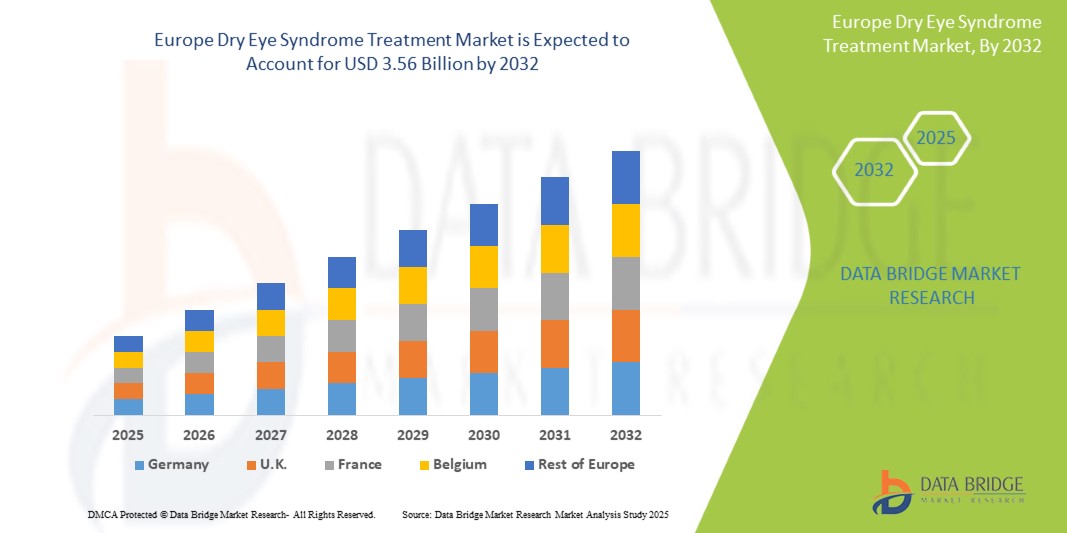
- The Europe Dry Eye Syndrome Treatment Market size was valued at USD 1.76 Billion in 2024 and is expected to reach USD 3.56 Billion by 2032, at a CAGR of 9.22% during the forecast period
- This growth is driven by factors such as the Increasing prevalence of dry eyes among people, Increasing screen time
Dry Eye Syndrome Treatment Market Analysis
- Dry Eye Syndrome Treatment, also known as keratoconjunctivitis sicca (KCS), is a condition in which the surface of the affected person's eyes lacks lubrication or moisture. It's a common ailment that can strike anyone at any time.
- The demand for microscopes in the Europe Dry Eye Syndrome Treatment Market is significantly driven by the increasing prevalence of age-related eye conditions and advancements in surgical techniques.
- Germany is expected to dominate the market due to high healthcare spending, advanced medical infrastructure, and greater patient awareness of eye health.
- U.K. is projected to be the fastest-growing region during the forecast period, , fueled by a rising number of dry eye cases and expanding research and development activities.
- The Tear Stimulators segment is anticipated to hold a substantial market share, driven by the high prevalence of Dry Eye Syndrome and increasing demand for effective therapies. Ongoing research and development efforts are enhancing treatment outcomes, contributing to the market's growth in Europe.
Report Scope and Dry Eye Syndrome Treatment Market Segmentation
|
Attributes |
Dry Eye Syndrome Treatment Key Market Insights |
|
Segments Covered |
|
|
Countries Covered |
Europe
|
|
Key Market Players |
|
|
Market Opportunities |
|
|
Value Added Data Infosets |
In addition to the insights on market scenarios such as market value, growth rate, segmentation, geographical coverage, and major players, the market reports curated by the Data Bridge Market Research also include import export analysis, production capacity overview, production consumption analysis, price trend analysis, climate change scenario, supply chain analysis, value chain analysis, raw material/consumables overview, vendor selection criteria, PESTLE Analysis, Porter Analysis, and regulatory framework. |
Dry Eye Syndrome Treatment Market Trends
“Advancements in Operating Microscopes & 3D Visualization for Intraocular Surgery”
- One prominent trend in the evolution of operating microscopes and 3D visualization systems for intraocular surgery is the increasing integration of advanced optics and digital enhancements
- These innovations enhance surgical precision by offering high-definition, real-time visualization of intraocular structures, improving accuracy in delicate procedures
- For instance, modern 3D visualization systems provide superior depth perception, enabling surgeons to navigate complex intraocular anatomy with greater clarity, which is particularly beneficial for vitreoretinal surgeries and minimally invasive glaucoma procedures.
- These advancements are transforming intraocular surgery, improving patient outcomes, and driving the demand for next-generation surgical microscopes with cutting-edge visualization capabilities
Dry Eye Syndrome Treatment Market Dynamics
Driver
“Increasing prevalence of dry eyes among people”
- The rising prevalence of dry eyes among people is a primary driver of the Dry Eye Syndrome Treatment market's growth. Thyroid disorders, lupus, Sjogren’s syndrome, diabetes, rheumatoid arthritis, scleroderma, and others are the various diseases contributing to the high prevalence of dry eyes among people
- As the global population ages, the incidence of these conditions continues to grow, with older adults being more prone to various vision impairments that require surgical intervention
- As more individuals seek treatment for these conditions, the demand for operational microscopes rises, ensuring improved surgical outcomes and reducing the risks associated with eye surgeries
For instance,
- In December 2021, according to the article published by National Center for Biotechnology Information, the global population is aging rapidly, with Australia projected to have nearly 25% of its population aged 65 years and older by 2066. Older individuals experience significantly higher healthcare needs, including eye diseases
- As a result of the rising prevalence of eye diseases such as cataracts, glaucoma, macular degeneration, and diabetic retinopathy, there is a significant increase in the demand for Dry Eye Syndrome Treatments
Opportunity
“Increase in the number of research and development activities”
- There is a significant opportunity for pharmaceutical companies to invest in research and development of new and more effective treatments for Dry Eye Syndrome in Europe. Novel medications and therapies can address the unmet needs of patients with chronic or severe dry eye conditions.
- Increasing investment in research and development is leading to the development of advanced therapeutic options, particularly targeting the root causes of Dry Eye Syndrome, such as inflammation or tear film instability
For instance,
- In January 2025, a European pharmaceutical company launched a phase 3 clinical trial evaluating a novel anti-inflammatory drug for severe Dry Eye Syndrome. This drug aims to provide long-term relief for patients with moderate to severe symptoms who have not responded to existing treatments
- With ongoing advancements in pharmaceutical R&D, new treatments are expected to improve patient outcomes, offering more effective, longer-lasting solutions for Dry Eye Syndrome.
Restraint/Challenge
“Limited Reimbursement Policies Impacting Access to Advanced Dry Eye Syndrome Treatments in Europe”
- The limited reimbursement policies for Dry Eye Syndrome treatments present a significant challenge for the market, particularly in Europe. These policies restrict access to newer, advanced treatments and create financial burdens for patients and healthcare providers, especially those relying on insurance coverage for specialized care.
- Limited reimbursement often prevents patients from accessing the most effective and innovative treatments, leading to reliance on older, less efficient options that may not fully address their condition. This results in suboptimal patient outcomes and slower adoption of newer therapies across the region.
For instance,
- In December 2024, the European Dry Eye Society reported that many European countries have restricted insurance coverage for advanced treatments like regenerative therapies and device-based solutions, forcing patients to pay out of pocket or rely on cheaper, less effective alternatives
- These reimbursement challenges hinder the growth of the market by limiting access to cutting-edge treatments, which may affect patient satisfaction and the overall adoption of new therapies in Europe
Dry Eye Syndrome Treatment Market Scope
The market is segmented on the basis product type, dosage type, drug class, dose, medication type, container type, packaging type, type, end-users and distribution channel.
|
Segmentation |
Sub-Segmentation |
|
By Product Type |
|
|
By Dosage Type |
|
|
By Treatment Type |
|
|
By Diagnosis |
|
|
By Dose |
|
|
By Medication Type |
|
|
By Container Type |
|
|
By Packaging Type |
|
|
By Type |
|
|
By End User |
|
|
By Distribution Channel
|
|
In 2025, the Tear stimulators is projected to dominate the market with a largest share in application segment
The Tear Stimulators segment is anticipated to lead the Europe Dry Eye Syndrome Treatment Market , capturing a significant share of 56.22% by 2025, driven by its widespread prevalence and the demand for precision treatments. As a primary method for vision restoration, advancements in surgical techniques and microscope technologies will improve outcomes, fueling market expansion. Additionally, the growing aging population and increasing rates of cataracts are expected to further solidify its dominance in the market.
The Lubricating Agent is expected to account for the largest share during the forecast period in technology market
In 2025, the Lubricating Agent segment is projected to dominate the Europe Dry Eye Syndrome Treatment Market , securing the largest share at 51.31% due to its high prevalence and demand for precision care. As a primary therapeutic option for alleviating symptoms, improvements in formulation and delivery methods will enhance treatment outcomes, driving market growth. Additionally, the aging population and an increase in cataract cases will further support the segment's market leadership.
Dry Eye Syndrome Treatment Market Regional Analysis
“Germany Holds the Largest Share in the Dry Eye Syndrome Treatment Market”
- Germany dominates the Dry Eye Syndrome Treatment market, driven by its advanced healthcare infrastructure, widespread adoption of cutting-edge medical technologies, and strong presence of leading industry players.
- Germany holds a significant share in the European Dry Eye Syndrome Treatment market due to increasing demand for precision ophthalmic procedures, a higher prevalence of eye conditions like cataracts and glaucoma, and ongoing advancements in surgical techniques.
- The country's well-established reimbursement policies, coupled with rising investments in research and development from major medical device companies, continue to bolster market growth.
- Furthermore, the growing number of ophthalmic surgeries, including cataract and refractive surgeries, along with an increased preference for minimally invasive techniques, is driving the expansion of the market across Europe.
“U.K. is Projected to Register the Highest CAGR in the Dry Eye Syndrome Treatment Market”
- The U.K. is expected to experience the highest growth rate in the Dry Eye Syndrome Treatment market, driven by rapid healthcare infrastructure expansion, increased awareness of eye health, and rising surgical volumes.
- Countries such as the U.K. and Germany are emerging as key markets due to the growing aging population, which is more prone to conditions like cataracts, diabetic retinopathy, and macular degeneration.
- The U.K., with its advanced medical technology and increasing number of ophthalmic surgeons, remains a crucial market for Dry Eye Syndrome treatments. The country is at the forefront in adopting advanced surgical equipment to enhance precision and efficiency in eye treatments.
- The U.K., with its large population and rising cases of vision-related disorders, is seeing more government and private sector investments in modern ophthalmic surgical setups. The increasing presence of global medical device manufacturers and improved access to advanced eye care are further contributing to the market's growth.
Dry Eye Syndrome Treatment Market Share
The market competitive landscape provides details by competitor. Details included are company overview, company financials, revenue generated, market potential, investment in research and development, new market initiatives, global presence, production sites and facilities, production capacities, company strengths and weaknesses, product launch, product width and breadth, application dominance. The above data points provided are only related to the companies' focus related to market.
The Major Market Leaders Operating in the Market Are:
- Teva Pharmaceutical Industries Ltd.(Jerusalem)
- Sanofi (France)
- Novartis AG (Switzerland)
- Eli Lilly and Company (US)
- Merck & Co., Inc. (US)
- AstraZeneca (UK)
- Johnson & Johnson Private Limited (US)
- Abbott (US)
- F. Hoffmann-La Roche Ltd. (Switzerland)
- AbbVie Inc. (US)
- Otsuka America Pharmaceutical, Inc. (US)
- Pfizer Inc. (US)
- GlaxoSmithKline plc (UK)
- Merck KGaA (Germany)
- Allergan (Ireland)
- Akorn Operating Company LLC (US)
- Allostera Pharma Inc. (Canada)
- I-Med Pharma Inc. (Canada)
- Santen Pharmaceuticals Co. Ltd., (Japan)
- AFT Pharmaceuticals (New Zealand)
- Novaliq GmbH (Germany)
Latest Developments in Europe Dry Eye Syndrome Treatment Market
- In October 2024, Novaliq and Laboratoires Théa announced that, Vevizye received approval from Europen commission to market the product for treating dry eye disease in adults. It is the first and only water-free ciclosporin 0.1% eye drop solution to receive approval in Europe.
- In June 2024, Oculis reported Phase 2b positive results for licaminlimab, anti-TNFα eye drop, shows significant improvement in multiple DED signs. The drug, effective in patients with a specific TNFR1 genetic biomarker, demonstrated rapid and notable reduction in corneal inflammation. Licaminlimab was well tolerated with similar side effects to a vehicle.
- In May 2024, Nordic Pharma, Inc. launched LACRIFILL Canalicular Gel, a novel dry eye treatment cleared by the FDA. This cross-linked hyaluronic acid gel temporarily blocks tear drainage by occluding the canalicular system, allowing natural tears to bathe the eyes. Administered via a simple in-office procedure, it lasts for six months and is reimbursed under CPT code 68761. Nordic Pharma is showcasing LACRIFILL at Kiawah Eye 2024, highlighting its potential to enhance ophthalmic practices. Nordic Pharma, part of SEVER Life Sciences, focuses on specialty pharmaceuticals and has a global presence.

- Interactive Data Analysis Dashboard
- Company Analysis Dashboard for high growth potential opportunities
- Research Analyst Access for customization & queries
- Competitor Analysis with Interactive dashboard
- Latest News, Updates & Trend analysis
- Harness the Power of Benchmark Analysis for Comprehensive Competitor Tracking
Data collection and base year analysis are done using data collection modules with large sample sizes. The stage includes obtaining market information or related data through various sources and strategies. It includes examining and planning all the data acquired from the past in advance. It likewise envelops the examination of information inconsistencies seen across different information sources. The market data is analysed and estimated using market statistical and coherent models. Also, market share analysis and key trend analysis are the major success factors in the market report. To know more, please request an analyst call or drop down your inquiry.
The key research methodology used by DBMR research team is data triangulation which involves data mining, analysis of the impact of data variables on the market and primary (industry expert) validation. Data models include Vendor Positioning Grid, Market Time Line Analysis, Market Overview and Guide, Company Positioning Grid, Patent Analysis, Pricing Analysis, Company Market Share Analysis, Standards of Measurement, Global versus Regional and Vendor Share Analysis. To know more about the research methodology, drop in an inquiry to speak to our industry experts.
Data Bridge Market Research is a leader in advanced formative research. We take pride in servicing our existing and new customers with data and analysis that match and suits their goal. The report can be customized to include price trend analysis of target brands understanding the market for additional countries (ask for the list of countries), clinical trial results data, literature review, refurbished market and product base analysis. Market analysis of target competitors can be analyzed from technology-based analysis to market portfolio strategies. We can add as many competitors that you require data about in the format and data style you are looking for. Our team of analysts can also provide you data in crude raw excel files pivot tables (Fact book) or can assist you in creating presentations from the data sets available in the report.













