


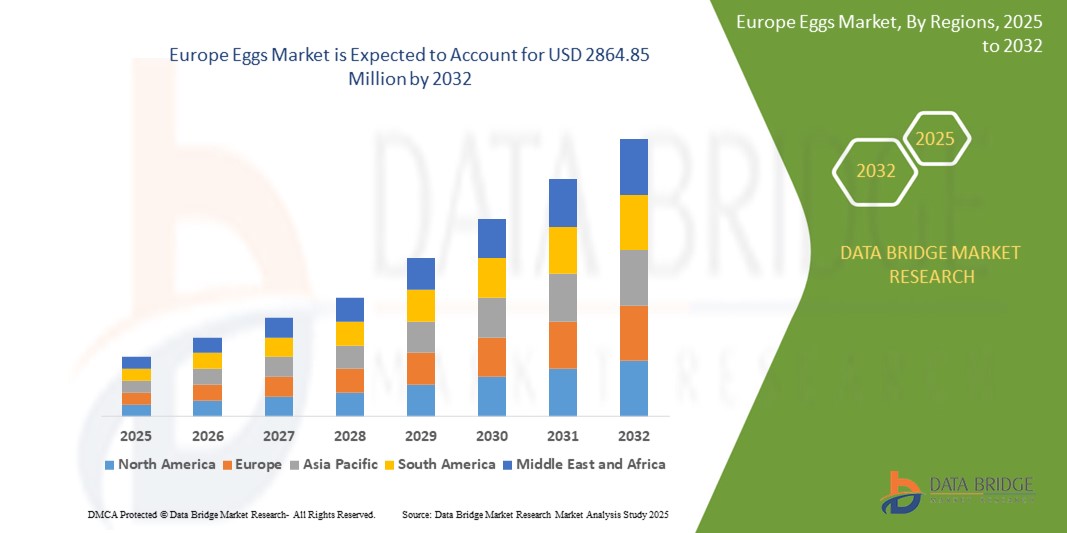
Eggs Market Size
- The Europe plant-based eggs market size was valued at USD 152.39 million in 2024 and is expected to reach USD 2864.85 million by 2032, at a CAGR of 44.3% during the forecast period
- The Europe animal-based eggs market size was valued at USD 33.12 billion in 2024 and is expected to reach USD 48.94 billion by 2032, at a CAGR of 5% during the forecast period
- The market growth is largely fueled by rising Europe demand for affordable, protein-rich foods, supported by population growth, urbanization, and increased health awareness across both developed and emerging economies
- Furthermore, technological advancements in poultry farming, cold chain logistics, and egg processing are enhancing productivity, safety, and shelf life, thereby driving large-scale adoption of both shell and processed eggs across retail and foodservice sectors. These converging factors are accelerating consumption patterns, significantly boosting the industry's growth
Eggs Market Analysis
- Eggs are a widely consumed source of animal protein, available in various forms including shell eggs, processed liquid and powdered eggs, and specialty variants such as organic or high-protein eggs. Their affordability, versatility, and nutritional profile make them a staple in diets globally, across both household and industrial food applications
- The escalating demand for eggs is primarily fueled by expanding applications in the food processing industry, rising consumer interest in functional and fortified foods, and increasing government support for poultry production to meet food security and nutritional goals
- Germany dominated the eggs market with a share in 2024, due to strong demand for organic, cage-free, and welfare-certified eggs, along with high per capita egg consumption across household and industrial segments
- U.K. is expected to be the fastest growing region in the eggs market during the forecast period due to rising demand for free-range and organic eggs, strong consumer interest in sustainable food sourcing, and growing incorporation of eggs in high-protein meal solutions
- Conventional segment dominated the plant-based eggs market with a market share of 63.9% in 2024, due to broader accessibility, lower pricing, and wider product availability across mainstream retail and foodservice channels. Conventional plant-based eggs are the entry point for most consumers new to alternative proteins
- Chicken segment dominated the animal-based eggs market with a market share of 88.8% in 2024, due toits dominance in global egg production and consumption. Chicken eggs are widely preferred due to their consistent availability, cost-effectiveness, and balanced nutritional profile, making them the standard in both retail and industrial use
Report Scope and Eggs Market Segmentation
|
Attributes |
Eggs Key Market Insights |
|
Segments Covered |
Plant-Based Eggs Market
Animal-Based Eggs Market
|
|
Countries Covered |
Europe
|
|
Key Market Players |
|
|
Market Opportunities |
|
|
Value Added Data Infosets |
In addition to the insights on market scenarios such as market value, growth rate, segmentation, geographical coverage, and major players, the market reports curated by the Data Bridge Market Research also include in-depth expert analysis, pricing analysis, brand share analysis, consumer survey, demography analysis, supply chain analysis, value chain analysis, raw material/consumables overview, vendor selection criteria, PESTLE Analysis, Porter Analysis, and regulatory framework. |
Eggs Market Trends
“Growing Demand for Affordable Protein Sources”
- The eggs market is experiencing steady growth driven by the increasing global demand for affordable and high-quality protein sources that support nutrition in both developing and developed economies
- For instance, the Vietnam Association of Seafood Exporters and Producers (VASEP) reports rising imports of eggs and egg products in major consumer regions such as the US and EU, reflecting the trend toward eggs as accessible and nutritious protein staples
- Consumers are increasingly seeking eggs from alternative and specialty production systems—such as cage-free, organic, and free-range options—to align with preferences for ethical and high-quality food products despite their higher price
- Technological improvements in egg processing—such as production of liquid eggs, egg powders, and other value-added formats—are enhancing product stability, convenience for food manufacturers, and expanding applications in processed foods
- Sustainability concerns and initiatives promoting carbon-neutral egg production methods are gaining momentum, attracting investment and consumer interest in more environmentally responsible egg production
- Expanding retail and distribution channels, including supermarkets, online platforms, and foodservice, are improving the availability and variety of egg products to meet diverse consumer needs
Eggs Market Dynamics
Driver
“Rising Demand for Convenience Foods”
- Increasing urbanization and busy lifestyles are driving demand for convenient food products, including ready-to-use or pre-processed egg products that facilitate quick meal preparation and food manufacturing processes
- For instance, companies such as Michael Foods have expanded their portfolio of liquid eggs, egg whites, and processed egg products to serve foodservice and industrial sectors seeking convenient, consistent, and safe egg ingredients
- Growing demand from bakery, confectionery, and processed food manufacturers for standardized egg products supports market growth by enabling efficient production and cost management
- Consumers increasingly prefer products that integrate eggs in prepared meals, snacks, and health foods, reflecting broader shifts toward convenience paired with nutritional value
- Technological advancements in refrigeration, packaging, and distribution ensure freshness and extended shelf life of convenience egg products, aiding market penetration worldwide
Restraint/Challenge
“Disease Outbreaks in Poultry”
- Disease outbreaks such as avian influenza and other poultry-related illnesses pose significant risks to egg supply stability, causing production disruptions, increased costs, and price volatility that affect market growth
- For instance, Cal-Maine Foods faced production setbacks and supply shortages during recent avian influenza outbreaks, impacting their market share and leading to increased egg prices in key regions
- Consumer confidence can be negatively impacted by outbreaks leading to demand fluctuations, particularly in markets with frequent or severe disease episodes
- Increased biosecurity and veterinary costs to manage disease risks raise production expenses, which can be passed onto consumers and restrain affordability
- Geographic concentration of outbreaks and supply chain disruptions in major egg-producing regions create vulnerabilities that challenge consistent global market supply
Eggs Market Scope
The plant-based eggs market is segmented on the basis of type, form, base ingredient, function, application, packaging type, category, end user, and distribution channel.
- By Type
On the basis of type, the plant-based eggs market is segmented into full egg, egg yolk, and white egg. The full egg segment dominated the largest market revenue share in 2024, driven by its functional versatility across cooking and baking applications. Full egg substitutes are widely adopted in retail and foodservice sectors because they closely replicate the texture, taste, and performance of traditional whole eggs. Their ability to emulsify, bind, and aerate makes them suitable for a wide range of recipes, from scrambled eggs to cakes, making them the most preferred format among consumers transitioning to plant-based alternatives.
The egg yolk segment is anticipated to witness the fastest growth rate from 2025 to 2032, fueled by rising demand for gourmet plant-based sauces, dressings, and specialty bakery products. Egg yolk alternatives are increasingly used in foodservice and fine dining due to their rich texture and flavor, catering to vegan and allergen-sensitive consumers. The growth is further supported by ongoing innovations in ingredient extraction and formulation, delivering yolk-like viscosity and nutritional profiles.
- By Form
On the basis of form, the plant-based eggs market is segmented into liquid and powder. The liquid segment held the largest market revenue share in 2024, driven by its convenience, ease of use, and appeal among consumers seeking direct replacements for conventional eggs. Liquid plant-based eggs offer pourable, ready-to-cook functionality, making them ideal for scrambles, omelets, and baking without the need for rehydration or mixing, and are heavily favored in both retail and foodservice applications.
The powder segment is expected to witness the fastest CAGR from 2025 to 2032, supported by its long shelf life, cost efficiency in bulk usage, and wide adoption among manufacturers of baked goods, dry mixes, and pre-packaged meals. Powdered plant-based eggs are particularly attractive in emerging markets and institutional catering, where storage, transport, and large-scale preparation efficiency are critical.
- By Base Ingredient
On the basis of base ingredient, the market is segmented into mung beans, garbanzo beans, pea, soy flour, starch, algal flour, chia seeds, wheat flour, and others. The mung beans segment dominated the market share in 2024, owing to its proven success in replicating the texture and color of scrambled eggs, along with high protein content and clean-label positioning. Mung bean-based formulations have gained wide traction in North America and Europe, especially in branded liquid egg alternatives.
The algal flour segment is projected to grow at the fastest rate during the forecast period, driven by its functional richness, sustainability credentials, and rising use in next-gen food tech innovations. Algae-derived ingredients are increasingly recognized for offering superior emulsification, water-binding, and nutrient density, aligning well with consumer preferences for eco-friendly and nutrient-rich plant-based options.
- By Function
On the basis of function, the market is segmented into full egg replacement, egg wash substitute, and partial egg replacement. Full egg replacement held the largest revenue share in 2024, supported by growing demand from consumers and bakeries for comprehensive, one-to-one substitutes that simplify plant-based cooking and baking. These products cater to vegan, allergic, and health-conscious buyers, addressing needs across both home and industrial food preparation.
The egg wash substitute segment is expected to experience the highest growth rate, driven by increasing application in artisan and commercial baking, where glossy finishes and binding properties are crucial. These alternatives are also gaining acceptance among clean-label bakers looking to eliminate animal products without compromising visual or structural appeal.
- By Application
On the basis of application, the market is segmented into breakfast application, homemade bakery applications, and others. Breakfast application dominated the market in 2024, as scrambled egg alternatives and plant-based breakfast sandwiches gain mainstream popularity in both quick-service restaurants and home kitchens. Rising awareness around cholesterol-free breakfast options and increasing product availability in convenient formats support this trend.
Homemade bakery applications are projected to register the fastest growth, propelled by rising at-home experimentation, increased availability of egg-free recipes, and strong demand for allergen-friendly and vegan baking ingredients. The surge in e-commerce platforms offering specialty baking kits and plant-based mixes is also driving segment expansion.
- By Packaging Type
On the basis of packaging type, the market is segmented into bottles, pouches, and tetra packs. Bottles dominated the market share in 2024, favored for their ease of use, resealability, and visual appeal on retail shelves. Brands prefer bottles for liquid egg alternatives as they align with consumer expectations for ready-to-use, refrigerator-stored products.
Tetra packs are expected to see the fastest growth, driven by increasing emphasis on sustainable packaging, longer shelf life, and lighter transport costs. Their popularity is growing across retail and institutional buyers focused on reducing plastic use and extending product freshness in environmentally conscious formats.
- By Category
On the basis of category, the market is segmented into organic and conventional. The conventional segment held the dominant share of 63.9% in 2024, due to broader accessibility, lower pricing, and wider product availability across mainstream retail and foodservice channels. Conventional plant-based eggs are the entry point for most consumers new to alternative proteins.
The organic segment is projected to grow at a faster pace, driven by rising demand for clean-label, non-GMO, and sustainably sourced ingredients. Health-aware consumers and specialty retailers are driving adoption of certified organic formulations, often paired with ethical sourcing and minimal processing narratives.
- By End User
On the basis of end user, the market is segmented into retail/household and food service sectors. The retail/household segment led the market in 2024, reflecting the rise of home cooking, increased availability of plant-based eggs in supermarkets, and strong marketing efforts by leading brands.
The food service sector is expected to expand rapidly, fueled by growing adoption of plant-based menus in restaurants, cafes, and institutional kitchens. This includes demand from hotel chains and workplace canteens offering vegan-friendly and allergen-conscious meals in line with changing consumer preferences.
- By Distribution Channel
On the basis of distribution channel, the market is segmented into store-based retailers and non-store retailers (online). Store-based retailers dominated the market in 2024, supported by strong product placement in supermarkets, natural food stores, and specialty grocery outlets that offer immediate accessibility and consumer familiarity.
Non-store retailers (online) are forecasted to witness the highest CAGR from 2025 to 2032, driven by the convenience of direct-to-consumer delivery, rising popularity of vegan subscription boxes, and expanded digital marketing by plant-based brands. E-commerce platforms also provide broader product education and reviews, influencing informed purchasing decisions.
The animal-based eggs market is segmented on the basis of type, source, packaging type, category, end user, and distribution channel.
- By Type
On the basis of type, the animal-based eggs market is segmented into shell egg and processed eggs. The shell egg segment dominated the largest market revenue share in 2024, primarily due to its widespread household consumption, minimal processing requirements, and easy availability across traditional and modern retail outlets. Shell eggs remain a dietary staple in many cultures, valued for their high protein content, affordability, and culinary versatility. Consumer preference for fresh and whole eggs continues to support the dominance of this segment in both urban and rural settings.
The processed eggs segment is anticipated to witness the fastest growth from 2025 to 2032, driven by increasing demand from the food service sector and commercial food manufacturers. Processed egg formats such as liquid, powdered, or frozen eggs offer extended shelf life, convenience in bulk handling, and food safety advantages, making them highly suitable for bakery, confectionery, and ready-to-eat applications.
- By Source
On the basis of source, the animal-based eggs market is segmented into chicken, duck, and others. The chicken segment held the largest market share of 88.8% in 2024, supported by its dominance in global egg production and consumption. Chicken eggs are widely preferred due to their consistent availability, cost-effectiveness, and balanced nutritional profile, making them the standard in both retail and industrial use.
The duck segment is expected to grow at a notable pace during the forecast period, particularly in Southeast Asian and European markets where duck eggs are favored for their richer flavor, larger size, and suitability for gourmet applications.
- By Packaging Type
On the basis of packaging type, the market is segmented into trays, boxes & carton, and bottles. Trays accounted for the largest share in 2024 due to their cost-effectiveness, ease of stacking, and suitability for bulk transport in retail chains and distribution centers. Their lightweight design and recyclability also contribute to broad adoption across conventional supply chains.
The bottles segment is projected to experience significant growth from 2025 to 2032, primarily driven by rising demand for liquid egg products in the food processing industry. Bottled formats allow for convenience, precise portioning, and ease of storage, particularly in commercial kitchens and QSRs.
- By Category
On the basis of category, the market is segmented into organic and conventional. The conventional segment dominated the market share in 2024, driven by its cost advantages, high production scalability, and strong consumer base across both developed and developing regions.
The organic segment is expected to grow rapidly during the forecast period as health-conscious consumers increasingly seek eggs sourced from hens raised on organic feed and humane practices. Premium pricing, coupled with clean-label trends and rising sustainability awareness, is further boosting demand in this category.
- By End User
On the basis of end user, the market is segmented into retail/household and food service sectors. The retail/household segment accounted for the highest market share in 2024, reflecting strong consumption patterns in daily home cooking and widespread availability through local and chain retailers.
The food service sector is projected to record robust growth due to increasing egg-based menu offerings in hotels, cafes, restaurants, and institutional catering. The demand is further supported by the need for reliable bulk supply of processed eggs that reduce preparation time and improve operational efficiency.
- By Distribution Channel
On the basis of distribution channel, the market is segmented into store-based retailer and non-store retailer (online). Store-based retailers held the dominant revenue share in 2024, supported by well-established supermarket chains, convenience stores, and traditional grocers that provide consumers with direct access to fresh eggs.
Non-store retailers are expected to witness the fastest growth rate from 2025 to 2032, driven by increasing online grocery adoption, digital retail platforms offering subscription-based egg delivery, and urban consumers' preference for contactless purchasing and doorstep convenience.
Eggs Market Regional Analysis
- Germany dominated the eggs market with the largest revenue share in 2024, driven by strong demand for organic, cage-free, and welfare-certified eggs, along with high per capita egg consumption across household and industrial segments
- The country’s leadership is supported by stringent animal welfare regulations, robust retail infrastructure, and increasing preference for ethically sourced, traceable food products among health-conscious consumers
- Germany’s position is further reinforced by continuous investment in sustainable poultry farming, innovation in specialty and fortified egg products, and alignment with EU standards promoting clean-label and environmentally responsible food systems
U.K. Eggs Market Insight
The U.K. eggs market is projected to register the fastest CAGR in the Europe eggs market during the forecast period of 2025 to 2032, driven by rising demand for free-range and organic eggs, strong consumer interest in sustainable food sourcing, and growing incorporation of eggs in high-protein meal solutions. Government-backed animal welfare initiatives and supermarket commitments to phase out caged eggs are further shaping the supply landscape, while health and fitness trends are fueling adoption of enriched and specialty eggs.
France Eggs Market Insight
France is expected to grow steadily during the forecast period of 2025 to 2032. Growth is supported by increasing consumer demand for local, organic, and high-welfare egg products, driven by cultural emphasis on culinary quality and sustainability. National food labeling schemes and environmental awareness campaigns are encouraging the shift toward premium egg categories, while a rising number of artisanal producers and urban farming initiatives are reshaping supply chains across both retail and hospitality sectors.
Eggs Market Share
The eggs industry is primarily led by well-established companies, including:
- Rose Acre Farms, Inc. (U.S.)
- Cal-Maine Foods, Inc. (U.S.)
- Charoen Pokphand Foods PCL (Thailand)
- Rembrandt Foods (U.S.)
- Hillandale Farms (U.S.)
- Michael Foods, Inc. (U.S.)
- Kazi Farms Group (Bangladesh)
- Bachoco Corporate (Mexico)
- Daybreak Foods, Inc. (U.S.)
- Sparboe (U.S.)
- Grupo Mantiqueira (Brazil) Herbruck's Poultry Ranch, Inc. (U.S.)
- Eat Just, Inc. (U.S.)
- Bob’s Red Mill Natural Foods (U.S.)
- Atlantic Natural Foods (U.S.)
Latest Developments in Europe Eggs Market
- In April 2025, Happy Egg expanded its product portfolio to include pasture-raised eggs, a move aimed at strengthening its position in the premium egg segment amid rising consumer demand for ethically produced, high-quality eggs. This strategic expansion comes in response to ongoing egg shortages caused by Avian influenza, with the company partnering with more small-scale family farmers to ensure consistent supply. By offering eggs laid by hens raised on expansive 50-acre pastures and nourished with a nutrient-rich diet, Happy Egg is reinforcing its brand value and enhancing consumer trust through a commitment to animal welfare, sustainability, and vibrant yolk quality that resonates with health-conscious and ethically driven buyers
- In June 2024, Madrid-based startup Awevo Foods entered the plant-based egg market with the launch of its Awevo liquid eggs, targeting both the foodservice (HORECA) and retail sectors. Available in 400 ml and 1000 ml formats, the product positions Awevo as a disruptive player in Spain’s growing alternative protein market. By offering a cholesterol-free, saturated fat-free egg substitute made primarily from potato protein, Awevo is addressing health, sustainability, and ethical consumption concerns, and is poised to gain traction among chefs, hospitality providers, and consumers seeking a plant-based lifestyle without compromising on taste or functionality
- In September 2022, EVO, an alternative protein startup operating across India and the U.S., launched the world’s first plant-based boiled egg, setting a new benchmark in the Europe egg alternative market. Designed to replicate the function and experience of a traditional chicken egg, EVO’s product can be grilled, fried, or pickled, offering unprecedented versatility for plant-based eaters. This innovation supports the company's mission to eliminate the environmental, ethical, and health issues associated with animal agriculture, and positions EVO as a frontrunner in the evolution of plant-based whole-egg formats in emerging and developed markets alike
- In June 2022, ISE Food Inc., one of Japan’s leading egg producers, expanded into India by introducing its product range across major retail channels. This entry signifies a strategic move to tap into India’s rapidly growing egg market, characterized by rising protein demand, urbanization, and shifting dietary preferences. By leveraging its established reputation and advanced production practices, ISE Food is contributing to the diversification and modernization of India’s egg supply, while enhancing consumer access to high-quality, internationally recognized egg products
- In July 2021, Alternative Foods introduced a new line of baked snack bars—Brownie, Flapjack, Millionaire, and Tiffin—featuring its proprietary aquafaba-based egg alternative. This launch demonstrated the versatility of plant-based egg substitutes beyond conventional applications, bringing sustainability and ethical innovation into the snack segment. By incorporating egg alternatives into popular indulgent formats, the company is broadening the appeal of plant-based ingredients and meeting growing demand for environmentally conscious, animal-free products in the functional snacking space
- In May 2021, Eat Just, Inc. announced its upcoming expansion into European markets with the launch of its vegan egg product by the end of the year. This strategic move underscores the company’s commitment to global accessibility and innovation in the alternative protein space. As consumer interest in vegan and clean-label food options accelerates across Europe, Eat Just’s entry is expected to intensify competition and broaden market availability of plant-based egg solutions, particularly in countries prioritizing sustainability and animal welfare in food choices

- Interactive Data Analysis Dashboard
- Company Analysis Dashboard for high growth potential opportunities
- Research Analyst Access for customization & queries
- Competitor Analysis with Interactive dashboard
- Latest News, Updates & Trend analysis
- Harness the Power of Benchmark Analysis for Comprehensive Competitor Tracking
Europe Eggs Market, Supply Chain Analysis and Ecosystem Framework
To support market growth and help clients navigate the impact of geopolitical shifts, DBMR has integrated in-depth supply chain analysis into its Europe Eggs Market research reports. This addition empowers clients to respond effectively to global changes affecting their industries. The supply chain analysis section includes detailed insights such as Europe Eggs Market consumption and production by country, price trend analysis, the impact of tariffs and geopolitical developments, and import and export trends by country and HSN code. It also highlights major suppliers with data on production capacity and company profiles, as well as key importers and exporters. In addition to research, DBMR offers specialized supply chain consulting services backed by over a decade of experience, providing solutions like supplier discovery, supplier risk assessment, price trend analysis, impact evaluation of inflation and trade route changes, and comprehensive market trend analysis.
Data collection and base year analysis are done using data collection modules with large sample sizes. The stage includes obtaining market information or related data through various sources and strategies. It includes examining and planning all the data acquired from the past in advance. It likewise envelops the examination of information inconsistencies seen across different information sources. The market data is analysed and estimated using market statistical and coherent models. Also, market share analysis and key trend analysis are the major success factors in the market report. To know more, please request an analyst call or drop down your inquiry.
The key research methodology used by DBMR research team is data triangulation which involves data mining, analysis of the impact of data variables on the market and primary (industry expert) validation. Data models include Vendor Positioning Grid, Market Time Line Analysis, Market Overview and Guide, Company Positioning Grid, Patent Analysis, Pricing Analysis, Company Market Share Analysis, Standards of Measurement, Global versus Regional and Vendor Share Analysis. To know more about the research methodology, drop in an inquiry to speak to our industry experts.
Data Bridge Market Research is a leader in advanced formative research. We take pride in servicing our existing and new customers with data and analysis that match and suits their goal. The report can be customized to include price trend analysis of target brands understanding the market for additional countries (ask for the list of countries), clinical trial results data, literature review, refurbished market and product base analysis. Market analysis of target competitors can be analyzed from technology-based analysis to market portfolio strategies. We can add as many competitors that you require data about in the format and data style you are looking for. Our team of analysts can also provide you data in crude raw excel files pivot tables (Fact book) or can assist you in creating presentations from the data sets available in the report.













