What is the Electrical Steel Market Size and Growth Rate?
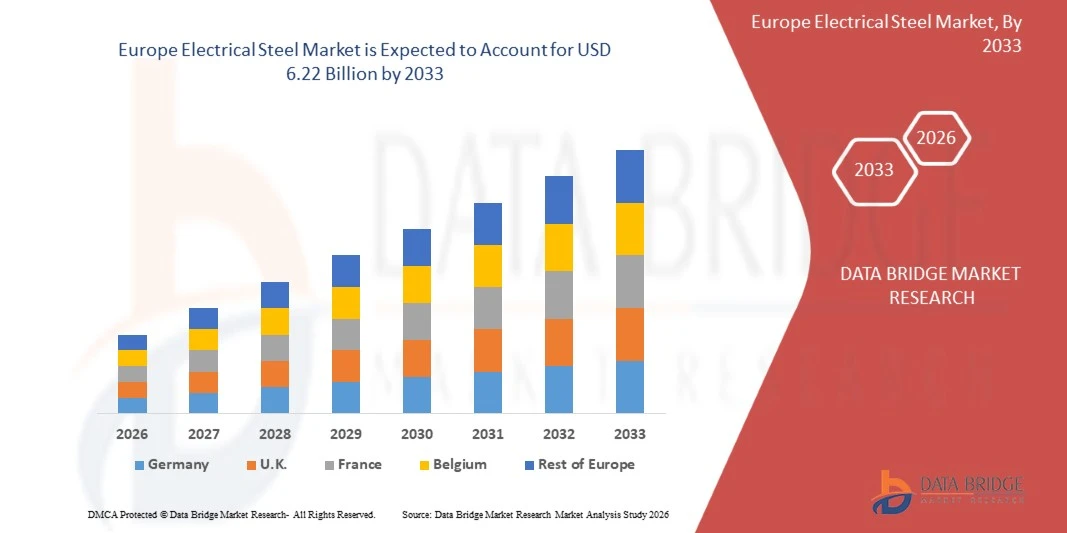
- As per Data Bridge Market Research analysis, the electrical steel market was valued at USD 3.99 billion in 2025 and is projected to reach USD 6.22 billion by 2033, growing at a CAGR of 5.7% from 2026 to 2033.
- The market is experiencing steady growth driven by accelerating grid modernization, rapid electric vehicle adoption, rising renewable energy installations, and increasing demand for high-efficiency motors and transformers across the power, automotive, manufacturing, household appliance, and construction sectors.
- The accelerating shift toward grid expansion, vehicle electrification, and renewable power generation, combined with stricter efficiency requirements for motors and transformers across the continent, is supporting market adoption. Electrical steel is being applied across power and distribution transformers, electric traction motors, wind and hydro generators, industrial drives, and household appliances, offering manufacturers lower core losses and higher magnetic efficiency through grain-oriented and non-grain-oriented grades.
Market Size & Forecast
- Europe Market Value (2025): USD 3.99 Billion
- Expected Market Value (2033): USD 6.22 Billion
- Forecast CAGR (2026–2033): 5.7%
- Leading Country in 2025: Germany
- Fastest Growing Country: Turkey
What are the Major Takeaways of the Electrical Steel Market?
- Germany dominated the electrical steel market with the largest revenue share of 27.35% in 2025, supported by its dense base of transformer, electric motor, and automotive component manufacturing and sustained grid and industrial electrification investment across the country.
- Turkey is expected to be the fastest-growing country at a CAGR of 7.84% from 2026 to 2033, fueled by expanding electrical equipment and appliance manufacturing, rising power infrastructure investment, and growing export-oriented motor production.
- The non-grain-oriented segment led the market with a 61.7% share in 2025, driven by rising electric vehicle traction motor and industrial drive production.
- Grain-oriented is the fastest-growing product type, projected to register a CAGR of 6.9%, reflecting the surge in demand for high-efficiency power and distribution transformer cores across expanding electricity grids.
- The 0.31–0.50 mm segment dominated the thickness category with a 46.2% revenue share in 2025, led by extensive use in industrial motors, generators, appliances, and medium-duty transformers.
- Motors accounted for 46.8% of the market share in 2025, supported by increasing electrification of vehicles, industrial drives, heat pumps, pumps, compressors, and household appliances.
- The transformers segment is the fastest-growing application category, with a CAGR of 6.6%, driven by increasing grid expansion and renewable energy integration.
Report Scope and Electrical Steel Market Segmentation
|
Attributes |
Electrical Steel Key Market Insights |
|
Segments Covered |
|
|
Countries Covered |
Europe
|
|
Key Market Players |
|
|
Market Opportunities |
|
|
Value Added Data Infosets |
In addition to the insights on market scenarios such as market value, growth rate, segmentation, geographical coverage, and major players, the market reports curated by the Data Bridge Market Research also include in-depth expert analysis, geographically represented company-wise production and capacity, network layouts of distributors and partners, detailed and updated price trend analysis and deficit analysis of supply chain and demand. |
What is the Key Trend in the Electrical Steel Market?
- Electrical steel producers are increasingly shifting from commodity silicon steel supply toward high-value, application-specific grades, combining thinner gauges, low-loss chemistries, advanced insulation coatings, and decarbonized production routes to serve electric vehicle motors, transformers, and renewable generators.
- For instance, in March 2026, according to ArcelorMittal Europe – Flat Products, the company produced the first industrial coil on its new Mardyck lines in northern France, a €500 million investment designed to triple its European electrical steel capacity to 295,000 tonnes per year and support upgraded high-polarisation and low-loss iCARe grades for e-traction applications.
- Grid operators and equipment makers are prioritizing low-loss transformer cores, making grain-oriented grades strategic inputs for substations, data centres, offshore wind connections, and cross-border transmission projects.
- Trade protection and supply security are reshaping sourcing strategies, with producers, transformer manufacturers, and policymakers increasingly focused on regional availability, melt-and-pour traceability, and resilience of grain-oriented electrical steel supply chains across the continent.
- For instance, in September 2026, according to the European Commission, provisional safeguard measures on grain-oriented electrical steel, related laminations, and cores took effect on 25 September for 155 days, with price thresholds of €2,800 to €3,400 per metric ton within quotas, reflecting the growing policy focus on protecting strategic electrical steel supply chains.
- As grid investment, electric vehicle penetration, and renewable capacity continue to expand, electrical steel is expected to evolve beyond a conventional magnetic material into a strategic enabler of Europe’s electrification, energy security, and industrial decarbonization goals.
What are the Key Drivers of the Electrical Steel Market?
- Rapid expansion and modernization of Europe’s electricity networks is significantly increasing demand for power and distribution transformers, which depend on low-loss grain-oriented electrical steel to improve efficiency and reduce losses.
- For instance, in December 2025, according to the European Commission, the European Grids Package estimated that EU electricity grids require investment of about USD 1,341.72 billion by 2040, including USD 816.21 billion for distribution grids, highlighting the long-term demand outlook for transformer cores, laminations, and grain-oriented electrical steel across utilities, wind developers, and data centres.
- Automakers, motor manufacturers, and industrial equipment makers are integrating high-efficiency electric drives to meet emission targets and energy-efficiency regulations, increasing consumption of thin, low-loss non-grain-oriented electrical steel for traction, industrial, and appliance motors.
- For instance, in March 2023, according to thyssenkrupp Steel Europe, the company announced an investment of about USD 167.72 million in a new annealing and insulating line in Bochum for thinner, highly silicized non-grain-oriented electrical steel, with capacity of up to 218,000 tonnes per year for electric vehicle motors in Germany.
- With wind, solar, and hydro capacity expanding and heating, transport, and industry electrifying, electrical steel producers are positioned to benefit from sustained demand for generators, transformers, and efficient motors.
What Factors Are Challenging the Growth of the Electrical Steel Market?
- Electrical steel production is capital-intensive and technically demanding, requiring precise silicon alloying, cold rolling, annealing, and coating, while elevated energy and carbon costs weigh on mills’ competitiveness.
- For instance, in December 2025, thyssenkrupp Steel Europe announced a temporary shutdown of electrical steel production in Gelsenkirchen, Germany, and Isbergues, France, blaming cheap imports from Asia and warning that 1,200 additional jobs were at risk across its steel operations.
- Surging low-priced imports, trade diversion, and global excess capacity can depress prices, reduce capacity utilization, and delay investment decisions among regional producers, particularly in grain-oriented grades where only a few qualified suppliers operate.
- Transformer and motor manufacturers face tight availability of qualified grades, long customer approval cycles, and rising input costs, which can extend lead times and increase project costs when trade measures restrict access to specialized imported steel.
- For instance, in September 2026, according to EU Perspectives, Transmission & Distribution Europe warned that the EU’s provisional safeguard on grain-oriented electrical steel would transfer over EUR 700 million per year from the transformer industry to just two domestic producers, noting that Europe’s producers cannot meet all industry needs, highlighting cost and supply challenges for downstream transformer manufacturers and the wider grid build-out.
- The combination of high production costs, import competition, trade-policy uncertainty, and dependence on a limited number of qualified suppliers can constrain expansion among cost-sensitive transformer, motor, and appliance manufacturers, particularly where alternative core materials or lower-priced imported grades are available.
How is the Electrical Steel Market Segmented?
The electrical steel market is segmented on the basis of product, thickness, application, and end user across the region.
- By Product
On the basis of product, the electrical steel market is segmented into non-grain-oriented and grain-oriented. The non-grain-oriented segment dominated the market with 61.7% share in 2025, supported by increasing production of electric vehicle traction motors, industrial drives, generators, and household appliances. Non-grain-oriented grades provide uniform magnetic properties in all directions, making them well suited to rotating machines. They are increasingly used across automotive, wind power, industrial automation, and consumer appliance applications. Improvements in thinner gauges, higher polarization, and lower core losses are further strengthening demand. Integration with advanced insulation and self-bonding coatings also enables higher efficiency and better stacking performance across motor designs.
The grain-oriented segment is projected to register the fastest growth at a CAGR of 6.9% from 2026 to 2033, driven by increasing demand for high-efficiency power and distribution transformer cores. Grain-oriented grades offer very low losses along the rolling direction, which is essential for reducing no-load losses in transformers. Their applications include power transformers, distribution transformers, substations, and renewable energy grid connections. Increasing grid expansion and replacement of aging network assets are creating additional demand across utilities, wind and solar developers, and data centres. Improvements in domain-refined and high-permeability grades are enhancing efficiency. Trade measures and the limited number of qualified regional producers are also reshaping supply and sourcing decisions.
- By Thickness
On the basis of thickness, the electrical steel market is segmented into up to 0.30 mm, 0.31–0.50 mm, and above 0.50 mm. The 0.31–0.50 mm segment dominated the market with 46.2% share in 2025, supported by extensive use in industrial motors, generators, appliances, and medium-duty transformers. This thickness range offers a balanced combination of magnetic performance, mechanical strength, and cost efficiency for high-volume manufacturing. Electrical steel in this range is widely used by motor and generator manufacturers seeking reliable, standardized lamination materials. The range also provides flexibility for stamping, stacking, and core assembly across diverse equipment designs and production volumes.
The up to 0.30 mm segment is projected to register the fastest growth at a CAGR of 7.1% from 2026 to 2033, supported by increasing adoption of electric vehicle traction motors, high-speed drives, and low-loss transformer cores. Thinner laminations reduce eddy current losses, enabling higher efficiency, compact motor designs, and improved driving range. Grain-oriented transformer sheets in this range also support lower no-load losses across power networks. Automakers and motor manufacturers are increasingly specifying ultra-thin and high-strength grades for next-generation electric drive units. High-performance coatings and tighter dimensional tolerances further strengthen the segment’s attractiveness and long-term growth outlook for premium grades.
- By Application
On the basis of application, the electrical steel market is segmented into motors, transformers, generators, and others. The motors segment dominated the application category with 46.8% share in 2025, supported by increasing electrification of vehicles, industrial drives, pumps, compressors, heat pumps, and household appliances. Electrical steel laminations enable motors to operate with lower losses and higher torque density. Regulatory focus on motor efficiency classes and energy savings is increasing the use of premium non-grain-oriented grades. Growth in electric vehicle production and factory automation further strengthens demand. Motor manufacturers are also seeking materials that combine low core loss, high polarization, and mechanical strength for high-speed applications.
The transformers segment is projected to register the fastest growth at a CAGR of 6.6% from 2026 to 2033, driven by increasing grid expansion, renewable energy integration, and replacement of aging network assets. Transformer cores made from grain-oriented electrical steel can reduce no-load losses and improve operating efficiency over long service lives. Utilities and industrial users are investing in power, distribution, and traction transformers to support electrification and data centre growth. Rising offshore wind connections and cross-border interconnectors are creating additional demand for large power transformers, substations, and interconnection equipment. Long procurement cycles and strict loss requirements make qualified grain-oriented supply particularly important.
- By End User
On the basis of end user, the electrical steel market is segmented into automotive, energy & power, manufacturing, household appliances, construction & infrastructure, and others. The energy & power segment dominated the end-user category with 34.6% share in 2025, supported by increasing requirements for transformers, generators, and grid equipment. Utilities, renewable developers, and equipment manufacturers rely on electrical steel to improve efficiency and reduce losses. The material supports power transformers, distribution transformers, wind turbine generators, and hydro generators. Increasing investment in grid modernization and renewable capacity is creating further opportunities. Long asset lifetimes also make efficiency-focused core materials an important consideration in procurement decisions.
The automotive segment is projected to register the fastest growth at CAGR of 7.2% from 2026 to 2033, driven by increasing production of electric vehicles, hybrid vehicles, and electrified auxiliary systems. Traction motors, generators, and onboard power components require thin, low-loss, high-strength electrical steel to maximize efficiency and driving range. Automakers and Tier-1 suppliers are expanding electric drivetrain platforms and localizing motor component supply chains. Closer collaboration with steelmakers is accelerating development of tailored grades and bonding coatings. Stricter vehicle emission regulations are further supporting adoption. Supply security, qualification timelines, and cost competitiveness remain important considerations for deployment.
Which Country Holds the Largest Share of the Electrical Steel Market?
- Germany dominated the electrical steel market with the largest revenue share of 27.35% in 2025, supported by its dense base of transformer, electric motor, and automotive component manufacturing and sustained grid and industrial electrification investment across the country.
- The country also benefits from a strong automotive and machinery supply base, advanced electrical equipment manufacturing, and the presence of established steel producers and research institutions, along with growing demand for transformers, wind generators, and efficient drives. Increasing grid expansion, electric mobility investment, and industrial electrification continue to strengthen Germany’s position in the European market.
Germany Electrical Steel Market Insight
The Germany electrical steel market is witnessing strong growth due to rising investment in grid expansion, electric mobility, renewable energy, and industrial electrification. The country’s mature manufacturing ecosystem, along with the presence of leading transformer, motor, and automotive component producers, is driving demand for advanced grain-oriented and non-grain-oriented grades. In addition, growing emphasis on low-loss cores, domestic supply security, and decarbonized steel production, supported by strong research and engineering capabilities, is accelerating adoption of high-efficiency electrical steel across power, automotive, and industrial applications.
Turkey Electrical Steel Market Insight
The Turkey electrical steel market is expected to witness rapid growth, driven by expanding electrical equipment production, rising appliance and motor exports, and increasing investments in power infrastructure and renewable energy. Growing demand for efficient motors, transformers, and household appliances is supporting country market expansion across industrial and residential segments. In addition, the country’s strong manufacturing base, proximity to European customers, and increasing localization of industrial supply chains are accelerating demand for electrical steel across energy, automotive, and consumer applications.
France Electrical Steel Market Insight
The France electrical steel market is witnessing consistent growth due to rising investments in electrified mobility, nuclear and renewable power infrastructure, and domestic electrical steel capacity. Producers, grid operators, automotive manufacturers, and industrial users are increasingly focusing on regional supply of advanced grades. Moreover, expansion of non-grain-oriented capacity in northern France and continued transformer demand, supported by policy emphasis on domestic industrial supply chains, are further contributing to market growth in France.
U.K. Electrical Steel Market Insight
The U.K. electrical steel market is experiencing steady growth, supported by increasing grid reinforcement, offshore wind expansion, and electrification of transport and heating. Transformer manufacturers, utilities, renewable developers, and industrial users are increasingly seeking reliable supply of efficient core materials. Furthermore, growing investment in network upgrades, interconnectors, and low-carbon infrastructure, along with rising focus on secure domestic supply of critical grid materials, is supporting wider adoption of grain-oriented and non-grain-oriented electrical steel in the U.K.
Which are the Top Companies in Electrical Steel Market?
The electrical steel industry is primarily led by well-established companies, including:
- thyssenkrupp Electrical Steel GmbH (Germany)
- ArcelorMittal S.A. (Luxembourg)
- voestalpine AG (Austria)
- Tata Steel Limited (India)
- Nippon Steel Corporation (Japan)
- Stalprodukt S.A. (Poland)
- POSCO Holdings Inc. (South Korea)
- JFE Steel Corporation (Japan)
- Baoshan Iron & Steel Co., Ltd. (China)
- Cogent Power Ltd. (U.K.)
- Acciai Speciali Terni S.p.A. (Italy)
- Novolipetsk Steel (Russia)
- Cleveland-Cliffs Inc. (U.S.)
- Hyundai Steel Company (South Korea)
- Shougang Group Co., Ltd. (China)
- Wuhan Iron and Steel Co., Ltd. (China)
- JSW Steel Limited (India)
- Orb Electrical Steels Ltd. (India)
- Ansteel Group Corporation Limited (China)
- Jindal Stainless Limited (India)
What are Latest Developments in Electrical Steel Market?
- In September 2026, the European Commission adopted provisional safeguard measures on grain-oriented electrical steel, related laminations and cores, and steel cores inside imported transformers, effective 25 September 2026 for 155 days. The measures set import quotas and minimum price thresholds, aiming to protect EU producers whose market share fell from 66% in 2021 to 43% in 2025.
- In April 2026, ArcelorMittal reported the first coil from its new electrical steel lines at Mardyck, France, a €500 million investment and its largest in Europe in the past ten years excluding decarbonization, lifting European electrical steel capacity to 295,000 tonnes per year, all concentrated in France, for motors and generators across automotive, wind, and industrial sectors.
- In March 2026, ArcelorMittal Europe – Flat Products presented its latest non-grain-oriented electrical steels at Coiltech Germany 2026 in Augsburg, highlighting the Mardyck capacity expansion in northern France which, together with its Saint-Chély-d’Apcher site, is intended to triple its non-grain-oriented electrical steel offering for e-mobility and energy transition applications while improving quality, efficiency, and supply flexibility for automotive, energy, and industrial customers.
- In December 2025, thyssenkrupp Steel Europe announced the temporary shutdown of its electrical steel plants in Gelsenkirchen, Germany, and Isbergues, France, from mid-December to year-end, with the French site set to operate at 50% capacity from January 2026 for at least four months, citing a sharp increase in low-priced grain-oriented electrical steel imports into the EU, which had tripled since 2022.
- In September 2025, Jindal Steel International submitted a non-binding offer to acquire thyssenkrupp Steel Europe, Germany’s largest steel producer, committing to invest more than USD 2.24 billion in electric arc furnaces and completion of a green steel project in Duisburg, and in October 2025 thyssenkrupp confirmed intensive negotiations while evaluating the proposal, highlighting ongoing restructuring across Europe’s steel industry.

- Interactive Data Analysis Dashboard
- Company Analysis Dashboard for high growth potential opportunities
- Research Analyst Access for customization & queries
- Competitor Analysis with Interactive dashboard
- Latest News, Updates & Trend analysis
- Harness the Power of Benchmark Analysis for Comprehensive Competitor Tracking
Europe Electrical Steel Market, Supply Chain Analysis and Ecosystem Framework
To support market growth and help clients navigate the impact of geopolitical shifts, DBMR has integrated in-depth supply chain analysis into its Europe Electrical Steel Market research reports. This addition empowers clients to respond effectively to global changes affecting their industries. The supply chain analysis section includes detailed insights such as Europe Electrical Steel Market consumption and production by country, price trend analysis, the impact of tariffs and geopolitical developments, and import and export trends by country and HSN code. It also highlights major suppliers with data on production capacity and company profiles, as well as key importers and exporters. In addition to research, DBMR offers specialized supply chain consulting services backed by over a decade of experience, providing solutions like supplier discovery, supplier risk assessment, price trend analysis, impact evaluation of inflation and trade route changes, and comprehensive market trend analysis.
Data collection and base year analysis are done using data collection modules with large sample sizes. The stage includes obtaining market information or related data through various sources and strategies. It includes examining and planning all the data acquired from the past in advance. It likewise envelops the examination of information inconsistencies seen across different information sources. The market data is analysed and estimated using market statistical and coherent models. Also, market share analysis and key trend analysis are the major success factors in the market report. To know more, please request an analyst call or drop down your inquiry.
The key research methodology used by DBMR research team is data triangulation which involves data mining, analysis of the impact of data variables on the market and primary (industry expert) validation. Data models include Vendor Positioning Grid, Market Time Line Analysis, Market Overview and Guide, Company Positioning Grid, Patent Analysis, Pricing Analysis, Company Market Share Analysis, Standards of Measurement, Global versus Regional and Vendor Share Analysis. To know more about the research methodology, drop in an inquiry to speak to our industry experts.
Data Bridge Market Research is a leader in advanced formative research. We take pride in servicing our existing and new customers with data and analysis that match and suits their goal. The report can be customized to include price trend analysis of target brands understanding the market for additional countries (ask for the list of countries), clinical trial results data, literature review, refurbished market and product base analysis. Market analysis of target competitors can be analyzed from technology-based analysis to market portfolio strategies. We can add as many competitors that you require data about in the format and data style you are looking for. Our team of analysts can also provide you data in crude raw excel files pivot tables (Fact book) or can assist you in creating presentations from the data sets available in the report.