


Europe Electronic Medical Records (EMR) Market Overview
The Europe Electronic Medical Records (EMR) market was valued at USD 6.37 billion in 2025 and is projected to reach USD 10.86 billion by 2033, growing at a CAGR of 6.9% from 2026 to 2033. The market is experiencing steady growth driven by increasing digitalization of healthcare systems, rising adoption of interoperable health information technologies, and growing emphasis on improving clinical efficiency, patient outcomes, and data-driven healthcare delivery.
The rising prevalence of chronic diseases across Europe, coupled with supportive government initiatives promoting electronic health records and healthcare digitization, is encouraging hospitals, clinics, and healthcare networks to implement advanced EMR solutions. Cloud-based and integrated EMR platforms are increasingly replacing paper-based and fragmented record management systems, providing secure, accessible, and standardized patient information while supporting regulatory compliance, care coordination, and population health management across the region.
Key Market Trends & Insights
- Germany dominated the Europe Electronic Medical Records (EMR) market with the largest revenue share of 24.68% in 2025, supported by strong healthcare digitalization initiatives, extensive hospital IT investments, and widespread adoption of electronic patient record systems.
- The Software segment led the market with a 68.42% share in 2025, driven by the growing deployment of comprehensive EMR platforms for patient data management, clinical documentation, e-prescribing, and healthcare workflow automation.
- France is expected to be the fastest-growing country at a CAGR of 8.1% from 2026 to 2033, fueled by government-backed digital health programs, increasing healthcare interoperability requirements, and rising investments in cloud-based healthcare infrastructure.
- Services are the fastest-growing component type, projected to register a CAGR of 8.5%, reflecting the surge in demand for implementation, integration, consulting, maintenance, and training services.
- The Traditional EMR segment dominated the type category with a 39.84% revenue share in 2025, led by its widespread installation across hospitals, physician practices, and healthcare facilities throughout Europe.
- General Application accounted for 61.27% of the market, preferred by its extensive utilization across primary care, hospitals, outpatient facilities, and multispecialty healthcare organizations.
- The Specialty Application segment is the fastest-growing application category, with a CAGR of 8.7%, driven by increasing demand for customized EMR solutions tailored to specific medical disciplines.
Market Size & Forecast
- Global Market Value (2025): USD 6.37 Billion
- Expected Market Value (2033): USD 10.86 Billion
- Forecast CAGR (2026–2033): 6.9%
- Leading Country in 2025: Germany
- Fastest Growing Country: France
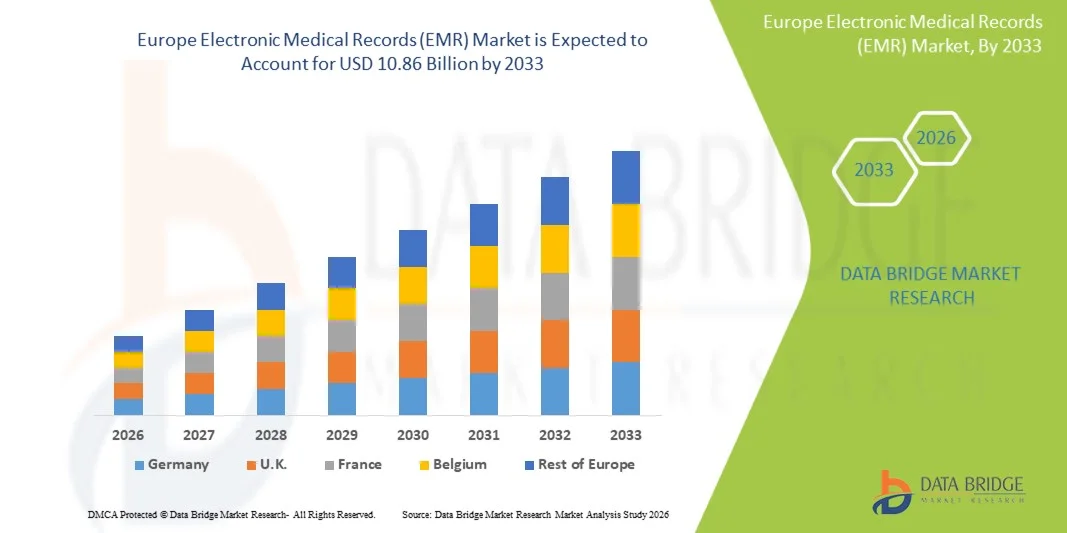
Report Scope and Europe Electronic Medical Records (EMR) Market Segmentation
|
Attributes |
Europe Electronic Medical Records (EMR) Key Market Insights |
|
Segments Covered |
|
|
Countries Covered |
Europe · Germany · France · U.K. · Netherlands · Switzerland · Belgium · Russia · Italy · Spain · Turkey · Rest of Europe |
|
Key Market Players |
· Dedalus Group (Italy) · CompuGroup Medical SE & Co. KGaA (Germany) · Oracle Corporation (U.S.) · Epic Systems Corporation (U.S.) · MEDITECH (U.S.) · Nexus AG (Germany) · Agfa HealthCare (Belgium) · System C Healthcare (U.K.) · EMIS Group Plc (U.K.) · TPP (U.K.) · Cegedim (France) · Clanwilliam (Ireland) · CGM Clinical Europe (Germany) · Cambio Healthcare Systems (Sweden) · InterSystems Corporation (U.S.) · Veradigm LLC (U.S.) · Altera Digital Health Inc. (U.S.) · Dedalus HealthCare France (France) · Medset Medizintechnik GmbH (Germany) · Mediware Information Systems (Netherlands) |
|
Market Opportunities |
· Expansion of cross-border health data exchange initiatives · Growing adoption of cloud-native EMR solutions among small and mid-sized healthcare providers · Integration of artificial intelligence and clinical decision support tools into EMR platforms |
|
Value Added Data Infosets |
In addition to the insights on market scenarios such as market value, growth rate, segmentation, geographical coverage, and major players, the market reports curated by the Data Bridge Market Research also include in-depth expert analysis, patient epidemiology, pipeline analysis, pricing analysis, and regulatory framework. |
Europe Electronic Medical Records (EMR) Market Trends
Trend: Rising Adoption of Interoperable and Cloud-Based EMR Platforms
Healthcare providers across Europe are increasingly adopting interoperable and cloud-based Electronic Medical Records systems to improve care coordination, streamline clinical workflows, and facilitate secure access to patient information across multiple healthcare settings. The integration of application programming interfaces, health information exchanges, and standardized data formats enables seamless communication between hospitals, clinics, laboratories, and pharmacies. Healthcare organizations are similarly leveraging cloud-based EMR platforms to reduce infrastructure costs through scalable, subscription-based deployment models, while advanced analytics and mobile accessibility tools enhance operational efficiency and support patient-centered healthcare delivery.
For instance, in January 2025, several European healthcare networks expanded interoperability-focused EMR modernization programs aligned with the European Health Data Space initiative, strengthening cross-institutional patient data exchange and digital healthcare collaboration.
Europe Electronic Medical Records (EMR) Market Dynamics
Key Market Driver: Government-Led Healthcare Digitalization and EHR Modernization Initiatives
The rapid expansion of healthcare digitalization programs and electronic health record modernization initiatives has created substantial demand for advanced EMR platforms that can support clinical documentation, patient data management, and secure information exchange across healthcare ecosystems. Hospitals, physician practices, and healthcare networks are deploying EMR solutions as a core component of their digital transformation strategies, improving operational efficiency, enhancing patient outcomes, and strengthening compliance with evolving healthcare data governance requirements and interoperability standards.
For instance, in March 2025, multiple healthcare providers across Germany accelerated electronic patient record implementation initiatives under national digital health programs, supporting broader adoption of integrated EMR technologies throughout the healthcare sector.
Key Restraint/Challenge: Data Privacy Compliance and Complex System Integration Requirements
A significant restraint in the Europe Electronic Medical Records market is the complexity associated with regulatory compliance, legacy system integration, and healthcare data security requirements. Modern EMR platforms must comply with stringent privacy regulations, interoperability standards, and cybersecurity frameworks, requiring substantial investment in implementation, customization, staff training, and ongoing system maintenance. The total cost of ownership extends to software upgrades, data migration processes, and compliance monitoring activities, making large-scale deployment challenging for smaller healthcare providers and resource-constrained medical institutions.
For instance, in September 2024, several European healthcare organizations reported delays in EMR modernization projects due to challenges associated with integrating legacy hospital information systems while maintaining compliance with regional data protection regulations.
Key Market Opportunity: Expansion of AI-Enabled Clinical Decision Support and Predictive Analytics
The integration of artificial intelligence within Electronic Medical Records platforms presents a significant market opportunity. AI-enabled solutions can automate clinical documentation, support predictive risk assessment, and deliver real-time decision support for healthcare professionals. The development of advanced analytics capabilities and population health management tools is further enhancing the value of EMR systems, opening growth opportunities across hospitals, specialty clinics, and integrated healthcare networks seeking data-driven approaches to improve care quality and operational performance.
For instance, in February 2025, healthcare technology providers across Europe expanded AI-powered clinical decision support functionalities within EMR platforms, enabling healthcare organizations to leverage predictive analytics for more efficient patient management and treatment planning.
Europe Electronic Medical Records (EMR) Market Scope
The Europe Electronic Medical Records (EMR) market is segmented on the basis of component, type, application, end user, and delivery mode.
- By Component
On the basis of component, the Europe Electronic Medical Records (EMR) market is segmented into software and services. The Software segment dominated the market with a 68.42% share in 2025, owing to the growing deployment of comprehensive EMR platforms for patient data management, clinical documentation, e-prescribing, and healthcare workflow automation. Healthcare providers increasingly rely on software solutions to streamline operations and improve care coordination. The segment benefits from continuous technological advancements in interoperability, cloud integration, and analytics capabilities. Regulatory mandates supporting digital health records further accelerate adoption. Software platforms also provide scalability and customization options for healthcare institutions of different sizes. Their central role in healthcare digital transformation continues to support market leadership.
The Services segment is projected to register the fastest growth at a CAGR of 8.5% from 2026 to 2033, driven by increasing demand for implementation, integration, consulting, maintenance, and training services. As healthcare organizations modernize legacy systems, the need for specialized support is rising significantly. Service providers assist institutions in achieving regulatory compliance and interoperability objectives. Growing migration toward cloud-based EMR platforms is creating additional service requirements. Demand for cybersecurity assessments and system optimization services is also expanding. The increasing complexity of healthcare IT ecosystems is expected to sustain strong growth in this segment.
- By Type
On the basis of type, the Europe Electronic Medical Records (EMR) market is segmented into Traditional EMR, Speech Enabled EMR, Interoperable EMR, and Others. The Traditional EMR segment led the market with a 39.84% share in 2025, driven by its widespread installation across hospitals, physician practices, and healthcare facilities throughout Europe. Many healthcare organizations continue to utilize traditional systems due to established infrastructure and familiarity among healthcare professionals. These systems provide reliable patient documentation and clinical workflow management capabilities. Existing investments in legacy platforms have supported continued utilization. Traditional EMR solutions also offer cost advantages compared to complete system replacements. Their extensive installed base contributes significantly to segment dominance.
The Interoperable EMR segment is expected to witness the fastest growth at a CAGR of 9.1% from 2026 to 2033, fueled by increasing emphasis on seamless health information exchange and coordinated patient care. Governments and healthcare authorities across Europe are promoting interoperability standards to improve healthcare efficiency. These solutions enable secure sharing of patient records among hospitals, clinics, laboratories, and pharmacies. Rising adoption of integrated healthcare networks is further supporting demand. Interoperable systems enhance clinical decision-making by providing comprehensive patient information. The expansion of digital health initiatives continues to accelerate segment growth.
- By Application
On the basis of application, the Europe Electronic Medical Records (EMR) market is segmented into specialty application and general application. The General Application segment dominated the market with a 61.27% share in 2025 owing to its extensive utilization across primary care, hospitals, outpatient facilities, and multispecialty healthcare organizations. These solutions support broad clinical documentation requirements and standardized patient record management processes. Healthcare providers favor general applications due to their versatility and comprehensive functionality. The segment benefits from widespread implementation across diverse healthcare environments. Continuous software enhancements are improving usability and workflow efficiency. Its ability to serve large patient populations contributes to strong market penetration.
The Specialty Application segment is projected to register the fastest growth at a CAGR of 8.7% from 2026 to 2033, driven by increasing demand for customized EMR solutions tailored to specific medical disciplines. Specialty-focused platforms offer advanced functionalities for cardiology, oncology, orthopedics, dermatology, and other clinical fields. These systems improve documentation accuracy and support specialty-specific treatment workflows. Growing emphasis on personalized medicine is encouraging adoption. Healthcare providers increasingly seek solutions that align with specialized clinical requirements. The rising complexity of disease management is expected to sustain segment expansion.
- By End User
On the basis of end user, the Europe Electronic Medical Records (EMR) market is segmented into hospitals, general physician clinics, specialised clinics, ambulatory surgical centres, and others. The Hospitals segment accounted for the largest market share of 46.53% in 2025, driven by high patient volumes, complex clinical workflows, and extensive requirements for integrated health information management. Hospitals rely on EMR systems for patient documentation, medication management, diagnostic reporting, and regulatory compliance. Large-scale digital transformation initiatives have accelerated adoption across healthcare institutions. The segment benefits from substantial investments in healthcare IT infrastructure. Advanced EMR capabilities support operational efficiency and quality improvement programs. Hospitals remain the primary users of comprehensive EMR platforms throughout Europe.
The Ambulatory Surgical Centres segment is anticipated to be the fastest-growing segment at a CAGR of 8.9% from 2026 to 2033, supported by the increasing shift toward outpatient and minimally invasive procedures. These facilities require efficient electronic record management systems to optimize patient flow and clinical coordination. EMR adoption helps improve scheduling, documentation, and billing processes. Growing healthcare cost-containment initiatives are encouraging expansion of ambulatory care services. The need for interoperability with hospitals and physician networks is also driving demand. Rising procedure volumes are expected to further strengthen segment growth.
- By Delivery Mode
On the basis of delivery mode, the Europe Electronic Medical Records (EMR) market is segmented into client based setups, cloud based setups, and hybrid setups. The Client Based Setups segment dominated the market with a 52.18% share in 2025, owing to their long-standing adoption among hospitals and healthcare institutions requiring direct control over patient data and system infrastructure. These deployments provide high levels of customization and data security. Many organizations continue to rely on client-based systems due to existing IT investments. They are particularly preferred in environments with strict regulatory and operational requirements. Established deployment practices have supported continued market presence. Their reliability and familiarity contribute to segment leadership.
The Cloud Based Setups segment is projected to witness the fastest growth at a CAGR of 9.4% from 2026 to 2033, driven by increasing demand for scalable, cost-efficient, and remotely accessible healthcare IT solutions. Cloud deployments reduce upfront infrastructure costs and simplify software updates and maintenance. Healthcare providers are increasingly adopting cloud-based platforms to support interoperability and data accessibility. Advances in cybersecurity technologies are improving confidence in cloud environments. The growing adoption of telehealth and digital healthcare services is further accelerating demand. Flexibility and operational efficiency advantages continue to make cloud-based setups the fastest-growing delivery mode segment.
Europe Electronic Medical Records (EMR) Market Regional Analysis
Germany dominated the Europe Electronic Medical Records (EMR) market with the largest revenue share of 24.68% in 2025, supported by strong healthcare digitalization initiatives, extensive hospital IT investments, and widespread adoption of electronic patient record systems. The country also benefits from robust healthcare spending, favorable regulatory frameworks, and increasing implementation of interoperable and cloud-based EMR platforms across public and private healthcare institutions. Growing focus on healthcare data integration, clinical workflow optimization, and secure health information exchange continues to strengthen Germany’s leadership position in the European market.
U.S. Europe Electronic Medical Records (EMR) Market Insight
The U.S. Electronic Medical Records (EMR) market is witnessing strong growth due to rising investments in healthcare digitalization programs, clinical workflow automation, and interoperable health information exchange technologies. The country’s advanced healthcare infrastructure, along with increasing adoption of cloud-based, AI-enabled, and analytics-driven EMR platforms, is driving demand across hospitals, physician practices, and ambulatory care settings. In addition, growing emphasis on improving patient outcomes, regulatory compliance, and healthcare efficiency is accelerating EMR adoption across healthcare providers and integrated delivery networks.
Europe Electronic Medical Records (EMR) Market Insight
The Europe Electronic Medical Records (EMR) market remains a major contributor to global revenue, driven by strong government support, healthcare modernization initiatives, and high demand for digital patient record management solutions. The widespread use of EMR platforms across hospitals, clinics, and healthcare networks is supporting market expansion throughout the region. Increasing investments in interoperable healthcare systems, coupled with strict data governance regulations and growing digital health adoption, continue to enhance EMR implementation across Europe.
U.K. Electronic Medical Records (EMR) Market Insight
The U.K. Electronic Medical Records (EMR) market is experiencing steady growth, supported by rising adoption of digital healthcare technologies, integrated care programs, and electronic patient record initiatives. Increasing investments in healthcare IT infrastructure and growing demand for efficient, data-driven clinical management solutions are contributing to market growth. Furthermore, integration of artificial intelligence, cloud computing, and healthcare analytics technologies is improving EMR functionality and operational efficiency, positioning the U.K. as a key innovation hub in the European digital health industry.
Germany Electronic Medical Records (EMR) Market Insight
The Germany Electronic Medical Records (EMR) market is expanding steadily due to the country’s advanced healthcare infrastructure, strong digital health policies, and increasing adoption of interoperable electronic patient record systems. Hospitals, physician groups, and healthcare organizations are increasingly utilizing EMR platforms for clinical documentation, patient management, and healthcare data exchange activities. Continuous advancements in healthcare software, cloud integration, and AI-enabled clinical support technologies, along with strong government focus on healthcare digitalization, are further driving market growth in Germany.
Asia-Pacific Electronic Medical Records (EMR) Market Insight
The Asia-Pacific Electronic Medical Records (EMR) market is expected to witness rapid growth, driven by increasing healthcare digitalization, expanding healthcare infrastructure, and rising investments in health information technology across countries such as China, India, and Japan. Growing awareness regarding efficient patient data management, rising adoption of cloud-based healthcare platforms, and increasing demand for scalable and cost-effective EMR solutions are supporting regional market expansion. Additionally, the growing focus on healthcare interoperability and digital transformation initiatives is accelerating EMR adoption across public and private healthcare sectors.
Japan Electronic Medical Records (EMR) Market Insight
The Japan Electronic Medical Records (EMR) market is witnessing consistent growth due to rising investments in healthcare information technology, hospital digital transformation, and patient care optimization initiatives. Healthcare providers, hospitals, and research institutions are increasingly adopting advanced EMR systems for clinical documentation, healthcare analytics, and operational efficiency purposes. Moreover, increasing integration of AI-powered healthcare tools and the country’s focus on delivering high-quality, technology-driven healthcare services are further contributing to market growth.
China Electronic Medical Records (EMR) Market Insight
The China Electronic Medical Records (EMR) market is growing rapidly, driven by increasing healthcare modernization efforts, expanding hospital infrastructure, and rising government focus on healthcare digital transformation. Growing adoption of cloud-based and AI-enabled EMR platforms across hospitals, clinics, and healthcare networks is significantly boosting market demand. In addition, rising investments in healthcare IT, increasing emphasis on healthcare data standardization, and rapid technological advancements are positioning China as one of the fastest-growing markets for Electronic Medical Records solutions globally.
Europe Electronic Medical Records (EMR) Market Share
The Europe Electronic Medical Records (EMR) industry is primarily led by well-established companies, including:
- Dedalus Group (Italy)
- CompuGroup Medical SE & Co. KGaA (Germany)
- Oracle Corporation (U.S.)
- Epic Systems Corporation (U.S.)
- MEDITECH (U.S.)
- Nexus AG (Germany)
- Agfa HealthCare (Belgium)
- System C Healthcare (U.K.)
- EMIS Group Plc (U.K.)
- TPP (U.K.)
- Cegedim (France)
- Clanwilliam (Ireland)
- CGM Clinical Europe (Germany)
- Cambio Healthcare Systems (Sweden)
- InterSystems Corporation (U.S.)
- Veradigm LLC (U.S.)
- Altera Digital Health Inc. (U.S.)
- Dedalus HealthCare France (France)
- Medset Medizintechnik GmbH (Germany)
- Mediware Information Systems (Netherlands)
Latest Developments in Europe Electronic Medical Records (EMR) Market
- In January 2025, Germany’s Federal Ministry of Health launched the pilot phase of the nationwide Electronic Patient Record (ePA) program across selected regions including Hamburg, Franconia, and parts of North Rhine-Westphalia. The initiative involves physician practices, hospitals, and pharmacies testing a unified digital patient record system designed to improve healthcare data accessibility, interoperability, and care coordination. This development represents one of Europe’s most significant EMR modernization efforts
- In October 2024, Oracle Health unveiled its next-generation Electronic Health Record (EHR) platform, incorporating artificial intelligence throughout clinical workflows to automate documentation, enhance decision support, and streamline healthcare operations. The cloud-native platform is designed to improve interoperability, regulatory compliance, and healthcare delivery efficiency, strengthening the evolution of advanced EMR systems across European healthcare organizations
- In May 2024, the European Parliament formally adopted the European Health Data Space (EHDS) regulation, a landmark initiative aimed at enabling secure cross-border exchange of electronic health data and improving patient access to medical records throughout the European Union. The framework is expected to accelerate interoperability standards and digital health integration across EMR platforms operating in Europe
- In March 2024, the Council of the European Union and the European Parliament reached a provisional agreement on the European Health Data Space legislation. The agreement established a foundation for standardized electronic health record sharing, digital healthcare services, and health data accessibility across EU member states, supporting long-term growth of interoperable EMR systems throughout Europe
- In October 2023, King’s College Hospital NHS Foundation Trust and Guy’s and St Thomas’ NHS Foundation Trust completed the largest-ever single deployment of the Epic electronic patient record system, integrating hundreds of legacy IT systems into a unified EMR platform. The implementation enhanced clinician access to patient information, improved workflow efficiency, and marked a major advancement in large-scale EMR adoption within the European healthcare sector

- Interactive Data Analysis Dashboard
- Company Analysis Dashboard for high growth potential opportunities
- Research Analyst Access for customization & queries
- Competitor Analysis with Interactive dashboard
- Latest News, Updates & Trend analysis
- Harness the Power of Benchmark Analysis for Comprehensive Competitor Tracking
Data collection and base year analysis are done using data collection modules with large sample sizes. The stage includes obtaining market information or related data through various sources and strategies. It includes examining and planning all the data acquired from the past in advance. It likewise envelops the examination of information inconsistencies seen across different information sources. The market data is analysed and estimated using market statistical and coherent models. Also, market share analysis and key trend analysis are the major success factors in the market report. To know more, please request an analyst call or drop down your inquiry.
The key research methodology used by DBMR research team is data triangulation which involves data mining, analysis of the impact of data variables on the market and primary (industry expert) validation. Data models include Vendor Positioning Grid, Market Time Line Analysis, Market Overview and Guide, Company Positioning Grid, Patent Analysis, Pricing Analysis, Company Market Share Analysis, Standards of Measurement, Global versus Regional and Vendor Share Analysis. To know more about the research methodology, drop in an inquiry to speak to our industry experts.
Data Bridge Market Research is a leader in advanced formative research. We take pride in servicing our existing and new customers with data and analysis that match and suits their goal. The report can be customized to include price trend analysis of target brands understanding the market for additional countries (ask for the list of countries), clinical trial results data, literature review, refurbished market and product base analysis. Market analysis of target competitors can be analyzed from technology-based analysis to market portfolio strategies. We can add as many competitors that you require data about in the format and data style you are looking for. Our team of analysts can also provide you data in crude raw excel files pivot tables (Fact book) or can assist you in creating presentations from the data sets available in the report.












