


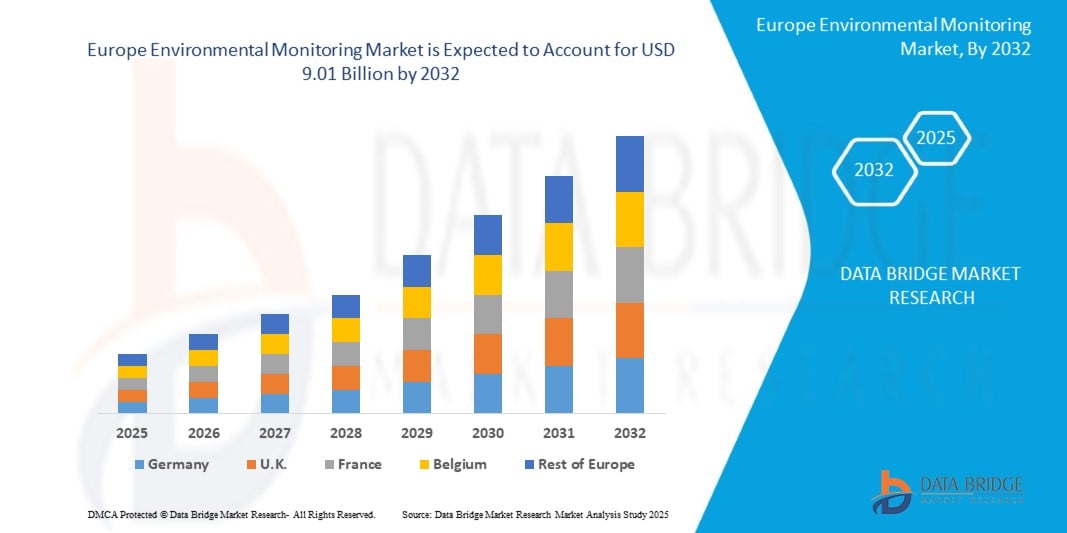
Environmental Monitoring Market Size
- The Europe Environmental Monitoring Market size was valued at USD 2.6 billion in 2024 and is expected to reach USD 9.01 billion by 2032, at a CAGR of 4.71% during the forecast period
- This growth is driven by factors such as the European Green Deal and Regulatory Frameworks, Technological Advancements
Environmental Monitoring Market Analysis
- Environmental management is the type of method of tracking and managing the status of the atmosphere after the end of production processes and functions. The purpose of environmental monitoring is to evaluate the success of the environmental targets of the initiative and to help identify new environmental issues. This includes of tools used to control water pollution, s air pollution, oil degradation, waste management and other environmental issues. It is an important mechanism to secure the natural ecosystem from the growing world population and related demands.
- Rising ongoing installation of environmental monitoring stations is a crucial factor accelerating the market growth, also rising development of environment-friendly industries, rising awareness on pollution monitoring, increasing expansion of pollution monitoring infrastructure across emerging markets, increase in the need of better natural resource management, rising health concern and increasing deaths due to rising pollution levels and are the major factors among others boosting the environmental monitoring market. Moreover, increasing participation and investments by businesses for deployment of pollution monitoring, rising expansion of the petrochemical, power generation, and natural gas industries and rising technological advancements and development of nanotechnology-based product will further create new opportunities for environmental monitoring market in the forecast period mentioned above.
- Germany is expected to dominate the Environmental Monitoring market due to its strong environmental regulations, advanced industrial infrastructure, and heavy investment in clean technologies. The country’s focus on sustainability and innovation further drives the adoption of modern monitoring systems.
- Italy is expected to grow the fastest in Europe’s environmental monitoring market because it's getting serious about protecting the environment. The government is putting strict rules in place to cut down on pollution and greenhouse gas emissions. At the same time, Italy is investing more in green technologies and cleaner ways to track the environment. All of this is boosting the need for modern monitoring systems to keep air, water, and land quality in check.
- The Chemical Detection segment is expected to lead the market with the highest share because of growing concerns over toxic pollutants in air, water, and soil. Stricter environmental laws and the need for safer industrial practices are driving demand for these monitoring systems.
Report Scope and Environmental Monitoring Market Segmentation
|
Attributes |
Environmental Monitoring Key Market Insights |
|
Segments Covered |
|
|
Countries Covered |
Europe
|
|
Key Market Players |
|
|
Market Opportunities |
|
|
Value Added Data Infosets |
In addition to the insights on market scenarios such as market value, growth rate, segmentation, geographical coverage, and major players, the market reports curated by the Data Bridge Market Research also include import export analysis, production capacity overview, production consumption analysis, price trend analysis, climate change scenario, supply chain analysis, value chain analysis, raw material/consumables overview, vendor selection criteria, PESTLE Analysis, Porter Analysis, and regulatory framework. |
Environmental Monitoring Market Trends
“Shift Toward Real-Time, Cloud-Based Monitoring Systems”
- One major trend in Europe’s environmental monitoring market is the move toward real-time, cloud-connected monitoring systems. Instead of relying on slow or manual reporting, many organizations are now using smart sensors and cloud platforms to track environmental data instantly. These systems allow for quick action when pollution levels spike or conditions become unsafe.
- For instance, in London, a network of real-time air quality sensors is used to monitor pollution near schools and busy roads. The data is sent to the cloud and made available to the public, helping people make safer travel and health decisions. This shift supports better compliance with EU regulations and improves transparency.
- As more cities and companies embrace smart tech, cloud-based monitoring is becoming the new standard across Europe. It’s faster, more efficient, and keeps everyone more informed
Environmental Monitoring Market Dynamics
Driver
“Growing Concern About Climate Change is Fueling Market Growth”
- People in Europe are becoming more aware of climate change and how it's affecting the environment around them—from heatwaves and wildfires to flooding and rising sea levels.
- This awareness is putting pressure on both governments and businesses to monitor the environment more closely and act quickly when changes happen. Climate issues aren’t just headlines—they’re real, and they’re local.
For instance,
- Italy and Greece have experienced extreme heat and wildfires in recent years, leading to more investment in air quality and weather monitoring systems. Citizens are also more engaged than ever, using apps and websites to check pollution levels and support green initiatives. This rising concern is pushing demand for environmental monitoring tools that can help track changes in the air, water, and soil in real time. Even farmers are adopting smart tech to monitor how climate shifts affect their crops. In short, as people wake up to climate risks, the demand for monitoring solutions is growing fast across Europe.
Opportunity
“Growth of Smart Cities and IoT Integration”
- As more European cities aim to become "smart cities," there’s a big opportunity for advanced environmental monitoring.
- With the rise of Internet of Things (IoT) technology, cities can now use connected sensors to track air and water quality in real-time.
- For instance, Barcelona has implemented smart environmental sensors that monitor air pollution and adjust traffic flow to reduce emissions. These systems help cities respond faster to environmental risks, improve public health, and meet EU climate goals. The push toward smarter, greener cities means growing demand for flexible, tech-driven monitoring solutions.
Restraint/Challenge
“High Cost and Compliance Make It Hard for Many to Keep Up”
- One big challenge in Europe’s environmental monitoring market is the high cost of equipment, testing, and staying compliant with regulations.
- While modern monitoring technologies like real-time sensors, lab testing kits, and automated systems are powerful, they aren’t cheap. Small businesses, local municipalities, and even some non-profits often struggle to afford these tools.
- On top of buying the equipment, there are also recurring costs—maintenance, data management, staff training, and regular audits.
- For instance, In Eastern European countries, many municipalities can't always afford full-scale water or air quality monitoring systems, even though pollution is a serious concern. This creates a gap where only larger or wealthier regions can keep up with environmental laws, leaving others behind. In the end, the high costs are slowing down adoption, especially in rural or economically struggling areas that still face real environmental risks.
Environmental Monitoring Market Scope
Environmental monitoring market is analysed and market size, volume information is provided by country, component, sampling method, application end-user and product type as referenced above.
|
Segmentation |
Sub-Segmentation |
|
By Component |
|
|
Sampling Method |
|
|
Application |
|
|
End-User |
|
|
Product Type |
|
In 2025, the Chemical Detection is projected to dominate the market with a largest share in Component segment
Chemical Detection is expected to lead the component segment of the European Environmental Monitoring Market. This is because detecting harmful chemicals in the air, water, and soil has become a top priority across industries and governments. With rising concerns about pollution, public health, and climate change, there's a growing need for accurate chemical analysis. Industries like manufacturing, agriculture, and waste management are required to monitor chemical levels to meet strict EU regulations. For example, France has expanded its water monitoring programs to detect chemical runoff from farms. These systems help catch contamination early and prevent bigger environmental problems. As a result, chemical detection tools are in high demand and are taking center stage in the market.
The Particulate Detection is expected to account for the largest share during the forecast period in Environmental Monitoring Market
Particulate Detection is expected to hold the largest share of the component segment in Europe’s Environmental Monitoring Market during the forecast period. This is because tracking tiny particles like dust, smoke, and soot in the air is crucial for both public health and environmental protection. These particles, especially PM2.5 and PM10, can cause serious health problems when inhaled. European cities with high traffic and industrial zones—like Milan or Berlin—are using advanced sensors to monitor these pollutants.
Environmental Monitoring Market Regional Analysis
“Germany Holds the Largest Share in the Environmental Monitoring Market”
- Germany holds the largest share 28.43% in Europe’s Environmental Monitoring Market, and it's easy to see why. The country has some of the toughest environmental regulations in Europe, especially when it comes to air and water quality.
- German industries are required to monitor their emissions closely, and this drives strong demand for advanced monitoring tools. Germany is also a leader in green technology and sustainability, pushing for cleaner energy and stricter pollution controls.
- Cities like Berlin and Munich are already using smart sensors to track air pollution in real time. The country invests heavily in research and innovation, which helps bring new monitoring solutions to market faster. Germany's strong economy allows both public and private sectors to fund environmental monitoring projects.
- Public awareness and support for environmental protection are also very high. All these factors make Germany the top player in Europe’s environmental monitoring space.
“Germany is Projected to Register the Highest CAGR in the Environmental Monitoring Market”
- Germany is expected the Highest CAGR 8.1% sin Europe’s Environmental Monitoring Market over the next few years, showing the highest CAGR. This means it's not just leading now—it’s expanding quickly, too.
- A big reason for this growth is Germany’s strong focus on environmental protection and sustainability. The government is constantly updating its regulations to fight pollution and promote clean technologies.
- As a result, industries are investing more in smart monitoring tools to stay compliant. Cities are also turning to real-time sensors and IoT-based systems to track air and water quality. For example, Hamburg is using a city-wide network of air sensors to improve urban planning and reduce emissions.
- Germany’s commitment to climate goals and green innovation is fueling this growth. With strong public support and funding, the country is set to lead the way in monitoring Europe’s environment.
Environmental Monitoring Market Share
The market competitive landscape provides details by competitor. Details included are company overview, company financials, revenue generated, market potential, investment in research and development, new market initiatives, Europe presence, production sites and facilities, production capacities, company strengths and weaknesses, product launch, product width and breadth, application dominance. The above data points provided are only related to the companies' focus related to market.
The Major Market Leaders Operating in the Market Are:
- 3M,
- Siemens,
- Thales Group,
- Merck KGaA,
- GENERAL ELECTRIC,
- Honeywell International Inc,
- Thermo Fisher Scientific Inc.,
- Agilent Technologies, Inc.,
- Danaher, Emerson Electric Co.,
- HORIBA, Ltd.,
- Spectris,
- PerkinElmer Inc.
- Shimadzu Corporation,
- TE Connectivity
Latest Developments in Europe Environmental Monitoring Market
- In March 2024, big cloud providers like Amazon Web Services (AWS) and Microsoft Azure launched new environmental intelligence tools and teamed up with existing service providers. These tools use cloud technology to help companies track things like air quality, emissions, and weather changes more easily. Because they're cloud-based, the tools are scalable and can be accessed from anywhere. This means even small and mid-sized businesses can now afford powerful environmental monitoring solutions. It’s a big step in making environmental data more available and useful. These partnerships are helping more companies take smarter, greener actions.
- In April 2023, GE introduced new emission-cutting technologies for its LM2500XPRESS gas turbines, now available globally. This comes after a successful installation in Colorado, where the upgrades helped reduce pollution significantly. GE also recently deployed a solution on four gas turbines at California’s Department of Water Resources sites in Yuba City and Roseville. These upgrades lowered nitrogen oxide (NOx) and carbon monoxide (CO) emissions by more than 90%, going beyond World Bank standards. The move shows GE’s commitment to cleaner energy solutions. It’s a major step toward reducing environmental impact in the power sector.
- In February 2023, Emerson launched its Ovation Green portfolio, a new solution to help power companies switch to clean energy more smoothly. This new platform combines Emerson’s own tech with Mita-Teknik’s software, which it recently acquired. The goal is to support wind, solar, and energy storage systems using smart automation and remote management. It also comes with built-in cybersecurity features to protect critical infrastructure. With this move, Emerson is giving energy providers better tools to manage the green energy transition. It’s a step forward in making renewable energy more efficient and reliable.
- In In February 2025, 3M launched its Digital Materials Hub, a powerful new platform that’s helping engineers and designers work faster and smarter. This easy-to-use online tool gives instant access to verified 3M material data, product specs, and simulation models—especially for tapes and adhesives. It’s already making a big impact in industries like automotive, aerospace, and consumer electronics, where faster product development is a priority. Engineers can now compare multiple products side by side and use the data to speed up design decisions and reduce development costs.

- Interactive Data Analysis Dashboard
- Company Analysis Dashboard for high growth potential opportunities
- Research Analyst Access for customization & queries
- Competitor Analysis with Interactive dashboard
- Latest News, Updates & Trend analysis
- Harness the Power of Benchmark Analysis for Comprehensive Competitor Tracking
Europe Environmental Monitoring Market, Supply Chain Analysis and Ecosystem Framework
To support market growth and help clients navigate the impact of geopolitical shifts, DBMR has integrated in-depth supply chain analysis into its Europe Environmental Monitoring Market research reports. This addition empowers clients to respond effectively to global changes affecting their industries. The supply chain analysis section includes detailed insights such as Europe Environmental Monitoring Market consumption and production by country, price trend analysis, the impact of tariffs and geopolitical developments, and import and export trends by country and HSN code. It also highlights major suppliers with data on production capacity and company profiles, as well as key importers and exporters. In addition to research, DBMR offers specialized supply chain consulting services backed by over a decade of experience, providing solutions like supplier discovery, supplier risk assessment, price trend analysis, impact evaluation of inflation and trade route changes, and comprehensive market trend analysis.
Data collection and base year analysis are done using data collection modules with large sample sizes. The stage includes obtaining market information or related data through various sources and strategies. It includes examining and planning all the data acquired from the past in advance. It likewise envelops the examination of information inconsistencies seen across different information sources. The market data is analysed and estimated using market statistical and coherent models. Also, market share analysis and key trend analysis are the major success factors in the market report. To know more, please request an analyst call or drop down your inquiry.
The key research methodology used by DBMR research team is data triangulation which involves data mining, analysis of the impact of data variables on the market and primary (industry expert) validation. Data models include Vendor Positioning Grid, Market Time Line Analysis, Market Overview and Guide, Company Positioning Grid, Patent Analysis, Pricing Analysis, Company Market Share Analysis, Standards of Measurement, Global versus Regional and Vendor Share Analysis. To know more about the research methodology, drop in an inquiry to speak to our industry experts.
Data Bridge Market Research is a leader in advanced formative research. We take pride in servicing our existing and new customers with data and analysis that match and suits their goal. The report can be customized to include price trend analysis of target brands understanding the market for additional countries (ask for the list of countries), clinical trial results data, literature review, refurbished market and product base analysis. Market analysis of target competitors can be analyzed from technology-based analysis to market portfolio strategies. We can add as many competitors that you require data about in the format and data style you are looking for. Our team of analysts can also provide you data in crude raw excel files pivot tables (Fact book) or can assist you in creating presentations from the data sets available in the report.













