


Europe Epilepsy Monitoring Devices Market Size
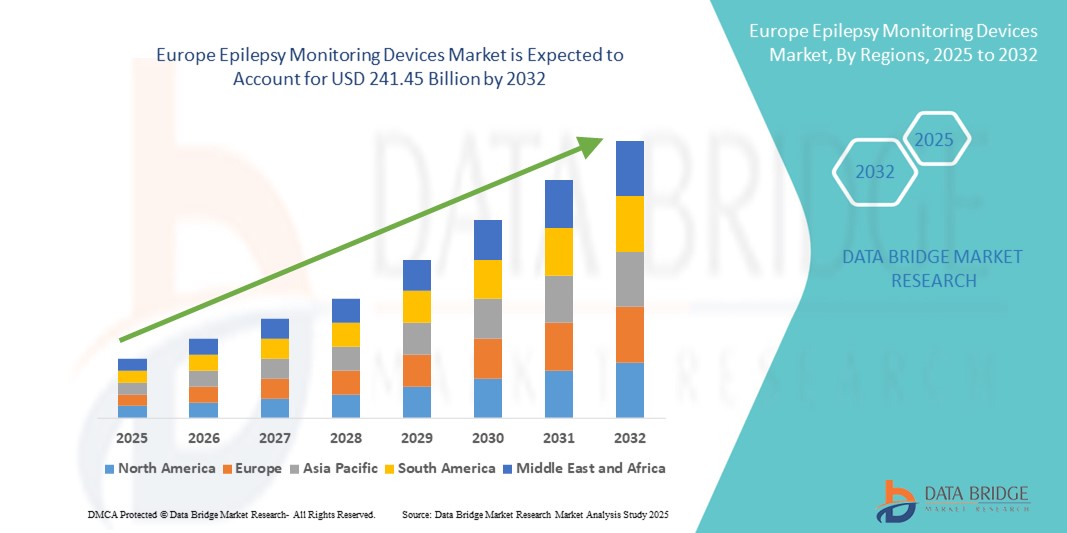
- The Europe epilepsy monitoring devices market size was valued at USD 158.52 billion in 2024 and is expected to reach USD 241.45 billion by 2032, at a CAGR of 5.40% during the forecast period
- The market growth is primarily driven by increasing prevalence of epilepsy, growing awareness for early diagnosis, and advancements in neurological monitoring technologies across hospitals and specialized epilepsy centers
- In addition, rising demand for precise, real-time, and non-invasive monitoring solutions for both adult and pediatric patients is positioning epilepsy monitoring devices as essential tools in effective patient management. These factors collectively are accelerating the adoption of advanced monitoring systems, thereby significantly contributing to market expansion
Europe Epilepsy Monitoring Devices Market Analysis
- Epilepsy monitoring devices, providing continuous or ambulatory monitoring for seizure activity, are increasingly vital components of modern neurology care in both hospitals and home settings due to their accuracy, real-time data capture, and seamless integration with diagnostic and telemedicine platforms
- The escalating demand for epilepsy monitoring devices is primarily fueled by the increasing prevalence of epilepsy, growing awareness among healthcare professionals and patients, and a rising preference for reliable, non-invasive, and easy-to-use monitoring solutions for both adults and pediatric patients
- Germany dominated the Europe epilepsy monitoring devices market with the largest revenue share of 29.5% in 2024, characterized by advanced healthcare infrastructure, strong presence of leading device manufacturers, and hospitals and specialized epilepsy centers investing heavily in advanced monitoring systems
- Poland is expected to be the fastest-growing country in the Europe epilepsy monitoring devices market during the forecast period, driven by improving healthcare infrastructure, increasing accessibility to advanced monitoring devices, and rising investments in neurological care
- Wearable devices dominated the Europe epilepsy monitoring devices market with a market share of 43% in 2024, driven by their portability, real-time monitoring capabilities, and growing integration with mobile apps and smart health platforms, making them the preferred choice for continuous seizure monitoring
Report Scope and Europe Epilepsy Monitoring Devices Market Segmentation
|
Attributes |
Europe Epilepsy Monitoring Devices Key Market Insights |
|
Segments Covered |
|
|
Countries Covered |
Europe
|
|
Key Market Players |
|
|
Market Opportunities |
|
|
Value Added Data Infosets |
In addition to the insights on market scenarios such as market value, growth rate, segmentation, geographical coverage, and major players, the market reports curated by the Data Bridge Market Research also include in-depth expert analysis, pricing analysis, brand share analysis, consumer survey, demography analysis, supply chain analysis, value chain analysis, raw material/consumables overview, vendor selection criteria, PESTLE Analysis, Porter Analysis, and regulatory framework. |
Europe Epilepsy Monitoring Devices Market Trends
Advancement in Wearable and AI-Enabled Monitoring Devices
- A significant and accelerating trend in the Europe epilepsy monitoring devices market is the adoption of wearable devices integrated with artificial intelligence (AI) and cloud-based platforms, enabling continuous, real-time seizure monitoring both in hospitals and homecare settings
- For instance, wearable EEG headbands and smart patches allow seamless monitoring of seizure activity while patients perform daily activities. Devices such as EmbracePlus and NeuroView provide real-time alerts and automated data logging for clinical review
- AI integration in these devices enables predictive analytics, seizure pattern recognition, and automated alert systems, allowing clinicians to optimize treatment plans and provide timely interventions. Some advanced systems can detect subtle pre-seizure signals and notify caregivers or healthcare providers
- The seamless integration of epilepsy monitoring devices with mobile apps and telemedicine platforms allows centralized tracking of patient data, enabling neurologists to manage multiple patients efficiently and remotely
- This trend toward intelligent, connected, and patient-friendly monitoring systems is reshaping expectations for epilepsy care. Companies such as Neuroelectrics are developing AI-enabled devices that combine continuous EEG monitoring with cloud analytics to enhance clinical decision-making
- The demand for wearable, AI-integrated monitoring devices is increasing rapidly across hospitals, neurology centers, and homecare settings, driven by the need for accurate diagnosis, personalized care, and remote patient management
Europe Epilepsy Monitoring Devices Market Dynamics
Driver
Rising Prevalence of Epilepsy and Need for Accurate Monitoring
- The increasing incidence of epilepsy across Europe and the need for precise, continuous monitoring is a significant driver of demand for epilepsy monitoring devices
- For instance, in 2024, hospitals in Germany and France expanded their neurology departments with advanced ambulatory and video-EEG monitoring solutions to address growing patient loads
- As healthcare providers seek improved diagnosis, treatment planning, and long-term patient management, epilepsy monitoring devices offer capabilities such as continuous EEG recording, real-time alerts, and integration with patient management platforms
- The growing awareness among clinicians and caregivers about early intervention benefits and personalized care is making these devices an integral part of treatment strategies
- Ease of use, portability, and remote monitoring features for adults and pediatric patients are key factors accelerating adoption in both clinical and homecare settings
Restraint/Challenge
High Cost and Regulatory Compliance Barriers
- The relatively high cost of advanced epilepsy monitoring devices, especially wearable and AI-enabled systems, can limit adoption in budget-sensitive hospitals or homecare settings
- Complex regulatory requirements for medical devices in Europe, including CE certification and adherence to MDR guidelines, pose challenges for manufacturers aiming to launch new products quickly
- In addition, concerns regarding data privacy and secure handling of patient EEG records may slow the uptake of connected monitoring solutions. For instance, in 2023, a major GDPR compliance audit delayed the launch of an AI-enabled wearable EEG device in France, highlighting regulatory hurdles for manufacturers
- Companies such as Neuroelectrics and Natus emphasize secure cloud platforms, encrypted data storage, and compliance with GDPR to build trust
- While prices are gradually decreasing for basic monitoring devices, advanced systems with AI capabilities, multi-channel EEG, and telemedicine integration still carry a premium, potentially limiting widespread adoption
- Overcoming these challenges through cost optimization, regulatory compliance strategies, and secure, user-friendly device designs will be vital for sustained growth in the Europe epilepsy monitoring devices market.
Europe Epilepsy Monitoring Devices Market Scope
The market is segmented on the basis of product type, type of seizure, patient type, end user, and distribution channel.
- By Product Type
On the basis of product type, the Europe epilepsy monitoring devices market is segmented into wearable devices, smart devices, and conventional devices. The wearable devices segment dominated the market with the largest revenue share of 43% in 2024, driven by its portability, real-time monitoring capabilities, and seamless integration with mobile applications and telemedicine platforms. Wearable devices allow patients to continue their daily activities while their neurological data is continuously recorded, improving overall quality of care. Hospitals and neurology centers are increasingly investing in wearable EEG systems for accurate diagnosis and long-term patient monitoring. These devices also provide caregivers with instant alerts in case of seizures, enhancing patient safety. Furthermore, wearable devices are widely adopted in homecare settings, enabling remote supervision and reducing the need for frequent hospital visits.
The smart devices segment is expected to witness the fastest CAGR of 19.8% from 2025 to 2032, driven by AI integration, cloud analytics, and predictive seizure detection features, which make them ideal for both clinical and home-based monitoring solutions. Smart devices offer advanced functionalities such as automated reporting, multi-channel EEG analysis, and telemedicine connectivity, which improve clinical decision-making and patient outcomes.
- By Type
On the basis of seizure type, the Europe epilepsy monitoring devices market is segmented into focal seizures and generalized seizures. The generalized seizures segment dominated with a market share of 55.3% in 2024, due to the higher prevalence of generalized epilepsy cases in Europe and the critical need for continuous monitoring for accurate diagnosis and treatment planning. Devices for generalized seizures provide automated alerts, allowing caregivers and clinicians to respond immediately to seizure events. They also enable long-term data collection, which supports the optimization of antiepileptic therapy. Integration with cloud platforms allows neurologists to remotely access patient data and track seizure patterns over time.
The focal seizures segment is expected to witness the fastest growth, driven by rising awareness of partial seizures, increasing adoption of advanced EEG mapping technologies, and the need for precise treatment planning. Specialized devices for focal seizures allow clinicians to capture localized neurological activity and improve patient outcomes in both hospital and homecare settings. There is a growing need for specialized devices that allow accurate localization of neurological activity, which aids in precise treatment planning.
- By Patient Type
On the basis of patient type, the Europe epilepsy monitoring devices market is segmented into paediatric, geriatric, and adults. The adult patient segment dominated the market with a revenue share of 48.7% in 2024, supported by the larger adult patient population and growing adoption of home-based monitoring solutions. Adults benefit from wearable and smart devices that provide continuous monitoring, automated data logging, and integration with telemedicine platforms for improved treatment outcomes. The devices reduce hospital visits and allow physicians to monitor long-term therapy effectiveness. Patient independence and convenience are further enhanced, making these devices highly preferred.
The paediatric segment is expected to witness the fastest growth, driven by increasing awareness among caregivers, rising prevalence of epilepsy in children, and the demand for non-invasive, child-friendly monitoring solutions. These devices ensure safety, comfort, and early intervention for pediatric patients, encouraging adoption in hospitals, neurology centers, and homecare environments. There is a growing need for non-invasive and child-friendly devices that ensure comfort and safety during use. These devices enable early detection of seizures and timely intervention, improving treatment outcomes and reducing hospital visits.
- By End User
On the basis of end user, the Europe epilepsy monitoring devices market is segmented into hospitals, homecare settings, neurology centers, diagnostic centers, ambulatory surgical centers & clinics, and others. The hospitals segment dominated with a market share of 50.2% in 2024, driven by advanced infrastructure, specialized staff, and the ability to conduct multi-channel, long-duration EEG monitoring. Hospitals are the primary purchasers of complex epilepsy monitoring devices and invest heavily in integration with hospital information systems for better patient management. They also handle severe and complex cases that require continuous monitoring. Neurology centers and diagnostic centers are increasingly adopting portable and smart solutions to supplement hospital-based monitoring.
The homecare settings segment is expected to witness the fastest growth in the Europe epilepsy monitoring devices market. This growth is fueled by the increasing adoption of telemonitoring solutions that allow patients to be continuously observed without visiting hospitals. Wearable devices play a major role by capturing real-time EEG data and transmitting it to caregivers and clinicians remotely. Patients and caregivers are increasingly preferring home-based monitoring for its convenience, comfort, and reduced disruption to daily life.
- By Distribution Channel
On the basis of distribution channel, the Europe epilepsy monitoring devices market is segmented into retail sales, online sales, direct tenders, and others. The direct tenders segment dominated with a market share of 46.8% in 2024, primarily driven by bulk procurement by hospitals, neurology centers, and government healthcare facilities. Direct tenders allow institutions to efficiently acquire high-end devices and often include maintenance and support services. Hospitals and large clinics prefer direct procurement to ensure device standardization and reliable post-sale service.
The online sales segment is expected to witness the fastest growth, supported by increased digital adoption, telemedicine platforms, and doorstep delivery of wearable and smart monitoring devices. Online distribution expands accessibility to individual patients and smaller clinics while offering competitive pricing and flexible payment options. Rising awareness among patients and caregivers about home-based monitoring solutions is accelerating online sales across Europe, making this channel increasingly important.
Europe Epilepsy Monitoring Devices Market Regional Analysis
- Germany dominated the Europe epilepsy monitoring devices market with the largest revenue share of 29.5% in 2024, characterized by advanced healthcare infrastructure, strong presence of leading device manufacturers, and hospitals and specialized epilepsy centers investing heavily in advanced monitoring systems
- Healthcare providers and hospitals in Germany are increasingly investing in wearable and smart epilepsy monitoring devices to improve diagnostic accuracy and patient management. Continuous EEG monitoring, AI-enabled predictive features, and telemedicine integration are widely utilized to enhance care for both adults and pediatric patients
- The widespread adoption is further supported by rising awareness among caregivers and clinicians about epilepsy management, strong government support for healthcare technology adoption, and well-developed reimbursement frameworks for advanced diagnostic equipment. This makes Germany a key market within Europe for epilepsy monitoring devices, both in hospital and homecare settings
The Germany Epilepsy Monitoring Devices Market Insight
The Germany dominates the Europe epilepsy monitoring devices market with the largest revenue share in 2024, fueled by advanced healthcare infrastructure, widespread adoption of technologically sophisticated devices, and high patient awareness. Hospitals and neurology centers in Germany are increasingly integrating wearable and smart monitoring solutions into clinical workflows to improve diagnosis and treatment outcomes. Continuous EEG monitoring, AI-enabled seizure prediction, and telemedicine platforms are being widely used to enhance patient care. The country’s strong emphasis on innovation and quality healthcare services drives demand for precision monitoring devices for both adults and pediatric patients.
France Epilepsy Monitoring Devices Market Insight
The France epilepsy monitoring devices market is anticipated to grow steadily during the forecast period, driven by rising epilepsy prevalence and increasing awareness of remote monitoring solutions. Hospitals and specialized neurology centers are adopting wearable and smart devices to improve patient management and reduce hospital stay durations. French healthcare providers are focusing on early seizure detection, continuous monitoring, and integration with telemedicine platforms for both adult and pediatric patients. Homecare adoption is also expanding, supported by increasing caregiver awareness and patient preference for convenient monitoring solutions.
U.K. Epilepsy Monitoring Devices Market Insight
The U.K. epilepsy monitoring devices market is expected to grow at a notable CAGR during the forecast period, driven by the growing trend of homecare monitoring and rising demand for advanced hospital-based solutions. Consumers and healthcare providers are increasingly prioritizing continuous monitoring, early seizure detection, and AI-assisted analysis. The adoption of wearable and smart devices for both adults and children is accelerating, particularly in homecare and outpatient settings. Telemedicine integration and user-friendly mobile applications are making monitoring more accessible and convenient for patients and caregivers. Concerns regarding seizure management and patient safety are motivating hospitals and clinics to deploy advanced devices.
Italy Epilepsy Monitoring Devices Market Insight
The Italy epilepsy monitoring devices market is poised to expand at a steady CAGR, driven by increasing awareness of epilepsy management and the demand for technologically advanced monitoring solutions. Hospitals and neurology centers are adopting wearable and smart devices that provide continuous monitoring, automated alerts, and integration with telemedicine platforms. Patient preference for home-based monitoring is rising, allowing caregivers to supervise seizures remotely and reducing the need for hospital visits. Government support and reimbursement policies further facilitate adoption of these devices in both urban and semi-urban regions.
Poland Epilepsy Monitoring Devices Market Insight
The Poland is emerging as the fastest-growing market for epilepsy monitoring devices in Europe, driven by increasing awareness of epilepsy management, rising healthcare expenditure, and the adoption of modern monitoring technologies. Hospitals, neurology centers, and homecare providers are rapidly deploying wearable and smart devices to improve patient care and facilitate remote monitoring. The government is actively supporting digital health initiatives and providing reimbursement frameworks to accelerate adoption. Telemedicine platforms and AI-enabled seizure prediction features are becoming widely used in both hospital and homecare settings.
Europe Epilepsy Monitoring Devices Market Share
The Europe Epilepsy Monitoring Devices industry is primarily led by well-established companies, including:
- Nihon Kohden Corporation (Japan)
- Medtronic (Ireland)
- Masimo Corporation (U.S.)
- Compumedics Limited (Australia)
- LivaNova PLC (U.K.)
- Boston Scientific Corporation (U.S.)
- Cadwell Laboratories, Inc. (U.S.)
- Emfit Ltd. (Finland)
- Empatica Inc. (U.S.)
- GE Healthcare (U.S.)
- Koninklijke Philips N.V. (Netherlands)
- Neurosoft Ltd. (Russia)
- Neurowave Systems (U.S.)
- Nonin Medical, Inc. (U.S.)
- Natus Medical Incorporated (U.S.)
- NeuroPace, Inc. (U.S.)
- Seer Medical (Australia)
- SeizAlarm LLC (U.S.)
- BrainScope Company, Inc. (U.S.)
- Ceribell, Inc. (U.S.)
What are the Recent Developments in Europe Epilepsy Monitoring Devices Market?
- In August 2025, research from King's College London and Mayo Clinic revealed that a subcutaneous EEG device is effective for ultra-long-term epilepsy monitoring. The device, placed under the scalp, demonstrated feasibility and clinical utility in a 15-month prospective study
- In August 2025, AIIMS Nagpur launched Tele-ESSI, a mobile application aimed at transforming the lives of children with epilepsy in India. Developed in collaboration with the Indian Council of Medical Research, the app provides teachers, parents, and healthcare workers with tools to identify and manage seizures, promoting safer and more inclusive school environments
- In April 2025, the U.S. FDA granted De Novo authorization to Epiminder’s Minder, an implantable continuous EEG monitoring system for epilepsy patients. This marks the first device of its kind approved in the U.S. A phased rollout is planned for the second half of 2025 at leading epilepsy centers
- In April 2025, the FDA cleared EpiWatch, an Apple Watch-based app for seizure monitoring. Developed in collaboration with Johns Hopkins Medicine, the app offers features such as medication reminders, seizure trigger tracking, and mental health screening, enhancing remote patient monitoring for individuals with epilepsy
- In March 2024, Empatica launched EpiMonitor, an FDA-cleared wearable device for seizure detection in individuals aged 6 and up. Serving as the successor to Embrace2, EpiMonitor is the only wearable solution with regulatory clearance for seizure detection available for purchase in the U.S.

- Interactive Data Analysis Dashboard
- Company Analysis Dashboard for high growth potential opportunities
- Research Analyst Access for customization & queries
- Competitor Analysis with Interactive dashboard
- Latest News, Updates & Trend analysis
- Harness the Power of Benchmark Analysis for Comprehensive Competitor Tracking
Data collection and base year analysis are done using data collection modules with large sample sizes. The stage includes obtaining market information or related data through various sources and strategies. It includes examining and planning all the data acquired from the past in advance. It likewise envelops the examination of information inconsistencies seen across different information sources. The market data is analysed and estimated using market statistical and coherent models. Also, market share analysis and key trend analysis are the major success factors in the market report. To know more, please request an analyst call or drop down your inquiry.
The key research methodology used by DBMR research team is data triangulation which involves data mining, analysis of the impact of data variables on the market and primary (industry expert) validation. Data models include Vendor Positioning Grid, Market Time Line Analysis, Market Overview and Guide, Company Positioning Grid, Patent Analysis, Pricing Analysis, Company Market Share Analysis, Standards of Measurement, Global versus Regional and Vendor Share Analysis. To know more about the research methodology, drop in an inquiry to speak to our industry experts.
Data Bridge Market Research is a leader in advanced formative research. We take pride in servicing our existing and new customers with data and analysis that match and suits their goal. The report can be customized to include price trend analysis of target brands understanding the market for additional countries (ask for the list of countries), clinical trial results data, literature review, refurbished market and product base analysis. Market analysis of target competitors can be analyzed from technology-based analysis to market portfolio strategies. We can add as many competitors that you require data about in the format and data style you are looking for. Our team of analysts can also provide you data in crude raw excel files pivot tables (Fact book) or can assist you in creating presentations from the data sets available in the report.













