


What is the Europe Espresso Coffee Market Size and Growth Rate?
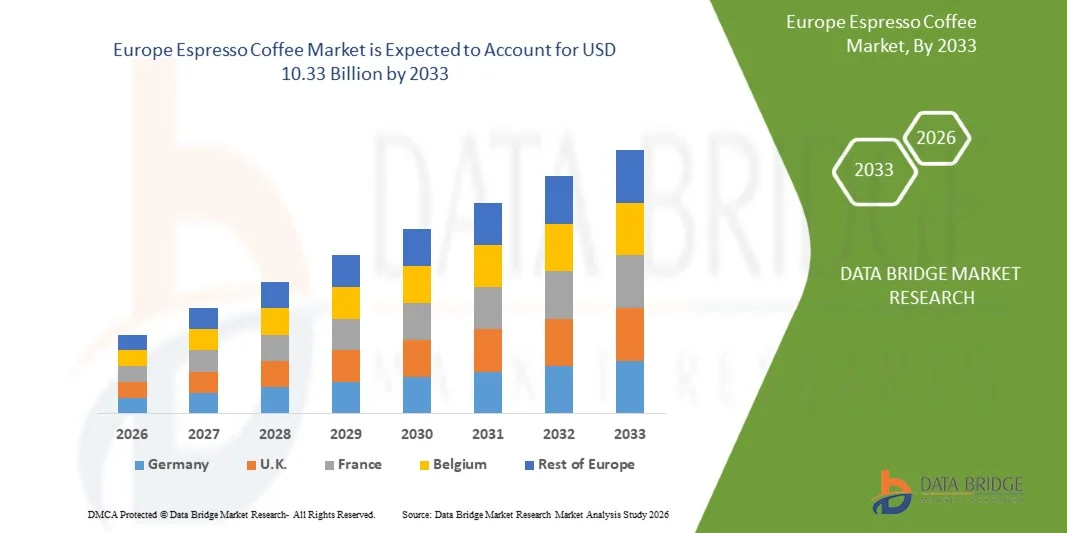
- As per Data Bridge Market Research analysis, the Europe espresso coffee market was valued at USD 7.77 Billion in 2025 and is projected to reach USD 10.33 Billion by 2033, growing at a CAGR of 3.63% from 2026 to 2033.
- The market is experiencing steady growth driven by Europe's deeply embedded café culture, high daily coffee consumption rates, and continued household adoption of capsule and pod-based espresso systems that make café-style beverages accessible at home.
- Rising consumer interest in specialty, single-origin, and traceable espresso offerings, combined with continued innovation in machine and packaging formats, is further shaping the competitive landscape even as elevated green coffee prices and tightening sustainability regulations reshape sourcing strategies across the region.
Market Size & Forecast
- Europe Market Value (2025): USD 7.77 Billion
- Expected Market Value (2033): USD 10.33 Billion
- Forecast CAGR (2026–2033): 3.63%
- Leading Country in 2025: Germany
- Fastest Growing Country: France
What are the Major Takeaways of the Europe Espresso Coffee Market?
- Germany dominated the Europe espresso coffee market with the largest revenue share of 26.50% in 2025, supported by its dual position as one of Europe's largest coffee importers and roasting hubs alongside strong household consumption of espresso and capsule systems.
- France is expected to be the fastest-growing country at a CAGR of 4.80% from 2026 to 2033, fueled by rapidly expanding specialty coffee culture and growing consumer interest in premium, café-quality espresso experiences at home.
- The classic espresso segment led the market with a 54.00% share in 2025, reflecting its status as the foundational preparation from which all other espresso-based drinks are derived.
- Mocha is the fastest-growing type segment, projected to register a CAGR of 4.17%, reflecting rising popularity of espresso-chocolate hybrid beverages among younger consumers.
- The Arabica beans segment dominated the market with a 60.60% revenue share in 2025, supported by its smoother flavor profile and strong association with premium espresso positioning.
- The supermarkets & hypermarkets distribution channel accounted for 40.70% of the market share in 2025, supported by its versatility for at-home espresso and ground coffee purchases.
- The offices end-user segment is the fastest-growing category, with a CAGR of 5.40%, driven by rising corporate investment in premium in-office espresso systems.
Report Scope and Europe Espresso Coffee Market Segmentation
|
Attributes |
Europe Espresso Coffee Key Market Insights |
|
Segments Covered |
|
|
Countries Covered |
|
|
Key Market Players |
|
|
Market Opportunities |
|
|
Value Added Data Infosets |
In addition to the insights on market scenarios such as market value, growth rate, segmentation, geographical coverage, and major players, the market reports curated by the Data Bridge Market Research also include in-depth expert analysis, pricing analysis, brand share analysis, consumer survey, demography analysis, supply chain analysis, value chain analysis, raw material/consumables overview, vendor selection criteria, PESTLE Analysis, Porter Analysis, and regulatory framework. |
What is the Key Trend in the Europe Espresso Coffee Market?
- Leading roasters are increasingly launching next-generation single-serve formats designed to eliminate the plastic and aluminum packaging traditionally associated with capsule-based espresso systems.
- For instance, in August 2026, Lavazza officially launched Tablì, a single-serve espresso system using compressed coffee tabs with no plastic casing, wrapping, or coating, following a successful initial rollout in Italy, where the accompanying machine retails for approximately EUR 249.99.
- Retailers across the region are also reporting a structural shift in purchasing behavior as consumers respond to sustained cost pressure on branded espresso and ground coffee products.
- For instance, private-label espresso and ground coffee products continued to gain shelf share at major European retailers including Aldi, Lidl, and Carrefour through 2026, as consumers traded down from premium branded stock-keeping units amid persistently elevated retail coffee prices.
- As sustainability expectations and price sensitivity continue to shape purchasing decisions, manufacturers are expected to expand plastic-free packaging formats and value-tier offerings, reinforcing format innovation as a core market trend.
What are the Key Drivers of the Europe Espresso Coffee Market?
- Europe's deeply embedded coffee-drinking culture and consistently high daily consumption rates continue to provide a stable, recurring demand base for espresso-based beverages across both retail and foodservice channels.
- For instance, according to the European Coffee Federation, more than 70% of Europeans consume coffee on a daily basis, with Germany alone accounting for approximately a quarter of total European coffee consumption, underscoring the scale of the region's underlying demand base.
- Rising national-level investment in coffee roasting, import infrastructure, and premium product development is reinforcing certain markets' positions as both consumption leaders and structural growth engines for the broader region.
- For instance, Germany continued to hold the largest share of the broader European coffee market at approximately 15.96% in 2025 while simultaneously recording the region's highest growth rate, reflecting its effective integration of traditional consumption patterns with emerging specialty and sustainable product trends.
- With café culture continuing to expand and premium, specialty-grade espresso gaining traction among younger consumers, sustained demand across both at-home and out-of-home channels is expected to remain a key growth driver for the market.
Which Factors are Challenging the Growth of the Europe Espresso Coffee Market?
- Volatile green coffee futures prices, driven by weather-related supply disruptions in major growing regions, continue to squeeze margins for roasters and foodservice operators across Europe.
- For instance, in April 2026, major European coffee chains including Starbucks, Costa Coffee, Nespresso, and Lavazza adjusted menu pricing and portion sizes after Arabica futures remained elevated following weather-driven supply stress in Brazil and Vietnam, with retail ground coffee prices across the EU staying well above 2024 averages.
- Tightening European Union sustainability and traceability regulations are requiring substantial compliance investment from roasters sourcing green coffee from deforestation-risk regions.
- For instance, through March 2026, the EU Deforestation Regulation continued to reshape European coffee sourcing as large roasters including Nestlé, JDE Peet's, and Tchibo accelerated investment in traceability systems, geolocation tagging, and supplier due diligence ahead of compliance obligations taking effect in late 2026.
- The combination of volatile input costs, tightening deforestation-related compliance obligations, and continued consumer trade-down toward private-label products continues to pressure margins across the value chain despite resilient underlying consumption demand.
How is the Europe Espresso Coffee Market Segmented?
The Europe espresso coffee market is segmented on the basis of type, beans, roast level, distribution channel, end user, packaging type, machine compatibility, product grade, price tier, and sales channel.
- By Type
On the basis of type, the Europe espresso coffee market is segmented into espresso (classic), ristretto, lungo, macchiato, and mocha. The classic espresso segment dominated the market with a 54.00% share in 2025, reflecting its status as the foundational preparation from which all other espresso-based drinks are derived and its deep cultural roots across Southern and Central Europe.
The mocha segment is projected to register the fastest growth at a CAGR of 4.17% from 2026 to 2033, driven by rising popularity of espresso-chocolate hybrid beverages among younger consumers seeking indulgent, café-style drinks both in coffee shops and at home.
- By Beans
On the basis of beans, the Europe espresso coffee market is segmented into Arabica, Robusta, and Arabica-Robusta blend. The Arabica segment dominated the market with a 60.60% share in 2025, supported by its smoother flavor profile, lower acidity, and strong association with premium and specialty espresso positioning across European cafés and roasters.
The Robusta segment is expected to witness the fastest CAGR of 4.40% from 2026 to 2033, driven by its higher caffeine content and crema-enhancing properties, which continue to appeal to traditional Italian-style espresso blends, alongside its relative cost advantage amid elevated Arabica prices.
- By Roast Level
On the basis of roast level, the Europe espresso coffee market is segmented into light roast, medium roast, dark roast, and medium-dark roast. The dark roast segment dominated the market with a 42.00% share in 2025, reflecting its long-standing association with traditional Italian espresso preparation and its ability to deliver a bold, full-bodied cup with a thick crema.
The light roast segment is projected to witness the fastest CAGR of 4.90% from 2026 to 2033, driven by growing specialty coffee culture and rising consumer interest in origin-forward, single-estate espresso profiles that highlight bean-specific flavor notes.
- By Distribution Channel
On the basis of distribution channel, the Europe espresso coffee market is segmented into supermarkets & hypermarkets, specialty coffee stores, online retail, and HoReCa. The supermarkets & hypermarkets segment dominated the market with a 40.70% share in 2025, supported by its versatility and widespread use for at-home espresso and ground coffee purchases across European households.
The online retail segment is expected to witness the fastest CAGR of 6.20% from 2026 to 2033, driven by growing direct-to-consumer subscription models from specialty roasters and increasing digital comfort with recurring coffee and capsule purchases.
- By End User
On the basis of end user, the Europe espresso coffee market is segmented into cafes & restaurants, households, offices, and hotels. The cafes & restaurants segment dominated the market with a 33.60% share in 2025, reflecting Europe's deeply embedded café culture and the continued central role of espresso-based beverages in the region's foodservice and hospitality sectors.
The offices segment is anticipated to witness the fastest CAGR of 5.40% from 2026 to 2033, driven by rising corporate investment in premium in-office espresso machines and capsule systems as an employee wellbeing and retention benefit.
- By Packaging Type
On the basis of packaging type, the Europe espresso coffee market is segmented into capsules & pods, ground coffee bags, whole bean bags, and cans/tins. The capsules & pods segment dominated the market with a 38.00% share in 2025, driven by strong European household penetration of single-serve espresso systems and continued innovation from leading capsule brands.
The whole bean bags segment is projected to witness the fastest CAGR of 6.10% from 2026 to 2033, driven by rising consumer interest in home grinding and the freshness and customization benefits associated with whole bean espresso preparation.
- By Machine Compatibility
On the basis of machine compatibility, the Europe espresso coffee market is segmented into manual/semi-automatic espresso machines, fully automatic espresso machines, capsule/pod machines, and traditional moka/stovetop. The capsule/pod machines segment dominated the market with a 36.00% share in 2025, supported by their convenience, consistency, and broad household adoption across the region.
The fully automatic espresso machines segment is expected to witness the fastest CAGR of 6.80% from 2026 to 2033, driven by rising consumer willingness to invest in premium, bean-to-cup home espresso systems that replicate café-quality output.
- By Product Grade
On the basis of product grade, the Europe espresso coffee market is segmented into standard/commercial grade, premium/specialty grade, and organic/certified grade. The standard/commercial grade segment dominated the market with a 57.00% share in 2025, reflecting its continued mainstream affordability and widespread availability across supermarket and foodservice channels.
The premium/specialty grade segment is anticipated to witness the fastest CAGR of 7.30% from 2026 to 2033, driven by rising consumer interest in single-origin, traceable, and higher-quality espresso offerings.
- By Price Tier
On the basis of price tier, the Europe espresso coffee market is segmented into mass/economy, mid-range, and premium/specialty. The mid-range segment dominated the market with a 44.00% share in 2025, offering a practical balance between quality, brand recognition, and affordability for mainstream European consumers.
The premium/specialty segment is projected to witness the fastest CAGR of 6.90% from 2026 to 2033, driven by rising consumer willingness to pay for elevated, traceable, and origin-specific espresso experiences.
- By Sales Channel
On the basis of sales channel, the Europe espresso coffee market is segmented into retail/off-trade and on-trade/foodservice. The retail/off-trade segment dominated the market with a 62.00% share in 2025, driven by strong at-home espresso consumption habits and high household penetration of capsule and pod-based brewing systems across the region.
The on-trade/foodservice segment is expected to witness the fastest CAGR of 5.60% from 2026 to 2033, supported by continued recovery and expansion of café and restaurant foodservice volumes across major European markets.
Which Country Holds the Largest Share of the Europe Espresso Coffee Market?
- Germany dominated the Europe espresso coffee market and accounted for the largest revenue share of 26.50% in 2025, supported by its dual position as one of Europe's largest coffee importers and domestic roasting hubs alongside strong household consumption of espresso and capsule-based systems.
- The country also benefits from a well-developed retail and specialty coffee infrastructure and rising demand for premium and sustainably sourced espresso products, which continues to reinforce Germany's leadership position within the regional market.
Germany Espresso Coffee Market Insight
The Germany espresso coffee market is experiencing steady growth, supported by the country's dual role as a major coffee import and roasting hub and strong household adoption of capsule and pod-based espresso systems. Leading domestic roasters, including Tchibo, Melitta, and Dallmayr, continue to expand premium and specialty product lines to meet evolving consumer preferences. Growing investment in sustainable sourcing and traceability is further shaping market development in Germany.
Italy Espresso Coffee Market Insight
The Italy espresso coffee market remains the cultural and commercial heart of the region's espresso tradition, supported by an extensive domestic roasting industry and deeply rooted café culture. Domestic brands including Lavazza, Illycaffè, and Caffè Vergnano continue to drive product innovation, from plastic-free single-serve formats to premium single-origin blends, while a growing appetite for specialty coffee among younger consumers is gradually expanding beyond the traditional espresso format.
France Espresso Coffee Market Insight
The France espresso coffee market is expected to witness the fastest growth in the region, driven by rapidly expanding specialty coffee culture and rising consumer interest in premium, café-quality espresso experiences at home. Growing numbers of independent specialty roasters and rising urban café density continue to support strong market expansion across the country.
U.K. Espresso Coffee Market Insight
The U.K. espresso coffee market is witnessing consistent growth, supported by a well-established café culture and strong consumer demand for both out-of-home and at-home espresso-based beverages. Leading operators, including Costa Limited, continue to expand product offerings, while growing interest in specialty and sustainably sourced coffee is further shaping consumer preferences in the U.K.
Poland Espresso Coffee Market Insight
The Poland espresso coffee market is growing steadily, supported by rising disposable incomes and rapidly expanding café culture across major urban centers. Growing consumer interest in specialty coffee and premium espresso formats, combined with expanding retail and online distribution infrastructure, continues to support strong market growth in Poland.
Which are the Top Companies in Europe Espresso Coffee Market?
The Europe espresso coffee industry is primarily led by well-established companies, including:
- Luigi Lavazza S.p.A. (Italy)
- Nestlé S.A. (Nespresso) (Switzerland)
- JDE Peet's N.V. (Netherlands)
- Tchibo GmbH (Germany)
- Illycaffè S.p.A. (Italy)
- Melitta Group (Germany)
- Massimo Zanetti Beverage Group S.p.A. (Italy)
- Julius Meinl (Austria)
- Costa Limited (U.K.)
- Löfbergs (Sweden)
- Paulig Group (Finland)
- Caffè Vergnano S.p.A. (Italy)
- Alois Dallmayr KG (Germany)
- De'Longhi S.p.A. (Italy)
- La Marzocco S.r.l. (Italy)
What are Latest Developments in Europe Espresso Coffee Market?
- In August 2026, Lavazza officially launched Tablì in international markets, a single-serve espresso system using compressed coffee tabs with no plastic casing, wrapping, or coating, following a successful initial rollout in Italy and strong pre-order demand ahead of its wider release.
- Through March 2026, the EU Deforestation Regulation continued to reshape European coffee sourcing as large roasters including Nestlé, JDE Peet's, and Tchibo accelerated investment in traceability systems, geolocation tagging, and supplier due diligence ahead of compliance obligations taking effect in late 2026.
- In April 2026, major European coffee chains including Starbucks, Costa Coffee, Nespresso, and Lavazza adjusted menu pricing and portion sizes after Arabica futures remained elevated following weather-driven supply stress in Brazil and Vietnam.
- Through 2026, private-label espresso and ground coffee products continued to gain shelf share at major European retailers including Aldi, Lidl, and Carrefour, as consumers traded down from premium branded stock-keeping units amid sustained retail price pressure.
- Throughout 2025, Illycaffè continued to expand its specialty single-origin espresso lines within the Italian market, reflecting rising interest in traceable, origin-specific coffee even within Italy's traditionally standardized espresso blending culture.

- Interactive Data Analysis Dashboard
- Company Analysis Dashboard for high growth potential opportunities
- Research Analyst Access for customization & queries
- Competitor Analysis with Interactive dashboard
- Latest News, Updates & Trend analysis
- Harness the Power of Benchmark Analysis for Comprehensive Competitor Tracking
Europe Espresso Coffee Market, Supply Chain Analysis and Ecosystem Framework
To support market growth and help clients navigate the impact of geopolitical shifts, DBMR has integrated in-depth supply chain analysis into its Europe Espresso Coffee Market research reports. This addition empowers clients to respond effectively to global changes affecting their industries. The supply chain analysis section includes detailed insights such as Europe Espresso Coffee Market consumption and production by country, price trend analysis, the impact of tariffs and geopolitical developments, and import and export trends by country and HSN code. It also highlights major suppliers with data on production capacity and company profiles, as well as key importers and exporters. In addition to research, DBMR offers specialized supply chain consulting services backed by over a decade of experience, providing solutions like supplier discovery, supplier risk assessment, price trend analysis, impact evaluation of inflation and trade route changes, and comprehensive market trend analysis.
Data collection and base year analysis are done using data collection modules with large sample sizes. The stage includes obtaining market information or related data through various sources and strategies. It includes examining and planning all the data acquired from the past in advance. It likewise envelops the examination of information inconsistencies seen across different information sources. The market data is analysed and estimated using market statistical and coherent models. Also, market share analysis and key trend analysis are the major success factors in the market report. To know more, please request an analyst call or drop down your inquiry.
The key research methodology used by DBMR research team is data triangulation which involves data mining, analysis of the impact of data variables on the market and primary (industry expert) validation. Data models include Vendor Positioning Grid, Market Time Line Analysis, Market Overview and Guide, Company Positioning Grid, Patent Analysis, Pricing Analysis, Company Market Share Analysis, Standards of Measurement, Global versus Regional and Vendor Share Analysis. To know more about the research methodology, drop in an inquiry to speak to our industry experts.
Data Bridge Market Research is a leader in advanced formative research. We take pride in servicing our existing and new customers with data and analysis that match and suits their goal. The report can be customized to include price trend analysis of target brands understanding the market for additional countries (ask for the list of countries), clinical trial results data, literature review, refurbished market and product base analysis. Market analysis of target competitors can be analyzed from technology-based analysis to market portfolio strategies. We can add as many competitors that you require data about in the format and data style you are looking for. Our team of analysts can also provide you data in crude raw excel files pivot tables (Fact book) or can assist you in creating presentations from the data sets available in the report.













