


Europe Exoskeleton Market Size
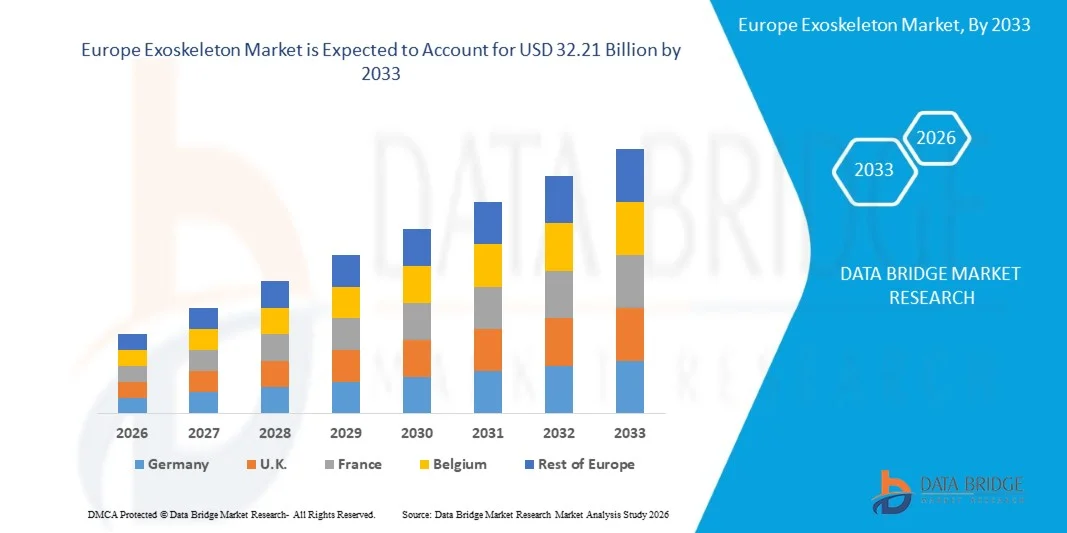
- The Europe Exoskeleton Market size was valued at USD 2.24 billion in 2025 and is expected to reach USD 32.21 billion by 2033, at a CAGR of 39.55% during the forecast period
- The market growth is largely fueled by the increasing adoption of wearable robotics and advanced rehabilitation technologies, leading to enhanced mobility, productivity, and safety across healthcare, industrial, and defense sectors
- Furthermore, rising demand for user-friendly, adaptable, and AI-enabled exoskeleton solutions is driving their adoption in clinical rehabilitation, industrial labor support, and military applications. These converging factors are accelerating the deployment of exoskeleton devices, thereby significantly boosting the industry’s growth
Europe Exoskeleton Market Analysis
- Exoskeletons are wearable robotic devices designed to support, enhance, or restore human movement and strength. These systems integrate sensors, actuators, and control algorithms to provide real-time assistance for walking, lifting, or performing repetitive tasks in medical, industrial, and defense applications
- The escalating demand for exoskeletons is primarily fueled by growing awareness of rehabilitation benefits, the need to improve worker ergonomics and safety, and advancements in AI, lightweight materials, and wearable robotics technology
- Germany dominated the Europe Exoskeleton Market in 2025, due to its strong industrial and manufacturing base, rising adoption of robotic-assisted rehabilitation in healthcare, and increasing deployment of wearable exoskeletons in automotive and logistics sectors to enhance workforce productivity and safety
- U.K. is expected to be the fastest growing country in the Europe Exoskeleton Market during the forecast period due to growing investments in rehabilitation centers, industrial automation programs, and rising adoption of wearable exoskeletons to improve workforce mobility, reduce fatigue, and support patient therapy
- Mobile segment dominated the market with a market share of 63.14% in 2025, due to its wide adoption across industrial, healthcare, and defense applications where flexibility, on-the-go assistance, and enhanced mobility are critical. Mobile exoskeletons provide users with freedom of movement, ergonomic support, and real-time load assistance, making them suitable for dynamic work environments and rehabilitation scenarios
Report Scope and Europe Exoskeleton Market Segmentation
|
Attributes |
Exoskeleton Key Market Insights |
|
Segments Covered |
|
|
Countries Covered |
Europe
|
|
Key Market Players |
|
|
Market Opportunities |
|
|
Value Added Data Infosets |
In addition to the insights on market scenarios such as market value, growth rate, segmentation, geographical coverage, and major players, the market reports curated by the Data Bridge Market Research also include in-depth expert analysis, geographically represented company-wise production and capacity, network layouts of distributors and partners, detailed and updated price trend analysis and deficit analysis of supply chain and demand. |
Europe Exoskeleton Market Trends
“Growing Adoption of AI-Enabled and Modular Exoskeletons”
- A significant trend in the Europe Exoskeleton Market is the increasing adoption of AI-powered and modular exoskeleton systems that enhance human mobility, strength, and endurance across healthcare and industrial applications. These systems provide adaptive assistance, enabling users to perform complex movements with greater efficiency and safety
- For instance, companies such as Ekso Bionics and ReWalk Robotics offer AI-enabled exoskeletons for rehabilitation and mobility assistance, allowing patients with spinal cord injuries to regain walking capabilities and perform therapeutic exercises effectively. Modular designs from these companies also support customization for industrial workers, improving ergonomic support and reducing fatigue
- The integration of sensor-driven exoskeletons is rising as advanced motion tracking, force sensors, and machine learning algorithms optimize user movement and reduce the risk of strain or injury. This trend is positioning exoskeletons as critical solutions in environments that require repetitive motion, heavy lifting, or extended physical activity
- Healthcare providers are increasingly deploying exoskeletons in rehabilitation centers to improve patient outcomes, including enhanced gait training, posture correction, and muscle strengthening. The adoption of these systems is accelerating innovations in physical therapy and patient-centered recovery programs
- Industrial and warehouse sectors are expanding exoskeleton use to support manual laborers and logistics personnel by providing lift-assist and posture support. This adoption is helping organizations minimize musculoskeletal injuries and increase productivity while complying with occupational health standards
- The market is witnessing strong growth in collaborative and wearable robotics where exoskeletons complement human labor, providing scalable solutions for both medical rehabilitation and industrial efficiency. The rising adoption of these systems is reinforcing the overall transition toward human-robot collaboration and intelligent mobility solutions
Europe Exoskeleton Market Dynamics
Driver
“Rising Demand for Rehabilitation and Industrial Mobility Solutions”
- The growing need for solutions that improve mobility for patients and support industrial workforce productivity is driving the Europe Exoskeleton Market. These systems enhance movement, reduce fatigue, and provide therapeutic benefits across clinical and workplace settings
- For instance, Ekso Bionics supplies exoskeletons that aid in spinal cord injury rehabilitation, allowing patients to perform repetitive walking exercises under controlled conditions. In industrial environments, suit systems such as those by SuitX reduce the physical strain of lifting and overhead tasks for warehouse workers, boosting operational efficiency
- The increasing prevalence of musculoskeletal disorders among industrial workers is motivating organizations to invest in wearable exoskeletons that mitigate injury risk and support ergonomics. Exoskeleton adoption contributes to both workforce safety and reduced long-term healthcare costs
- Advancements in rehabilitation technology, including robotic gait training and sensor-assisted therapy, are expanding the scope of exoskeleton applications in clinical settings. Patients benefit from consistent therapy sessions and measurable progress in mobility outcomes
- Government and healthcare initiatives focused on improving accessibility and workplace safety are supporting exoskeleton adoption. Policies that promote rehabilitation technologies and occupational safety programs strengthen market growth by incentivizing the use of supportive robotic devices
Restraint/Challenge
“High Costs and Complex Integration of Exoskeleton Systems”
- The Europe Exoskeleton Market faces challenges due to the high costs of advanced robotic systems, which include sensors, actuators, and AI software necessary for safe and effective operation. These costs restrict adoption to well-funded hospitals, research centers, and large industrial organizations
- For instance, ReWalk Robotics’ exoskeletons can cost upwards of USD 80,000, which limits affordability for smaller clinics or individual users. Integrating these systems into existing rehabilitation or industrial workflows also requires specialized training and infrastructure adjustments, adding to deployment complexity
- Developing exoskeletons with precise motion control and safety features involves extensive R&D and testing, increasing the time and financial investment for manufacturers. These factors collectively create barriers for scaling production and broad market penetration
- Maintenance and software updates of AI-enabled exoskeletons require ongoing technical support, which can strain operational budgets for healthcare facilities or industrial operators. Ensuring reliability across diverse applications remains a persistent challenge
- The market continues to encounter constraints related to the interoperability of exoskeleton systems with existing equipment and the need for user-specific customization. These challenges emphasize the importance of balancing technological sophistication with practical usability to achieve broader adoption
Europe Exoskeleton Market Scope
The market is segmented on the basis of component, mobility, type, end user, and body part.
• By Component
On the basis of component, the Europe Exoskeleton Market is segmented into hardware and software. The hardware segment dominated the largest market revenue share in 2025, driven by its critical role in providing structural support, actuation, and real-time motion assistance. Hardware components such as sensors, actuators, and wearable frames are essential for enabling precise movement and load distribution, making them indispensable for both medical rehabilitation and industrial applications. The segment benefits from ongoing innovations in lightweight materials and ergonomic designs that enhance user comfort and performance. In addition, hardware-focused solutions often incorporate advanced safety mechanisms, further boosting adoption in critical applications across healthcare and defense. The market also witnesses strong demand for hardware due to its compatibility with various software modules and control systems enhancing efficiency and usability.
The software segment is anticipated to witness the fastest growth rate from 2026 to 2033, fueled by increasing reliance on AI-driven motion algorithms and predictive analytics for optimized performance. For instance, companies such as ReWalk Robotics are developing sophisticated software that personalizes movement assistance for users, enhancing rehabilitation outcomes. Software enables seamless integration with sensors and wearable hardware, allowing real-time feedback, remote monitoring, and adaptive control in industrial and healthcare settings. The rapid development of cloud-based and mobile applications for exoskeleton control is also driving software adoption. Furthermore, software solutions facilitate data collection and analytics, supporting research, performance evaluation, and continuous product improvement. The growing demand for customized, user-friendly software applications ensures this segment will continue its high growth trajectory.
• By Mobility
On the basis of mobility, the Europe Exoskeleton Market is segmented into stationary and mobile types. The mobile types segment dominated the largest market revenue share of 63.14% in 2025, primarily driven by its wide adoption across industrial, healthcare, and defense applications where flexibility, on-the-go assistance, and enhanced mobility are critical. Mobile exoskeletons provide users with freedom of movement, ergonomic support, and real-time load assistance, making them suitable for dynamic work environments and rehabilitation scenarios. Their compatibility with wearable sensors, AI-assisted motion control, and battery-powered actuation further strengthens their market presence and user preference.
The stationary segment is expected to witness the fastest growth rate from 2026 to 2033, fueled by rising demand in clinical rehabilitation and research centers where controlled, precise motion assistance is essential. Stationary exoskeletons allow consistent therapeutic exercises, real-time monitoring, and integration with advanced diagnostic and feedback systems. For instance, rehabilitation hospitals are increasingly adopting stationary exoskeletons for stroke and spinal injury recovery programs to ensure safe and repeatable patient movement. Growing healthcare infrastructure investment and emphasis on advanced rehabilitation techniques support rapid adoption of stationary types across emerging markets.
• By Type
On the basis of type, the Europe Exoskeleton Market is segmented into powered and passive types. The powered segment dominated the largest market revenue share in 2025, driven by its ability to deliver mechanical assistance using motors, actuators, and energy-efficient control systems. Powered exoskeletons reduce physical strain, enhance endurance, and allow users to perform tasks beyond natural capabilities, making them essential in medical, industrial, and defense sectors. Their increasing adoption in rehabilitation programs, heavy-lifting operations, and military applications is supported by technological advancements in robotics and AI control systems. In addition, powered exoskeletons offer precise motion support and customization, improving user safety and productivity. Continuous investment in research and development ensures new powered designs are lightweight, ergonomic, and user-friendly.
The passive segment is anticipated to witness the fastest growth rate from 2026 to 2033, fueled by demand for low-cost, energy-free exoskeletons that provide mechanical support through springs and elastic materials. For instance, German company Ottobock has developed passive solutions for industrial workers to reduce fatigue and repetitive strain without requiring batteries or motors. Passive exoskeletons are gaining popularity in manufacturing and logistics, offering cost-effective alternatives to powered devices while ensuring ergonomic support. Their simple design and minimal maintenance requirements make them accessible to small and medium enterprises. Growing interest in sustainable, low-energy assistance devices ensures strong adoption across emerging markets.
• By End User
On the basis of end user, the Europe Exoskeleton Market is segmented into healthcare, defense/military, industrial, and others. The healthcare segment dominated the largest market revenue share in 2025, driven by the rising prevalence of mobility impairments, aging populations, and demand for advanced rehabilitation solutions. Exoskeletons assist patients recovering from stroke, spinal cord injuries, and musculoskeletal disorders by enabling repetitive, controlled motion and real-time feedback. The segment benefits from increasing hospital adoption, insurance support, and government funding for medical robotics. In addition, partnerships between device manufacturers and medical institutions ensure tailored solutions for rehabilitation and therapy. Growing awareness of the clinical benefits of exoskeleton-assisted recovery further strengthens the segment.
The industrial segment is expected to witness the fastest growth rate from 2026 to 2033, fueled by the rising adoption of exoskeletons for labor-intensive tasks in manufacturing, logistics, and construction. For instance, Hyundai Robotics is deploying wearable industrial exoskeletons to reduce worker fatigue and prevent injuries during heavy lifting. Industrial applications focus on boosting productivity, ergonomics, and safety while supporting extended work shifts. Companies are increasingly integrating exoskeletons into workplace safety programs to comply with regulations and improve operational efficiency. The growing emphasis on employee wellness and cost savings through injury prevention ensures rapid adoption in industrial environments.
• By Body Part
On the basis of body part, the Europe Exoskeleton Market is segmented into lower extremities, upper extremities, and full body. The lower extremities segment dominated the largest market revenue share in 2025, primarily driven by applications in rehabilitation, mobility enhancement, and industrial support. Exoskeletons targeting the legs improve walking ability, reduce strain on joints, and enable patients or workers to perform weight-bearing tasks safely. In addition, lower extremity devices are increasingly integrated with smart sensors and feedback systems to monitor gait, posture, and load distribution. Hospitals, rehabilitation centers, and industrial facilities prefer lower extremity exoskeletons due to their focused application, proven efficacy, and ease of use. Rising prevalence of mobility disorders and growing investment in rehabilitation technology further support market dominance.
The full-body segment is expected to witness the fastest growth rate from 2026 to 2033, fueled by increasing demand for comprehensive assistance solutions in defense, industrial, and advanced rehabilitation applications. For instance, Lockheed Martin is developing full-body exoskeletons to enhance soldier endurance and strength in field operations. Full-body devices provide coordinated support to upper and lower limbs simultaneously, offering holistic ergonomic benefits and fatigue reduction. Rapid advancements in lightweight materials, battery efficiency, and AI-driven motion control are driving adoption. The versatility and multifunctionality of full-body exoskeletons ensure strong demand across emerging commercial and military applications.
Europe Exoskeleton Market Regional Analysis
- Germany dominated the Europe Exoskeleton Market with the largest revenue share in 2025, driven by its strong industrial and manufacturing base, rising adoption of robotic-assisted rehabilitation in healthcare, and increasing deployment of wearable exoskeletons in automotive and logistics sectors to enhance workforce productivity and safety
- The country’s well-established engineering ecosystem, supported by companies such as Ottobock and German Bionic Systems, reinforces consistent demand for exoskeleton solutions across applications including industrial lifting, ergonomic support, and rehabilitation therapy that require adaptive, high-performance wearable systems
- Increasing adoption of AI-enabled exoskeletons, expansion of industrial automation initiatives, and growing focus on workplace safety and physical rehabilitation strengthens Germany’s leading position in the Europe Exoskeleton Market
U.K. Europe Exoskeleton Market Insight
The U.K. is projected to register the fastest CAGR in the Europe Exoskeleton Market during the forecast period, supported by growing investments in rehabilitation centers, industrial automation programs, and rising adoption of wearable exoskeletons to improve workforce mobility, reduce fatigue, and support patient therapy. The country’s focus on technological innovation, integration of AI-assisted wearable systems, and initiatives to enhance occupational safety and healthcare outcomes are accelerating market expansion. Expansion of smart manufacturing, increased emphasis on physical rehabilitation infrastructure, and growing awareness of workplace ergonomics contribute to positioning the U.K. as the fastest-growing market in Europe.
France Europe Exoskeleton Market Insight
France is expected to witness steady growth during the forecast period, driven by ongoing adoption of exoskeleton solutions across healthcare rehabilitation, industrial manufacturing, and logistics operations to enhance mobility, prevent musculoskeletal injuries, and improve operational efficiency. Investments in medical technology modernization, industrial automation initiatives, and workplace safety programs support sustained market development. The country’s focus on improving patient outcomes, implementing AI-driven wearable robotics, and expanding rehabilitation and industrial support systems reinforces France’s consistent growth and positions it as a stable contributor to the Europe Exoskeleton Market.
Europe Exoskeleton Market Share
The exoskeleton industry is primarily led by well-established companies, including:
- Ekso Bionics (U.S.)
- Hocoma (Switzerland)
- ReWalk Robotics (Israel)
- PARKER HANNIFIN CORP (U.S.)
- OTTOBOCK (Germany)
- Fourier Intelligence (China)
- DIH Medical (South Korea)
- B-Temia Inc. (Canada)
- CYBERDYNE INC. (Japan)
- Lockheed Martin Corporation (U.S.)
- Honda Motor Co., Ltd. (Japan)
Latest Developments in Europe Exoskeleton Market
- In January 2026, Ascentiz unveiled a modular exoskeleton at CES 2026, featuring swappable hip and knee modules optimized with distinct drive technologies for natural movement assistance. The system integrates AI trained on over 690,000 gait cycles to enable rapid mode switching and significant reductions in leg effort, knee cartilage pressure, and energy loss during dynamic and load-bearing activities. This launch strengthens the Europe Exoskeleton Market by pushing innovation in modular and AI-driven mobility solutions, setting new benchmarks for adaptive, high-performance wearable robotics in both industrial and rehabilitation sectors. The modular approach also allows cost-effective customization for diverse end-users, expanding market accessibility
- In January 2026, OYMotion Technology and Melexis formed a strategic partnership to advance robot perception and control by combining OYMotion’s system integration expertise with Melexis’s sensor technology. The collaboration focuses on commercializing dexterous robotic hands and rehabilitation exoskeletons, leveraging OYMotion’s EMG/EEG AI capabilities, lightweight designs, and global supply chain. This partnership is expected to accelerate market adoption of highly intelligent and responsive exoskeletons, particularly in medical, industrial, and humanoid robotics applications, by enhancing product precision, safety, and usability. It also signals growing investment in AI-enabled robotics as a differentiating factor in competitive markets
- In February 2025, Wandercraft launched a landmark clinical trial for its Personal Exoskeleton, the world’s first self-balancing device aimed at restoring natural standing, walking, bending, and reaching abilities for individuals with severe mobility impairments. This development impacts the Europe Exoskeleton Market by validating advanced balance-assist technologies for rehabilitation, potentially expanding clinical adoption and improving patient outcomes. The trial demonstrates market readiness for more sophisticated, autonomous exoskeletons that enhance independence and mobility, driving growth in healthcare-focused segments
- In February 2025, Chulalongkorn University introduced the “Exoskeleton Wheelchair”, a robotic suit designed to assist individuals with disabilities in sitting, standing, and walking. This innovation supports market expansion in assistive technology and rehabilitation solutions by addressing mobility challenges for users with physical impairments. It emphasizes the growing demand for versatile and multifunctional devices in emerging healthcare markets, showcasing research-led contributions to practical exoskeleton applications
- In January 2025, German Bionic unveiled the Apogee ULTRA, providing up to 80 lbs (36 kg) of lifting support to enhance worker safety and productivity in industries such as logistics, manufacturing, and healthcare. This launch influences the industrial Europe Exoskeleton Market by demonstrating the economic and ergonomic benefits of wearable support devices, reducing fatigue and injury risks for labor-intensive tasks. The product reinforces the adoption of exoskeletons in industrial workflows, encouraging organizations to invest in workforce augmentation technologies to improve efficiency and compliance with safety standards

- Interactive Data Analysis Dashboard
- Company Analysis Dashboard for high growth potential opportunities
- Research Analyst Access for customization & queries
- Competitor Analysis with Interactive dashboard
- Latest News, Updates & Trend analysis
- Harness the Power of Benchmark Analysis for Comprehensive Competitor Tracking
Europe Exoskeleton Market, Supply Chain Analysis and Ecosystem Framework
To support market growth and help clients navigate the impact of geopolitical shifts, DBMR has integrated in-depth supply chain analysis into its Europe Exoskeleton Market research reports. This addition empowers clients to respond effectively to global changes affecting their industries. The supply chain analysis section includes detailed insights such as Europe Exoskeleton Market consumption and production by country, price trend analysis, the impact of tariffs and geopolitical developments, and import and export trends by country and HSN code. It also highlights major suppliers with data on production capacity and company profiles, as well as key importers and exporters. In addition to research, DBMR offers specialized supply chain consulting services backed by over a decade of experience, providing solutions like supplier discovery, supplier risk assessment, price trend analysis, impact evaluation of inflation and trade route changes, and comprehensive market trend analysis.
Data collection and base year analysis are done using data collection modules with large sample sizes. The stage includes obtaining market information or related data through various sources and strategies. It includes examining and planning all the data acquired from the past in advance. It likewise envelops the examination of information inconsistencies seen across different information sources. The market data is analysed and estimated using market statistical and coherent models. Also, market share analysis and key trend analysis are the major success factors in the market report. To know more, please request an analyst call or drop down your inquiry.
The key research methodology used by DBMR research team is data triangulation which involves data mining, analysis of the impact of data variables on the market and primary (industry expert) validation. Data models include Vendor Positioning Grid, Market Time Line Analysis, Market Overview and Guide, Company Positioning Grid, Patent Analysis, Pricing Analysis, Company Market Share Analysis, Standards of Measurement, Global versus Regional and Vendor Share Analysis. To know more about the research methodology, drop in an inquiry to speak to our industry experts.
Data Bridge Market Research is a leader in advanced formative research. We take pride in servicing our existing and new customers with data and analysis that match and suits their goal. The report can be customized to include price trend analysis of target brands understanding the market for additional countries (ask for the list of countries), clinical trial results data, literature review, refurbished market and product base analysis. Market analysis of target competitors can be analyzed from technology-based analysis to market portfolio strategies. We can add as many competitors that you require data about in the format and data style you are looking for. Our team of analysts can also provide you data in crude raw excel files pivot tables (Fact book) or can assist you in creating presentations from the data sets available in the report.













