What is the Feed Flavor and Sweetener Ingredients Market Size and Growth Rate?
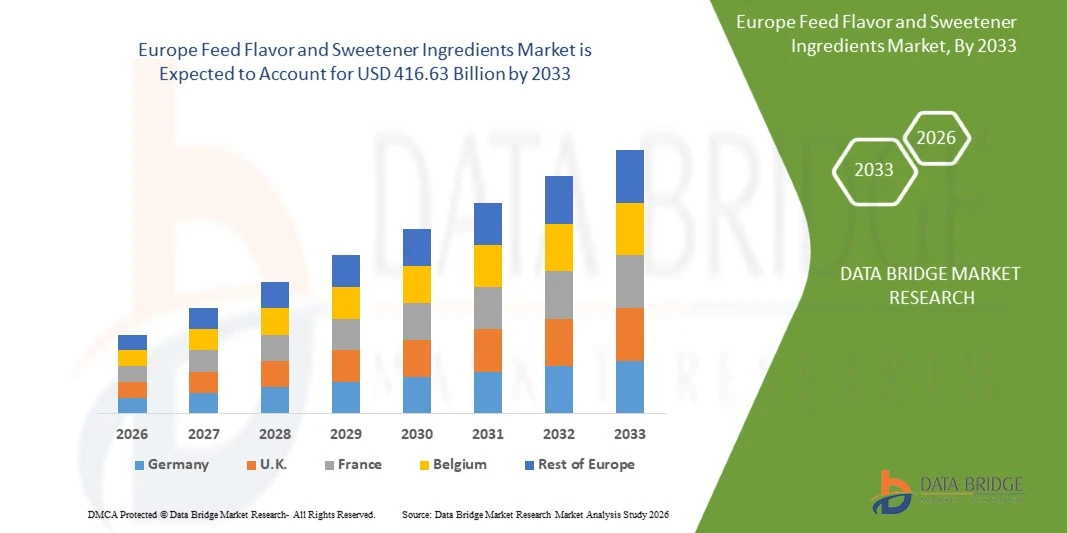
- As per Data Bridge Market Research analysis, the feed flavor and sweetener ingredients market was valued at USD 277.73 million in 2025 and is projected to reach USD 416.63 million by 2033, growing at a CAGR of 5.20% from 2026 to 2033, across livestock, pet, and aquaculture diets.
- The market is experiencing consistent growth driven by rising demand for palatability solutions, increasing focus on young animal nutrition, and expanding applications across swine, poultry, ruminant, pet food, and aquaculture feed programs across Europe.
- The increasing shift toward early feed intake support, reduced reliance on pharmacological growth promoters, and regulation-driven reformulation, combined with growing demand for natural and traceable ingredients, is supporting market adoption. Feed flavors and sweeteners are being applied across piglet starters, calf feeds, poultry diets, aquafeed, and pet food, offering feed producers improved acceptance, intake, and consistency through modern palatability and feed additive programs.
Market Size & Forecast
- Global Market Value (2025): USD 277.73 million
- Expected Market Value (2033): USD 416.63 million
- Forecast CAGR (2026–2033): 5.20%
What are the Major Takeaways of the Feed Flavor and Sweetener Ingredients Market?
- Spain dominated the feed flavor and sweetener ingredients market with the largest revenue share of 22.40% in 2025, supported by large pig production, established flavor and sweetener suppliers, and strong demand for piglet palatability solutions across the country and neighboring markets.
- Turkey is expected to be the fastest-growing country at a CAGR of 7.10% from 2026 to 2033, fueled by expanding poultry and ruminant production, rising feed manufacturing, and growing adoption of feed additives across regional markets.
- The flavors segment led the market with a 52.4% share in 2025, driven by extensive use in starter, creep, and specialty feeds across species and regions.
- Sweeteners are the fastest-growing product type, projected to register a CAGR of 6.3%, reflecting the surge in demand for saccharin-free alternatives to restricted sweeteners.
- The nature-identical segment dominated the source category with a 41.2% revenue share in 2025, led by cost-effective, consistent flavor performance across feed types.
- Swine accounted for 49.3% of the market share in 2025, preferred by increasing focus on weaning transition and feed intake in young pigs.
- The pet food manufacturers segment is the fastest-growing end-user category, with a CAGR of 6.2%, driven by increasing premiumization and product innovation.
Report Scope and Feed Flavor and Sweetener Ingredients Market Segmentation
|
Attributes |
Feed Flavor and Sweetener Ingredients Key Market Insights |
|
Segments Covered |
|
|
Countries Covered |
Europe
|
|
Key Market Players |
|
|
Market Opportunities |
|
|
Value Added Data Infosets |
In addition to the insights on market scenarios such as market value, growth rate, segmentation, geographical coverage, and major players, the market reports curated by the Data Bridge Market Research also include import export analysis, production capacity overview, production consumption analysis, price trend analysis, climate change scenario, supply chain analysis, value chain analysis, raw material/consumables overview, vendor selection criteria, PESTLE Analysis, Porter Analysis, and regulatory framework. |
What is the Key Trend in the Feed Flavor and Sweetener Ingredients Market?
- Feed producers and additive suppliers are increasingly shifting toward saccharin-free, natural, and stage-specific palatability systems, combining flavors, sweet taste modifiers, and masking solutions to support intake while complying with European feed additive regulations and customer expectations.
- For instance, in December 2024, according to AgTechNavigator, Regulation (EU) 2024/1727 introduced a ban on sodium saccharin in feed, with stocks usable until 11 July 2025 and saccharin-containing compound feed allowed only until 11 July 2026, prompting saccharin-free innovation across swine nutrition and the wider feed additive supply chain in Europe.
- Customized sensory design is replacing generic flavors, as piglet creep feed, calf milk replacer, poultry starter, aquafeed, and pet food each require different aroma, sweetness, and masking profiles for reliable acceptance.
- Natural, clean-label, encapsulated, and heat-stable flavor formats are gaining relevance as feed mills seek precise palatability systems that survive pelleting and extrusion, while liquid and powder formats are chosen for different mill setups.
- For instance, in June 2025, Phytobiotics introduced PhytoSense 2.5, a saccharin-free sweetener designed as a drop-in replacement for saccharin-based products and based on natural ingredients, with field trial results showing piglets consumed 7% more feed in the first 14 days post-weaning than a control group receiving a conventional saccharin and NHDC blend, while maintaining similar daily gain and feed conversion.
- As regulation, animal welfare, and sustainability expectations continue to strengthen, feed flavors and sweeteners are expected to evolve from simple palatability aids into science-based nutritional tools that support early feed intake and performance across species.
What are the Key Drivers of the Feed Flavor and Sweetener Ingredients Market?
- Rising focus on early feed intake, weaning transition, and consistent animal performance is increasing demand for flavors and sweeteners that improve acceptance of starter and transition diets in commercial production.
- For instance, in April 2025, Adisseo Europe wrote that post-weaning anorexia in piglets can delay development and affect lifetime performance when diet transition stress is not managed through palatability support, underlining why feed producers use flavors and sweeteners during early life feeding programs.
- The shift away from pharmacological growth support in feed programs is increasing interest in additives that support intake, gut comfort, and performance in a clean-label way across species.
- For instance, in December 2024, ADM reported that weaned piglets receiving Sucram M’I Sweet gained 0.55 kg more body weight than those on saccharin-based diets over 28 days in a study of 120 animals, supporting demand for modern saccharin-free sweetener technologies among swine producers.
- With producers seeking efficiency and animal welfare gains, palatability solutions help improve feed conversion, reduce transition stress, and support consistent performance across production systems in Europe.
What Factors Are Challenging the Growth of the Feed Flavor and Sweetener Ingredients Market?
- Flavor and sweetener production depends on natural and synthetic inputs whose prices can fluctuate, while strict European feed additive regulation increases documentation, safety, and authorization requirements for suppliers.
- Regulation can limit permitted ingredients and inclusion levels, and bans such as the saccharin restriction require reformulation, trials, and customer education to maintain palatability and performance across customer segments.
- Efficacy can vary by species, age, and diet composition, so suppliers must provide trial data and tailored solutions, which increases research costs and slows adoption by cautious feed producers and integrators.
- For instance, in January 2022, according to All About Feed, Pancosma noted that the European market had somewhat reduced potential because feed ingredient legislation limits the level of certain permitted sweetening ingredients, constraining formulation options, even though 75% of piglet feed manufacturers were using sweeteners in their diets, while sugar prices remain volatile.
- The combination of raw material costs, regulatory compliance, reformulation needs, and cost-conscious feed buyers can constrain expansion among smaller suppliers, particularly where generic products already satisfy basic palatability requirements or where sugar-based ingredients provide sweetness at lower cost.
How is the Feed Flavor and Sweetener Ingredients Market Segmented?
The feed flavor and sweetener ingredients market is segmented on the basis of product, source, application, and end user across countries.
- By Product
On the basis of product, the feed flavor and sweetener ingredients market is segmented into flavors and sweeteners. The flavors segment dominated the market with 52.4% share in 2025, supported by extensive use in starter, creep, and specialty feeds across species. Flavors provide aroma and taste cues that encourage feed intake and help mask unpalatable ingredients. They are widely used across swine, poultry, ruminant, aquaculture, and pet feed. Improvements in encapsulation, heat stability, and stage-specific design are further strengthening demand. Integration with natural ingredients and functional additives also enables better performance across modern feed programs.
The sweeteners segment is projected to register the fastest growth at a CAGR of 6.3% from 2026 to 2033, driven by increasing demand for saccharin-free alternatives. Sweeteners enhance acceptance of weaning diets by providing sensory cues similar to the sweet taste of sow’s milk. Their applications include piglet starters, calf feeds, and young animal diets. Increasing regulatory change is creating additional demand across feed mills, premix producers, and integrators. Improvements in natural sweet modifiers, such as monk fruit-based solutions, are enhancing performance. Combination products with flavors are also expanding commercial use. Sweet ingredients such as sugar, glucose, and molasses also improve taste, but intense sweeteners and potentiators offer longer-lasting effects at low inclusion rates.
- By Source
On the basis of source, the feed flavor and sweetener ingredients market is segmented into natural, nature-identical, and synthetic. The nature-identical segment dominated the market with 41.2% share in 2025, supported by consistent flavor performance, cost effectiveness, and stable supply for high-volume feed production. Nature-identical ingredients offer a balanced combination of sensory quality, stability, and affordability for feed mills. Their availability across multiple suppliers expands the potential customer base. Formulators use them to maintain repeatable palatability across batches and seasons. The segment also benefits from established regulatory pathways and long-standing use in commercial feeds.
The natural segment is projected to register the fastest growth at a CAGR of 6.6% from 2026 to 2033, supported by increasing demand for clean-label feed ingredients and regulation-driven reformulation. Plant-based flavors and natural sweet modifiers appeal to producers seeking sustainable, traceable, and welfare-oriented solutions. Suppliers are developing botanical blends tailored to young animal preferences. Feed mills and integrators are increasingly asking for drop-in replacements for restricted synthetic sweeteners. Improved extraction and formulation further strengthen the segment’s attractiveness. Raw material cost and variability remain important considerations for expansion. Natural options must also show repeatable performance in independent trials before wide adoption.
- By Application
On the basis of application, the feed flavor and sweetener ingredients market is segmented into swine, poultry, ruminants, and others. The swine segment dominated the application category with 49.3% share in 2025, supported by increasing focus on weaning transition and feed intake. Piglets benefit from sweet and aromatic cues that encourage consumption of solid feed after weaning. Performance and welfare goals are increasing the use of palatability solutions. Growth in intensive production further strengthens demand. Producers are also seeking products that combine intake support, consistent performance, and compliance with changing regulation for young animals across production stages. Trial data show intake and gain benefits in weaned piglets.
The ruminants segment is projected to register the fastest growth at a CAGR of 6.1% from 2026 to 2033, driven by increasing calf starter use, milk replacer programs, and focus on early rumen development. Flavors and sweeteners help calves accept starter feed and transition from milk to solid diets. Dairy and beef producers in Europe are investing in young stock nutrition. Rising emphasis on animal welfare is creating additional opportunities. Reliable intake makes palatability solutions particularly attractive during weaning. Supportive research and trial data can further improve adoption across regions. Differences in sweet taste perception between species also encourage development of ruminant-specific products.
- By End User
On the basis of end user, the feed flavor and sweetener ingredients market is segmented into feed mills, integrated livestock producers, premix & additive blenders, pet food manufacturers, aquaculture operators, and others. The feed mills segment dominated the end-user category with 63.8% share in 2025, supported by increasing requirements for consistent, high-volume palatability solutions. Compound feed producers rely on flavors and sweeteners to standardize intake across batches. The segment includes starter, creep, and specialty feeds produced under strict quality systems. Increasing demand for tailored feeds is creating further opportunities. Large volumes also make cost, stability, and supplier support important considerations in purchase decisions.
The pet food manufacturers segment is projected to register the fastest growth at CAGR of 6.2% from 2026 to 2033, driven by increasing premiumization, demand for palatable formulations, and interest in natural ingredients. Brands use flavors and enhancers to improve acceptance of kibble, wet food, and functional diets. Manufacturers are expanding portfolios for cats, dogs, and small animals. Closer collaboration between ingredient suppliers and pet food companies is accelerating development of tailored products. Clean-label expectations are further supporting adoption. Safety, consistency, and regulatory documentation remain important considerations for deployment in premium pet food and companion animal diets.
Which Country Holds the Largest Share of the Feed Flavor and Sweetener Ingredients Market?
- Spain dominated the feed flavor and sweetener ingredients market with the largest revenue share of 22.40% in 2025, supported by large pig production, established flavor and sweetener suppliers, and strong demand for piglet palatability solutions across the country and neighboring markets.
- The country also benefits from established feed additive manufacturers, strong research in palatability and animal nutrition, and a large livestock sector, along with growing demand for natural and saccharin-free solutions. Increasing innovation, export orientation, and regulatory expertise continue to strengthen Spain’s position in the European market, supported by close collaboration between industry, universities, and feed producers.
Spain Feed Flavor and Sweetener Ingredients Market Insight
The Spain feed flavor and sweetener ingredients market is witnessing strong growth due to rising investment in piglet nutrition, feed additive innovation, and sustainable livestock production. The country’s large pig sector, along with the presence of leading flavor and sweetener suppliers, is driving demand for advanced palatability solutions. In addition, growing emphasis on weaning transition, saccharin-free formulations, and consistent performance is accelerating adoption of flavors and sweeteners across swine, poultry, and ruminant diets, supported by strong research capabilities and well-established supplier networks.
Turkey Feed Flavor and Sweetener Ingredients Market Insight
The Turkey feed flavor and sweetener ingredients market is expected to witness rapid growth, driven by expanding poultry and ruminant production, rising compound feed manufacturing, and increasing adoption of feed additives. Growing demand for animal protein, export-oriented livestock production, and improved feed efficiency is supporting country market expansion. In addition, the country’s strategic location and growing feed industry are accelerating demand for flavors and sweeteners across diverse species, supported by growing investment in modern feed mills and integrated production systems.
Germany Feed Flavor and Sweetener Ingredients Market Insight
The Germany feed flavor and sweetener ingredients market is witnessing consistent growth due to rising investments in precision feeding, animal welfare, and feed additive research. Feed mills, additive suppliers, and livestock producers are increasingly focusing on palatability and gut health. Moreover, a strong agricultural technology base and continued launches of saccharin-free and natural sweeteners, supported by strict regulation, are further contributing to market growth in Germany, particularly among precision feeding programs.
France Feed Flavor and Sweetener Ingredients Market Insight
The France feed flavor and sweetener ingredients market is growing steadily, driven by strong pig, poultry, and dairy sectors, rising focus on feed efficiency, and increasing demand for natural additives. Growing use of palatability solutions in young animal diets is boosting market demand. In addition, the country’s additive research base, presence of leading suppliers, and focus on sustainable livestock production are positioning France as an important market across Europe, supported by strong cooperative networks and technical advisory services.
Which are the Top Companies in Feed Flavor and Sweetener Ingredients Market?
The feed flavor and sweetener ingredients industry is primarily led by well-established companies, including:
- Lucta S.A. (Spain)
- Kerry Group plc (Ireland)
- Archer-Daniels-Midland Company (ADM) (U.S.)
- Adisseo (France)
- dsm-firmenich (Switzerland)
- Phytobiotics Futterzusatzstoffe GmbH (Germany)
- Norel S.A. (Spain)
- Nutreco N.V. (Netherlands)
- Cargill, Incorporated (U.S.)
- Palital Feed Additives (Netherlands)
- Symrise AG (Germany)
- International Flavors & Fragrances Inc. (U.S.)
- Givaudan SA (Switzerland)
- Delacon Biotechnik GmbH (Austria)
- Kemin Industries, Inc. (U.S.)
- Orffa (Netherlands)
- Alltech, Inc. (U.S.)
- Biochem Zusatzstoffe GmbH (Germany)
- Pancosma SA (Switzerland)
- Ajinomoto Co., Inc. (Japan)
What are Latest Developments in Feed Flavor and Sweetener Ingredients Market?
- In July 2026, the deadline for using saccharin-containing compound feed under Regulation (EU) 2024/1727 took effect, following the 11 July 2025 limit for including existing sodium saccharin stocks in premixtures or compound feed, accelerating the transition to saccharin-free sweeteners across European piglet nutrition programs and encouraging wider adoption of natural taste modifiers and customized flavor systems.
- In June 2025, Phytobiotics introduced PhytoSense 2.5, a saccharin-free sweetener designed as a drop-in replacement for saccharin-based products and based on natural ingredients, with field trial results showing piglets consumed 7% more feed in the first 14 days post-weaning than a control group receiving a conventional saccharin and NHDC blend, while maintaining similar daily gain and feed conversion.
- In April 2025, Adisseo Europe highlighted that post-weaning anorexia in piglets can delay development and affect lifetime performance, and reported improved piglet fecal consistency and feed efficiency trends at the 16th International Symposium on Digestive Physiology of Pigs, supporting the case for palatability programs that help young animals accept solid feed during the stressful weaning transition.
- In December 2024, ADM Animal Nutrition promoted its saccharin-free sweetener range for swine, including monk fruit-based Sucram M’I Sweet, with a study of 120 weaned piglets showing 0.55 kg more body weight gain over 28 days than saccharin-based diets, while Norel reported trial results for DULCOAPETENTE NT-75 in a study of 198 weaned piglets, with higher final body weight.
- In July 2024, Regulation (EU) 2024/1727 came into force, banning sodium saccharin in animal feed due to environmental and occupational health concerns, and giving the industry a phased timeline to adopt alternatives, which opened opportunities for new sweeteners, natural taste modifiers, and customized palatability solutions for piglets, calves, poultry, aquaculture, and pets, in line with the EU’s emphasis on traceable and well-documented ingredients.
- Interactive Data Analysis Dashboard
- Company Analysis Dashboard for high growth potential opportunities
- Research Analyst Access for customization & queries
- Competitor Analysis with Interactive dashboard
- Latest News, Updates & Trend analysis
- Harness the Power of Benchmark Analysis for Comprehensive Competitor Tracking
Data collection and base year analysis are done using data collection modules with large sample sizes. The stage includes obtaining market information or related data through various sources and strategies. It includes examining and planning all the data acquired from the past in advance. It likewise envelops the examination of information inconsistencies seen across different information sources. The market data is analysed and estimated using market statistical and coherent models. Also, market share analysis and key trend analysis are the major success factors in the market report. To know more, please request an analyst call or drop down your inquiry.
The key research methodology used by DBMR research team is data triangulation which involves data mining, analysis of the impact of data variables on the market and primary (industry expert) validation. Data models include Vendor Positioning Grid, Market Time Line Analysis, Market Overview and Guide, Company Positioning Grid, Patent Analysis, Pricing Analysis, Company Market Share Analysis, Standards of Measurement, Global versus Regional and Vendor Share Analysis. To know more about the research methodology, drop in an inquiry to speak to our industry experts.
Data Bridge Market Research is a leader in advanced formative research. We take pride in servicing our existing and new customers with data and analysis that match and suits their goal. The report can be customized to include price trend analysis of target brands understanding the market for additional countries (ask for the list of countries), clinical trial results data, literature review, refurbished market and product base analysis. Market analysis of target competitors can be analyzed from technology-based analysis to market portfolio strategies. We can add as many competitors that you require data about in the format and data style you are looking for. Our team of analysts can also provide you data in crude raw excel files pivot tables (Fact book) or can assist you in creating presentations from the data sets available in the report.