




Europe Fertility Testing Devices Market
Market Size in USD Million
CAGR :
% 
 USD
132.31 Million
USD
238.61 Million
2025
2033
USD
132.31 Million
USD
238.61 Million
2025
2033
 Forecast Period Forecast Period |
2026 –2033 |
 Market Size (Base Year) Market Size (Base Year) |
USD 132.31 Million |
 Market Size (Forecast Year) Market Size (Forecast Year) |
USD 238.61 Million |
 CAGR CAGR |
% |
| Major Markets Players |
|
Europe Fertility Testing Devices Market Size
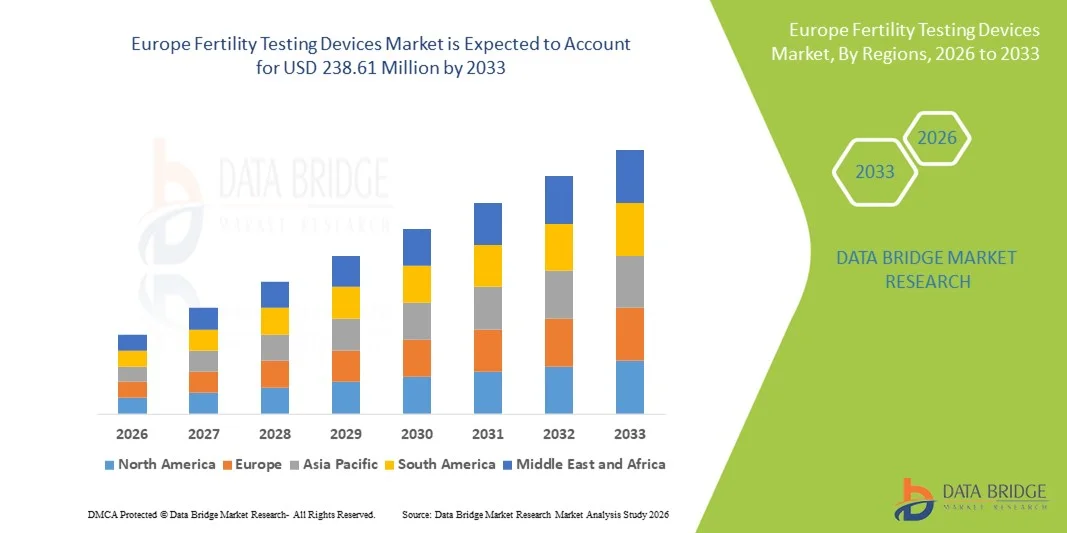
- The Europe fertility testing devices market size was valued at USD 132.31 million in 2025 and is expected to reach USD 238.61 million by 2033, at a CAGR of 7.65% during the forecast period
- The market growth is largely fueled by rising adoption of fertility awareness and reproductive health solutions, expanding fertility clinic networks, and increasing consumer demand for both at-home and clinical fertility testing technologies
- Furthermore, technological advancements in fertility diagnostics, including ovulation prediction kits and male fertility testing devices, along with growing consumer preference for secure, user-friendly, and integrated reproductive health solutions, are positioning fertility testing devices as essential tools in personal and clinical fertility monitoring. These converging factors are accelerating the uptake of fertility testing solutions, thereby significantly boosting the industry’s growth.
Europe Fertility Testing Devices Market Analysis
- Fertility testing devices, including ovulation prediction kits, fertility monitors, and male fertility testing systems, are increasingly vital components of reproductive healthcare management across Europe due to their role in early fertility assessment, cycle tracking, and informed family planning decisions in both homecare and clinical settings
- The escalating demand for fertility testing devices is primarily fueled by rising infertility rates, increasing maternal age, growing awareness regarding reproductive health, and a rising preference for convenient and reliable at-home diagnostic solutions
- Germany dominated the Europe fertility testing devices market with the largest revenue share of 22.4% in 2025, supported by advanced healthcare infrastructure, a strong network of fertility clinics, favorable regulatory standards, and high consumer awareness, alongside increasing adoption of both clinical diagnostic systems and home-based fertility testing kits
- The United Kingdom is expected to be the fastest growing country in the Europe fertility testing devices market during the forecast period driven by rising infertility prevalence, delayed parenthood trends, expanding assisted reproductive technology (ART) services, and growing demand for digital and app-connected fertility monitoring solutions
- Ovulation prediction kits segment dominated the Europe fertility testing devices market with a market share of 46.3% in 2025, attributed to affordability, ease of use, wide retail and online availability, and increasing consumer preference for non-invasive, self-monitoring reproductive health solutions
Report Scope and Europe Fertility Testing Devices Market Segmentation
|
Attributes |
Europe Fertility Testing Devices Key Market Insights |
|
Segments Covered |
|
|
Countries Covered |
Europe
|
|
Key Market Players |
|
|
Market Opportunities |
|
|
Value Added Data Infosets |
In addition to the insights on market scenarios such as market value, growth rate, segmentation, geographical coverage, and major players, the market reports curated by the Data Bridge Market Research also include in-depth expert analysis, patient epidemiology, pipeline analysis, pricing analysis, and regulatory framework |
Europe Fertility Testing Devices Market Trends
Rising Adoption of Digital and App-Connected Fertility Monitoring Solutions
- A significant and accelerating trend in the Europe fertility testing devices market is the increasing integration of digital health technologies and smartphone-connected fertility monitoring applications, significantly enhancing user convenience, cycle tracking accuracy, and personalized reproductive insights
- For instance, several advanced ovulation monitors available across Europe now sync with dedicated mobile applications, enabling users to record hormonal data, predict fertile windows with higher precision, and share reports directly with healthcare professionals for improved consultation outcomes
- Digital integration in fertility testing devices enables features such as algorithm-based cycle prediction, AI-driven fertility insights, and cloud-based data storage for long-term reproductive health tracking. For instance, certain premium fertility monitors utilize adaptive algorithms to refine ovulation predictions over time and generate intelligent alerts regarding irregular hormonal patterns or cycle variations
- The seamless integration of fertility testing devices with broader digital health ecosystems facilitates centralized reproductive health management. Through a single interface, users can track ovulation, basal body temperature, menstrual cycles, and related health indicators, creating a comprehensive and data-driven fertility management experience
- This trend toward more intelligent, intuitive, and interconnected fertility solutions is fundamentally reshaping consumer expectations for reproductive healthcare management. Consequently, manufacturers are developing advanced fertility testing devices featuring Bluetooth connectivity, AI-based hormone analysis, and compatibility with digital health platforms
- The demand for digitally integrated and user-friendly fertility testing devices is growing rapidly across Europe, as individuals and couples increasingly prioritize convenience, privacy, early diagnosis, and proactive reproductive health planning
- Growing collaboration between fertility technology companies and telehealth providers is further enhancing remote consultation capabilities, enabling users to share real-time fertility data with clinicians and receive personalized treatment guidance
Europe Fertility Testing Devices Market Dynamics
Driver
Growing Need Due to Rising Infertility Rates and Delayed Parenthood Trends
- The increasing prevalence of infertility across Europe, coupled with the rising trend of delayed parenthood due to career priorities and lifestyle changes, is a significant driver for the heightened demand for fertility testing devices
- For instance, fertility clinics across major European countries are expanding diagnostic services and incorporating advanced hormone testing systems to address the growing number of couples seeking assisted reproductive solutions, which is expected to drive market growth during the forecast period
- As awareness regarding reproductive health improves, individuals are proactively monitoring fertility status through early diagnostic tools, with fertility testing devices offering reliable hormone detection, ovulation tracking, and sperm analysis capabilities that support informed decision-making
- Furthermore, supportive healthcare frameworks and increasing public discourse around fertility challenges are encouraging both clinical and at-home testing adoption, making fertility monitoring an integral component of preventive reproductive healthcare strategies
- The convenience of discreet home-based ovulation kits, rapid test results, and the ability to track fertility metrics through smartphone applications are key factors propelling the adoption of fertility testing devices across Europe. The expansion of online retail channels and pharmacy availability further contributes to market growth
- Rising investments in assisted reproductive technology (ART) infrastructure across key European countries are strengthening the overall ecosystem for fertility diagnostics and testing solutions
- Increasing government and non-government initiatives focused on reproductive health awareness campaigns are further stimulating demand for early-stage fertility assessment tools
Restraint/Challenge
Accuracy Limitations and Regulatory Compliance Hurdles
- Concerns regarding the accuracy and reliability of certain at-home fertility testing kits pose a significant challenge to broader market penetration. As fertility testing devices rely on hormonal detection thresholds and user compliance, inconsistent usage or biological variability may lead to misleading results, raising concerns among consumers
- For instance, variability in luteinizing hormone levels or improper sample handling can affect ovulation prediction accuracy, leading some healthcare professionals to recommend confirmatory clinical diagnostic procedures
- Addressing these accuracy concerns through enhanced sensor precision, clinical validation studies, and transparent product labeling is crucial for building consumer trust. In addition, stringent European regulatory requirements for in vitro diagnostic (IVD) devices can increase time-to-market and compliance costs for manufacturers
- While technological improvements are enhancing reliability, the relatively higher cost of advanced digital fertility monitors compared to basic ovulation kits can act as a barrier for price-sensitive consumers, particularly in certain European markets
- Overcoming these challenges through continuous technological refinement, strengthened regulatory alignment, consumer education on proper usage, and broader affordability strategies will be vital for sustained market growth across Europe
- Limited reimbursement coverage for fertility testing devices in several European healthcare systems may restrict access for certain patient groups, particularly for non-clinical at-home diagnostic products
- Data privacy concerns associated with storing sensitive reproductive health information on digital platforms may also hinder adoption among privacy-conscious consumers
Europe Fertility Testing Devices Market Scope
The market is segmented on the basis of mode of purchase, application, product, and end-user.
- By Mode of Purchase
On the basis of mode of purchase, the Europe fertility testing devices market is segmented into over the counter and prescription based. The over the counter segment dominated the market with the largest revenue share in 2025, driven by increasing consumer preference for convenient, private, and easily accessible fertility monitoring solutions. OTC fertility testing devices, particularly ovulation prediction kits, are widely available across pharmacies, supermarkets, and online retail platforms throughout Europe. Consumers favor these products due to affordability, rapid results, and the ability to monitor reproductive health without clinical appointments. Growing awareness regarding early fertility assessment and self-care practices further supports segment dominance. In addition, discreet packaging and app-connected tracking features have enhanced user confidence and adoption across homecare settings.
The prescription based segment is anticipated to witness the fastest growth rate from 2026 to 2033, fueled by increasing infertility consultations and rising utilization of assisted reproductive technology (ART) services. Prescription-based fertility testing devices are commonly recommended in clinical pathways for hormone profiling and male fertility diagnostics. The growing number of fertility clinics across countries such as Germany, the U.K., and France is accelerating demand for clinically validated diagnostic tools. Furthermore, supportive healthcare policies and improved diagnostic accuracy standards are contributing to segment growth. Increasing collaboration between diagnostic laboratories and fertility specialists is also strengthening prescription-based device adoption.
- By Application
On the basis of application, the market is segmented into female fertility testing device and male fertility testing device. The female fertility testing device segment dominated the Europe fertility testing devices market in 2025, attributed to higher awareness of ovulation tracking and hormonal monitoring among women. Ovulation prediction kits and fertility monitors are widely used for natural conception planning and early fertility assessment. Rising maternal age and delayed parenthood trends across Europe further contribute to strong demand in this segment. Healthcare campaigns focusing on women’s reproductive health have increased adoption of at-home diagnostic tools. In addition, digital integration with menstrual tracking applications enhances usability and long-term engagement.
The male fertility testing device segment is expected to register the fastest growth during the forecast period, driven by growing recognition of male-factor infertility and increasing availability of at-home sperm analysis kits. Social awareness initiatives and reduced stigma surrounding male fertility issues are encouraging more proactive testing. Technological advancements enabling smartphone-based sperm motility analysis are further accelerating segment expansion. Fertility clinics are also integrating advanced semen analysis systems to improve diagnostic accuracy. As couples increasingly pursue comprehensive fertility evaluation, male testing devices are gaining stronger market traction.
- By Product
On the basis of product, the market is segmented into ovulation prediction kit and fertility monitor. The ovulation prediction kit segment dominated the market with the largest revenue share of 46.3% in 2025, driven by affordability, ease of use, and broad retail distribution across Europe. These kits provide quick hormone detection results and require minimal technical expertise, making them highly accessible for homecare use. High repeat purchase rates and strong consumer trust contribute to sustained revenue generation. The non-invasive nature and rapid turnaround time further strengthen adoption. In addition, increasing online sales channels have expanded consumer reach across urban and semi-urban regions.
The fertility monitor segment is anticipated to witness the fastest growth rate from 2026 to 2033, fueled by rising demand for advanced digital tracking and multi-hormone analysis capabilities. Fertility monitors provide more comprehensive cycle insights compared to single-use kits. Integration with smartphone applications and AI-based predictive analytics enhances personalization and long-term fertility planning. Consumers seeking higher accuracy and data-driven reproductive health management are increasingly opting for digital monitors. Continuous technological innovation and premium product positioning are expected to accelerate growth within this segment.
- By End-User
On the basis of end-user, the market is segmented into home care settings, hospitals, fertility clinics, and others. The home care settings segment dominated the Europe fertility testing devices market in 2025, supported by rising preference for privacy, convenience, and self-monitoring solutions. Increasing availability of OTC fertility kits and digital fertility monitors has strengthened adoption in non-clinical environments. Consumers value the ability to track fertility cycles discreetly without frequent hospital visits. The expansion of e-commerce platforms has further facilitated direct-to-consumer distribution. Growing awareness campaigns promoting early fertility tracking also contribute to homecare dominance.
The fertility clinics segment is expected to witness the fastest growth during the forecast period, driven by rising infertility cases and expanding assisted reproductive treatment infrastructure across Europe. Fertility clinics rely on advanced diagnostic systems for hormone testing and semen analysis to support ART procedures. Increasing patient inflow and growing investments in reproductive health facilities are strengthening segment expansion. Enhanced diagnostic precision and integrated laboratory services further boost demand. As more couples seek specialized fertility treatment, clinic-based testing volumes are projected to rise steadily.
Europe Fertility Testing Devices Market Regional Analysis
- Germany dominated the Europe fertility testing devices market with the largest revenue share of 22.4% in 2025, supported by advanced healthcare infrastructure, a strong network of fertility clinics, favorable regulatory standards, and high consumer awareness, alongside increasing adoption of both clinical diagnostic systems and home-based fertility testing kits
- Consumers in the region highly value the privacy, convenience, and accuracy offered by fertility testing devices, particularly at-home ovulation prediction kits and digital fertility monitors integrated with smartphone applications for real-time cycle tracking
- This widespread adoption is further supported by well-established healthcare infrastructure, supportive regulatory standards for diagnostic devices, high healthcare expenditure, and the growing preference for proactive fertility assessment, establishing fertility testing devices as essential tools in both home care settings and specialized fertility clinics
The Germany Fertility Testing Devices Market Insight
The Germany fertility testing devices market captured the largest revenue share within Europe in 2025, fueled by rising infertility prevalence, delayed parenthood trends, and strong awareness regarding reproductive health management. Consumers are increasingly prioritizing early fertility assessment through both at-home ovulation prediction kits and clinically prescribed hormone diagnostic solutions. The country’s well-established healthcare infrastructure and strong presence of specialized fertility clinics significantly support market expansion. In addition, Germany’s emphasis on medical device quality standards and regulatory compliance enhances consumer confidence in diagnostic accuracy. The growing adoption of digital fertility monitors integrated with smartphone applications and AI-based tracking tools is further accelerating demand. Rising investments in assisted reproductive technology (ART) centers continue to reinforce Germany’s leadership position in the regional market.
U.K. Fertility Testing Devices Market Insight
The U.K. fertility testing devices market is anticipated to grow at a noteworthy CAGR during the forecast period, driven by rising infertility consultations and strong public discourse around reproductive health. Delayed pregnancies, career prioritization, and lifestyle-related fertility challenges are encouraging individuals to monitor fertility status more proactively. The country’s advanced digital health ecosystem supports integration of fertility devices with mobile health applications and teleconsultation platforms. Expanding access to NHS-supported fertility treatments and private fertility clinics further stimulates demand for accurate diagnostic tools. Increasing consumer preference for discreet, home-based ovulation kits is strengthening the OTC segment. Growing awareness campaigns and improved access to reproductive health education are expected to continue propelling market expansion.
France Fertility Testing Devices Market Insight
The France fertility testing devices market is expected to expand at a considerable CAGR during the forecast period, supported by favorable reproductive healthcare policies and strong clinical infrastructure. Government support for assisted reproductive treatments and broader insurance coverage in certain cases positively influence diagnostic testing volumes. Rising maternal age and declining birth rates are prompting greater interest in early fertility evaluation. The country’s investment in laboratory modernization and diagnostic technologies enhances clinical adoption of prescription-based fertility testing devices. In addition, increasing consumer trust in regulated OTC fertility kits contributes to stable retail sales. The integration of digital fertility tracking applications with hormone monitoring devices is also gaining traction among tech-savvy consumers.
Italy Fertility Testing Devices Market Insight
The Italy fertility testing devices market is poised for steady growth during the forecast period, driven by demographic shifts and increasing awareness of fertility preservation strategies. Declining fertility rates and delayed family planning decisions are encouraging couples to seek early-stage diagnostic assessment. Expansion of fertility clinics and improved access to ART procedures are strengthening demand for hormone testing and semen analysis systems. Consumers are increasingly turning to affordable ovulation kits for preliminary fertility tracking before seeking clinical consultation. Rising urbanization and digital health adoption are enhancing accessibility to app-connected fertility monitors. Furthermore, educational initiatives regarding reproductive health are supporting broader acceptance of fertility testing solutions.
Europe Fertility Testing Devices Market Share
The Europe Fertility Testing Devices industry is primarily led by well-established companies, including:
- SPD Swiss Precision Diagnostics GmbH (Switzerland)
- Geratherm Medical AG (Germany)
- Fertility Focus Limited (U.K.)
- Babystart Ltd. (U.K.)
- UEBE Medical GmbH (Germany)
- Valley Electronics AG (Germany)
- Sensiia Ltd. (U.K.)
- BioZhena Corporation (U.S.)
- Fairhaven Health, LLC (U.S.)
- Church & Dwight Co., Inc. (U.S.)
- Tempdrop Ltd. (Israel)
- Quanovate Tech Inc. (U.S.)
- Natural Cycles Nordic AB (Sweden)
- viO HealthTech Ltd. (U.K.)
- Inex Innovate (Switzerland)
- Ava Science Inc. (Switzerland)
- iXensor Co., Ltd. (Netherlands)
- Tandem Devices Ltd. (U.K.)
- Femometer (China)
- Easy Healthcare Corporation (U.S.)
What are the Recent Developments in Europe Fertility Testing Devices Market?
- In June 2025, Inne’s saliva-based hormone testing device Minilab was certified as a contraceptive and prepared for EU rollout, transforming its use from a fertility tracker to also a certified contraceptive tool that tracks progesterone levels via saliva, expanding its utility across Europe
- In October 2023, Enhanced Fertility unveiled and launched its European Fertility Test Kit during a webinar for healthcare professionals, expanding access for fertility clinics and patients with CE-marked diagnostic tools across Europe
- In August 2023, a German start-up became the first in Europe to launch at-home fertility test kits using dried blood microsampling (VAMS) technology, enabling convenient and medically certified blood sampling for anti-Müllerian hormone (AMH) analysis to assess ovarian reserve
- In September 2022, Eurofins Genoma launched niPGT-A, a non-invasive preimplantation genetic aneuploidy screening test, allowing IVF centres across Europe to screen embryos without a biopsy, offering clinics a less invasive diagnostic alternative within reproductive genetics workflows
- In June 2021, at-home fertility test kit maker Proov expanded into Europe after receiving CE clearance, enabling its PdG urine test to confirm successful ovulation and become available to European consumers, marking broader access to clinical-grade ovulation confirmation tools outside the U.S.
SKU-
Get online access to the report on the World's First Market Intelligence Cloud

- Interactive Data Analysis Dashboard
- Company Analysis Dashboard for high growth potential opportunities
- Research Analyst Access for customization & queries
- Competitor Analysis with Interactive dashboard
- Latest News, Updates & Trend analysis
- Harness the Power of Benchmark Analysis for Comprehensive Competitor Tracking
Research Methodology
Data collection and base year analysis are done using data collection modules with large sample sizes. The stage includes obtaining market information or related data through various sources and strategies. It includes examining and planning all the data acquired from the past in advance. It likewise envelops the examination of information inconsistencies seen across different information sources. The market data is analysed and estimated using market statistical and coherent models. Also, market share analysis and key trend analysis are the major success factors in the market report. To know more, please request an analyst call or drop down your inquiry.
The key research methodology used by DBMR research team is data triangulation which involves data mining, analysis of the impact of data variables on the market and primary (industry expert) validation. Data models include Vendor Positioning Grid, Market Time Line Analysis, Market Overview and Guide, Company Positioning Grid, Patent Analysis, Pricing Analysis, Company Market Share Analysis, Standards of Measurement, Global versus Regional and Vendor Share Analysis. To know more about the research methodology, drop in an inquiry to speak to our industry experts.
Customization Available
Data Bridge Market Research is a leader in advanced formative research. We take pride in servicing our existing and new customers with data and analysis that match and suits their goal. The report can be customized to include price trend analysis of target brands understanding the market for additional countries (ask for the list of countries), clinical trial results data, literature review, refurbished market and product base analysis. Market analysis of target competitors can be analyzed from technology-based analysis to market portfolio strategies. We can add as many competitors that you require data about in the format and data style you are looking for. Our team of analysts can also provide you data in crude raw excel files pivot tables (Fact book) or can assist you in creating presentations from the data sets available in the report.












