


What is the Europe Fiber Optic Connector in Telecom Market Size and Growth Rate?
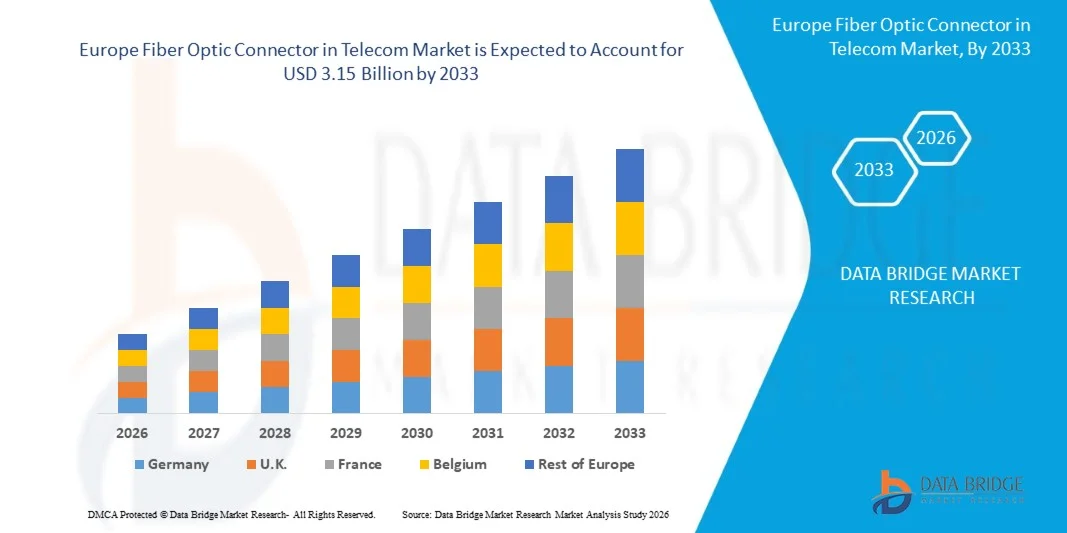
- As per Data Bridge Market Research analysis, the Europe fiber optic connector in telecom market was valued at USD 1.18 billion in 2025 and is projected to reach USD 3.15 billion by 2033, growing at a CAGR of 13.1% from 2026 to 2033.
- The market is experiencing strong growth driven by accelerating fiber-to-the-home (FTTH) deployments, rapid 5G network densification, and rising investments in hyperscale and edge data center infrastructure across the region.
- The increasing shift toward gigabit broadband connectivity, combined with EU digital-decade broadband targets and national fiberization programs, is compelling telecom operators, data center providers, and enterprises to expand high-density, low-loss fiber connectivity. LC and MPO/MTP connectors are increasingly replacing legacy SC and ST formats in many high-bandwidth deployments, offering compact form factors, lower insertion loss, and higher port density for next-generation network architectures.
Market Size & Forecast
- Regional Market Value (2025): USD 1.18 Billion
- Expected Market Value (2033): USD 3.15 Billion
- Forecast CAGR (2026–2033): 13.1%
- Leading Country in 2025: Germany
- Fastest Growing Country: U.K.
What are the Major Takeaways of the Europe Fiber Optic Connector in Telecom Market?
- Germany dominated the Europe fiber optic connector in telecom market with the largest revenue share of 22.47% in 2025, supported by extensive FTTH rollout programs and strong domestic telecom equipment manufacturing.
- The U.K. is expected to be the fastest-growing country at a CAGR of 8.4% from 2026 to 2033, fueled by aggressive full-fiber broadband targets, growing 5G small-cell deployments, and rising data center construction activity.
- The Multi-Fiber Termination Push On/Pull Off (MTP) segment is expected to be the fastest-growing type, with a projected CAGR of 9.1% from 2026 to 2033, reflecting increasing demand for multi-fiber, high-density connectivity capable of supporting higher bandwidth requirements and rapid network expansion.
- The telephone application segment is expected to maintain steady demand through 2033 as European telecom operators continue transitioning legacy copper-based networks toward fiber-based communication infrastructure, while cable TV networks increasingly adopt fiber connectivity to enhance bandwidth capacity and service reliability.
- Internet communication represented the largest application segment in 2025, supported by expanding fiber broadband networks, rising internet traffic, increasing cloud and data center connectivity, and growing requirements for high-speed and low-latency telecommunications infrastructure across Europe.
- The duplex segment dominated the market in 2025, driven by its ability to support simultaneous bidirectional data transmission and its extensive use in telecom networks, enterprise communication systems, and high-speed internet infrastructure. Simplex connectors continue to serve applications requiring one-way optical signal transmission.
Report Scope and Europe Fiber Optic Connector in Telecom Market Segmentation
|
Attributes |
Europe Fiber Optic Connector in Telecom Key Market Insights |
|
Segments Covered |
|
|
Countries Covered |
Europe
|
|
Key Market Players |
|
|
Market Opportunities |
|
|
Value Added Data Infosets |
In addition to the insights on market scenarios such as market value, growth rate, segmentation, geographical coverage, and major players, the market reports curated by the Data Bridge Market Research also include in-depth expert analysis, geographically represented company-wise production and capacity, network layouts of distributors and partners, detailed and updated price trend analysis and deficit analysis of supply chain and demand. |
What is the Key Trend in the Europe Fiber Optic Connector in Telecom Market?
- The Europe fiber optic connector in telecom market is witnessing a strong shift toward high-density and very-small-form-factor (VSFF) fiber connectivity, driven by the growing need among telecom operators, cloud providers, and data center operators to accommodate rapidly increasing bandwidth requirements while optimizing rack space and equipment footprints.
- For instance, in March 2025, HUBER+SUHNER highlighted the integration of SENKO’s SN connectivity into its LISA optical distribution frames and IANOS patch panels. The SN connector architecture enables significantly higher connection density than conventional LC-based connectivity, with the upgraded systems supporting up to 6,480 ports in optical distribution frames and up to 432 ports in a 1U patch panel.
- The increasing deployment of 400G and 800G networks is further driving the adoption of low-loss, high-density connector architectures that can accommodate higher fiber counts without significantly increasing the physical footprint of telecom and data center infrastructure.
- Field-installable and pre-polished connector technologies are also gaining importance in FTTH deployments, as operators and installers seek to reduce installation time, simplify field termination, and reduce dependence on complex splicing procedures. SENKO, for example, offers its XP Fit Plus SC field-installable connector, which can be terminated in approximately two minutes using standard industry tools and is designed for FTTH and telecommunications applications.
- In addition, angled physical contact (APC) connectivity is becoming increasingly important in applications requiring low back-reflection. SENKO’s Q-XP Premium SC APC field-installable connector, for example, provides a typical return loss of at least 65 dB and is designed for FTTH and telecommunications applications.
- As European telecom and data center networks continue to transition toward higher transmission speeds, greater fiber density, and simplified deployment, high-density, low-loss, and field-installable connector technologies are expected to remain a major technology trend in the market.
What are the Key Drivers of the Europe Fiber Optic Connector in Telecom Market?
- The continued expansion of FTTP, gigabit broadband, 5G infrastructure, cloud services, and data centers across Europe is a major driver of demand for fiber optic connectors. These networks require reliable, low-loss optical interconnections across access, aggregation, transport, and data center infrastructure.
- The European Union’s Digital Decade connectivity objectives provide a particularly important structural driver. The European Commission aims to ensure that all European households are covered by a Gigabit network and all populated areas are covered by 5G by 2030, supporting continued investment in fiber-rich communications infrastructure.
- For instance, in April 2025, HUBER+SUHNER launched its Ribbon end-to-end solution for data center operations. The high-density fiber optic connectivity system integrates components including LISA, IANOS, OptiRibbon cables, and Ribbon Splice Box technology and enables splicing up to 60% faster than conventional approaches, supporting growing requirements for scalable and high-capacity connectivity.
- Rapid growth in hyperscale and AI-oriented data center infrastructure is also stimulating investment in advanced optical connectivity. In June 2025, HUBER+SUHNER opened a new manufacturing facility in Pisary, Poland, for POLATIS optical circuit switches used in AI and hyperscale data centers, with plans to increase production capacity at least fivefold over the following two years.
- Europe’s underlying fiber deployment is also expanding. The European Commission’s 2026 Connectivity Coverage report states that FTTP had become Europe’s most widespread fixed connectivity technology by mid-2025, demonstrating the continuing transition toward fiber-based broadband infrastructure.
- Therefore, continued investment in FTTP, 5G, hyperscale data centers, cloud infrastructure, and high-capacity optical networks is expected to sustain demand for LC, SC, MPO/MTP, VSFF, APC, and other advanced fiber connectivity solutions across Europe.
Which Factors are Challenging the Growth of the Europe Fiber Optic Connector in Telecom Market?
- High deployment costs, installation complexity, stringent optical-performance requirements, and the need for specialized installation and testing capabilities remain important challenges for the Europe fiber optic connector in telecom market.
- Fiber network deployment involves not only the cost of connectors and cables but also civil works, ducts, network equipment, installation, testing, maintenance, and skilled technical personnel. These requirements can increase the overall cost of FTTH and very-high-capacity network deployments, particularly in rural and less densely populated areas.
- For instance, a European Commission study estimated that approximately EUR 114 billion of investment would be required to achieve the EU’s fixed Gigabit coverage objective using Fibre-to-the-Premises (FTTP), illustrating the substantial capital requirements associated with extending fiber infrastructure across Europe.
- Deployment complexity is sufficiently significant that the EU introduced the Gigabit Infrastructure Act, which is specifically intended to make the rollout of very-high-capacity networks faster, cheaper, and simpler. Measures include greater sharing of ducts and poles, coordination of civil works, and streamlined administrative procedures.
- Fiber connector installation also requires careful cleaning, inspection, termination, and testing to maintain low insertion loss and return loss. These requirements can increase installation time and labor costs, particularly where large numbers of connections must be deployed or maintained.
- Consequently, although Europe continues to invest heavily in fiber and 5G infrastructure, high capital requirements, deployment complexity, skilled-labor needs, and stringent optical-performance requirements can constrain the pace and economics of network expansion, particularly in less densely populated and cost-sensitive areas.
How is the Europe Fiber Optic Connector in Telecom Market Segmented?
The Europe fiber optic connector in telecom market is segmented on the basis of connector type, fiber mode, application, end user, material, installation type, polish type, and distribution channel.
- By Type
On the basis of type, the Europe fiber optic connector in telecom market is segmented into Lucent Connector (LC), Subscriber Connector (SC), Straight Tip (ST), Fiber Connector (FC), Multi-Fiber Termination Push On/Pull Off (MTP), Master Unit (MU), e2000 Connector, lx-5 Connector, Fiber Distributed Data Interface (FDDI), Volition Connector, Opti-jack Connector, Sub Multi Assembly (SMA), and Others. the lucent connector (LC) segment dominated the Europe fiber optic connector in telecom market with a 34.86% share in 2025, owing to its compact form factor, high port density, low insertion loss, and widespread compatibility with telecom equipment. Strong deployment across FTTH networks, optical distribution frames, data centers, switches, and high-density communication infrastructure further supported the segment’s leading market position across Europe.
The multi-fiber termination push on/pull off (MTP) segment is projected to register the fastest growth at a CAGR of 9.1% from 2026 to 2033, driven by increasing requirements for high-density fiber connectivity. Expansion of hyperscale and edge data centers, increasing bandwidth consumption, adoption of parallel optics, and modernization of telecom backbone networks are accelerating demand for multi-fiber connector solutions across Europe.
- By Organization Size
On the basis of organization size, the market is segmented into Large Enterprise, Medium Enterprise, and Small Enterprise. The large enterprise segment dominated the Europe fiber optic connector in telecom market with an estimated 58.42% share in 2025, supported by significant investments in high-capacity fiber infrastructure. Large telecom operators, cloud providers, data center operators, and enterprises require extensive optical connectivity for distributed operations, data-intensive applications, network modernization, and cloud services, strengthening demand for reliable, scalable, and high-performance fiber connector solutions.
The medium enterprise segment is projected to register the fastest growth at an estimated CAGR of 8.6% from 2026 to 2033, driven by accelerating digital transformation and adoption of cloud-based business applications. Increasing requirements for high-speed connectivity, migration from legacy copper infrastructure, expansion of enterprise data networks, and growing affordability of fiber solutions are encouraging medium-sized organizations to invest in advanced optical connectivity infrastructure.
- By Configuration
On the basis of configuration, the market is segmented into Duplex and Simplex. The duplex segment dominated the Europe fiber optic connector in telecom market with an estimated 63.74% share in 2025, owing to its extensive use for simultaneous bidirectional data transmission. Growing deployment across Ethernet networks, telecom switches, routers, servers, data centers, and enterprise communication infrastructure has strengthened adoption, while increasing bandwidth requirements and the need for reliable two-way optical communication continue supporting its leading market position.
The duplex segment is projected to register the fastest growth at an estimated CAGR of 8.3% from 2026 to 2033, supported by increasing adoption of high-speed Ethernet and bidirectional optical communication systems. Expansion of fiber broadband networks, data center interconnections, cloud infrastructure, and telecom transmission systems is increasing requirements for duplex connectors capable of supporting reliable simultaneous transmission and reception of high-volume digital information.
- By Fiber Type
On the basis of fiber type, the market is segmented into single mode and multimode. The single mode segment dominated the Europe fiber optic connector in telecom market with an estimated 67.28% share in 2025, owing to its superior performance in long-distance and high-bandwidth optical transmission. Its extensive deployment across FTTH, metro networks, telecom backbones, 5G transport infrastructure, and long-haul communication networks, combined with low attenuation and high transmission capacity, continues to support its strong market position.
The single mode segment is projected to register the fastest growth at an estimated CAGR of 8.5% from 2026 to 2033, driven by continued FTTH expansion and increasing requirements for high-capacity optical transmission. Growing 5G backhaul and fronthaul deployments, data center connectivity, metro network upgrades, and investments in long-distance telecom infrastructure are further accelerating demand for single-mode fiber connectors throughout Europe.
-
By Material
On the basis of material, the market is segmented into metal, plastic, ceramic, and others. The ceramic segment dominated the Europe fiber optic connector in telecom market with an estimated 46.35% share in 2025, primarily due to widespread utilization of zirconia ceramic ferrules in high-performance optical connectors. Superior dimensional accuracy, low insertion loss, precise fiber alignment, strong wear resistance, and thermal stability make ceramic components suitable for telecom networks, data centers, FTTH installations, and other demanding optical communication applications.
The plastic segment is projected to register the fastest growth at an estimated CAGR of 8.7% from 2026 to 2033, driven by increasing demand for lightweight and cost-effective fiber connector components. Advancements in engineering polymers, improved mechanical durability, easier manufacturing, and increasing fiber deployment across access networks and enterprise connectivity are supporting greater utilization of plastic connector housings and related components throughout Europe.
-
By Sales Channel
On the basis of sales channel, the market is segmented into business to business, business to customers, and others. The business to business segment dominated the Europe fiber optic connector in telecom market with an estimated 76.52% share in 2025, supported by large-volume procurement from telecom operators, data center operators, network equipment manufacturers, and system integrators. Long-term supply agreements, customized connectivity requirements, infrastructure projects, and direct manufacturer relationships further strengthen B2B distribution as the primary sales channel for professional fiber connectivity products.
The business to business segment is projected to register the fastest growth at an estimated CAGR of 8.2% from 2026 to 2033, driven by continued investments in FTTH, 5G networks, data centers, and telecom modernization. Increasing collaboration between connector manufacturers, telecom operators, equipment vendors, and system integrators, alongside growing requirements for customized high-density fiber solutions, is expected to strengthen B2B sales across Europe.
-
By Application
On the basis of application, the market is segmented into internet communication, cable tv, telephone, and others. The internet communication segment dominated the Europe fiber optic connector in telecom market with an estimated 52.68% share in 2025, supported by rapid growth in broadband data consumption and extensive FTTH deployment. Increasing cloud adoption, video streaming, online services, data center traffic, and demand for high-speed internet connectivity are driving installation of fiber connectors across broadband access, backbone, metro, and enterprise communication networks.
The internet communication segment is projected to register the fastest growth at an estimated CAGR of 8.9% from 2026 to 2033, driven by continued migration toward full-fiber broadband and gigabit connectivity. Growing cloud computing, IoT traffic, video streaming, 5G transport requirements, and data center interconnection are increasing demand for scalable optical infrastructure capable of supporting high bandwidth, low latency, and rapidly expanding internet traffic.
Which Country Holds the Largest Share of the Europe Fiber Optic Connector in Telecom Market?
- Germany dominated the Europe fiber optic connector in telecom market and accounted for the largest revenue share of 22.47% in 2025, supported by extensive FTTH rollout programs, strong domestic telecom equipment manufacturing, and significant investment in 5G network densification.
- The country also benefits from a well-established data center ecosystem, high adoption of high-density MPO/MTP connectivity, and growing use of fiber connectors across metro and long-haul network expansion. Increasing focus on digital infrastructure modernization continues to strengthen Germany's leadership position in the regional market.
U.K. Fiber Optic Connector in Telecom Market Insight
The U.K. fiber optic connector in telecom market is experiencing rapid growth, supported by aggressive full-fiber broadband targets, expanding 5G small-cell deployments, and rising hyperscale data center construction around London and other major digital hubs. Increasing investments in high-density MPO/MTP connectivity and growing demand for cost-effective, field-installable connector solutions are contributing to market growth. Furthermore, integration of advanced APC polish technologies is improving network performance, positioning the U.K. as the fastest-growing country in the regional market.
France Fiber Optic Connector in Telecom Market Insight
The France fiber optic connector in telecom market is expanding steadily due to the country's strong national fiberization program, advanced telecom manufacturing base, and increasing adoption of next-generation PON technologies. Telecom operators, data center providers, and enterprises are increasingly utilizing high-density fiber connectors for network modernization and 5G backhaul expansion. Continuous advancements in ceramic ferrule manufacturing and growing government focus on digital infrastructure are further driving market growth in France.
Italy Fiber Optic Connector in Telecom Market Insight
The Italy fiber optic connector in telecom market is witnessing consistent growth due to rising investments in FTTH expansion, growing 5G infrastructure rollout, and increasing government emphasis on closing the rural-urban digital divide. Telecom operators and network integrators are increasingly adopting factory pre-terminated connector systems to accelerate deployment timelines. Moreover, increasing collaboration between domestic manufacturers and international connector suppliers is further contributing to market growth.
Netherlands Fiber Optic Connector in Telecom Market Insight
The Netherlands fiber optic connector in telecom market is growing steadily, driven by its position as a key European data center and internet exchange hub, rising demand for high-density interconnects, and strong government support for digital infrastructure investment. Growing adoption of MPO/MTP connectivity across hyperscale and colocation data centers is significantly boosting market demand. In addition, rising investments in metro network expansion and rapid technological advancements are positioning the Netherlands as a key growth market for fiber optic connectors in the region.
Which are the Top Companies in the Europe Fiber Optic Connector in Telecom Market?
The Europe fiber optic connector in telecom industry is primarily led by well-established companies, including:
- Corning Incorporated (U.S.)
- CommScope Holding Company, Inc. (U.S.)
- Amphenol Corporation (U.S.)
- TE Connectivity Ltd. (Switzerland)
- Rosenberger Hochfrequenztechnik GmbH & Co. KG (Germany)
- Diamond SA (Switzerland)
- Senko Advanced Components, Inc. (Japan)
- US Conec Ltd. (U.S.)
- Huber+Suhner AG (Switzerland)
- Nexans S.A. (France)
- Prysmian Group (Italy)
- Belden Inc. (U.S.)
- LEONI AG (Germany)
- Reichle & De-Massari AG (R&M) (Switzerland)
- Radiall S.A. (France)
- Molex, LLC (U.S.)
- Coherent Corp. (U.S.)
- Legrand S.A. (France)
- Panduit Corp. (U.S.)
- HellermannTyton Group PLC (U.K.)
- LEMO S.A. (Switzerland)
- Furukawa Electric Co., Ltd. (Japan)
What are Latest Developments in the Europe Fiber Optic Connector in Telecom Market?
- In September 2021, The acquisition strengthened TE Connectivity’s connector portfolio, particularly in high-speed and fine-pitch connectivity solutions for factory automation, automotive, medical, and other industrial applications. ERNI also expanded TE’s board-connectivity engineering and manufacturing capabilities, customer base, and presence across attractive industrial connectivity market segments.
- In March 2021, Amphenol Sine Systems introduced its PRM Series Panel Rack Mount Power Connectors, available as two-position plugs and receptacles. The quick-connect solution supports denser installations and faster deployment and replacement in network infrastructure. Key market applications include telecommunications infrastructure, data centers, and broadband networks, strengthening Amphenol’s connectivity product portfolio.
- In July 2022, Amphenol Industrial Operations enhanced its Amphe-Lite connector series to address increasing demand for fiber-optic interconnection across medical, oil & gas, security, and grid applications. The solution supports high-speed and reliable optical data transmission in harsh environments, strengthening Amphenol’s fiber-optic connectivity portfolio and its position in high-performance interconnect applications.
- In June 2021, Corning introduced SMF-28 Contour optical fiber to support telecom operators in expanding 5G networks, cloud infrastructure, and connected-device ecosystems. The product combines improved bend resilience with low-loss transmission and compatibility with existing networks, supporting denser fiber deployments and network upgrades and consequently driving demand for associated fiber-optic connectivity and connector solutions.

- Interactive Data Analysis Dashboard
- Company Analysis Dashboard for high growth potential opportunities
- Research Analyst Access for customization & queries
- Competitor Analysis with Interactive dashboard
- Latest News, Updates & Trend analysis
- Harness the Power of Benchmark Analysis for Comprehensive Competitor Tracking
Europe Fiber Optic Connector In Telecom Market, Supply Chain Analysis and Ecosystem Framework
To support market growth and help clients navigate the impact of geopolitical shifts, DBMR has integrated in-depth supply chain analysis into its Europe Fiber Optic Connector In Telecom Market research reports. This addition empowers clients to respond effectively to global changes affecting their industries. The supply chain analysis section includes detailed insights such as Europe Fiber Optic Connector In Telecom Market consumption and production by country, price trend analysis, the impact of tariffs and geopolitical developments, and import and export trends by country and HSN code. It also highlights major suppliers with data on production capacity and company profiles, as well as key importers and exporters. In addition to research, DBMR offers specialized supply chain consulting services backed by over a decade of experience, providing solutions like supplier discovery, supplier risk assessment, price trend analysis, impact evaluation of inflation and trade route changes, and comprehensive market trend analysis.
Data collection and base year analysis are done using data collection modules with large sample sizes. The stage includes obtaining market information or related data through various sources and strategies. It includes examining and planning all the data acquired from the past in advance. It likewise envelops the examination of information inconsistencies seen across different information sources. The market data is analysed and estimated using market statistical and coherent models. Also, market share analysis and key trend analysis are the major success factors in the market report. To know more, please request an analyst call or drop down your inquiry.
The key research methodology used by DBMR research team is data triangulation which involves data mining, analysis of the impact of data variables on the market and primary (industry expert) validation. Data models include Vendor Positioning Grid, Market Time Line Analysis, Market Overview and Guide, Company Positioning Grid, Patent Analysis, Pricing Analysis, Company Market Share Analysis, Standards of Measurement, Global versus Regional and Vendor Share Analysis. To know more about the research methodology, drop in an inquiry to speak to our industry experts.
Data Bridge Market Research is a leader in advanced formative research. We take pride in servicing our existing and new customers with data and analysis that match and suits their goal. The report can be customized to include price trend analysis of target brands understanding the market for additional countries (ask for the list of countries), clinical trial results data, literature review, refurbished market and product base analysis. Market analysis of target competitors can be analyzed from technology-based analysis to market portfolio strategies. We can add as many competitors that you require data about in the format and data style you are looking for. Our team of analysts can also provide you data in crude raw excel files pivot tables (Fact book) or can assist you in creating presentations from the data sets available in the report.













