


Europe Forklift Truck Market Overview
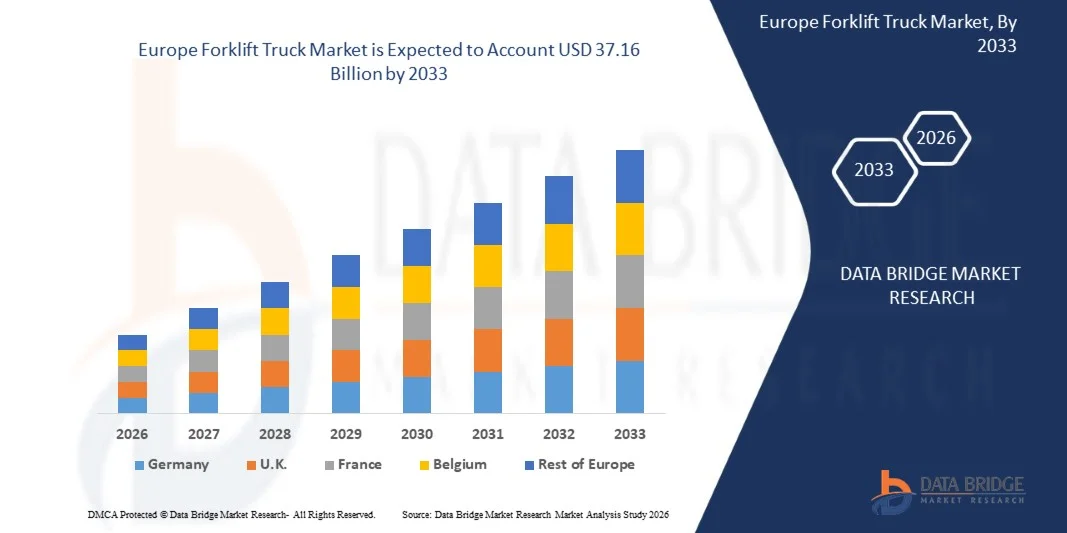
As per Data Bridge Market Research analysis The Europe forklift truck market was valued at USD 22.29 billion in 2025 and is projected to reach USD 37.16 billion by 2033, growing at a CAGR of 6.60% from 2026 to 2033. The market is witnessing steady growth driven by rising demand for efficient material handling equipment across manufacturing, warehousing, logistics, and construction industries, along with increasing automation and electrification of industrial fleets across European countries.
The growing expansion of e-commerce, coupled with stringent workplace safety regulations and sustainability initiatives, is accelerating the adoption of electric and hybrid forklift trucks across Europe. Advancements in lithium-ion battery technology, telematics integration, and autonomous forklift systems are further enhancing operational efficiency, reducing emissions, and lowering long-term operational costs. In addition, the replacement of aging material handling equipment in key economies such as Germany, France, and the U.K. is supporting sustained market expansion.
Key Market Trends & Insights
- Germany dominated the global forklift truck market with the largest revenue share of 33.84% in 2025, supported by a strong industrial manufacturing base, advanced logistics infrastructure, and high adoption of warehouse automation technologies.
- The counterbalance forklifts segment led the market with a 58.6% share in 2025, driven by its extensive usage in manufacturing plants, logistics hubs, ports, and outdoor material handling operations.
- Poland is expected to be the fastest-growing country at a CAGR of 7.2% from 2026 to 2033, fueled by rapid expansion of logistics hubs, increasing foreign direct investment in manufacturing, and strong growth in e-commerce fulfillment infrastructure.
- Warehouse forklifts are the fastest-growing product type, projected to register a CAGR of 6.9%, reflecting the surge in expansion of e-commerce fulfillment centers and automated warehousing infrastructure across Europe.
- The Class V: Internal Combustion Engine Trucks segment dominated the class category with a 32.4% revenue share in 2025, led by its widespread application in heavy-duty industrial operations, construction sites, and outdoor logistics activities.
- Diesel accounted for 39.8% of the market, preferred by its high-power output, suitability for heavy-duty applications, and widespread usage in construction, ports, and large industrial facilities
- The 5 ton–10 ton segment is the fastest-growing lifting capacity category, with a CAGR of 7.6%, driven by rising demand in heavy warehousing, automotive manufacturing, and industrial logistics applications.
Market Size & Forecast
- Global Market Value (2025): USD 22.29 Billion
- Expected Market Value (2033): USD 37.16 Billion
- Forecast CAGR (2026–2033): 6.60%
- Leading Country in 2025: Germany
- Fastest Growing Country: Poland
Report Scope and Europe Forklift Truck Market Segmentation
|
Attributes |
Europe Forklift Truck Key Market Insights |
|
Segments Covered |
|
|
Countries Covered |
Europe · Germany · France · U.K. · Netherlands · Switzerland · Belgium · Russia · Italy · Spain · Turkey · Rest of Europe |
|
Key Market Players |
· Toyota Material Handling Europe (Sweden) · Jungheinrich AG (Germany) · KION GROUP AG (Germany) · Linde Material Handling GmbH (Germany) · STILL GmbH (Germany) · Baoli EMEA S.p.A. (Italy) · Mitsubishi Logisnext Europe B.V. (Netherlands) · Cat Lift Trucks (Netherlands) · Hyster-Yale Group, Inc. (U.S.) · Crown Equipment Corporation (U.S.) · CLARK Material Handling Company (South Korea) · Combilift (Ireland) · Aisle-Master (Ireland) · Manitou Group (France) · HANGCHA Group Co., Ltd. (China) · HANGCHA EUROPE GmbH (Germany) · Doosan Bobcat Inc. (South Korea) · EP Equipment Co., Ltd. (China) · HC Forklift America Corporation (China) · HERCU JSC (Bulgaria) |
|
Market Opportunities |
· Rapid expansion of e-commerce fulfillment centers in Poland and Central & Eastern Europe · Increasing shift toward lithium-ion battery-powered forklifts in Germany and France · Growing adoption of warehouse automation and Industry 4.0 technologies |
|
Value Added Data Infosets |
In addition to the market insights such as market value, growth rate, market segments, geographical coverage, market players, and market scenario, the market report curated by the Data Bridge Market Research team includes in-depth expert analysis, import/export analysis, pricing analysis, production consumption analysis, and pestle analysis. |
Europe Forklift Truck Market Trends
Trend: Strong Shift Toward Electrification and Smart Warehouse Integration
European logistics and industrial operators are increasingly replacing conventional diesel and LPG forklifts with electric and lithium-ion battery-powered models due to tightening EU emission regulations and rising pressure to achieve carbon neutrality targets. Countries such as Germany, France, the Netherlands, and the United Kingdom are leading this transition, supported by strong investments in green logistics infrastructure and warehouse modernization programs. Alongside electrification, forklifts are becoming more connected and data-driven through the integration of IoT sensors, telematics systems, and fleet management software. These technologies enable real-time tracking of equipment performance, battery health, and utilization rates, helping companies optimize fleet efficiency and reduce downtime. In large distribution centers, smart charging systems and predictive maintenance solutions are further improving operational continuity, making forklifts an integral part of digitally enabled warehouse ecosystems.
Europe Forklift Truck Market Dynamics
Key Market Driver: Expansion of E-commerce and Advanced Distribution Networks
The rapid expansion of e-commerce, quick commerce, and omnichannel retailing across Europe is significantly increasing the demand for efficient material handling equipment. Countries such as Germany, the United Kingdom, France, and Poland are witnessing strong growth in large-scale fulfillment centers and automated warehouses designed to handle high order volumes and faster delivery expectations. Forklifts are essential in these environments for pallet movement, stacking, loading, and vertical storage operations. Modern warehouses are increasingly integrating forklifts with warehouse management systems (WMS), barcode/RFID tracking, and semi-autonomous navigation technologies, which improves accuracy and reduces manual intervention. In advanced logistics hubs, forklifts also operate alongside robotic systems and conveyor automation, creating hybrid environments that significantly enhance throughput, reduce operational delays, and improve overall supply chain responsiveness.
Key Restraint/Challenge: High Acquisition and Lifecycle Costs of Advanced Forklift Systems
Despite strong adoption potential, the market faces significant cost-related challenges. Electric forklifts, particularly lithium-ion variants, require high upfront investment compared to traditional internal combustion models. Additional costs arise from charging infrastructure setup, battery replacement cycles, and energy system upgrades within warehouses. Moreover, advanced forklifts equipped with telematics, automation features, and AI-based navigation require continuous software updates, licensing fees, and specialized technical support. Small and medium-sized enterprises in countries such as Italy, Spain, and parts of Eastern Europe often struggle to justify these investments due to budget limitations and uncertain return on investment timelines. The shortage of trained operators and maintenance technicians further adds complexity, slowing down adoption in cost-sensitive markets despite long-term efficiency benefits.
Key Market Opportunity: Integration of Automation, AI, and Smart Fleet Ecosystems
A major growth opportunity lies in the convergence of forklifts with artificial intelligence, robotics, and digital warehouse ecosystems. Modern forklifts are increasingly evolving into intelligent, connected machines capable of real-time decision-making within complex logistics environments. AI-enabled systems help optimize travel routes inside warehouses, reduce congestion in aisles, and automatically assign tasks based on workload priorities. Predictive analytics tools also help in forecasting maintenance needs, reducing unexpected breakdowns and improving fleet uptime. Countries such as Germany, the Netherlands, and Poland are at the forefront of deploying such advanced warehouse automation technologies. In addition, the growing use of digital twin technology allows companies to simulate warehouse layouts and forklift movement patterns before implementation, improving operational planning and efficiency. As automation continues to expand, forklifts are becoming fully integrated components of smart supply chain networks rather than standalone material handling equipment.
Europe Forklift Truck Market Scope
The Europe forklift truck market is segmented on the basis of product type, class, fuel type, engine type, lifting capacity, and end-use industry.
- By Product Type
On the basis of product type, the Europe forklift truck market is segmented into warehouse forklifts and counterbalance forklifts. The counterbalance forklifts segment dominated the market with a 58.6% share in 2025, owing to its extensive usage in manufacturing plants, logistics hubs, ports, and outdoor material handling operations. These forklifts offer high versatility in lifting heavy loads and operating in both indoor and outdoor environments, making them a preferred choice across industries such as automotive and construction in countries such as Germany, France, and the United Kingdom. Strong demand for robust load-handling equipment in large-scale industrial operations further strengthens its dominance. Continuous improvements in operator comfort, safety systems, and fuel efficiency are also enhancing adoption. However, higher fuel consumption in internal combustion variants remains a limiting factor compared to electric alternatives.
The warehouse forklifts segment is expected to witness the fastest growth, with a projected CAGR of 6.9%, driven by rapid expansion of e-commerce fulfillment centers and automated warehousing infrastructure across Europe. These forklifts are widely used in narrow-aisle operations, high-rack storage, and indoor logistics environments where space optimization is critical. Increasing investments in smart warehouses in countries such as Germany, the Netherlands, and Poland are accelerating adoption. Electric and compact forklift variants are further boosting efficiency in confined spaces. Integration with warehouse management systems (WMS) and automation technologies is enhancing operational precision. Rising demand for high-speed order fulfillment is also supporting strong growth in this segment.
- By Class
On the basis of class, the market is segmented into Class I: Electric Motor Rider Trucks, Class II: Electric Motor Narrow Aisle Trucks, Class III: Electric Motor Pedestrian Trucks, Class IV: Internal Combustion Engine Trucks; Class V: Internal Combustion Engine Trucks, Class VI: Electric and Internal Combustion Engine Tractors, and Class VII: Rough Terrain Forklift Trucks. The Class V: Internal Combustion Engine Trucks segment dominated the market with a 32.4% share in 2025, due to its widespread application in heavy-duty industrial operations, construction sites, and outdoor logistics activities. These forklifts are preferred for their high load capacity, durability, and ability to operate in harsh environments. Countries such as France, Italy, and parts of Eastern Europe continue to rely heavily on IC engine forklifts for cost-effective heavy material handling. Strong presence in traditional manufacturing and construction sectors further supports dominance. However, environmental regulations in Europe are gradually limiting long-term growth of this segment.
The Class I: Electric Motor Rider Trucks segment is expected to be the fastest growing, with a CAGR of 7.4%, driven by strict EU emission regulations and the shift toward electrified material handling solutions. These forklifts are widely used in warehouses, retail distribution centers, and manufacturing facilities due to their zero-emission operation and low noise levels. Rapid electrification of logistics infrastructure in Germany, the Netherlands, and Sweden is accelerating demand. Advancements in lithium-ion batteries and charging technologies are improving efficiency and reducing downtime. Growing focus on workplace safety and indoor air quality is also driving adoption. Increasing automation in warehouses is further strengthening growth prospects for this segment.
- By Fuel Type
On the basis of fuel type, the market is segmented into diesel, gasoline & LPG/CNG, and electric/hybrid forklifts. The diesel fuel segment dominated the market with a 39.8% share in 2025, primarily due to its high-power output, suitability for heavy-duty applications, and widespread usage in construction, ports, and large industrial facilities. Diesel forklifts are particularly favored in outdoor environments where long operational hours and high load capacities are required. Countries with strong industrial bases such as Germany and France continue to utilize diesel forklifts in legacy infrastructure. Their ability to perform under extreme conditions ensures consistent demand. However, environmental concerns and tightening emission norms are gradually limiting their expansion in Europe.
The electric/hybrid segment is expected to register the fastest growth, with a CAGR of 8.1%, driven by Europe’s aggressive decarbonization policies and rising adoption of sustainable logistics solutions. These forklifts are increasingly used in warehouses, retail centers, and food industry applications due to zero emissions and lower operating costs. Strong adoption is visible in countries such as Germany, the United Kingdom, and the Netherlands, where green logistics initiatives are well established. Improvements in battery technology, especially lithium-ion systems, are enhancing performance and charging efficiency. Government incentives and carbon reduction targets are further accelerating adoption. The growing shift toward smart and automated warehouses is also boosting demand.
- By Engine Type
On the basis of engine type, the market is segmented into internal combustion (IC) engine power and electric power forklifts. The IC engine segment dominated the market with a 56.2% share in 2025, driven by strong demand for high-power lifting capabilities in heavy industries, construction, and outdoor logistics operations. These forklifts are widely used where continuous operation and high load handling are required without dependency on charging infrastructure. Countries such as Italy, Spain, and parts of Central and Eastern Europe continue to rely on IC engine forklifts due to cost considerations. Their durability and suitability for rugged environments further support their dominance. However, regulatory pressure on emissions is gradually restricting long-term expansion.
The electric power forklifts segment is expected to be the fastest growing, with a CAGR of 8.5%, fueled by rapid electrification of warehouse operations and stringent environmental regulations across Europe. Electric forklifts are increasingly preferred in indoor logistics, retail, and manufacturing environments due to zero emissions, lower noise levels, and reduced maintenance requirements. Germany, France, the Netherlands, and Sweden are leading adoption due to strong sustainability targets. Advancements in lithium-ion battery systems are significantly improving performance and operational uptime. Growing integration with automation and smart warehouse systems is further enhancing efficiency. The shift toward carbon-neutral supply chains is a key growth driver.
- By Lifting Capacity
On the basis of lifting capacity, the market is segmented into < 5 ton, 5 ton–10 ton, 11 ton–36 ton, and > 36 ton forklifts. The < 5 ton segment dominated the market with a 44.3% share in 2025, as it is widely used in warehouses, retail distribution, food processing, and general manufacturing applications. These forklifts are highly versatile and suitable for standard pallet handling operations across Europe’s expanding logistics infrastructure. Strong demand from e-commerce fulfillment centers in Germany, Poland, and the United Kingdom is further supporting dominance. Their lower cost, compact design, and ease of operation make them highly preferred. Increasing warehouse automation is also boosting deployment of small-capacity electric models.
The 5 ton–10 ton segment is expected to be the fastest growing, with a CAGR of 7.6%, driven by rising demand in heavy warehousing, automotive manufacturing, and industrial logistics applications. These forklifts offer a balance between power and maneuverability, making them suitable for medium-to-heavy load operations. Expanding industrial production hubs in Germany and France are contributing to strong demand. Growth in infrastructure development and construction activities in Eastern Europe is further supporting adoption. Increasing use of advanced electric variants in this capacity range is improving efficiency. Rising need for flexible material handling solutions in hybrid industrial environments is accelerating growth.
- By End-Use Industry
On the basis of end-use industry, the market is segmented into retail & wholesale, transportation & logistics, automotive & electrical engineering, food industry, and other industries. The transportation & logistics segment dominated the market with a 46.7% share in 2025, driven by the rapid expansion of e-commerce, third-party logistics (3PL) providers, and large-scale distribution centers across Europe. Countries such as Germany, the Netherlands, and Poland are major logistics hubs, heavily reliant on forklifts for efficient cargo handling and warehouse operations. Integration with warehouse management systems and automation technologies further strengthens this segment. Continuous growth in cross-border trade within the EU is also supporting demand. High volume movement of goods ensures sustained forklift utilization.
The food industry segment is expected to be the fastest growing, with a CAGR of 7.9%, driven by increasing demand for cold chain logistics, packaged food distribution, and strict hygiene regulations. Forklifts used in this sector are increasingly electric to ensure zero emissions in indoor food handling environments. Countries such as France, Italy, and Spain are witnessing strong investment in food processing and refrigerated warehouses. Growth in online grocery and quick-commerce delivery is further boosting demand. Compliance with food safety and hygiene standards is encouraging adoption of specialized forklifts. Expansion of automated cold storage facilities is also accelerating market growth in this segment.
Europe Forklift Truck Market Regional Analysis
Germany dominated the global forklift truck market with the largest revenue share of 33.84% in 2025, supported by a strong industrial manufacturing base, advanced logistics infrastructure, and high adoption of warehouse automation technologies. The region also benefits from stringent emission regulations, rapid expansion of e-commerce logistics networks, and increasing investments in smart warehouse technologies. Growing deployment of IoT-enabled forklifts, fleet management systems, and lithium-ion battery-powered equipment across Germany, France, the United Kingdom, and Poland continues to strengthen Europe’s leadership position in the global forklift truck market.
U.S. Europe Forklift Truck Market Insight
The U.S. forklift truck market is witnessing strong growth due to rising investments in e-commerce logistics infrastructure, warehouse automation, and advanced material handling technologies. The country’s large-scale distribution networks, well-established manufacturing base, and expanding retail sector are driving consistent demand for electric and IC engine forklifts across commercial and industrial applications. In addition, increasing adoption of lithium-ion battery-powered forklifts, AI-enabled fleet management systems, and autonomous material handling solutions is further accelerating market expansion across warehouses, ports, and manufacturing facilities.
Europe Forklift Truck Market Insight
The Europe forklift truck market remains a major contributor to global revenue, driven by strong industrial production, advanced warehousing infrastructure, and strict environmental and emission regulations. The widespread adoption of electric forklifts, lithium-ion battery systems, and smart fleet management technologies is supporting market expansion across logistics, manufacturing, and retail sectors. Increasing investments in warehouse automation, along with growing demand for sustainable and energy-efficient material handling equipment, continue to strengthen the adoption of forklifts throughout Europe.
U.K. Forklift Truck Market Insight
The U.K. forklift truck market is experiencing steady growth, supported by rising e-commerce activities, modernization of warehouse infrastructure, and increasing demand for efficient material handling solutions. Growing adoption of electric forklifts and fleet telematics systems is improving operational efficiency and reducing emissions across logistics and retail sectors. Furthermore, integration of automation technologies and smart warehouse solutions is enhancing productivity, positioning the U.K. as a key innovation-driven market in Europe’s forklift truck industry.
Germany Forklift Truck Market Insight
The Germany forklift truck market is expanding steadily due to its strong industrial manufacturing base, advanced logistics networks, and leadership in automotive production. Forklifts are widely used across manufacturing plants, automotive supply chains, and large-scale distribution centers for efficient material handling operations. Increasing adoption of electric forklifts, automation systems, and lithium-ion battery technologies, along with strong focus on sustainability and Industry 4.0 initiatives, is further driving market growth in Germany.
Asia-Pacific Forklift Truck Market Insight
The Asia-Pacific forklift truck market is expected to witness rapid growth, driven by expanding industrialization, booming e-commerce logistics, and increasing investments in warehouse infrastructure across countries such as China, India, and Japan. Rising demand for cost-efficient material handling equipment, coupled with growing adoption of electric and automated forklifts, is supporting regional expansion. In addition, increasing manufacturing activities and development of smart logistics hubs are accelerating forklift adoption across commercial and industrial sectors.
Japan Forklift Truck Market Insight
The Japan forklift truck market is witnessing steady growth due to strong industrial automation, advanced manufacturing capabilities, and increasing focus on efficient logistics systems. Automotive manufacturers, electronics companies, and logistics providers are increasingly adopting electric forklifts and smart fleet management solutions to enhance operational efficiency. Moreover, rising integration of robotics, AI-based logistics systems, and lithium-ion battery technologies is further contributing to market growth in Japan.
China Forklift Truck Market Insight
The China forklift truck market is growing rapidly, driven by large-scale industrial expansion, strong e-commerce logistics growth, and increasing investments in smart warehouse infrastructure. The country is witnessing rising adoption of electric forklifts, lithium-ion battery systems, and automated material handling solutions across manufacturing, retail, and logistics sectors. In addition, government support for industrial modernization and growing focus on green logistics are positioning China as one of the fastest-growing forklift truck markets globally.
Europe Forklift Truck Market Share
The Europe forklift truck industry is primarily led by well-established companies, including:
- Toyota Material Handling Europe (Sweden)
- Jungheinrich AG (Germany)
- KION GROUP AG (Germany)
- Linde Material Handling GmbH (Germany)
- STILL GmbH (Germany)
- Baoli EMEA S.p.A. (Italy)
- Mitsubishi Logisnext Europe B.V. (Netherlands)
- Cat Lift Trucks (Netherlands)
- Hyster-Yale Group, Inc. (U.S.)
- Crown Equipment Corporation (U.S.)
- CLARK Material Handling Company (South Korea)
- Combilift (Ireland)
- Aisle-Master (Ireland)
- Manitou Group (France)
- HANGCHA Group Co., Ltd. (China)
- HANGCHA EUROPE GmbH (Germany)
- Doosan Bobcat Inc. (South Korea)
- EP Equipment Co., Ltd. (China)
- HC Forklift America Corporation (China)
- HERCU JSC (Bulgaria)
Latest Developments in Europe Forklift Truck Market
- In May 2025, KION Group announced the expansion of its electrified and automated industrial truck portfolio in Europe, strengthening its focus on lithium-ion battery-powered forklifts and smart intralogistics solutions. The development is aimed at supporting rising demand for energy-efficient warehouse operations and Industry 4.0-driven logistics systems across key European markets. The initiative further reinforces KION’s strategy to enhance automation capabilities in material handling equipment and improve operational efficiency in large-scale distribution centers
- In September 2024, Jungheinrich introduced new advancements in its automation and intralogistics solutions portfolio, expanding its autonomous mobile robot (AMR) and smart warehouse systems across Europe. The development focuses on integrating AI-driven fleet management and scalable automation technologies to improve warehouse productivity and operational flexibility. This expansion supports growing demand for automated forklift solutions in high-volume logistics and e-commerce fulfillment centers
- In June 2023, Toyota Material Handling Europe expanded its electric forklift lineup, accelerating its shift toward lithium-ion battery-powered industrial trucks designed for sustainable warehouse operations. The launch supports increasing demand for low-emission and energy-efficient material handling equipment across Europe’s logistics and manufacturing sectors. It also enhances operational efficiency and reduces total lifecycle costs for fleet operators
- In October 2022, KION Group announced a major capacity expansion investment in its German manufacturing facilities to meet rising demand for electric and automated forklift trucks in Europe. The development focuses on increasing production of warehouse trucks and automation systems to support e-commerce growth and supply chain modernization. It strengthens the company’s ability to supply advanced intralogistics solutions across European markets
- In July 2021, STILL (a KION Group brand) enhanced its autonomous intralogistics and forklift automation solutions across Europe, focusing on improving safety, efficiency, and scalability in warehouse operations. The development includes advanced navigation systems and intelligent fleet coordination technologies for automated material handling. It supports the growing transition toward smart warehouse ecosystems and autonomous logistics operations

- Interactive Data Analysis Dashboard
- Company Analysis Dashboard for high growth potential opportunities
- Research Analyst Access for customization & queries
- Competitor Analysis with Interactive dashboard
- Latest News, Updates & Trend analysis
- Harness the Power of Benchmark Analysis for Comprehensive Competitor Tracking
Data collection and base year analysis are done using data collection modules with large sample sizes. The stage includes obtaining market information or related data through various sources and strategies. It includes examining and planning all the data acquired from the past in advance. It likewise envelops the examination of information inconsistencies seen across different information sources. The market data is analysed and estimated using market statistical and coherent models. Also, market share analysis and key trend analysis are the major success factors in the market report. To know more, please request an analyst call or drop down your inquiry.
The key research methodology used by DBMR research team is data triangulation which involves data mining, analysis of the impact of data variables on the market and primary (industry expert) validation. Data models include Vendor Positioning Grid, Market Time Line Analysis, Market Overview and Guide, Company Positioning Grid, Patent Analysis, Pricing Analysis, Company Market Share Analysis, Standards of Measurement, Global versus Regional and Vendor Share Analysis. To know more about the research methodology, drop in an inquiry to speak to our industry experts.
Data Bridge Market Research is a leader in advanced formative research. We take pride in servicing our existing and new customers with data and analysis that match and suits their goal. The report can be customized to include price trend analysis of target brands understanding the market for additional countries (ask for the list of countries), clinical trial results data, literature review, refurbished market and product base analysis. Market analysis of target competitors can be analyzed from technology-based analysis to market portfolio strategies. We can add as many competitors that you require data about in the format and data style you are looking for. Our team of analysts can also provide you data in crude raw excel files pivot tables (Fact book) or can assist you in creating presentations from the data sets available in the report.













