


What is the Europe Gas Equipment Market Size and Growth Rate?
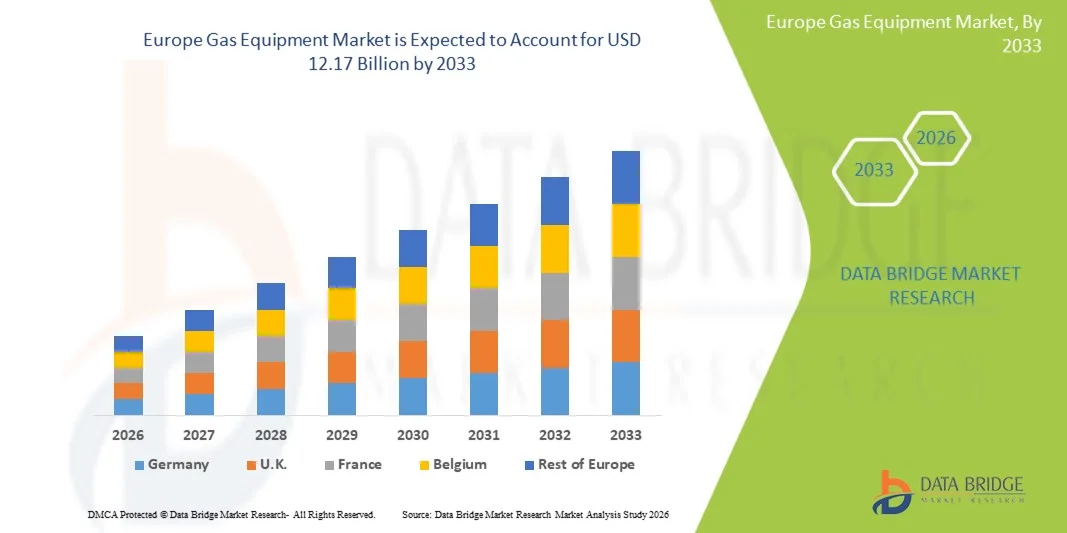
- As per Data Bridge Market Research analysis, the Europe gas equipment market size was valued at USD 5.14 billion in 2025 and is expected to reach USD 12.17 billion by 2033, at a CAGR of 11.38% during the forecast period
- The market growth is largely driven by increasing industrialization, expanding energy infrastructure, and growing adoption of advanced gas equipment across various sectors including oil & gas, chemical, and manufacturing industries
- Furthermore, stringent safety regulations, rising demand for efficient and reliable gas handling systems, and technological advancements in gas storage and distribution solutions are positioning gas equipment as a critical component in modern industrial operations. These factors are collectively accelerating market adoption, thereby significantly supporting the industry’s growth
Market Size & Forecast
- Global Market Value (2025): USD 5.14 billion
- Expected Market Value (2033): USD 12.17 billion
- Forecast CAGR (2026-2033): 11.38%
What are the Major Takeaways of Europe Gas Equipment Market?
- Gas equipment, encompassing devices and systems for storage, distribution, and control of industrial and specialty gases, is increasingly vital across sectors such as oil & gas, chemicals, healthcare, and metal fabrication due to enhanced operational efficiency, safety compliance, and precision in gas handling
- The rising demand for gas equipment is primarily driven by stringent safety and environmental regulations, growing industrialization, and the need for automated, reliable, and high-performance gas systems in European industries
- Germany dominated the gas equipment market with the largest revenue share of 35.8% in 2025, attributed to early industrial modernization, robust regulatory frameworks, and a strong presence of key industry players, with significant adoption of advanced gas detection, delivery, and purification systems across manufacturing and chemical sectors
- Poland is expected to be the fastest-growing country in the gas equipment market during the forecast period, driven by rising industrial activity, modernization of gas infrastructure, and increasing investment in energy efficiency and process automation projects
- Gas Delivery Systems segment dominated the gas equipment market with a market share of 42.7% in 2025, propelled by their critical role in ensuring safe, precise, and continuous supply of industrial and specialty gases across multiple end-user industries
Report Scope and Europe Gas Equipment Market Segmentation
|
Attributes |
Europe Gas Equipment Key Market Insights |
|
Segments Covered |
|
|
Countries Covered |
Europe
|
|
Key Market Players |
|
|
Market Opportunities |
|
|
Value Added Data Infosets |
In addition to the insights on market scenarios such as market value, growth rate, segmentation, geographical coverage, and major players, the market reports curated by the Data Bridge Market Research also include in-depth expert analysis, patient epidemiology, pipeline analysis, pricing analysis, and regulatory framework |
What is the Key Trend in the Europe Gas Equipment Market?
“Advanced Automation and Digital Monitoring”
- A significant and accelerating trend in the Europe gas equipment market is the adoption of advanced automation and digital monitoring systems, which enable real-time tracking, precise flow control, and predictive maintenance across industrial gas operations
- For instance, Emerson’s Roxar gas monitoring solutions integrate with digital control systems, allowing operators to remotely track gas flow and detect anomalies instantly
- Automation in gas delivery and detection systems enhances operational efficiency, reduces human error, and improves safety compliance by providing continuous monitoring and alerts for deviations in pressure, temperature, or gas composition
- Digital integration also facilitates centralized control of multiple gas systems, enabling operators to manage gas generation, storage, and distribution from a single interface, thereby optimizing energy usage and reducing downtime
- Increasing adoption of IoT-enabled gas equipment is providing operators with predictive insights, enabling proactive maintenance and minimizing unexpected downtime in industrial facilities
- Companies such as Air Liquide are implementing AI-driven analytics in their gas networks to optimize performance, reduce waste, and improve energy efficiency
- The trend toward smart, connected, and automated gas equipment is fostering collaboration between equipment manufacturers and industrial operators for customized, industry-specific solutions
- The demand for gas equipment with advanced automation and digital monitoring is growing rapidly across manufacturing, healthcare, and energy sectors, as operators increasingly prioritize efficiency, safety, and operational reliability
Europe Gas Equipment Market Dynamics
Driver
“Increasing Industrialization and Stringent Safety Regulations”
- The growing industrial base in Europe, combined with strict safety and environmental regulations, is a significant driver of the heightened demand for advanced gas equipment
- For instance, in March 2025, Linde PLC upgraded its gas delivery and detection systems in German chemical plants to comply with updated EU safety standards while improving operational efficiency
- As industrial facilities seek safer and more efficient gas handling solutions, equipment such as automated regulators, flow devices, and detection systems provide precise control and reduce operational risks
- Furthermore, modernization of energy and manufacturing infrastructure is driving investments in high-performance gas storage, purification, and delivery systems across multiple European countries
- The increasing focus on sustainability and energy efficiency in industrial operations is pushing companies to adopt advanced gas equipment that reduces emissions and minimizes resource consumption
- Strategic partnerships between gas equipment manufacturers and end-users are accelerating the deployment of cutting-edge technologies, driving market growth in key European economies
- The need for reliable, compliant, and technologically advanced gas equipment to support industrial growth and ensure regulatory adherence is propelling market adoption in both mature and emerging European economies
Restraint/Challenge
“High Capital Costs and Regulatory Complexity”
- The relatively high upfront costs of advanced gas equipment and complex regulatory requirements pose a significant challenge to broader market penetration
- For instance, small and medium-sized manufacturing units in Poland and Eastern Europe face budget constraints that limit the adoption of high-end gas delivery and detection systems
- Compliance with stringent EU regulations for safety, emissions, and equipment certification can result in longer procurement cycles and increased operational costs, affecting market expansion
- In addition, specialized maintenance, skilled labor requirements, and integration with legacy systems can further increase total implementation costs and complexity for industrial operators
- Limited awareness and technical expertise among smaller industrial operators can delay adoption of modern gas equipment despite potential operational benefits
- Uncertainty regarding regulatory updates and evolving standards may lead to hesitation among companies in committing to long-term investments in advanced gas systems
- Overcoming these challenges through cost-optimized solutions, modular systems, and support for regulatory compliance will be vital for sustained growth and wider adoption of gas equipment across European industries
How is the Europe Gas Equipment Market Segmented?
The market is segmented on the basis of equipment type, process, gas type, and end-user.
- By Equipment Type
On the basis of equipment type, the Europe gas equipment market is segmented into gas delivery systems, gas regulators, flow devices, purifiers and filters, gas generating systems, gas detection systems, cryogenic products, and accessories. The Gas Delivery Systems segment dominated the market with the largest revenue share of 42.7% in 2025, driven by its critical role in safely transporting industrial and specialty gases across manufacturing, healthcare, and energy sectors. Gas delivery systems ensure precise flow control, maintain consistent pressure, and support uninterrupted operations in highly regulated environments. Europe’s stringent safety and industrial regulations also favor their adoption, as these systems reduce operational risk and enhance process reliability. Large industrial facilities in Germany, France, and the U.K. rely on advanced delivery systems for continuous supply to critical processes. Established suppliers offer robust, scalable, and high-performance solutions, further reinforcing this segment’s dominance. In addition, integration with automation and digital monitoring platforms enhances efficiency and operational control.
The Gas Detection Systems segment is expected to witness the fastest growth from 2026 to 2033, fueled by rising safety concerns, stricter EU regulations, and growing demand for real-time monitoring. Gas detection systems are increasingly IoT-enabled, providing predictive maintenance alerts and early hazard detection. They are critical in chemical, oil & gas, and healthcare facilities, where gas leaks or exposure can have severe consequences. Increasing workplace safety awareness and compliance requirements are driving adoption across Western and Eastern Europe. Technological advancements, such as AI-enabled detection and cloud-based monitoring, further enhance their appeal. Emerging industrial hubs in Eastern Europe are rapidly investing in detection systems, accelerating market growth.
- By Process
On the basis of process, the Europe gas equipment market is segmented into gas generation, gas storage, gas detection, and gas transportation. The Gas Storage segment dominated the market in 2025 due to the need for safe, scalable, and efficient storage solutions for industrial gases such as oxygen, nitrogen, and carbon dioxide. Storage systems ensure uninterrupted supply for manufacturing, healthcare, and energy sectors, while complying with strict safety and environmental regulations. Adoption of cryogenic and high-pressure storage tanks, combined with advanced monitoring technologies, enhances reliability and minimizes operational risks. Major equipment manufacturers in Germany, France, and the U.K. reinforce the segment’s leadership. Industrial facilities prioritize storage systems to manage high-demand processes and emergency backup supply. Increasing integration with digital platforms allows real-time monitoring of gas levels and pressure, improving overall process control.
The Gas Detection segment is projected to register the fastest growth from 2026 to 2033, driven by stricter industrial safety mandates and rising automation in monitoring systems. Advanced detection systems are equipped with AI and IoT analytics for predictive alerts and remote monitoring. Chemical, oil & gas, and healthcare sectors are rapidly adopting these systems to reduce risks and maintain compliance. Governments across Europe are mandating real-time monitoring in high-risk industries, fueling investments. Small and medium-sized industrial units are also upgrading systems to meet certification requirements. Integration with centralized control systems allows operators to manage multiple processes simultaneously, enhancing efficiency and safety.
- By Gas
On the basis of gas type, the Europe gas equipment market is segmented into nitrogen, hydrogen, helium, oxygen, carbon dioxide, and others. The Oxygen segment dominated the market in 2025 due to extensive use in healthcare, metal fabrication, and chemical processing industries. Oxygen supply systems, including cylinders, pipelines, and storage tanks, are critical for operational continuity and patient safety. Hospitals and manufacturing units prioritize reliable oxygen delivery to comply with stringent EU regulations. Germany, France, and the U.K. account for the majority of demand due to advanced healthcare infrastructure and industrial operations. Technological integration with digital monitoring systems enhances efficiency and ensures safety standards. Increasing investments in industrial and medical facilities further reinforce the dominance of oxygen-related gas equipment.
The Hydrogen segment is expected to witness the fastest growth from 2026 to 2033, driven by Europe’s energy transition initiatives and adoption of hydrogen as a clean energy source. Investments in hydrogen production, storage, and distribution infrastructure are rising across Germany, the Netherlands, and France. Equipment for hydrogen handling is advancing to support safe storage, transportation, and usage in industrial and energy sectors. Government policies and incentives for green hydrogen adoption are accelerating market expansion. Industrial players are increasingly collaborating with technology providers to implement scalable hydrogen solutions. Growing focus on decarbonization and renewable energy integration underpins rapid growth in this segment.
- By End-user
On the basis of end-user, the Europe gas equipment market is segmented into metal fabrication, chemicals, healthcare, oil and gas, food and beverage, and others. The Chemicals segment dominated the market in 2025, driven by high demand for precise and safe gas control systems in chemical plants. Industrial gas equipment is essential for processes such as synthesis, separation, and reaction control, ensuring operational efficiency and compliance with European environmental regulations. Germany, France, and the U.K. are leading markets due to their large chemical manufacturing bases. Integration with automated and digital monitoring systems further improves productivity and safety. The need for reliable gas supply and advanced purification solutions reinforces dominance in this segment. Continuous investments in industrial modernization and expansion of chemical facilities maintain strong demand.
The Healthcare segment is anticipated to register the fastest growth from 2026 to 2033, owing to rising demand for medical gases and advanced delivery systems in hospitals and clinics. Integration with IoT-enabled monitoring systems allows real-time tracking of oxygen, nitrogen, and specialty medical gases. Rising patient volumes, healthcare modernization, and regulatory compliance are driving adoption. Germany, France, and Italy are witnessing rapid infrastructure upgrades to meet growing healthcare demands. Technological advancements, including automated delivery and digital alert systems, improve operational efficiency. Increasing awareness about patient safety and the critical role of reliable gas supply supports growth in this segment.
Europe Gas Equipment Market Regional Analysis
- Germany dominated the gas equipment market with the largest revenue share of 35.8% in 2025, attributed to early industrial modernization, robust regulatory frameworks, and a strong presence of key industry players, with significant adoption of advanced gas detection, delivery, and purification systems across manufacturing and chemical sectors
- Industrial operators in Germany highly prioritize efficiency, reliability, and compliance, leading to widespread adoption of automated gas delivery systems, detection systems, and purifiers that integrate with digital monitoring platforms
- This dominance is further supported by the presence of key gas equipment manufacturers, high investment in industrial infrastructure, and a focus on modernizing energy and chemical production facilities, establishing Germany as the leading market for gas equipment in Europe
The Germany Gas Equipment Market Insight
The Germany gas equipment market is expected to expand at a considerable CAGR during the forecast period, fueled by its robust industrial base, stringent regulatory compliance, and the increasing adoption of advanced, automated gas handling solutions. Germany’s focus on innovation, sustainability, and operational efficiency promotes the deployment of high-performance gas delivery, storage, and detection systems, particularly in manufacturing, chemical, and healthcare industries. Industrial operators in Germany prioritize reliability, safety, and digital integration, driving demand for IoT-enabled and AI-assisted monitoring systems. The integration of gas equipment with automated processes enhances efficiency, reduces operational risks, and ensures adherence to strict EU safety standards. In addition, Germany’s well-developed infrastructure and emphasis on technological advancement encourage continuous adoption of cutting-edge solutions.
U.K. Gas Equipment Market Insight
The U.K. gas equipment market is anticipated to grow at a noteworthy CAGR during the forecast period, driven by rising industrial modernization, growing investments in energy and chemical sectors, and regulatory emphasis on safety and environmental compliance. Both manufacturing and healthcare facilities are increasingly adopting automated and digitally monitored gas systems to improve operational efficiency and safety. Concerns over industrial hazards and the need for precise, reliable gas delivery and detection solutions are encouraging companies to deploy advanced equipment. The U.K.’s strong focus on digitalization, IoT-enabled monitoring, and integration with process automation is expected to continue driving market growth. In addition, government incentives and safety mandates for high-risk industries are supporting adoption in new and existing facilities.
France Gas Equipment Market Insight
The France gas equipment market is expected to expand steadily during the forecast period, fueled by increasing industrialization, modernization of chemical and manufacturing sectors, and regulatory focus on safety and environmental standards. French operators are prioritizing advanced gas delivery, purification, and storage solutions that ensure operational reliability and compliance with stringent European regulations. Integration with digital monitoring platforms and automated control systems is enhancing efficiency and reducing human error. The demand for safe and precise gas handling equipment is increasing across healthcare, energy, and metal fabrication sectors. Moreover, France’s investments in energy efficiency and process automation are encouraging adoption of modern gas equipment. Technological innovation and collaborations with leading equipment manufacturers further support market expansion.
Poland Gas Equipment Market Insight
The Poland gas equipment market is expected to witness the fastest growth during the forecast period, fueled by rapid industrialization, modernization of manufacturing and energy infrastructure, and increasing awareness of safety and operational efficiency. Small and medium-sized enterprises are increasingly adopting automated gas delivery, storage, and detection systems to comply with EU regulations and improve productivity. Technological advancements such as IoT-enabled monitoring and predictive maintenance are accelerating adoption. Government incentives for energy efficiency and infrastructure upgrades are supporting market expansion. The rising demand for industrial gases in chemical, healthcare, and metal fabrication sectors is further driving growth. In addition, partnerships with leading equipment manufacturers are facilitating access to modern, high-performance gas solutions across the country.
Which are the Top Companies in Europe Gas Equipment Market?
The Europe Gas Equipment industry is primarily led by well-established companies, including:
- LINDE PLC (Ireland)
- Air Liquide (France)
- BASF SE (Germany)
- Air Products and Chemicals, Inc. (U.S.)
- Messer Construction Co. (Germany)
- SOL Group (Italy)
- Matheson Tri-Gas Inc. (U.S.)
- Taiyo Nippon Sanso Corporation (Japan)
- Elliniki Gases S.A. (Greece)
- Chevron Corporation (U.S.)
- BP Plc (U.K.)
- TotalEnergies SE (France)
- Exxon Mobil Corporation (U.S.)
- Equinor ASA (Norway)
- NK Lukoil PAO (Russia)
- Gazprom PJSC ADR (Russia)
- Rosneft Oil Co. PJSC (Russia)
- NIPPON SANSO HOLDINGS CORPORATION (Japan)
- Bhoruka Specialty Gases Pvt Ltd (India)
- Gruppo SIAD (Italy)
What are the Recent Developments in Europe Gas Equipment Market?
- In August 2025, Eiffage with start-up Revcoo began a cryogenic carbon-capture pilot at its lime-production plant in northern France. The system uses a nitrogen jet cooled to –196 °C to freeze and liquify CO₂ directly, avoiding water or chemical solvents. The pilot currently captures ~1,000 tonnes of CO₂ annually, with plans to scale to 100,000 tonnes by 2030
- In July 2025, French grid operator Natran, storage operator Terega, and Spain’s Enagas formed a joint venture to build the Barmar hydrogen pipeline, an underwater link between Barcelona and Marseille. This project is part of the broader H2Med corridor, a €2.5 billion initiative that aims by 2030 to transport up to 2 million tons of green hydrogen annually boosting cross-border hydrogen infrastructure in Europe
- In February 2025, Enagas (Spain) announced plans to invest over €4 billion by 2030, with €3.13 billion earmarked specifically for hydrogen infrastructure. The investment will go into hydrogen networks, CO₂ capture facilities, and may involve ammonia infrastructure as well. This signals a strong strategic shift by a traditional gas‐grid company toward hydrogen and decarbonized gas systems
- In September 2024, Eni and Snam launched Italy’s first carbon capture, transport, and storage (CCS) project. The project will capture CO₂ from an Eni gas-treatment plant in Ravenna and inject it into a depleted offshore gas reservoir ~3,000 meters under the Adriatic Sea. The initiative helps heavy industries cut emissions and repurpose gas‑equipment infrastructure for CO₂ storage
- In April 2023, The Porthos CCS project in the Port of Rotterdam (Netherlands) marked a major step: a 50 km CO₂ transport pipeline (from industry to a storage site) was launched to collect emissions and inject them into a depleted offshore gas field. This €1.3 billion project, involving major European industrial players, is one of the most ambitious carbon capture & storage (CCS) efforts in Europe, helping to decarbonize hard‑to-abate sectors

- Interactive Data Analysis Dashboard
- Company Analysis Dashboard for high growth potential opportunities
- Research Analyst Access for customization & queries
- Competitor Analysis with Interactive dashboard
- Latest News, Updates & Trend analysis
- Harness the Power of Benchmark Analysis for Comprehensive Competitor Tracking
Data collection and base year analysis are done using data collection modules with large sample sizes. The stage includes obtaining market information or related data through various sources and strategies. It includes examining and planning all the data acquired from the past in advance. It likewise envelops the examination of information inconsistencies seen across different information sources. The market data is analysed and estimated using market statistical and coherent models. Also, market share analysis and key trend analysis are the major success factors in the market report. To know more, please request an analyst call or drop down your inquiry.
The key research methodology used by DBMR research team is data triangulation which involves data mining, analysis of the impact of data variables on the market and primary (industry expert) validation. Data models include Vendor Positioning Grid, Market Time Line Analysis, Market Overview and Guide, Company Positioning Grid, Patent Analysis, Pricing Analysis, Company Market Share Analysis, Standards of Measurement, Global versus Regional and Vendor Share Analysis. To know more about the research methodology, drop in an inquiry to speak to our industry experts.
Data Bridge Market Research is a leader in advanced formative research. We take pride in servicing our existing and new customers with data and analysis that match and suits their goal. The report can be customized to include price trend analysis of target brands understanding the market for additional countries (ask for the list of countries), clinical trial results data, literature review, refurbished market and product base analysis. Market analysis of target competitors can be analyzed from technology-based analysis to market portfolio strategies. We can add as many competitors that you require data about in the format and data style you are looking for. Our team of analysts can also provide you data in crude raw excel files pivot tables (Fact book) or can assist you in creating presentations from the data sets available in the report.













