


Glucose Monitoring Devices Market Size
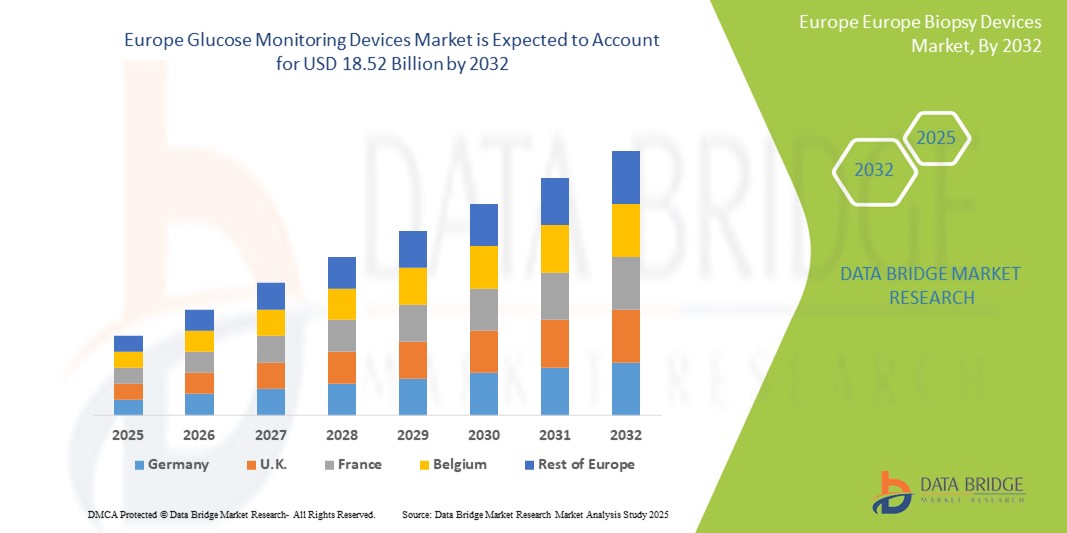
- The Europe Glucose Monitoring Devices market size was valued at USD 8.23 Billion in 2024 and is expected to reach USD 18.52 billion by 2032, at a CAGR of 10.67 % during the forecast period
- This growth is driven by factors such as the rising Europe diabetic population, increasing awareness of blood glucose monitoring, and advancements in glucose meter technology
Glucose Monitoring Devices Market Analysis
- Glucose Monitoring Devices are essential diagnostic tools that enable accurate and convenient blood glucose tracking in home-based settings, supporting early detection and ongoing management of diabetes
- The demand for these devices is significantly driven by the aging population, increasing prevalence of diabetes, and rising awareness of preventive healthcare
- Germany is expected to dominate the Glucose Monitoring Devices market due to the presence of a well-established healthcare infrastructure and high consumer adoption of at-home health monitoring devices
- U.K. is expected to be the fastest growing region in the Glucose Monitoring Devices market during the forecast period due to rapid urbanization, rising healthcare awareness, and supportive government health initiatives
- Continuous Glucose Monitoring Devices segment is expected to dominate the Glucose Monitoring Devices market with a market share of 56.38% due to increasing demand for real-time blood glucose tracking, advancements in sensor-based technologies, and rising prevalence of diabetes requiring continuous monitoring for effective management.
Report Scope and Glucose Monitoring Devices Market Segmentation
|
Attributes |
Glucose Monitoring Devices Key Market Insights |
|
Segments Covered |
|
|
Countries Covered |
Europe
|
|
Key Market Players |
|
|
Market Opportunities |
|
|
Value Added Data Infosets |
In addition to the insights on market scenarios such as market value, growth rate, segmentation, geographical coverage, and major players, the market reports curated by the Data Bridge Market Research also include import export analysis, production capacity overview, production consumption analysis, price trend analysis, climate change scenario, supply chain analysis, value chain analysis, raw material/consumables overview, vendor selection criteria, PESTLE Analysis, Porter Analysis, and regulatory framework. |
Glucose Monitoring Devices Market Trends
“Integration of Digital Health Technologies”
- Increasing adoption of smartphone-compatible Glucose Monitoring Devices and mobile apps enhances patient engagement and self-monitoring.
- Advancements in cloud-based data platforms enable real-time glucose tracking and sharing with healthcare providers.
For Instance
The increasing use of smartphone-compatible glucose monitoring devices and mobile apps is boosting patient engagement and self-monitoring. Cloud-based platforms allow real-time data sharing with healthcare providers, while AI-driven analytics deliver predictive insights, enabling more effective glycemic control and personalized diabetes management, significantly enhancing outcomes for diabetic patients.
- AI and analytics integration provide predictive insights for better glycemic control and personalized diabetes management.
Glucose Monitoring Devices Market Dynamics
Driver
Increase the cases of Diabetes
- The increasing number of individuals diagnosed with diabetes creates a substantial demand for effective insulin therapies, which in turn drives growth in the Europe insulin market.
- Factors such as sedentary lifestyles, unhealthy diets, and an aging population contribute to this trend, resulting in a larger patient base requiring diabetes management solutions.
For instance,
- In 2024, as per WHO , the number of people living with diabetes rose from 200 million in 1990 to 830 million in 2022. This rise was more rapid in low- and middle-income countries than in high-income countries. Diabetes caused over 2 million deaths in 2021, with significant complications like kidney failure and heart disease.
- The heightened need for insulin products spurs innovation and competition among pharmaceutical companies, leading to the development of new formulations and delivery methods.
- This dynamic environment supports existing therapies and encourages the introduction of affordable biosimilars and improved technologies, further expanding market opportunities.
Opportunity
“Expansion in Emerging Markets”
- Rising prevalence of diabetes in U.K. is creating strong demand for affordable glucose monitoring devices.
- Government-led health awareness campaigns and subsidized healthcare programs are boosting product adoption.
For Instance,
The rising diabetes prevalence in U.K. is driving demand for affordable glucose monitoring devices. Government health campaigns and subsidized programs support adoption, while increased investments in localized manufacturing and distribution by key players are enhancing accessibility, affordability, and market penetration in these emerging regions.
- Growing investments by key players in localized manufacturing and distribution are improving accessibility and affordability.
Restraint/Challenge
“Accuracy and Consistency of Readings”
- Differences in calibration methods and sensor technologies across various Glucose Monitoring Devices can result in inconsistent readings, making it difficult to ensure reliable monitoring and comparison over time.
- Inaccurate results can stem from improper usage, such as insufficient blood sample, incorrect strip handling, or failure to clean the device, especially in home settings where professional guidance is limited.
For Instance
Variations in calibration and sensor technologies can lead to inconsistent glucose readings, complicating long-term monitoring. Inaccuracies often arise from improper usage or environmental factors like temperature and humidity. This is especially problematic in home settings with limited professional oversight, affecting the reliability of low-cost or older monitoring devices.
- External factors like temperature, humidity, and altitude can impact the accuracy of readings, particularly in low-cost or older devices not designed to compensate for environmental fluctuations.
Glucose Monitoring Devices Market Scope
The market is segmented on the basis Product, Type, Testing Site, Technique, Distribution Channel, End-User.
|
Segmentation |
Sub-Segmentation |
|
Product |
|
|
Type |
|
|
Testing Site |
|
|
Technique |
|
|
Distribution Channel |
|
|
End-User |
|
In 2025, the Self-Monitoring Blood Glucose System is projected to dominate the market with a largest share in product segment
The Self-Monitoring Blood Glucose System segment is expected to dominate the Glucose Monitoring Devices market with the largest share of 55.30% in 2024 due to increasing demand for accurate, user-friendly glucose monitoring solutions at home. As a cornerstone of diabetes management, advancements in device accuracy, portability, and digital connectivity enhance patient engagement and glycemic control. The growing diabetic population, rising health awareness, and the shift toward self-care practices further contribute to the segment’s market dominance.
The Wearable is expected to account for the largest share during the forecast period in type segment
In 2025, the Wearable segment is expected to dominate the Glucose Monitoring Devices market with the largest market share of 57.89% due to increasing demand for continuous glucose monitoring, rising adoption of smart health technologies, user convenience, real-time data tracking, and growing prevalence of diabetes among tech-savvy and aging populations.
Glucose Monitoring Devices Market Regional Analysis
“Germany Holds the Largest Share in the Glucose Monitoring Devices Market”
- Germany dominates the Glucose Monitoring Devices market, driven by advanced healthcare infrastructure, high adoption of digital health solutions, and strong presence of key market players
- The U.K holds a significant share due to increased demand for remote patient monitoring, rising prevalence of diabetes, and growing preference for home-based glucose tracking
- The availability of well-established reimbursement policies and growing investments in healthcare IT by leading technology firms further strengthen the market
- In addition, the increasing shift toward value-based care, integration of AI and connected health platforms, and the rising elderly population are fueling market expansion across the region
“U.K. is Projected to Register the Highest CAGR in the Glucose Monitoring Devices Market”
- The U.K. region is expected to witness the highest growth rate in the Glucose Monitoring Devices market, driven by rapid expansion in healthcare infrastructure, increasing digital health awareness, and rising demand for home-based medical services
- U.K, with its advanced healthcare technology and strong focus on innovation, remains a crucial market for Glucose Monitoring Devices. The country continues to lead in the adoption of AI-powered and integrated health platforms to support elderly care
- China and India, with their large populations and increasing burden of chronic diseases, are witnessing growing government and private sector investments in telehealth, remote monitoring, and digital healthcare solutions. The expanding footprint of Europe health tech companies and improving access to home healthcare services further fuel market growth
Glucose Monitoring Devices Market Share
The market competitive landscape provides details by competitor. Details included are company overview, company financials, revenue generated, market potential, investment in research and development, new market initiatives, Europe presence, production sites and facilities, production capacities, company strengths and weaknesses, product launch, product width and breadth, application dominance. The above data points provided are only related to the companies' focus related to market.
The Major Market Leaders Operating in the Market Are:
- F. Hoffmann-La Roche Ltd (Switzerland)
- Dexcom, Inc. (U.S)
- B. Braun Melsungen AG (Germany)
- Medtronic (Ireland)
- Lifespan Health System (U.S)
- Ascensia Diabetes Care Holdings AG (Switzerland)
- Terumo Europe NV (Belgium)
- Abbott (U.S)
- Sanofi (Germany)
- DiaMonTech AG (Germany)
- ACON Laboratories, Inc. (U.S)
- AgaMatrix (U.S)
- ARKRAY, Inc. (Japan)
- BD (U.S)
- Bionime Corporation (Taiwan)
- Johnson & Johnson Private Limited (U.S)
Latest Developments in Europe Glucose Monitoring Devices Market
- In 2022, LiveMetric launched LiveOne, a nano-sensor technology used to monitor blood pressure every 10 seconds. LiveOne is a wrist-worn, cuff-free solution that gives real-time measurements for better management of people suffering from hypertension and other cardiovascular disorders.
- In 2022, InBody launched the InBody BP 170 blood pressure monitor, a new at-home automatic blood pressure monitor with a large display for optimal visibility.

- Interactive Data Analysis Dashboard
- Company Analysis Dashboard for high growth potential opportunities
- Research Analyst Access for customization & queries
- Competitor Analysis with Interactive dashboard
- Latest News, Updates & Trend analysis
- Harness the Power of Benchmark Analysis for Comprehensive Competitor Tracking
Data collection and base year analysis are done using data collection modules with large sample sizes. The stage includes obtaining market information or related data through various sources and strategies. It includes examining and planning all the data acquired from the past in advance. It likewise envelops the examination of information inconsistencies seen across different information sources. The market data is analysed and estimated using market statistical and coherent models. Also, market share analysis and key trend analysis are the major success factors in the market report. To know more, please request an analyst call or drop down your inquiry.
The key research methodology used by DBMR research team is data triangulation which involves data mining, analysis of the impact of data variables on the market and primary (industry expert) validation. Data models include Vendor Positioning Grid, Market Time Line Analysis, Market Overview and Guide, Company Positioning Grid, Patent Analysis, Pricing Analysis, Company Market Share Analysis, Standards of Measurement, Global versus Regional and Vendor Share Analysis. To know more about the research methodology, drop in an inquiry to speak to our industry experts.
Data Bridge Market Research is a leader in advanced formative research. We take pride in servicing our existing and new customers with data and analysis that match and suits their goal. The report can be customized to include price trend analysis of target brands understanding the market for additional countries (ask for the list of countries), clinical trial results data, literature review, refurbished market and product base analysis. Market analysis of target competitors can be analyzed from technology-based analysis to market portfolio strategies. We can add as many competitors that you require data about in the format and data style you are looking for. Our team of analysts can also provide you data in crude raw excel files pivot tables (Fact book) or can assist you in creating presentations from the data sets available in the report.













