


Healthcare 3D Printing Market Size
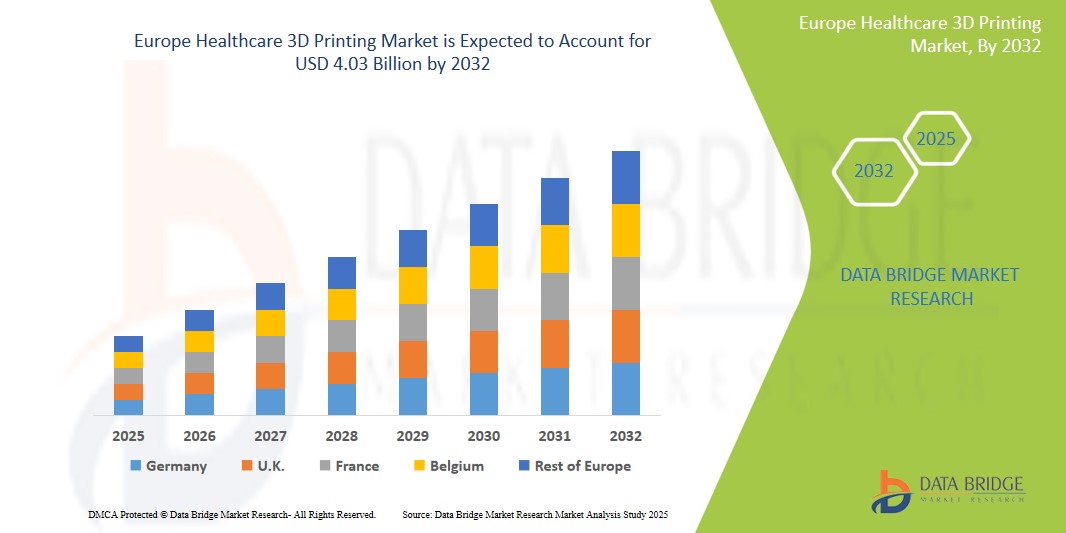
- The Europe Healthcare 3D Printing market size was valued at USD 1.23 billion in 2024 and is expected to reach USD 4.03 billion by 2032, at a CAGR of 16.0% during the forecast period
- This growth is driven by factors such as the aging population, increasing prevalence of eye diseases, and advancements in ophthalmic technology
Healthcare 3D Printing Market Analysis
- Healthcare 3D Printing plays a crucial role in creating personalized implants, prosthetics, and surgical guides, offering high precision and customization. These technologies enable tailored treatments in various medical fields, such as orthopedics, dentistry, and ophthalmology, significantly enhancing the effectiveness of surgeries and post-surgical recovery.
- The demand for 3D printing in healthcare is primarily driven by the need for personalized and cost-effective medical solutions. Advancements in 3D printing technology allow for the production of customized implants, reducing surgery times and improving patient outcomes. The increasing demand for patient-specific treatments is further fueling market growth.
- The U.K. is expected to dominate the Healthcare 3D Printing market due to its advanced healthcare infrastructure, rapid adoption of medical technologies, and strong presence of leading healthcare institutions. The rising focus on personalized medicine and customized medical devices further strengthens the country’s position as a key market player.
- The Standalone segment is expected to dominate the market with a market share of 56.22%, driven by its ability to deliver high-precision, customizable solutions. Standalone 3D printers offer flexibility in creating a wide range of medical devices, including prosthetics and surgical implants, contributing to their growing demand in healthcare applications.
Report Scope and Healthcare 3D Printing Market Segmentation
|
Attributes |
Healthcare 3D Printing Key Market Insights |
|
Segments Covered |
|
|
Countries Covered |
Europe
|
|
Key Market Players |
|
|
Market Opportunities |
|
|
Value Added Data Infosets |
In addition to the insights on market scenarios such as market value, growth rate, segmentation, geographical coverage, and major players, the market reports curated by the Data Bridge Market Research also include import export analysis, production capacity overview, production consumption analysis, price trend analysis, climate change scenario, supply chain analysis, value chain analysis, raw material/consumables overview, vendor selection criteria, PESTLE Analysis, Porter Analysis, and regulatory framework. |
Healthcare 3D Printing Market Trends
“Increasing Demand for Personalized Healthcare Solutions”
- 3D printing enables the production of customized medical devices, such as prosthetics and implants, tailored to individual patient needs. This personalized approach enhances precision, improving surgical outcomes and overall treatment effectiveness.
- Personalized healthcare solutions, made possible by 3D printing, help reduce post-surgery complications and risks. By creating patient-specific devices, the technology ensures better fit and function, promoting faster recovery and higher satisfaction.
- For Instance, The increasing demand for personalized healthcare solutions is a major driver for the healthcare 3D printing market. 3D printing technology allows the production of patient-specific medical devices like implants and prosthetics, ensuring better treatment outcomes. This customization improves surgical precision, reduces risks, accelerates recovery, and enhances overall patient satisfaction.
- The growing demand for personalized healthcare solutions is accelerating the adoption of 3D printing, as it offers tailored medical devices that improve treatment accuracy, minimize risks, and enhance overall patient satisfaction.
Healthcare 3D Printing Market Dynamics
Driver
“Rising Prevalence of Chronic Diseases and Ageing Population”
- The rising prevalence of chronic diseases and the aging population are significant drivers of the healthcare 3D printing market.
- 3D printing allows for the production of personalized medical devices, such as prosthetics and implants, which cater to the specific needs of older patients or those with chronic conditions, improving their quality of life.
- For Instance, The increasing number of elderly patients requiring joint replacements and orthopedic care has led to higher demand for 3D-printed, patient-specific implants. These customized solutions offer better anatomical fit, reduce surgery time, and enhance recovery, making 3D printing an essential tool in managing age-related and chronic health conditions effectively.
- As the Europe population ages and chronic diseases become more prevalent, 3D printing plays a crucial role in developing customized healthcare solutions.
- Tailored devices such as implants and prosthetics not only improve treatment outcomes but also contribute to enhanced patient satisfaction and reduced recovery times.
Opportunity
“Growing Investment for Healthcare Facilities”
- Growing investments in healthcare facilities are boosting the adoption of advanced technologies like 3D printing.
- These investments enable the integration of personalized medical devices, improving the effectiveness of treatments and enhancing patient care through precision and customization, especially in surgeries requiring implants or prosthetics.
- For Instance, Several hospitals across Europe and North America have established in-house 3D printing labs with support from government and private investments. These facilities produce patient-specific implants and surgical models, improving preoperative planning, reducing surgery durations, and enhancing patient outcomes demonstrating how infrastructure funding accelerates the adoption of 3D printing in healthcare.
- The increasing financial commitment to healthcare facilities is driving the adoption of innovative technologies like 3D printing.
- These investments enable the production of patient-specific devices, improving surgical outcomes, reducing recovery times, and ultimately enhancing the quality of care across healthcare settings, making treatment more accessible and precise.
Restraint/Challenge
“High Cost of Equipment and Materials”
- The high cost of 3D printing equipment and materials poses a challenge for widespread adoption in healthcare.
- Despite this, technological advancements and mass production are expected to reduce these costs, making 3D printing more accessible and fostering the creation of customized medical devices for improved patient care.
- For Instance, The initial investment for medical-grade 3D printers and biocompatible materials remains high, limiting use to major hospitals and research centers. However, collaborations between manufacturers and healthcare providers are underway to develop cost-effective solutions, aiming to democratize access and expand 3D printing capabilities in medium-sized and rural healthcare facilities.
- While the high cost of 3D printing equipment and materials remains a barrier, ongoing technological innovations and decreasing costs are likely to increase accessibility.
- As 3D printing becomes more affordable, healthcare providers will be able to offer more personalized and precise medical solutions, improving patient outcomes and satisfaction.
Healthcare 3D Printing Market Scope
The market is segmented on the basis Modality, Components, Technology, Application, Medical Specialty, End User.
|
Segmentation |
Sub-Segmentation |
|
By Modality |
|
|
Components |
|
|
Technology |
|
|
Application |
|
|
Medical Specialty |
|
|
End User |
|
In 2025, the Standalone is projected to dominate the market with a largest share in application segment
The Standalone segment is expected to dominate the Healthcare 3D Printing market with the largest share of 56.22% in 2025 due to its cost-effectiveness, versatility, and ease of use. Standalone printers provide high precision for customized medical devices, prosthetics, and implants, contributing to increased demand across healthcare applications.
The Integrated is expected to account for the largest share during the forecast period in technology market
In 2025, the Integrated segment is expected to dominate the market with the largest market share of 51.31% due to its ability to combine advanced technologies such as 3D printing with other systems like CAD software and automated workflows. This integration enhances efficiency, accuracy, and scalability, allowing for faster production of complex medical devices, implants, and tissue engineering solutions. The integration of various processes also reduces human error, improves data management, and supports custom, patient-specific solutions, making it a preferred choice in the healthcare industry.
Healthcare 3D Printing Market Regional Analysis
“U.K Holds the Largest Share in the Healthcare 3D Printing Market”
- U.K dominates the Healthcare 3D Printing market, driven by advanced healthcare infrastructure, high adoption of cutting-edge medical technologies, and the strong presence of key market players. Favorable government policies and increasing investments in personalized medicine further propel market growth across the region.
- The U.K holds a significant share due to increased demand for high-precision medical applications, particularly in custom prosthetics and implants. The growing adoption of 3D printing technologies and advancements in surgical procedures, combined with strong healthcare institutions, contribute to the continued market expansion.
- Europe is projected to witness substantial growth, fueled by rising healthcare expenditures, rapid technological advancements, and expanding access to 3D printing applications in countries like U.K and Germany. The increasing focus on affordable, customized healthcare solutions supports regional market development.
“Germany is Projected to Register the Highest CAGR in the Healthcare 3D Printing Market”
- Germany is expected to witness the highest growth rate in the Healthcare 3D Printing market, driven by rapid expansion in healthcare infrastructure, increasing awareness about customized medical treatments, and rising demand for patient-specific prosthetics and implants. Additionally, the country’s strong healthcare policy support boosts market development.
- Countries such as Germany and France are emerging as key markets due to the growing aging population, more susceptible to conditions requiring 3D-printed medical solutions. The demand for customized implants, prosthetics, and surgical models increases as the population ages, leading to an expansion in 3D printing adoption.
- Germany, with its advanced medical technology, remains a crucial market for healthcare 3D printing. The increasing number of healthcare professionals and ophthalmic surgeons, combined with the country’s focus on precision and efficiency in medical treatments, supports the continuous adoption of 3D-printed medical devices, particularly in customized implants.
Healthcare 3D Printing Market Share
The market competitive landscape provides details by competitor. Details included are company overview, company financials, revenue generated, market potential, investment in research and development, new market initiatives, Europe presence, production sites and facilities, production capacities, company strengths and weaknesses, product launch, product width and breadth, application dominance. The above data points provided are only related to the companies' focus related to market.
The Major Market Leaders Operating in the Market Are:
- Carbon, Inc. (U.S.)
- Stratasys Ltd. (Israel)
- 3D Systems, Inc. (U.S.)
- Organavo Holdings Inc. (U.S.)
- CELLINK EUROPE (Sweden)
- EOS (Germany)
- ENVISIONTEC, INC. (U.S.)
- Materialise (Belgium)
- Renishaw plc (U.K.)
- SLM Solutions (Germany)
- FIT AG (Germany)
- Prodways Technologies (a subsidiary of Prodways Group) (France)
- Advanced Solutions Life Sciences, LLC (U.S.)
- 3D Biotek (U.S.)
- Aprecia Pharmaceuticals (U.S.)
- Nano3D Biosciences (U.S.)
- TeVido BioDevices (U.S.)
- Stratasys (Israel)
- BioBots (U.S.)
- Allevi, Inc. (U.S.)
- Wacker Chemie AG (Germany)
Latest Developments in Europe Healthcare 3D Printing Market
- In February 2021, ENVISIONTEC, INC. announced that it has been acquired by the Desktop Metal, Inc. in order to maximize the production of polymer additive manufacturing. This acquisition done by the company has increased its sales and demand in the market leading to increased demand for its products in the market.
- In January 2020, 3D Systems, a company that designs, manufactures and sells 3D printers in Rock Hill, South Carolina, developed tissue and scaffold bioprinting processes for third-party companies. CollPlant Biotechnologies with CLGN.

- Interactive Data Analysis Dashboard
- Company Analysis Dashboard for high growth potential opportunities
- Research Analyst Access for customization & queries
- Competitor Analysis with Interactive dashboard
- Latest News, Updates & Trend analysis
- Harness the Power of Benchmark Analysis for Comprehensive Competitor Tracking
Data collection and base year analysis are done using data collection modules with large sample sizes. The stage includes obtaining market information or related data through various sources and strategies. It includes examining and planning all the data acquired from the past in advance. It likewise envelops the examination of information inconsistencies seen across different information sources. The market data is analysed and estimated using market statistical and coherent models. Also, market share analysis and key trend analysis are the major success factors in the market report. To know more, please request an analyst call or drop down your inquiry.
The key research methodology used by DBMR research team is data triangulation which involves data mining, analysis of the impact of data variables on the market and primary (industry expert) validation. Data models include Vendor Positioning Grid, Market Time Line Analysis, Market Overview and Guide, Company Positioning Grid, Patent Analysis, Pricing Analysis, Company Market Share Analysis, Standards of Measurement, Global versus Regional and Vendor Share Analysis. To know more about the research methodology, drop in an inquiry to speak to our industry experts.
Data Bridge Market Research is a leader in advanced formative research. We take pride in servicing our existing and new customers with data and analysis that match and suits their goal. The report can be customized to include price trend analysis of target brands understanding the market for additional countries (ask for the list of countries), clinical trial results data, literature review, refurbished market and product base analysis. Market analysis of target competitors can be analyzed from technology-based analysis to market portfolio strategies. We can add as many competitors that you require data about in the format and data style you are looking for. Our team of analysts can also provide you data in crude raw excel files pivot tables (Fact book) or can assist you in creating presentations from the data sets available in the report.













