


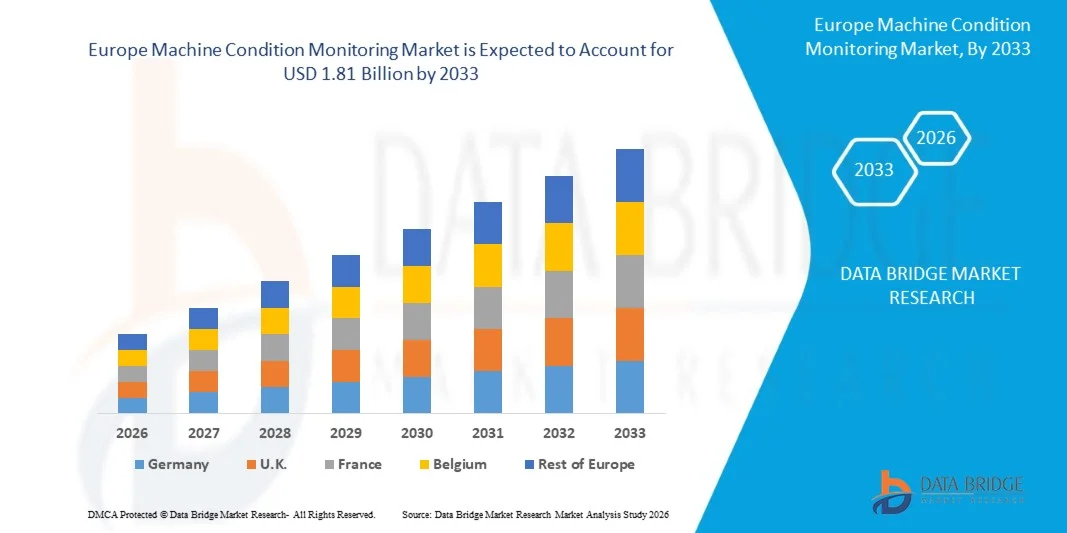
Europe Machine Condition Monitoring Market Size
- The Europe Machine Condition Monitoring Market size was valued at USD 1.01 billion in 2025 and is expected to reach USD 1.81 billion by 2033, at a CAGR of 7.6% during the forecast period
- The market growth is largely fueled by the increasing adoption of predictive maintenance technologies and advancements in industrial automation, enabling real-time monitoring and early fault detection across machinery and equipment. The integration of IoT sensors, AI-driven analytics, and wireless communication is transforming traditional maintenance into proactive asset management, reducing operational downtime and maintenance costs for industries such as manufacturing, oil & gas, and power generation
- Furthermore, rising demand for reliability, operational efficiency, and cost optimization in industrial operations is accelerating the adoption of machine condition monitoring systems. For instance, leading players are developing advanced vibration and thermal monitoring solutions that provide continuous diagnostics and predictive insights, allowing companies to maximize equipment lifespan and minimize unexpected failures. These combined factors are propelling significant growth in the market as industries move toward smarter, data-driven maintenance ecosystems
Europe Machine Condition Monitoring Market Analysis
- Machine condition monitoring systems play a critical role in industrial operations by providing continuous assessment of equipment health through techniques such as vibration analysis, thermography, and oil analysis. These technologies help detect faults at an early stage, allowing for timely maintenance and preventing costly downtime. The adoption of such systems is essential for maintaining safety, efficiency, and reliability in heavy industries and manufacturing plants
- The rising need for predictive maintenance, coupled with growing digitalization across industrial sectors, is driving market expansion. Increasing use of cloud-based monitoring platforms, AI-enabled diagnostics, and wireless sensors enhances the accuracy and accessibility of real-time data, reinforcing the shift from reactive to preventive maintenance strategies and ensuring sustained growth of the Europe Machine Condition Monitoring Market
- Germany dominated the Europe Machine Condition Monitoring Market in 2025, due to its strong industrial automation base, high concentration of manufacturing facilities, and early adoption of predictive maintenance technologies
- U.K. is expected to be the fastest growing country in the Europe Machine Condition Monitoring Market during the forecast period due to the rapid modernization of industrial infrastructure, expansion of renewable energy projects, and growing adoption of IoT-enabled monitoring solutions
- Hardware segment dominated the market with a market share of 63.3% in 2025, due to the growing adoption of advanced sensors, data acquisition devices, and vibration analyzers that enable real-time monitoring of machine health. Industries depend heavily on robust hardware systems to detect anomalies early and prevent unplanned downtime. The increasing installation of condition monitoring hardware in manufacturing and heavy machinery environments further drives this segment’s dominance due to its reliability and direct contribution to predictive maintenance efficiency
Report Scope and Europe Machine Condition Monitoring Market Segmentation
|
Attributes |
Europe Machine Condition Monitoring Key Market Insights |
|
Segments Covered |
|
|
Countries Covered |
Europe
|
|
Key Market Players |
|
|
Market Opportunities |
|
|
Value Added Data Infosets |
In addition to the insights on market scenarios such as market value, growth rate, segmentation, geographical coverage, and major players, the market reports curated by the Data Bridge Market Research also include in-depth expert analysis, geographically represented company-wise production and capacity, network layouts of distributors and partners, detailed and updated price trend analysis and deficit analysis of supply chain and demand. |
Europe Machine Condition Monitoring Market Trends
“Integration of AI and IoT for Predictive Maintenance”
- The Europe Machine Condition Monitoring Market is rapidly evolving due to the integration of artificial intelligence (AI) and Internet of Things (IoT) technologies, which enable effective predictive maintenance strategies. This integration enhances the capability to continuously monitor equipment health, predict failures before they occur, and optimize maintenance schedules, thereby minimizing downtime and operational costs
- For instance, companies such as Siemens and GE Digital have embedded AI-driven analytics within their IoT-enabled condition monitoring platforms. These systems collect real-time sensor data, process it using machine learning algorithms, and generate actionable insights that allow operators to prevent unplanned breakdowns and extend asset life
- The combination of AI and IoT facilitates the aggregation and analysis of large volumes of equipment data from diverse sources, improving the accuracy of fault detection and reducing false alarms. This capability allows industries to tailor maintenance activities based on actual machine conditions rather than fixed schedules, increasing efficiency
- In addition, remote monitoring enabled by IoT connectivity supports real-time decision-making and rapid response to emerging machine faults, enhancing operational safety and productivity. This capability is particularly valuable for industries with geographically dispersed assets or critical infrastructure requiring continuous supervision
- The development of advanced sensor technologies and cloud computing platforms has further accelerated adoption by allowing scalable deployment of condition monitoring systems across multiple assets and locations. The synergistic effect of these technologies is driving a transition towards smart manufacturing and Industry 4.0 environments
- Overall, the trend toward AI and IoT-powered predictive maintenance is transforming machine condition monitoring from reactive to proactive management. This shift is fostering cost savings, improved asset reliability, and enhanced operational resilience across manufacturing, energy, and transportation sectors
Europe Machine Condition Monitoring Market Dynamics
Driver
“Rising Demand for Real-Time Equipment Health Monitoring”
- The substantial costs associated with implementing and maintaining advanced machine condition monitoring systems remain a significant challenge limiting market penetration. Initial investments for sensors, data infrastructure, software licenses, and integration with legacy equipment can strain capital budgets, especially for small and medium-sized enterprises
- For instance, manufacturers in developing regions have reported difficulties in funding comprehensive condition monitoring solutions due to expensive hardware and limited technical expertise. This financial barrier slows adoption and perpetuates reliance on traditional reactive maintenance methods
- In addition, ongoing maintenance costs—such as sensor calibration, software updates, data storage, and skilled personnel—add to the total cost of ownership and complicate budgeting. High operational expenses may deter companies from scaling systems beyond pilot projects or select equipment
- The complexity involved in integrating diverse data sources and ensuring cybersecurity for connected assets adds further challenges. Addressing these issues requires specialized skills and continuous investment, which can be resource-intensive for organizations with constrained IT capacities
- Overcoming these cost and operational hurdles through modular, scalable solutions, cloud-based services, and vendor-supported maintenance programs will be essential to drive wider adoption. Cost-effective innovations that lower entry barriers and simplify deployment are critical for enabling sustained market growth
Restraint/Challenge
“High Implementation and Maintenance Costs”
- The substantial costs associated with implementing and maintaining advanced machine condition monitoring systems remain a significant challenge limiting market penetration. Initial investments for sensors, data infrastructure, software licenses, and integration with legacy equipment can strain capital budgets, especially for small and medium-sized enterprises
- For instance, manufacturers in developing regions have reported difficulties in funding comprehensive condition monitoring solutions due to expensive hardware and limited technical expertise. This financial barrier slows adoption and perpetuates reliance on traditional reactive maintenance methods
- In addition, ongoing maintenance costs—such as sensor calibration, software updates, data storage, and skilled personnel—add to the total cost of ownership and complicate budgeting. High operational expenses may deter companies from scaling systems beyond pilot projects or select equipment
- The complexity involved in integrating diverse data sources and ensuring cybersecurity for connected assets adds further challenges. Addressing these issues requires specialized skills and continuous investment, which can be resource-intensive for organizations with constrained IT capacities
- Overcoming these cost and operational hurdles through modular, scalable solutions, cloud-based services, and vendor-supported maintenance programs will be essential to drive wider adoption. Cost-effective innovations that lower entry barriers and simplify deployment are critical for enabling sustained market growth
Europe Machine Condition Monitoring Market Scope
The market is segmented on the basis of component, monitoring type, monitoring technique, deployment mode, application, and industry.
- By Component
On the basis of component, the Europe Machine Condition Monitoring Market is segmented into hardware and software. The hardware segment dominated the market with the largest revenue share of 63.3% in 2025 owing to the growing adoption of advanced sensors, data acquisition devices, and vibration analyzers that enable real-time monitoring of machine health. Industries depend heavily on robust hardware systems to detect anomalies early and prevent unplanned downtime. The increasing installation of condition monitoring hardware in manufacturing and heavy machinery environments further drives this segment’s dominance due to its reliability and direct contribution to predictive maintenance efficiency.
The software segment is projected to witness the fastest growth rate from 2026 to 2033 driven by rising demand for data analytics platforms and AI-powered predictive algorithms. Software solutions enhance operational insights by integrating data from multiple sensors into a unified monitoring dashboard, enabling better diagnostics and trend analysis. Cloud-based analytics and machine learning-based diagnostic tools are reshaping how companies interpret maintenance data, thus creating a strong growth trajectory for the software segment during the forecast period.
- By Monitoring Type
On the basis of monitoring type, the Europe Machine Condition Monitoring Market is segmented into fixed monitoring systems and portable monitoring systems. The fixed monitoring system segment dominated the market in 2025 due to its extensive use in continuous and large-scale industrial setups. These systems offer 24/7 machine surveillance and instant alert mechanisms, providing high reliability for mission-critical operations in industries such as oil & gas, power generation, and manufacturing. Their permanent installation ensures long-term operational safety and minimal human intervention, supporting consistent asset health evaluation.
The portable monitoring system segment is anticipated to exhibit the fastest growth rate from 2026 to 2033 driven by its flexibility, cost-effectiveness, and suitability for smaller facilities or multi-site operations. Portable systems allow operators to carry monitoring devices between locations, making them ideal for periodic maintenance inspections. The rising preference for handheld vibration analyzers and wireless diagnostic tools among small and medium enterprises is also boosting the adoption of portable systems due to their ease of use and adaptability.
- By Monitoring Technique
On the basis of monitoring technique, the market is segmented into thermography, vibration monitoring, oil analysis, ultrasound emission monitoring, corrosion monitoring, and motor current signature analysis. The vibration monitoring segment dominated the market with the largest revenue share in 2025 owing to its ability to detect imbalance, misalignment, and bearing wear at early stages. It is the most widely used technique across industrial applications due to its accuracy, cost efficiency, and compatibility with automated monitoring systems. The increasing incorporation of IoT sensors and wireless vibration detectors has strengthened this segment’s dominance in predictive maintenance.
The thermography segment is projected to witness the fastest growth rate from 2026 to 2033, driven by its effectiveness in detecting temperature anomalies and electrical faults before equipment failure occurs. Infrared imaging cameras and thermal sensors enable non-contact analysis, reducing the risk of machine damage and enhancing workplace safety. As industries prioritize energy efficiency and thermal diagnostics, thermography continues to gain rapid adoption, especially in electrical systems and rotating equipment maintenance.
- By Deployment Mode
On the basis of deployment mode, the market is segmented into cloud and on-premise. The on-premise segment dominated the market in 2025 owing to strong demand from large-scale manufacturing and oil & gas facilities where data security and real-time control are critical. On-premise solutions allow organizations to maintain full ownership of operational data and reduce latency, making them suitable for critical environments that cannot risk downtime or data breaches. The preference for internal servers and in-house infrastructure continues to drive steady demand for on-premise condition monitoring systems.
The cloud segment is expected to register the fastest growth from 2026 to 2033 due to increasing adoption of remote monitoring and IoT-enabled platforms. Cloud deployment provides scalability, centralized analytics, and easy access to machine data from multiple sites. The growing integration of AI-based predictive tools and subscription-based software models further enhances the cloud segment’s appeal, particularly among mid-sized enterprises aiming to minimize upfront infrastructure costs.
- By Application
On the basis of application, the Europe Machine Condition Monitoring Market is segmented into facility maintenance, maintenance, production/manufacturing, and quality assurance. The maintenance segment dominated the market in 2025 due to its crucial role in preventing equipment failures and extending machinery lifespan. Continuous monitoring allows operators to plan maintenance schedules proactively, thus minimizing operational disruptions. Industries across automotive and energy sectors prioritize predictive maintenance systems to enhance productivity and ensure cost-efficient asset management.
The production/manufacturing segment is anticipated to experience the fastest growth rate from 2026 to 2033 owing to increasing automation in manufacturing lines and the need to maintain equipment performance consistency. With the rise of Industry 4.0, manufacturers are investing in AI-driven condition monitoring to ensure uninterrupted production cycles. The focus on improving overall equipment effectiveness (OEE) and reducing scrap or rework further strengthens growth prospects in this segment.
- By Industry
On the basis of industry, the Europe Machine Condition Monitoring Market is segmented into agriculture, automotive, aerospace, chemical, construction, foods & beverages, semiconductor & electronics, oil & gas, metals & mining, marine, power generation, healthcare, paper & pulp, and others. The oil & gas segment dominated the market in 2025 due to the sector’s heavy reliance on continuous equipment performance and safety compliance. Condition monitoring helps detect early signs of equipment fatigue, pipeline corrosion, and compressor inefficiencies, which are critical in preventing costly breakdowns and accidents in offshore and onshore facilities.
The power generation segment is projected to witness the fastest growth rate from 2026 to 2033 driven by the growing transition to renewable energy systems and the need to maintain uptime in power infrastructure. Power plants are increasingly adopting predictive monitoring for turbines, generators, and transformers to ensure operational reliability. The integration of IoT and AI-based analytics in energy facilities is enhancing fault detection capabilities, contributing to the robust growth of this segment.
Europe Machine Condition Monitoring Market Regional Analysis
- Germany dominated the Europe Machine Condition Monitoring Market with the largest revenue share in 2025, driven by its strong industrial automation base, high concentration of manufacturing facilities, and early adoption of predictive maintenance technologies
- The country’s advanced engineering ecosystem and Industry 4.0 initiatives have accelerated the integration of AI-powered monitoring systems across automotive, aerospace, and energy sectors. A robust presence of leading industrial automation firms and strong R&D investment in sensor and vibration analysis technology further strengthen market expansion
- Germany’s commitment to minimizing equipment downtime, improving operational efficiency, and achieving sustainability in manufacturing reinforces its leadership position in the regional market
U.K. Europe Machine Condition Monitoring Market Insight
The U.K. market is projected to register the fastest CAGR in the Europe Machine Condition Monitoring Market during 2026–2033, fueled by the rapid modernization of industrial infrastructure, expansion of renewable energy projects, and growing adoption of IoT-enabled monitoring solutions. Increasing focus on predictive maintenance in manufacturing and power generation sectors is driving demand for cloud-based and remote condition monitoring systems. Supportive government initiatives promoting digital transformation in industry, combined with strategic collaborations between domestic tech firms and international automation players, are accelerating the country’s growth. The U.K.’s emphasis on enhancing equipment reliability and reducing operational costs positions it as the fastest-growing market in the region.
France Europe Machine Condition Monitoring Market Insight
France is expected to witness steady growth between 2026 and 2033, supported by the expansion of aerospace, automotive, and energy industries and the adoption of smart factory initiatives. The country’s focus on process optimization and early fault detection is increasing the deployment of vibration and thermographic monitoring systems. Rising investments in industrial automation, coupled with strong government support for digital industrial transformation, are improving adoption rates among medium and large enterprises. Collaborations between local maintenance solution providers and multinational technology firms are also enhancing system integration and service efficiency. France’s commitment to sustainable industrial growth and predictive maintenance practices underpins its stable market outlook in the European region.
Europe Machine Condition Monitoring Market Share
The machine condition monitoring industry is primarily led by well-established companies, including:
- Emerson Electric Co. (U.S.)
- General Electric (U.S.)
- Honeywell International Inc. (U.S.)
- National Instruments Corp. (U.S.)
- AB SRF (India)
- ALS (Australia)
- Wilcoxon Sensing Technologies (U.S.),
- Rockwell Automation, Inc. (U.S.)
- PARKER HANNIFIN CORP (U.S.)
- Schaeffler AGSYMPHONY AZIMAAI, Brüel & Kjær (Germany)
- Fluke Corporation (U.S.)
- Meggitt PLC (U.K.)
- PCB Piezotronics, Inc. (U.S.)
- FLIR Systems, Inc. (U.S.)
- SPM Instrument AB (Sweden)
- Analog Devices, Inc. (U.S.)
- Machine Saver (U.S.)
- 3d SignalsLogiLube, LLC (Canada)
- Petasense Inc. (U.S.)
- Senseye Ltd. (U.K.)
Latest Developments in Europe Machine Condition Monitoring Market
- In June 2023, SKF launched its next-generation Enlight Collect IMx-1 wireless condition monitoring system, a major advancement in predictive maintenance technology. The system enables automated machine data collection, real-time diagnostics, and AI-based analytics for enhanced performance insights across industrial and energy applications. By integrating edge computing and wireless communication, the solution reduces manual inspection efforts and enhances equipment uptime. This development strengthened SKF’s position in the smart manufacturing space, aligning with the growing demand for connected, data-driven maintenance ecosystems
- In September 2022, Honeywell entered a strategic partnership with Shell Global Solutions to co-develop advanced asset performance management (APM) and machine condition monitoring technologies. The collaboration focuses on integrating Honeywell’s digital transformation and automation capabilities with Shell’s deep operational expertise in the energy sector. This partnership aims to enhance predictive maintenance efficiency, improve asset reliability, and support sustainability objectives through data-driven insights. The initiative also strengthens Honeywell’s role in providing scalable industrial digitalization solutions
- In January 2022, Siemens completed the acquisition of Senseye, a U.K.-based company specializing in AI-powered predictive maintenance software. This acquisition expanded Siemens’ Digital Industries portfolio by integrating Senseye’s advanced machine learning algorithms into its industrial IoT ecosystem. The move allows Siemens to offer comprehensive predictive analytics and asset health monitoring capabilities to industrial clients worldwide. The acquisition reinforces Siemens’ commitment to advancing digitalized maintenance and optimizing equipment performance through intelligent monitoring
- In March 2021, Emerson introduced a suite of digital solutions including the Rosemount 4390 Series of Corrosion and Erosion Wireless Transmitters and the Plantweb Insight Non-Intrusive Corrosion Application. These innovations provide real-time monitoring, predictive maintenance, and plant optimization, enabling operators to proactively manage corrosion and erosion risks. The solutions enhance plant reliability and operational efficiency, helping industries achieve cost savings through early fault detection and reduced maintenance downtime
- In April 2020, GE Healthcare deployed its Mural Virtual Care Solution on Microsoft Azure to support real-time remote monitoring of ventilated COVID-19 patients. The platform enabled clinicians to track patient conditions, predict deterioration, and optimize clinical resources during the pandemic. By integrating cloud-based analytics with medical monitoring systems, the solution improved response efficiency and patient care quality. This development marked a key step toward expanding condition monitoring technologies into healthcare and critical care environments

- Interactive Data Analysis Dashboard
- Company Analysis Dashboard for high growth potential opportunities
- Research Analyst Access for customization & queries
- Competitor Analysis with Interactive dashboard
- Latest News, Updates & Trend analysis
- Harness the Power of Benchmark Analysis for Comprehensive Competitor Tracking
Europe Machine Condition Monitoring Market, Supply Chain Analysis and Ecosystem Framework
To support market growth and help clients navigate the impact of geopolitical shifts, DBMR has integrated in-depth supply chain analysis into its Europe Machine Condition Monitoring Market research reports. This addition empowers clients to respond effectively to global changes affecting their industries. The supply chain analysis section includes detailed insights such as Europe Machine Condition Monitoring Market consumption and production by country, price trend analysis, the impact of tariffs and geopolitical developments, and import and export trends by country and HSN code. It also highlights major suppliers with data on production capacity and company profiles, as well as key importers and exporters. In addition to research, DBMR offers specialized supply chain consulting services backed by over a decade of experience, providing solutions like supplier discovery, supplier risk assessment, price trend analysis, impact evaluation of inflation and trade route changes, and comprehensive market trend analysis.
Data collection and base year analysis are done using data collection modules with large sample sizes. The stage includes obtaining market information or related data through various sources and strategies. It includes examining and planning all the data acquired from the past in advance. It likewise envelops the examination of information inconsistencies seen across different information sources. The market data is analysed and estimated using market statistical and coherent models. Also, market share analysis and key trend analysis are the major success factors in the market report. To know more, please request an analyst call or drop down your inquiry.
The key research methodology used by DBMR research team is data triangulation which involves data mining, analysis of the impact of data variables on the market and primary (industry expert) validation. Data models include Vendor Positioning Grid, Market Time Line Analysis, Market Overview and Guide, Company Positioning Grid, Patent Analysis, Pricing Analysis, Company Market Share Analysis, Standards of Measurement, Global versus Regional and Vendor Share Analysis. To know more about the research methodology, drop in an inquiry to speak to our industry experts.
Data Bridge Market Research is a leader in advanced formative research. We take pride in servicing our existing and new customers with data and analysis that match and suits their goal. The report can be customized to include price trend analysis of target brands understanding the market for additional countries (ask for the list of countries), clinical trial results data, literature review, refurbished market and product base analysis. Market analysis of target competitors can be analyzed from technology-based analysis to market portfolio strategies. We can add as many competitors that you require data about in the format and data style you are looking for. Our team of analysts can also provide you data in crude raw excel files pivot tables (Fact book) or can assist you in creating presentations from the data sets available in the report.













