


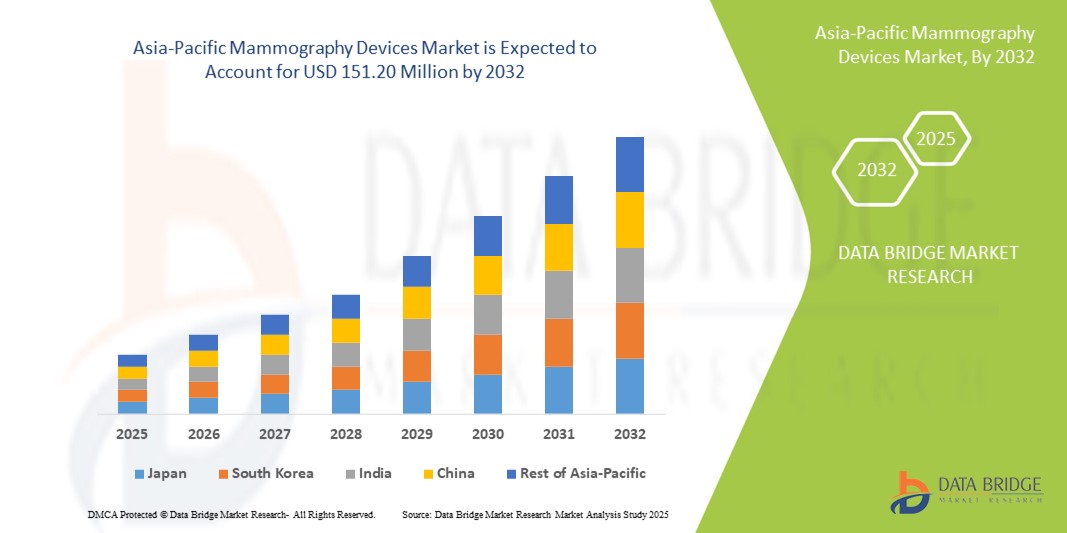
Mammography Devices Market Size
- The Europe Mammography Devices Market Treatment market was valued at USD 106.32 million in 2024 and is expected to reach USD 151.20 Million by 2032, at a CAGR of 4.5%, during the forecast period
- The rising incidence of breast cancer and the growing emphasis on early detection are driving demand for the Mammography Devices Market in Europe. Additionally, increasing awareness about routine breast screening, coupled with technological advancements in digital and 3D mammography systems, is further propelling market growth.
Mammography Devices Market Analysis
- Mammography devices are specialized imaging systems used for the early detection and diagnosis of breast cancer through low-dose X-rays. These devices play a critical role in identifying abnormal growths and changes in breast tissue, facilitating timely medical intervention. Advanced mammography technologies, including digital mammography and 3D tomosynthesis, enhance image accuracy, reduce false positives, and contribute to improved patient outcomes and survival rates.
- The U.K. emerges as a leading region in the Europe Mammography Devices Market, supported by a well-established healthcare infrastructure, high awareness of breast cancer screening, and favorable reimbursement policies for diagnostic imaging procedures.
- Ongoing investments in innovative imaging technologies, including AI-enhanced diagnostics and portable mammography units, along with a rising geriatric population and increased public health initiatives, continue to drive growth and technological advancement in the region’s mammography devices market.
- Film Screen segment is expected to dominate the market with a market share of 56.22% due a rising geriatric population and increased public health initiatives.
Report Scope and Mammography Devices Market Segmentation
|
Attributes |
Mammography Devices Market Key Market Insights |
|
Segments Covered |
|
|
Countries Covered |
Europe
|
|
Key Market Players |
|
|
Market Opportunities |
|
|
Value Added Data Infosets |
In addition to the insights on market scenarios such as market value, growth rate, segmentation, geographical coverage, and major players, the market reports curated by the Data Bridge Market Research also include import export analysis, production capacity overview, production consumption analysis, price trend analysis, climate change scenario, supply chain analysis, value chain analysis, raw material/consumables overview, vendor selection criteria, PESTLE Analysis, Porter Analysis, and regulatory framework. |
Mammography Devices Market Trends
“Integration of Artificial Intelligence and Machine Learning in Breast Imaging”
- A prominent trend in the Europe Mammography Devices Market is the growing integration of artificial intelligence (AI) and machine learning (ML) algorithms into mammography systems to enhance diagnostic accuracy and efficiency.
- AI-powered tools are being used to assist radiologists in detecting subtle abnormalities, prioritizing cases, reducing reading time, and minimizing false positives and negatives.
- For instance, AI-based computer-aided detection (CAD) systems can highlight suspicious areas on mammograms, helping clinicians focus on high-risk findings and improve early cancer detection rates.
- These technologies also support workflow optimization by automating image sorting, reporting, and data management, which is particularly valuable in high-volume screening environments.
- The increased adoption of AI in breast imaging is also fostering the development of personalized screening protocols based on individual risk profiles, further aligning with precision medicine approaches.
- This digital transformation is expected to revolutionize breast cancer diagnostics, reduce radiologist workload, and drive long-term growth and competitiveness in the Europe Mammography Devices Market.
Mammography Devices Market Dynamics
Driver
“Rising Prevalence of Breast Cancer and Demand for Early Detection”
- As the Europen population ages and risk factors such as obesity, hormonal imbalance, alcohol consumption, and family history become more common, the incidence of breast cancer is increasing significantly. Breast cancer remains one of the leading causes of cancer-related deaths among women, underscoring the urgent need for effective, early diagnostic tools like mammography devices.
- Mammography devices, particularly digital breast tomosynthesis (3D mammography), offer a non-invasive solution for early detection, allowing clinicians to identify tumors at an earlier and more treatable stage. These technologies are favored over conventional methods due to improved accuracy, reduced false positives, and greater patient comfort.
For instance,
- In October 2023, the Cancer Society reported that nearly 300,000 new cases of invasive breast cancer were expected in the U.K. for 2024, with early detection being crucial for survival.
- According to the CDC (2024), routine mammography screening has contributed to a 40% reduction in breast cancer mortality among women aged 40–74 in the U.K.
- The growing burden of breast cancer is driving demand for accessible and reliable imaging systems. Simultaneously, heightened awareness through public health campaigns and improved physician referral rates are accelerating adoption.
- As clinical outcomes improve through advancements in imaging resolution, software-driven diagnostics, and portable screening units, healthcare providers are increasingly recommending mammography as a frontline diagnostic approach. This synergy of clinical need, awareness, and technology is fostering a strong growth environment for the Europe Mammography Devices Market.
Opportunity
“Technological Advancements in Digital Imaging and AI-Driven Diagnostics”
- Significant innovations in mammography systems—such as 3D tomosynthesis, contrast-enhanced spectral mammography (CESM), and AI-integrated computer-aided detection (CAD) software—are transforming the landscape of breast cancer diagnostics. These advancements offer higher image clarity, enhanced lesion detection, and reduced need for biopsies, improving clinical outcomes and patient confidence.
- Cutting-edge technologies, including portable mammography units and cloud-connected imaging platforms, are expanding access to breast screening, particularly in remote and underserved areas. These improvements align with the Europen healthcare system's shift toward preventative care and early intervention.
For instance,
- Companies like Hologic, GE Healthcare, and Siemens Healthineers have introduced AI-powered mammography platforms that support radiologists with real-time analysis, risk stratification, and workflow optimization.
- In early 2024, peer-reviewed studies in Radiology and JAMA Oncology highlighted that AI-assisted mammography systems demonstrated up to 10% greater sensitivity in detecting early-stage cancers compared to traditional reads.
- These technological leaps meet the growing demand for precision diagnostics and patient-centric care in both urban and rural settings.
- Firms investing in smart imaging, mobile diagnostic services, and risk-adaptive screening algorithms are well-positioned to capitalize on the Europen push for scalable, accessible, and high-quality breast health solutions—making the Mammography Devices Market a high-value sector for strategic investment and innovation.
Restraint/Challenge
“High Equipment Costs and Disparities in Screening Access”
- The high cost of acquiring and maintaining advanced mammography equipment, especially 3D tomosynthesis systems and AI-driven platforms, poses a significant barrier to widespread adoption—particularly in community hospitals and rural clinics with limited capital budgets. Even in wealthier regions, disparities in insurance coverage and access to care persist, creating inequities in screening participation.
- While digital mammography improves diagnostic accuracy, the associated costs of installation, technician training, and ongoing system upgrades often deter smaller practices from transitioning from analog systems.
- Further, follow-up imaging, diagnostic biopsies, and specialist consultations can compound the financial burden on patients, especially those without comprehensive insurance coverage. This often leads to delayed diagnosis and worsened outcomes.
For instance,
-
- A 2023 report from the American College of Radiology noted that the cost of digital breast tomosynthesis equipment can exceed USD 400,000, excluding operational and maintenance expenses.
- In January 2024, The Lancet Regional Health – Americas emphasized that women in rural areas of Europe are 25–40% less likely to receive regular mammograms compared to their urban counterparts due to equipment shortages and travel constraints.
- Major manufacturers acknowledge that pricing disparities, maintenance requirements, and inconsistent reimbursement policies are limiting market penetration in certain regions.
- To overcome these barriers, initiatives such as expanded telemammography services, public-private partnerships, mobile screening units, and broader insurance reforms will be vital to ensuring equitable access and sustained growth in the Europe Mammography Devices Market.
Mammography Devices Market Scope
The market is segmented on the product, technology, end user.
|
Segmentation |
Sub-Segmentation |
|
By Product |
|
|
By technology |
|
|
By End Users |
|
In 2025, the Breast Tomosynthesis Segments Projected to Dominate the Market with the Largest Share in the technology Segment
The Breast Tomosynthesis segment is expected to dominate the Europe Mammography Devices Market in 2025, accounting for the largest market share of approximately 68.7%. This leadership is primarily driven by its superior cancer detection capabilities and increasing adoption in routine breast cancer screening programs.
In 2025, Film Screen are Expected to Account for the Largest Share During the Forecast Period in product segment
In 2025, Film Screen are projected to dominate the Europe Mammography Devices Market, accounting for the largest market share of approximately 64.9%. This segment's dominance is fueled by the the widespread availability of conventional systems and cost-effectiveness in resource-limited or rural healthcare settings.
Mammography Devices Market Regional Analysis
“U.K. is the Dominant country in the Europe Mammography Devices Market”
- The U.K. leads the Europe Mammography Devices Market, driven by its highly advanced healthcare infrastructure, high screening volumes, and widespread availability of-the-art mammography technologies such as digital breast tomosynthesis and AI-assisted imaging.
- The U.K. holds the largest market share due to a rising incidence of breast cancer, a growing aging female population, and strong public health emphasis on early detection through regular mammography screenings.
- Favorable reimbursement frameworks, extensive insurance coverage, and strong federal support for cancer awareness and screening programs contribute significantly to market dominance.
- Additionally, the presence of major industry players such as Hologic, GE Healthcare, and Siemens Healthineers, coupled with continuous R&D investments, product innovations, and clinical collaborations, accelerates adoption of next-generation mammography systems across the country.
“U.K. is Projected to Register the Highest Growth Rate”
- The U.K. is anticipated to experience the fastest growth in the Mammography Devices Market, driven by increasing breast cancer awareness, expanding access to preventive healthcare, and rapid adoption of advanced imaging modalities.
- The market is benefiting from large-scale public screening campaigns, demographic shifts such as delayed childbirth and increased life expectancy, and growing patient demand for non-invasive, accurate diagnostic options.
- Robust government initiatives—such as the CDC’s National Breast and Cervical Cancer Early Detection Program (NBCCEDP)—are further boosting screening rates among underserved populations.
- Moreover, rising integration of AI in diagnostic workflows, along with mobile screening units in rural and remote areas, is expected to enhance early detection and fuel continued market expansion in the U.K.
Mammography Devices Market Share
The market competitive landscape provides details by competitor. Details included are company overview, company financials, revenue generated, market potential, investment in research and development, new market initiatives, Europe presence, production sites and facilities, production capacities, company strengths and weaknesses, product launch, product width and breadth, application dominance. The above data points provided are only related to the companies' focus related to market.
The Major Market Leaders Operating in the Market Are:
- Hologic, Inc. (United States)
- GE HealthCare Technologies Inc. (United States)
- Siemens Healthineers AG (Germany)
- FUJIFILM Holdings Corporation (Japan)
- Koninklijke Philips N.V. (Netherlands)
- Canon Medical Systems Corporation (Japan)
- Planmed Oy (Finland)
- Metaltronica S.p.A. (Italy)
- IMS Giotto S.p.A. (Italy)
- Analogic Corporation (United States)
Latest Developments in Europe Mammography Devices Market
- In May 2023, TGH Imaging enhanced patient access to breast cancer screening by introducing Genius 3D Mammography exams from Hologic at 18 locations across Pasco, Hillsborough, Pinellas, and Palm Beach counties. Also known as tomosynthesis, 3D mammography generates a three-dimensional image of the breast, improving the detection of breast cancer.
- In June 2023, Amrita Hospital implemented a new contrast-enhanced mammogram system that detects breast cancer before it becomes visible on standard mammograms. This system features auto-stabilization, improving usability, reducing examination time, and enhancing patient comfort. Its contrast-enhanced 3D imaging capabilities provide high-resolution images that can identify even the smallest abnormalities.

- Interactive Data Analysis Dashboard
- Company Analysis Dashboard for high growth potential opportunities
- Research Analyst Access for customization & queries
- Competitor Analysis with Interactive dashboard
- Latest News, Updates & Trend analysis
- Harness the Power of Benchmark Analysis for Comprehensive Competitor Tracking
Data collection and base year analysis are done using data collection modules with large sample sizes. The stage includes obtaining market information or related data through various sources and strategies. It includes examining and planning all the data acquired from the past in advance. It likewise envelops the examination of information inconsistencies seen across different information sources. The market data is analysed and estimated using market statistical and coherent models. Also, market share analysis and key trend analysis are the major success factors in the market report. To know more, please request an analyst call or drop down your inquiry.
The key research methodology used by DBMR research team is data triangulation which involves data mining, analysis of the impact of data variables on the market and primary (industry expert) validation. Data models include Vendor Positioning Grid, Market Time Line Analysis, Market Overview and Guide, Company Positioning Grid, Patent Analysis, Pricing Analysis, Company Market Share Analysis, Standards of Measurement, Global versus Regional and Vendor Share Analysis. To know more about the research methodology, drop in an inquiry to speak to our industry experts.
Data Bridge Market Research is a leader in advanced formative research. We take pride in servicing our existing and new customers with data and analysis that match and suits their goal. The report can be customized to include price trend analysis of target brands understanding the market for additional countries (ask for the list of countries), clinical trial results data, literature review, refurbished market and product base analysis. Market analysis of target competitors can be analyzed from technology-based analysis to market portfolio strategies. We can add as many competitors that you require data about in the format and data style you are looking for. Our team of analysts can also provide you data in crude raw excel files pivot tables (Fact book) or can assist you in creating presentations from the data sets available in the report.













