


What is the Europe Manual Resuscitators Market Size and Growth Rate ?
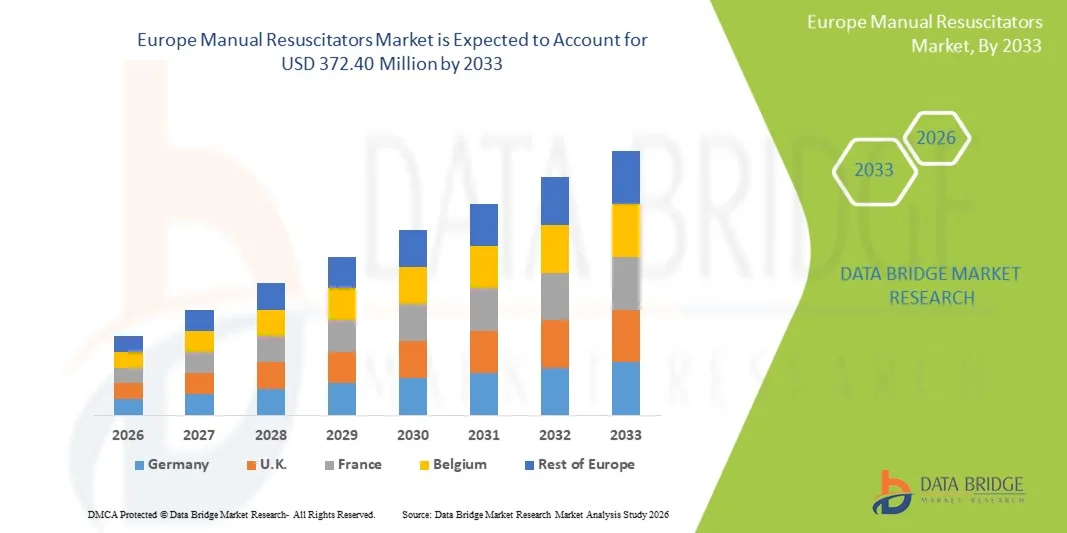
- As per Data Bridge Market Research Analysis the Europe Manual Resuscitators Market size was valued at USD 222.00 Million in 2025 and is expected to reach USD 372.40 Million by 2033, at a CAGR of 6.68% during the forecast period
- The market growth is largely fueled by the rising incidence of respiratory disorders, increasing number of emergency medical cases, and the growing demand for effective ventilation support devices in hospitals, ambulatory care, and pre-hospital emergency settings, leading to wider adoption of manual resuscitators across healthcare systems
- Furthermore, increasing awareness among healthcare professionals regarding the importance of immediate and reliable respiratory support, along with advancements in manual resuscitator design for improved safety, ease of use, and infection control, is accelerating the uptake of Manual Resuscitators solutions, thereby significantly boosting the market’s overall growth
Market Size & Forecast
- Global Market Value (2025): USD 222.00 Million
- Expected Market Value (2033): USD 372.40 Million
- Forecast CAGR (2026–2033): 6.68%
What are the Major Takeaways of Europe Manual Resuscitators Market ?
- Manual resuscitators, designed to provide positive-pressure ventilation during respiratory failure and emergency situations, are essential life-saving medical devices widely used across hospitals, ambulances, and emergency care settings due to their reliability, ease of use, and ability to function without external power sources
- The escalating demand for manual resuscitators is primarily driven by the rising prevalence of respiratory diseases, increasing number of surgical procedures, growth in emergency medical services, and heightened preparedness for critical care situations, along with a growing emphasis on patient safety and infection control
- The U.K. dominated the Europe Manual Resuscitators Market with the largest revenue share of 37.2% in 2025, supported by advanced healthcare infrastructure, high adoption of emergency medical equipment, strong presence of key medical device manufacturers, and well-established emergency response systems, with other European countries contributing to significant market activity due to robust hospital networks and high procedure volumes
- Germany is expected to be the fastest-growing region in the Europe Manual Resuscitators Market during the forecast period, registering a strong CAGR, driven by improving healthcare infrastructure, rising healthcare expenditure, increasing awareness of emergency care, and growing patient populations across key medical centers and emergency response units
- The reusable segment accounted for the largest market revenue share of approximately 57.3% in 2025, driven by its cost efficiency for long-term hospital use
Report Scope and Europe Manual Resuscitators Market Segmentation
|
Attributes |
Manual Resuscitators Key Market Insights |
|
Segments Covered |
|
|
Countries Covered |
Europe
|
|
Key Market Players |
|
|
Market Opportunities |
|
|
Value Added Data Infosets |
In addition to the insights on market scenarios such as market value, growth rate, segmentation, geographical coverage, and major players, the market reports curated by the Data Bridge Market Research also include in-depth expert analysis, patient epidemiology, pipeline analysis, pricing analysis, and regulatory framework. |
What is the Key Trend in the Europe Manual Resuscitators Market?
“Growing Global Emphasis on Emergency Preparedness and Critical Care Readiness”
- A significant and accelerating trend in the global Europe Manual Resuscitators Market is the increasing focus on emergency preparedness and rapid-response respiratory support across hospitals, ambulatory care centers, and pre-hospital emergency services worldwide. Rising incidences of cardiac arrest, respiratory failure, trauma cases, and surgical procedures are reinforcing the essential role of manual resuscitators as frontline life-saving devices
- For instance, healthcare systems across North America and Europe are strengthening emergency and intensive care capabilities by expanding ambulance fleets and upgrading hospital emergency departments, leading to consistent procurement of manual resuscitators for adult, pediatric, and neonatal care
- Continuous product improvements, such as enhanced oxygen delivery efficiency, improved valve mechanisms, and ergonomic bag designs, are improving clinical performance while reducing operator fatigue during prolonged manual ventilation
- The global shift toward single-use and disposable manual resuscitators is gaining momentum, driven by heightened infection control awareness and stricter hospital hygiene protocols, particularly in the post-pandemic healthcare environment
- This growing preference for safe, reliable, and easily deployable ventilation solutions is influencing manufacturers to focus on lightweight materials, latex-free components, and compliance with international safety standards
- Collectively, these developments are reshaping global procurement strategies and reinforcing the role of manual resuscitators as indispensable devices across emergency medicine, anesthesia, and critical care settings
Europe Manual Resuscitators Market Dynamics
Driver
“Rising Incidence of Respiratory Emergencies and Expansion of Healthcare Infrastructure”
- The increasing global burden of respiratory disorders, cardiovascular diseases, road accidents, and surgical interventions is a key driver accelerating demand for manual resuscitators, which are essential for immediate ventilation support during life-threatening emergencies
- For instance, expanding healthcare infrastructure in emerging economies, combined with modernization of emergency medical services in developed regions, is driving widespread adoption of manual resuscitators across hospitals, clinics, and emergency transport systems
- Manual resuscitators are widely used during anesthesia induction, patient transport, neonatal resuscitation, and emergency airway management, making them a critical component of standard medical equipment worldwide
- Growing investments in emergency response training programs for healthcare professionals and first responders are further supporting market growth, as manual ventilation remains a foundational skill in basic and advanced life support protocols
- In addition, the affordability, portability, and independence from electricity make manual resuscitators particularly valuable in low-resource settings, disaster response situations, and remote care environments, further strengthening global demand
Restraint/Challenge
“Cost Pressures and Inconsistent Quality Standards Across Regions”
- Despite strong demand, the global Europe Manual Resuscitators Market faces challenges related to cost pressures, particularly in resource-limited healthcare systems where budget constraints can restrict access to high-quality or disposable resuscitation devices
- For instance, regulatory authorities in several countries have reported recalls and warnings related to low-quality manual resuscitators with faulty valves or inadequate oxygen delivery, highlighting the risks associated with cost-driven procurement and inconsistent manufacturing standards
- Variability in regulatory standards and product quality across regions may result in the circulation of low-cost, substandard devices, raising concerns regarding safety, durability, and clinical effectiveness
- Inadequate training or improper usage of manual resuscitators in certain healthcare settings can limit their effectiveness and increase the risk of ventilation-related complications
- In addition, the recurring cost associated with disposable resuscitators and replacement accessories can add to the operational burden for healthcare facilities with high patient volumes
- Addressing these challenges through stricter regulatory oversight, standardized training initiatives, and the development of cost-effective yet high-quality manual resuscitation solutions will be essential for sustaining long-term global market growth
How is the Europe Manual Resuscitators Market Segmented ?
The market is segmented on the basis of product, modality, material, technology, patient type, application, end user, and distribution channel.
• By Product
On the basis of product, the Europe Manual Resuscitators Market is segmented into Self-Inflating Resuscitator, Flow-Inflating Resuscitator, and T-Piece Resuscitator. The self-inflating resuscitator segment dominated the largest market revenue share of approximately 48.5% in 2025, primarily due to its widespread use in emergency and critical care settings. These devices function independently without the need for an external gas source, making them highly reliable in pre-hospital and emergency transport scenarios. Their ease of operation allows rapid deployment by both trained clinicians and emergency responders. Self-inflating resuscitators are extensively used across hospitals, ambulances, military medical units, and disaster response teams. Compatibility with oxygen reservoirs and masks across all patient groups further enhances demand. Their durability and long shelf life support large-scale procurement. Additionally, regulatory approvals and standardization across global healthcare systems strengthen adoption. Cost-effectiveness compared to advanced automated systems further contributes to dominance.
The T-piece resuscitator segment is expected to witness the fastest CAGR of around 8.9% from 2026 to 2033, driven by rising adoption in neonatal and pediatric intensive care units. These devices provide precise control over peak inspiratory pressure and PEEP, reducing lung injury risks. Growing awareness of lung-protective ventilation strategies supports demand. Increasing global focus on neonatal resuscitation programs further accelerates growth. Technological advancements improving pressure consistency boost clinical confidence. Rising preterm birth rates globally contribute significantly. Expanding NICU infrastructure in emerging economies further fuels adoption.
• By Modality
On the basis of modality, the Europe Manual Resuscitators Market is segmented into Disposable and Reusable. The reusable segment accounted for the largest market revenue share of approximately 57.3% in 2025, driven by its cost efficiency for long-term hospital use. Hospitals and surgical centers prefer reusable resuscitators due to their durability and ability to withstand repeated sterilization cycles. These devices are widely used in ICUs, operating rooms, and emergency departments. Strong infection control protocols allow safe reuse in controlled environments. The availability of high-quality silicone-based reusable models further supports demand. Budget constraints in public hospitals also favor reusable solutions. Increased investments in healthcare infrastructure in developing regions contribute to sustained adoption. Training institutions also rely heavily on reusable models for simulation purposes.
The disposable segment is projected to register the fastest CAGR of around 9.4% from 2026 to 2033, driven by heightened concerns over cross-contamination and hospital-acquired infections. Disposable resuscitators are increasingly preferred in emergency transport vehicles and field settings. The COVID-19 pandemic significantly increased demand for single-use medical devices. Growing EMS networks further accelerate adoption. Lower upfront costs and convenience support usage in resource-limited settings. Regulatory emphasis on infection prevention strengthens growth. Expansion of home healthcare services also contributes.
• By Material
On the basis of material, the market is segmented into Silicon, PVC, and Rubber. The silicon segment dominated the market with a revenue share of nearly 45.8% in 2025, owing to its superior biocompatibility and durability. Silicone resuscitators offer excellent flexibility and resistance to cracking under repeated sterilization. These properties make them ideal for reusable applications in hospitals. Silicone materials also reduce the risk of allergic reactions and patient discomfort. High transparency allows better visualization during ventilation. Long product life cycles reduce replacement costs. Growing adoption in advanced healthcare facilities supports dominance. Manufacturers increasingly prefer silicone for premium product lines.
The PVC segment is expected to grow at the fastest CAGR of approximately 8.1% during 2026–2033, driven by its suitability for disposable resuscitators. PVC offers cost advantages and ease of mass production. Increasing demand for single-use devices supports growth. Improved formulations enhancing flexibility and safety further boost adoption. Rising emergency care demand accelerates procurement. PVC devices are widely used in ambulances and temporary care centers. Expansion of healthcare access in low-income regions fuels growth.
• By Technology
On the basis of technology, the market is segmented into Pop-Off Valve, PEEP Valve, Pneumatic, Double Wall, Mask, and Others. The PEEP valve segment held the largest market revenue share of approximately 41.6% in 2025, driven by its critical role in maintaining positive airway pressure. PEEP valves improve oxygenation and prevent alveolar collapse during resuscitation. These valves are essential in managing patients with respiratory failure. Rising prevalence of COPD and acute respiratory distress supports demand. Increased clinician awareness of ventilation best practices strengthens adoption. Integration with modern resuscitator designs further boosts usage. Hospitals prioritize devices with adjustable PEEP features. Growing surgical and anesthesia procedures also contribute.
The double-wall technology segment is anticipated to witness the fastest CAGR of about 9.2% from 2026 to 2033, driven by enhanced safety and ventilation efficiency. Double-wall designs minimize gas leakage and improve airflow consistency. These devices are preferred in high-acuity care environments. Technological improvements increase reliability and clinician confidence. Growing investments in advanced emergency care support growth. Increased demand from neonatal and pediatric care further accelerates adoption.
• By Patient Type
On the basis of patient type, the market is segmented into Adult, Pediatric, and Infant. The adult segment dominated the market with a revenue share of around 52.4% in 2025, driven by the high incidence of cardiopulmonary emergencies among adults. Rising prevalence of cardiovascular diseases increases resuscitation demand. Adults account for the majority of emergency room admissions. Trauma and accident cases further contribute. Hospitals and EMS prioritize adult-sized resuscitators. Aging populations globally strengthen dominance. Increased ICU admissions support sustained demand. Government emergency preparedness programs also play a role.
The infant segment is expected to grow at the fastest CAGR of nearly 9.7% from 2026 to 2033, driven by increased focus on neonatal care. Rising preterm births globally increase resuscitation needs. Expansion of NICUs supports demand. Technological advancements tailored for neonates improve safety. Government maternal and child health initiatives boost adoption. Training programs emphasizing neonatal resuscitation further support growth. Increased awareness among clinicians strengthens market expansion.
• By Application
On the basis of application, the market is segmented into COPD, Cardiopulmonary Arrest, Anesthesia, Asthma, and Others. The cardiopulmonary arrest segment accounted for the largest market share of approximately 46.9% in 2025, primarily due to the urgent and life-saving role of manual resuscitators during sudden cardiac emergencies. Cardiopulmonary arrest requires immediate airway management and ventilation, making manual resuscitators indispensable across emergency settings. The high global incidence of sudden cardiac arrest significantly drives demand. Emergency departments, intensive care units, and ambulances maintain large inventories to ensure rapid response readiness. Increased prevalence of cardiovascular diseases further strengthens segment dominance. Government initiatives focused on improving emergency response systems contribute to sustained adoption. Public access defibrillation and first-responder training programs increase usage frequency. Hospitals prioritize cardiopulmonary arrest readiness in procurement planning. Growing elderly populations globally raise emergency ventilation needs. Continuous advancements in emergency care protocols reinforce reliance on manual resuscitators. Overall, the critical nature of cardiopulmonary arrest management sustains this segment’s leadership.
The anesthesia segment is projected to register the fastest CAGR of around 8.5% from 2026 to 2033, driven by the steady increase in global surgical volumes. Manual resuscitators are routinely used during anesthesia induction, maintenance, and post-operative recovery. Growth in outpatient and minimally invasive surgical procedures significantly supports demand. Expansion of surgical infrastructure in emerging economies accelerates adoption. Rising numbers of elective surgeries further contribute to growth. Improved anesthesia safety standards emphasize availability of backup ventilation devices. Increasing use in ambulatory surgical centers supports faster expansion. Growth in geriatric surgeries also fuels demand. Technological improvements enhancing ease of use boost clinician confidence. Training programs for anesthesiology staff further increase utilization. Overall, expanding surgical care drives robust growth in this segment.
• By End User
On the basis of end user, the market is segmented into Hospitals, Ambulatory Surgical Centers, Military, Specialized Diagnostic Centers, and Emergency Transport Vehicles. The hospital segment dominated the market with a revenue share of nearly 58.1% in 2025, driven by the high concentration of critical care services. Hospitals require manual resuscitators across emergency rooms, ICUs, operating theaters, and recovery wards. High patient admission volumes significantly increase device utilization. Availability of trained medical professionals ensures frequent and correct usage. Continuous ICU monitoring demands reliable ventilation backup systems. Strong procurement budgets allow bulk purchasing and regular replacement. Expansion of multi-specialty hospitals globally supports sustained dominance. Government investments in hospital infrastructure further strengthen adoption. Hospitals also serve as primary training centers, increasing device familiarity. Rising trauma and emergency cases reinforce demand. Overall, hospitals remain the central hub for resuscitation device usage.
The emergency transport vehicle segment is expected to witness the fastest CAGR of about 9.0% from 2026 to 2033, driven by the rapid expansion of emergency medical services. Growing urbanization increases accident and trauma incidence, boosting ambulance demand. Pre-hospital ventilation is critical for patient survival during transport. Governments are heavily investing in ambulance fleet expansion. Increased disaster preparedness programs support segment growth. Portable and easy-to-use resuscitators are preferred in emergency vehicles. Rising awareness of early intervention improves utilization. Growth of private ambulance services further accelerates adoption. Technological advancements improve portability and durability. Training of paramedics enhances effective usage. Overall, pre-hospital emergency care expansion fuels rapid growth.
• By Distribution Channel
On the basis of distribution channel, the market is segmented into Direct Tenders, Retail Sales, and Online Sales. The direct tenders segment held the largest market revenue share of approximately 49.7% in 2025, driven by large-scale procurement by hospitals and government healthcare agencies. Bulk purchasing through tenders ensures cost efficiency and supply consistency. Public healthcare systems rely heavily on centralized tender processes. Long-term contracts provide stable revenue streams for manufacturers. Competitive pricing strengthens supplier participation. Standardized procurement guidelines favor established brands. Tenders ensure compliance with regulatory and quality standards. Emergency preparedness programs rely on tender-based procurement. Large teaching hospitals prefer this channel for volume reliability. Predictable demand cycles sustain dominance. Overall, institutional purchasing keeps direct tenders leading.
The online sales segment is anticipated to grow at the fastest CAGR of around 10.1% from 2026 to 2033, driven by increasing digitalization of healthcare procurement. Online platforms offer easy access to a wide range of products. Small clinics and diagnostic centers increasingly prefer online purchasing. Faster order processing and doorstep delivery improve adoption. Transparent pricing enhances buyer confidence. Growth of e-commerce in medical supplies accelerates demand. Improved logistics and cold-chain systems support reliability. Rising use of digital marketplaces by private healthcare providers fuels growth. Online channels enable easy comparison of specifications. Increasing internet penetration in emerging markets strengthens expansion. Overall, digital procurement trends drive rapid growth.
Which Region Holds the Europe Manual Resuscitators Market?
- The Europe Manual Resuscitators Market is expected to grow at during the forecast period of 2026 to 2033, driven by improving healthcare infrastructure, rising healthcare expenditure, and increasing awareness of emergency medical care
- Rapid population growth and expanding access to hospital and pre-hospital emergency services in key European countries are significantly boosting demand
- Government initiatives to strengthen emergency preparedness and critical care capabilities further support regional growth
United Kingdom Europe Manual Resuscitators Market Insight
The U.K. Europe Manual Resuscitators Market dominated the Europe Manual Resuscitators Market with the largest revenue share of 37.2% in 2025, supported by advanced healthcare infrastructure, high adoption of emergency medical equipment, strong presence of key medical device manufacturers, and well-established emergency response systems, with other European countries contributing to significant market activity due to robust hospital networks and high procedure volumes
Germany Europe Manual Resuscitators Market Insight
Germany Europe Manual Resuscitators Market is expected to be the fastest-growing region in the Europe Manual Resuscitators Market during the forecast period, registering a strong CAGR, driven by improving healthcare infrastructure, rising healthcare expenditure, increasing awareness of emergency care, and growing patient populations across key medical centers and emergency response units
Which are the Top Companies in Europe Manual Resuscitators Market ?
The Manual Resuscitators industry is primarily led by well-established companies, including:
- Medtronic (Ireland)
- Smiths Medical (U.K.)
- Laerdal Medical (Norway)
- Teleflex Incorporated (U.S.)
- ResMed (U.S.)
- WEINMANN Emergency Medical Technology (Germany)
- Intersurgical Ltd. (U.K.)
- Mercury Medical (U.S.)
- Pulmodyne, Inc. (U.S.)
- Besmed Health Business Corp. (Taiwan)
- CareFusion (U.S.)
- Flexicare Medical Ltd. (U.K.)
- Medline Industries, Inc. (U.S.)
- HSINER Co., Ltd. (Taiwan)
- Fuji Systems Corp. (Japan)
- Nonin Medical, Inc. (U.S.)
- Drägerwerk AG & Co. KGaA (Germany)
- Armstrong Medical Ltd. (U.K.)
What are Latest Developments in Europe Manual Resuscitators Market ?
- In March 2021, Ambu A/S announced an expansion of production capacity for its manual resuscitators and other respiratory devices to meet rising global emergency care demand following the COVID-19 pandemic. The expansion focused on ensuring uninterrupted supply of bag valve masks (BVMs) for hospitals, emergency transport vehicles, and critical care units. This move highlighted Ambu’s commitment to strengthening respiratory emergency preparedness worldwide
- In July 2021, Laerdal Medical introduced enhancements to its reusable manual resuscitator portfolio, emphasizing improved infection control, durability, and ease of cleaning for hospital and pre-hospital settings. These upgrades addressed heightened hygiene requirements post-pandemic and reinforced Laerdal’s leadership in emergency ventilation solutions
- In February 2022, Intersurgical Ltd. received regulatory approvals in multiple regions for its next-generation manual resuscitators featuring integrated PEEP valves and pressure monitoring options. The approvals enabled broader commercialization of advanced BVM systems designed to improve patient safety during emergency ventilation
- In September 2022, Smiths Medical (now part of ICU Medical) announced the integration of its emergency respiratory care portfolio, including manual resuscitators, into ICU Medical’s global distribution network following its acquisition. This development strengthened supply chain efficiency and expanded global access to manual resuscitation devices
- In April 2023, Laerdal Medical launched an updated neonatal manual resuscitator system designed to deliver more controlled ventilation for newborns and premature infants. The product incorporated improved oxygen delivery accuracy and ergonomic design, supporting safer neonatal resuscitation practices in hospitals and maternity centers
- In August 2023, Ambu A/S unveiled a redesigned disposable manual resuscitator range aimed at reducing cross-contamination risks in emergency departments and ambulance services. The launch aligned with growing demand for single-use emergency devices driven by stricter infection prevention protocols
- In January 2024, Intersurgical Ltd. announced U.S. FDA 510(k) clearance for an enhanced bag valve mask manual resuscitator intended for adult, pediatric, and neonatal applications. The clearance expanded the company’s footprint in the North American emergency respiratory care market
- In June 2024, Smiths Medical reported the expansion of its manufacturing footprint in North America and Latin America to support increased demand for manual resuscitators and critical airway management products. The investment aimed to improve regional availability and reduce lead times for emergency medical equipment
- In October 2024, Vyaire Medical highlighted strategic investments in R&D focused on improving ergonomics, pressure control, and compatibility of manual resuscitators with modern ventilation accessories. This development reflected industry-wide emphasis on enhancing clinician usability and patient safety
- In February 2025, global market analyses indicated accelerated adoption of manual resuscitators in Europe due to increased government procurement for emergency transport vehicles and public hospitals. Manufacturers responded by expanding distribution partnerships and localized production to serve emerging markets
- In May 2025, several leading manufacturers, including Ambu and Laerdal, emphasized sustainability initiatives by incorporating recyclable and eco-friendly materials into manual resuscitator components. This trend marked a shift toward environmentally responsible manufacturing in the emergency medical device sector
- In November 2025, industry reports confirmed growing integration of manual resuscitators into standardized emergency care kits used by EMS providers, military medical units, and disaster response teams worldwide. This development reinforced the critical role of manual resuscitators in global emergency preparedness frameworks

- Interactive Data Analysis Dashboard
- Company Analysis Dashboard for high growth potential opportunities
- Research Analyst Access for customization & queries
- Competitor Analysis with Interactive dashboard
- Latest News, Updates & Trend analysis
- Harness the Power of Benchmark Analysis for Comprehensive Competitor Tracking
Data collection and base year analysis are done using data collection modules with large sample sizes. The stage includes obtaining market information or related data through various sources and strategies. It includes examining and planning all the data acquired from the past in advance. It likewise envelops the examination of information inconsistencies seen across different information sources. The market data is analysed and estimated using market statistical and coherent models. Also, market share analysis and key trend analysis are the major success factors in the market report. To know more, please request an analyst call or drop down your inquiry.
The key research methodology used by DBMR research team is data triangulation which involves data mining, analysis of the impact of data variables on the market and primary (industry expert) validation. Data models include Vendor Positioning Grid, Market Time Line Analysis, Market Overview and Guide, Company Positioning Grid, Patent Analysis, Pricing Analysis, Company Market Share Analysis, Standards of Measurement, Global versus Regional and Vendor Share Analysis. To know more about the research methodology, drop in an inquiry to speak to our industry experts.
Data Bridge Market Research is a leader in advanced formative research. We take pride in servicing our existing and new customers with data and analysis that match and suits their goal. The report can be customized to include price trend analysis of target brands understanding the market for additional countries (ask for the list of countries), clinical trial results data, literature review, refurbished market and product base analysis. Market analysis of target competitors can be analyzed from technology-based analysis to market portfolio strategies. We can add as many competitors that you require data about in the format and data style you are looking for. Our team of analysts can also provide you data in crude raw excel files pivot tables (Fact book) or can assist you in creating presentations from the data sets available in the report.













