


Medical Robotic Systems Market Size
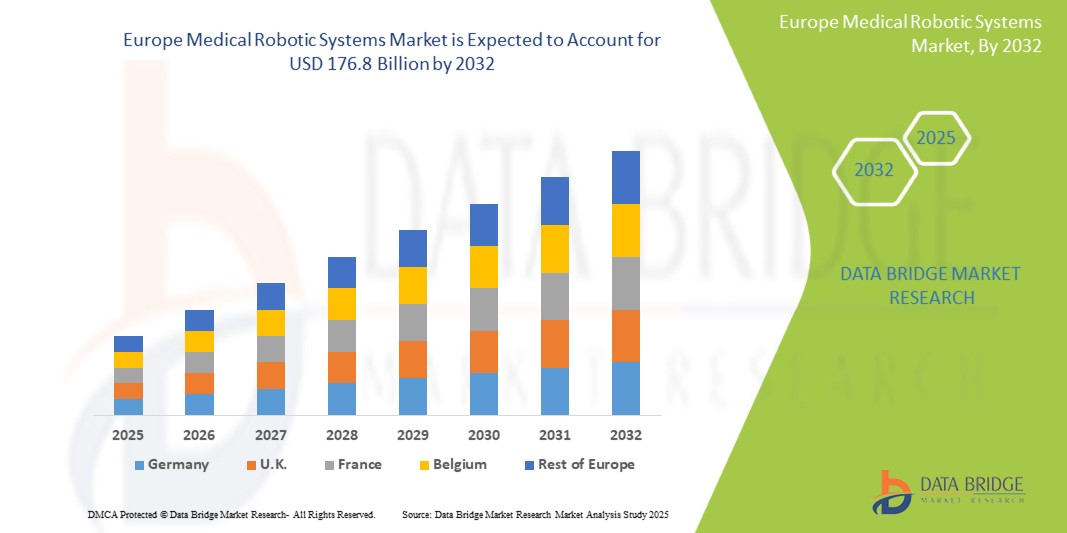
- The Europe Medical Robotic Systems Market was valued at USD 132.6 million in 2024 and is expected to reach USD 176.8 million by 2032, at a CAGR of 3.8% during the forecast period
- The increasing prevalence of chronic diseases such as colorectal cancer, bladder cancer, and inflammatory bowel diseases (IBD), which are fuelling the demand for advanced and minimally invasive surgical solutions provided by medical robotic systems.
Europe Medical Robotic Systems Market Analysis
- Medical Robotic Systems play a critical role in the management of various conditions requiring surgical interventions, such as colorectal cancer, bladder cancer, and inflammatory bowel diseases (IBD). These systems—designed to perform precise, minimally invasive procedures—enhance surgical outcomes, reduce recovery time, and improve the overall quality of life for patients. Medical robotic systems are widely utilized across hospitals, specialty surgical centers, and outpatient clinics throughout Europe.
- The demand for Medical Robotic Systems in Europe is primarily driven by a rising incidence of chronic conditions that require complex surgeries, including colorectal cancer, Crohn’s disease, and ulcerative colitis. Additionally, the growing geriatric population—more susceptible to chronic illnesses and in need of surgical interventions—along with increasing awareness about the benefits of robotic-assisted surgeries, are contributing to the market’s expansion. Technological advancements in robotic platforms, offering enhanced precision, control, and patient safety, are further boosting adoption.
- Germany is a leading region in the Europe Medical Robotic Systems market, supported by its advanced healthcare infrastructure, proactive adoption of innovative medical technologies, and favorable government reimbursement frameworks. Countries such as Germany, France, and the UK are at the forefront, owing to strong investments in healthcare modernization and a high volume of robotic-assisted procedures performed annually.
- The Medical Robotic Systems market is also shaped by regulatory approvals and ongoing innovations in robotic platforms. Increasing healthcare expenditure, a growing preference for minimally invasive procedures, and integration of smart technologies—such as AI-assisted surgical planning and real-time imaging—are enhancing both patient outcomes and surgical efficiency. The market is further propelled by the trend toward personalized surgical care and the focus on long-term management of chronic conditions through precision medicine.
Report Scope Medical Robotic Systems Market Segmentation
|
Attributes |
Medical Robotic Systems Key Market Insights |
|
Segments Covered |
|
|
Countries Covered |
Europe
|
|
Key Market Players |
|
|
Market Opportunities |
|
|
Value Added Data Infosets |
In addition to the insights on market scenarios such as market value, growth rate, segmentation, geographical coverage, and major players, the market reports curated by the Data Bridge Market Research also include import export analysis, production capacity overview, production consumption analysis, price trend analysis, climate change scenario, supply chain analysis, value chain analysis, raw material/consumables overview, vendor selection criteria, PESTLE Analysis, Porter Analysis, and regulatory framework. |
Medical Robotic Systems Market Trends
“AI Integration and Data-Driven Surgery”
- The integration of artificial intelligence (AI) and machine learning into medical robotic systems is emerging as a key trend in Europe, transforming how surgeries are planned, executed, and evaluated. AI-powered systems can analyze preoperative imaging, predict surgical outcomes, and assist in real-time decision-making, thereby increasing accuracy and reducing the likelihood of complications. This trend is enhancing surgeon performance and enabling greater standardization across procedures.
- For instance, hospitals in the Netherlands and the UK are increasingly implementing robotic systems equipped with AI-assisted navigation and intraoperative analytics, helping surgeons achieve higher precision in complex procedures like prostatectomies and colorectal surgeries.
- Data-driven surgical platforms are allowing for continuous learning and performance tracking through the collection of intraoperative data. These insights are being used to refine surgical techniques, train new surgeons, and improve patient outcomes over time. The use of cloud-based analytics and remote monitoring capabilities is also promoting cross-border collaboration and tele-surgical support, further strengthening the market in technologically advanced European regions.
Medical Robotic Systems Market Dynamics
Driver
“Rising Surgical Volume and Demand for Minimally Invasive Procedures”
- The increasing number of surgeries across Europe, particularly in oncology, urology, and orthopedics, is a key driver for the adoption of medical robotic systems. Hospitals are investing in robotic platforms to manage higher caseloads with greater precision and efficiency.
- Patients and healthcare professionals are favoring minimally invasive procedures due to their benefits such as reduced post-operative pain, faster recovery, lower infection risks, and shorter hospital stays—outcomes more reliably achieved with robotic assistance.
- Robotic systems are also helping address the shortage of skilled surgeons in some regions by enabling higher precision, repeatability, and performance consistency, even for complex procedures.
For instance,
- In France, regional hospitals are investing in multi-specialty robotic systems to reduce dependence on central urban surgical centers.
Opportunity
“Integration of AI and Machine Learning in Surgical Robotics”
- The convergence of AI and robotics is opening new frontiers in surgical precision, pre-operative planning, and intraoperative guidance. AI algorithms can analyze patient data and real-time feedback to assist surgeons during complex procedures.
- Opportunities exist in developing predictive analytics tools, real-time error detection, and smart robotic arms that adapt based on tissue resistance or surgeon behavior—creating safer and more efficient surgeries.
- The European market is well-positioned to benefit from these technologies due to its strong research ecosystem and supportive regulatory environment for digital health innovations.
For instance,
- In March 2024, a partnership between Siemens Healthineers and a German university hospital launched a pilot AI-driven robotic surgery suite for gynecological procedures, focusing on workflow optimization and outcome prediction.
- European startups are increasingly receiving funding to develop AI-based platforms that integrate with existing robotic systems, expanding market potential.
Restraint/Challenge
“Training Requirements and Operational Complexity”
- Despite the benefits of robotic systems, their adoption is hindered by the steep learning curve and extensive training required for surgical teams. Hospitals must invest significant time and resources in onboarding staff, limiting short-term usability.
- The complexity of robotic systems can lead to increased procedure times during the initial adoption phase, which may negatively impact operating room efficiency and surgeon confidence.
- Smaller or rural healthcare facilities often lack the infrastructure or budget to support training programs, which further widens the adoption gap between urban and less-resourced centers.
For instance,
- A 2023 European Surgical Society study found that nearly 40% of surgeons in mid-sized hospitals cited insufficient training as a barrier to fully utilizing robotic surgical systems.
- Healthcare systems in Eastern Europe face challenges in accessing certified robotic surgery training programs, limiting their ability to integrate these technologies widely.
Medical Robotic Systems Market Scope
The market is segmented on the basis, five notable segments based on By Product, Application.
|
Segmentation |
Sub-Segmentation |
|
By Product |
|
|
By Application
|
|
In 2025, the Instruments & Accessories is projected to dominate the market with a largest share in product segment
The Instruments & Accessories segment is expected to dominate the Medical Robotic Systems Market with the largest share of 36.72% in 2025 due to its high prevalence and demand for precision. This dominance driven by the recurring demand for consumables during robotic procedures. Its dominance is also supported by continuous innovation in surgical tools, enhancing precision and expanding application versatility.
The Laparoscopy is expected to account for the largest share during the forecast period in applications market
In 2025, the Laparoscopy segment is expected to dominate the market with the largest market share of 42.41% due to the growing preference for minimally invasive procedures offering faster recovery and reduced surgical risks.
Medical Robotic Systems Market Regional Analysis
“Germany is the Dominant Country in the Medical Robotic Systems Market”
- Germany dominates the Europe Medical Robotic Systems Market, accounting for the largest share due to its well-developed healthcare infrastructure, high surgical volume, and early adoption of advanced robotic technologies across multiple specialties.
- The increasing prevalence of conditions requiring surgical intervention—such as colorectal cancer, urological disorders, and gynecological conditions—combined with a strong aging population, is driving the demand for robotic-assisted procedures in both public and private hospitals.
- Major players such as Siemens Healthineers, Intuitive Surgical, and Medtronic have a strong operational presence in Germany, supporting innovation, training, and system deployment across leading healthcare institutions.
- Supportive government initiatives, including investments in digital health, robotics integration, and favorable reimbursement frameworks for minimally invasive surgeries, continue to position Germany as the leader in the European Medical Robotic Systems Market.
“Italy is Projected to Register the Highest Growth Rate”
- Italy is expected to witness the fastest growth in the Europe Medical Robotic Systems Market, fueled by increased public investment in surgical innovation and a growing emphasis on improving surgical outcomes in regional and community hospitals.
- The rising incidence of chronic and age-related diseases, alongside healthcare reforms promoting early intervention and shorter hospital stays, is accelerating the adoption of robotic-assisted procedures across the country.
- The expansion of robotic surgery programs in multidisciplinary clinics and rehabilitation centers—particularly in regions emphasizing outpatient care—is contributing to increased accessibility and patient acceptance of robotic technologies.
- Collaboration between Italian healthcare authorities, academic institutions, and medical technology firms is fostering R&D and pilot programs that enhance the availability of advanced, cost-effective robotic surgery platforms in both urban and underserved regions.
Medical Robotic Systems Market Share
The market competitive landscape provides details by competitor. Details included are company overview, company financials, revenue generated, market potential, investment in research and development, new market initiatives, Europe presence, production sites and facilities, production capacities, company strengths and weaknesses, product launch, product width and breadth, application dominance. The above data points provided are only related to the companies' focus related to market.
The Major Market Leaders Operating in the Market Are:
- Intuitive Surgical, Inc. (USA)
- Medtronic plc (Ireland)
- Stryker Corporation (USA)
- Zimmer Biomet Holdings, Inc. (USA)
- Siemens Healthineers AG (Germany)
- CMR Surgical Ltd. (United Kingdom)
- Asensus Surgical, Inc. (USA)
- Johnson & Johnson (Ethicon and Verb Surgical) (USA)
- Smith+Nephew plc (United Kingdom)
- Brainlab AG (Germany)
Latest Developments in Europe Medical Robotic Systems Market
- in December 2023, Stafford Hospital announced the acquisition of a da Vinci XI surgical robot system, representing the initial phase of its ambitious robotics program development. The hospital invested USD 2 million in this advanced robotic system.
- In June 2023, the Hugo robotic-assisted surgery (RAS) system from Medtronic made its debut in the UK at Guy’s and St Thomas’ Hospital. This trend reflects a broader shift towards innovative medical technologies in the UK healthcare sector.

- Interactive Data Analysis Dashboard
- Company Analysis Dashboard for high growth potential opportunities
- Research Analyst Access for customization & queries
- Competitor Analysis with Interactive dashboard
- Latest News, Updates & Trend analysis
- Harness the Power of Benchmark Analysis for Comprehensive Competitor Tracking
Data collection and base year analysis are done using data collection modules with large sample sizes. The stage includes obtaining market information or related data through various sources and strategies. It includes examining and planning all the data acquired from the past in advance. It likewise envelops the examination of information inconsistencies seen across different information sources. The market data is analysed and estimated using market statistical and coherent models. Also, market share analysis and key trend analysis are the major success factors in the market report. To know more, please request an analyst call or drop down your inquiry.
The key research methodology used by DBMR research team is data triangulation which involves data mining, analysis of the impact of data variables on the market and primary (industry expert) validation. Data models include Vendor Positioning Grid, Market Time Line Analysis, Market Overview and Guide, Company Positioning Grid, Patent Analysis, Pricing Analysis, Company Market Share Analysis, Standards of Measurement, Global versus Regional and Vendor Share Analysis. To know more about the research methodology, drop in an inquiry to speak to our industry experts.
Data Bridge Market Research is a leader in advanced formative research. We take pride in servicing our existing and new customers with data and analysis that match and suits their goal. The report can be customized to include price trend analysis of target brands understanding the market for additional countries (ask for the list of countries), clinical trial results data, literature review, refurbished market and product base analysis. Market analysis of target competitors can be analyzed from technology-based analysis to market portfolio strategies. We can add as many competitors that you require data about in the format and data style you are looking for. Our team of analysts can also provide you data in crude raw excel files pivot tables (Fact book) or can assist you in creating presentations from the data sets available in the report.













