


Europe Microsurgery Market Size
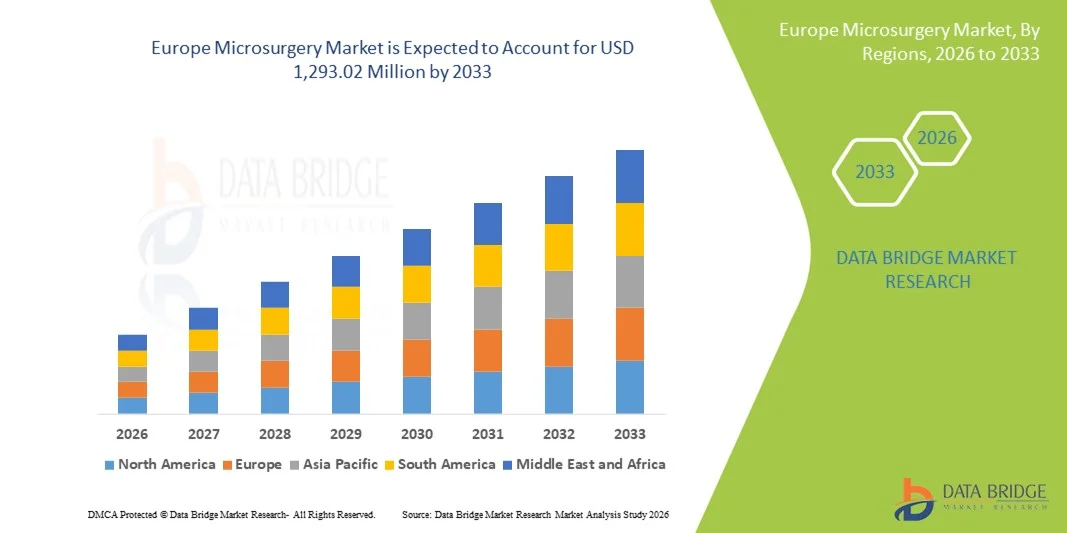
- The Europe microsurgery market size was valued at USD 703.78 million in 2025 and is expected to reach USD 1,293.02 million by 2033, at a CAGR of 7.9% during the forecast period
- The market growth is primarily driven by the rising prevalence of chronic diseases, increasing number of reconstructive and cosmetic surgical procedures, and expanding applications of microsurgical techniques in specialties such as neurosurgery, ophthalmology, orthopedics, and plastic surgery across Europe
- Furthermore, continuous technological advancements in operating microscopes, micro-instruments, and minimally invasive surgical systems, along with growing investments in healthcare infrastructure and surgeon training programs, are positioning microsurgery as a critical component of advanced surgical care, thereby significantly accelerating market expansion in the region
Europe Microsurgery Market Analysis
- Microsurgery, involving highly precise surgical procedures performed using operating microscopes and specialized micro-instruments, plays a critical role across applications such as neurosurgery, ophthalmology, plastic and reconstructive surgery, oncology, and orthopedic surgery in Europe, owing to its ability to enhance surgical precision, minimize tissue damage, and improve overall patient outcomes in complex procedures
- The escalating demand for microsurgical procedures is primarily fueled by the rising incidence of cancer and neurological disorders, growing number of trauma and reconstructive cases, increasing infertility treatments, and expanding adoption of advanced transplantation and free tissue transfer techniques across leading European healthcare systems
- Germany dominated the Europe microsurgery market with the largest revenue share of 28.47% in 2025, characterized by advanced hospital infrastructure, strong reimbursement frameworks, and the presence of leading medical device manufacturers, with healthcare institutions increasingly investing in high-performance microscopes and microsurgical instruments to support complex surgical interventions
- The United Kingdom is expected to be the fastest growing country in the Europe microsurgery market during the forecast period due to rising healthcare expenditure, increasing focus on minimally invasive and precision-based surgeries, and expansion of academic and research centres specializing in microsurgical training and innovation
- Microsurgical instruments segment dominated the Europe microsurgery market with a market share of 34.6% in 2025, driven by their extensive use across multiple applications including transplantation, replantation, and free tissue transfer procedures
Report Scope and Europe Microsurgery Market Segmentation
|
Attributes |
Europe Microsurgery Key Market Insights |
|
Segments Covered |
|
|
Countries Covered |
Europe
|
|
Key Market Players |
|
|
Market Opportunities |
|
|
Value Added Data Infosets |
In addition to the insights on market scenarios such as market value, growth rate, segmentation, geographical coverage, and major players, the market reports curated by the Data Bridge Market Research also include in-depth expert analysis, patient epidemiology, pipeline analysis, pricing analysis, and regulatory framework |
Europe Microsurgery Market Trends
Technological Advancements in Precision Imaging and Minimally Invasive Techniques
- A significant and accelerating trend in the Europe microsurgery market is the continuous advancement in high-definition visualization systems, fluorescence-guided imaging, and minimally invasive microsurgical techniques, which are significantly enhancing surgical precision, intraoperative decision-making, and overall patient outcomes across multiple specialties
- For instance, leading European hospitals are increasingly adopting advanced operating microscopes equipped with 3D visualization and fluorescence modules to improve accuracy in neurosurgical tumor resections and complex vascular procedures. Similarly, robotic-assisted microsurgical platforms are being introduced to enhance dexterity and reduce surgeon fatigue
- The integration of digital imaging and augmented visualization technologies in microsurgery enables improved identification of critical anatomical structures, enhanced precision in suturing and tissue manipulation, and reduced risk of complications. For instance, fluorescence-guided systems allow surgeons to better differentiate between healthy and diseased tissues during oncological and reconstructive procedures. Furthermore, ergonomic microscope designs and heads-up display systems offer surgeons improved comfort and workflow efficiency
- The seamless incorporation of advanced microscopes, microsurgical instruments, and microsutures materials with digital operating room infrastructures facilitates centralized surgical data management and real-time collaboration. Through integrated platforms, surgical teams can enhance procedural planning, documentation, and post-operative analysis, creating a more connected and efficient surgical environment
- This trend toward more precise, technology-driven, and minimally invasive microsurgical interventions is fundamentally reshaping surgical standards across Europe. Consequently, medical device manufacturers are developing next-generation microscopes and microsurgical instruments with enhanced optical clarity, robotic compatibility, and improved ergonomics to meet evolving clinical demands
- The demand for technologically advanced microsurgical solutions is growing rapidly across hospitals, ambulatory surgery centres, and academic and research centres, as healthcare providers increasingly prioritize improved clinical outcomes, shorter recovery times, and higher procedural efficiency
- Moreover, increasing cross-border collaborations among European research organizations and academic institutions are accelerating innovation in microsurgical techniques, fostering the development of advanced instruments and specialized training programs to strengthen clinical expertise across the region
Europe Microsurgery Market Dynamics
Driver
Rising Burden of Chronic Diseases and Increasing Demand for Reconstructive Procedures
- The increasing prevalence of chronic conditions such as cancer, neurological disorders, and cardiovascular diseases, coupled with a growing number of trauma and reconstructive cases, is a significant driver for the heightened demand for microsurgical procedures across Europe
- For instance, the rising number of breast reconstruction surgeries following mastectomy procedures in several European countries has led hospitals to expand their capabilities in free tissue transfer and microsurgical reconstruction techniques. Such strategic expansions by healthcare institutions are expected to drive the microsurgery market growth during the forecast period
- As healthcare systems focus on improving survival rates and quality of life, microsurgery offers enhanced precision for complex procedures such as transplantation, replantation, and infertility treatments, providing a compelling advantage over conventional surgical approaches
- Furthermore, the growing emphasis on minimally invasive techniques and advanced surgical training programs is making microsurgery an integral component of modern healthcare systems, offering improved patient safety, reduced hospital stays, and better functional outcomes
- The increasing availability of specialized microsurgical instruments, advanced microscopes, and high-quality microsutures materials, along with supportive reimbursement frameworks in several European countries, are key factors propelling adoption across hospitals and clinics. The expansion of academic and research centres focusing on microsurgical innovation further contributes to market growth
- In addition, demographic shifts including an aging population in several European countries are contributing to a higher volume of complex surgical interventions, thereby increasing the demand for precision-based microsurgical procedures
- Government initiatives aimed at strengthening healthcare infrastructure and funding advanced surgical technologies are further supporting the adoption of microsurgical equipment and techniques across public and private healthcare facilities
Restraint/Challenge
High Equipment Costs and Skilled Workforce Limitations
- Concerns surrounding the high cost of advanced microsurgical equipment, including state-of-the-art microscopes and precision instruments, pose a significant challenge to broader market expansion, particularly for smaller hospitals and clinics with constrained budgets
- For instance, the procurement and maintenance costs associated with high-end surgical microscopes and robotic-assisted systems can limit adoption in certain healthcare facilities, creating disparities in access to advanced microsurgical care across regions
- Addressing these financial barriers through government funding initiatives, value-based procurement strategies, and technology-sharing collaborations is crucial for ensuring equitable access. In addition, the limited availability of highly trained microsurgeons and the extensive learning curve associated with complex procedures can restrict service capacity in some European countries
- While training programs and simulation-based education are gradually expanding, the time and investment required to develop microsurgical expertise can slow widespread adoption, particularly in emerging healthcare markets within Europe
- Overcoming these challenges through cost optimization, broader training initiatives, and continuous technological innovation aimed at improving ease of use and procedural efficiency will be vital for sustaining long-term growth in the Europe microsurgery market
- Moreover, stringent regulatory requirements for medical device approvals and compliance across different European countries can extend product launch timelines and increase operational costs for manufacturers
- Economic uncertainties and budgetary constraints within certain national healthcare systems may further delay capital investments in advanced microsurgical infrastructure, limiting uniform market expansion across the region
Europe Microsurgery Market Scope
The market is segmented on the basis of application, procedure, equipment type, and end user.
- By Application
On the basis of application, the Europe microsurgery market is segmented into general surgery, neurosurgery, ophthalmology, orthopedic surgery, plastic surgery, oncology, gynecological surgery, oral surgery, and pediatric surgery. The Neurosurgery segment dominated the market with the largest revenue share in 2025, driven by the high prevalence of neurological disorders, brain tumors, and spinal conditions requiring extreme surgical precision. Microsurgical techniques are widely utilized in neurosurgery to enable delicate manipulation of neural tissues, minimize collateral damage, and improve post-operative recovery outcomes. The increasing adoption of advanced operating microscopes and fluorescence-guided imaging systems in complex cranial and spinal procedures further supports segment dominance. In addition, strong investments in specialized neurosurgical centers across major European countries contribute significantly to revenue generation. The presence of skilled neurosurgeons and advanced healthcare infrastructure also strengthens this segment’s leadership position in the regional market.
The Plastic Surgery segment is anticipated to witness the fastest growth rate from 2026 to 2033, fueled by the rising demand for reconstructive and aesthetic procedures across Europe. Microsurgery plays a critical role in free tissue transfer, breast reconstruction post-mastectomy, and complex trauma reconstruction cases. Increasing awareness regarding advanced reconstructive options and improved reimbursement policies in several countries are encouraging higher procedural volumes. Technological advancements in microsurgical instruments and suturing materials are enhancing surgical success rates and aesthetic outcomes. Furthermore, the growing medical tourism sector in select European nations is contributing to the expansion of plastic and reconstructive microsurgical services.
- By Procedure
On the basis of procedure, the Europe microsurgery market is segmented into transplantation, replantation, treatment of infertility, and free tissue transfer. The Free Tissue Transfer segment dominated the market in 2025 due to its extensive application in reconstructive surgeries, particularly in oncology and trauma cases. This procedure allows surgeons to transfer tissue along with its blood supply to restore form and function, making it essential in breast, head, and neck reconstructions. The growing incidence of cancer and traumatic injuries across Europe is significantly increasing the demand for such complex microsurgical interventions. Continuous improvements in vascular anastomosis techniques and microsutures materials further enhance procedural success rates. Hospitals are increasingly investing in specialized microsurgical teams to support the rising number of free flap procedures.
The Transplantation segment is expected to witness the fastest CAGR from 2026 to 2033, driven by increasing organ transplant procedures and advancements in vascular microsurgery techniques. Microsurgery is critical in connecting small blood vessels during organ transplantation, ensuring graft viability and improved patient survival rates. Rising cases of end-stage organ failure and expanding donor programs across Europe are contributing to higher transplantation volumes. In addition, improvements in immunosuppressive therapies and perioperative care are enhancing long-term transplant outcomes. Growing government initiatives aimed at strengthening organ donation networks are also supporting segment expansion.
- By Equipment Type
On the basis of equipment type, the Europe microsurgery market is segmented into microsurgical instruments, microscope, and microsutures materials. The Microsurgical Instruments segment dominated the market in 2025 with a market share of 34.6% owing to their extensive use across all microsurgical procedures, including neurosurgery, plastic surgery, and transplantation. Instruments such as forceps, needle holders, and scissors are essential for delicate tissue handling and vascular suturing. Continuous innovation in ergonomic design, material durability, and precision engineering enhances surgical efficiency and reduces operator fatigue. The high replacement rate and recurring demand for specialized instruments further contribute to strong revenue generation. Moreover, increasing surgical volumes across European hospitals sustain consistent product utilization.
The Microscope segment is projected to be the fastest growing during the forecast period, driven by rapid technological advancements in optical clarity, digital imaging integration, and 3D visualization capabilities. Modern surgical microscopes equipped with fluorescence-guided technology and augmented reality features significantly improve intraoperative accuracy. Rising demand for minimally invasive and high-precision procedures across neurosurgery and ophthalmology is accelerating adoption. Hospitals are increasingly upgrading legacy systems to advanced digital microscopes to improve workflow integration and surgical documentation. These innovations are expected to fuel robust growth in this segment over the coming years.
- By End User
On the basis of end user, the Europe microsurgery market is segmented into hospitals, clinics, research organization, ambulatory surgery centres, and academic and research centres. The Hospitals segment dominated the market in 2025 due to the high volume of complex surgical procedures performed in tertiary care and specialized medical centers. Hospitals possess advanced infrastructure, skilled surgical teams, and access to high-cost microsurgical equipment necessary for intricate interventions. The availability of multidisciplinary expertise further supports comprehensive patient management in neurosurgical, oncological, and reconstructive procedures. Favorable reimbursement structures in several European countries also contribute to strong procedural volumes within hospital settings.
The Ambulatory Surgery Centres segment is expected to witness the fastest growth from 2026 to 2033, driven by the increasing preference for outpatient surgical procedures and cost-effective care models. Advancements in minimally invasive microsurgical techniques enable shorter recovery times and reduced hospital stays, supporting the shift toward ambulatory settings. These centres offer operational efficiency, lower procedural costs, and faster patient turnover compared to traditional hospitals. Growing healthcare system pressures to optimize resource utilization are encouraging the expansion of ambulatory surgical infrastructure. As a result, this segment is poised for substantial growth during the forecast period.
Europe Microsurgery Market Regional Analysis
- Germany dominated the Europe microsurgery market with the largest revenue share of 28.47% in 2025, characterized by advanced hospital infrastructure, strong reimbursement frameworks, and the presence of leading medical device manufacturers
- Healthcare providers across the region highly value the clinical accuracy, enhanced visualization, and improved patient outcomes offered by advanced microscopes, microsurgical instruments, and high-quality microsutures materials in intricate surgical interventions
- This widespread adoption is further supported by robust reimbursement frameworks, a well-established network of specialized hospitals and academic centres, and the growing preference for minimally invasive and precision-based surgical approaches, establishing microsurgery as a critical component of modern surgical care across Europe
The Germany Microsurgery Market Insight
The Germany microsurgery market captured the largest revenue share of 28.47% in 2025 within Europe, fueled by its well-established hospital infrastructure and strong presence of leading medical device manufacturers. The country places significant emphasis on technological innovation and high clinical standards in complex surgical procedures. Increasing volumes of neurosurgical, reconstructive, and transplantation procedures are driving equipment adoption. Furthermore, supportive reimbursement frameworks and continuous modernization of healthcare facilities are further accelerating market growth in Germany.
U.K. Microsurgery Market Insight
The U.K. microsurgery market is anticipated to grow at a noteworthy CAGR during the forecast period, driven by rising demand for advanced reconstructive surgeries and minimally invasive techniques. Increasing focus on improving surgical outcomes and reducing hospital stays is encouraging adoption of precision-based microsurgical systems. In addition, expanding academic and research centres specializing in surgical innovation are strengthening procedural capabilities. Government initiatives aimed at enhancing healthcare quality and accessibility are expected to continue stimulating market expansion.
France Microsurgery Market Insight
The France microsurgery market is expected to expand at a considerable CAGR during the forecast period, supported by increasing cancer incidence and demand for reconstructive and oncological surgeries. France’s strong public healthcare system and emphasis on advanced medical technologies promote the adoption of high-performance microscopes and microsurgical instruments. Growing awareness of fertility treatments and transplantation procedures is also contributing to higher procedural volumes. The integration of digital imaging technologies into surgical workflows is further supporting market growth across major medical centers.
Italy Microsurgery Market Insight
The Italy microsurgery market is witnessing steady growth due to increasing investments in hospital modernization and the rising number of complex surgical procedures. The country is experiencing growing demand for microsurgical applications in plastic surgery, orthopedics, and oncology. Enhanced training programs and collaborations between academic institutions and hospitals are improving technical expertise in microsurgical techniques. In addition, improved access to advanced equipment and rising healthcare expenditure are positively influencing the market outlook.
Europe Microsurgery Market Share
The Europe Microsurgery industry is primarily led by well-established companies, including:
- Stryker (U.S.)
- Medtronic (Ireland)
- Johnson & Johnson Services, Inc. (U.S.)
- Zimmer Biomet (U.S.)
- B. Braun SE (Germany)
- Danaher (U.S.)
- Olympus Corporation (Japan)
- Beaver-Visitec International Inc. (U.S.)
- Global Surgical Corporation (U.S.)
- Microsurgery Instruments, Inc. (U.S.)
- Synovis Micro Companies Alliance, Inc. (U.S.)
- KLS Martin Group (Germany)
- Scanlan International (U.S.)
- Leica Microsystems (Germany)
- Carl Zeiss Meditec AG (Germany)
- Integra LifeSciences Corporation (U.S.)
- Synovis Life Technologies, Inc. (U.S.)
- Checkpoint Surgical, Inc. (U.S.)
- Aesculap, Inc. (U.S.)
- MicroSurgical Technology (U.S.)
What are the Recent Developments in Europe Microsurgery Market?
- In October 2025, Surgerix, a newly founded Kuopio, Finland-based technology company, acquired the rights to a novel software innovation from the University of Eastern Finland and Kuopio University Hospital aimed at enhancing real-time video processing in microsurgery; the software provides an expanded surgical view compatible with existing microscopes and has shown early success in reducing procedure times and potential complications
- In October 2024, researchers at Eindhoven University of Technology and Maastricht UMC+ demonstrated a precision-enhancing surgical robot that can improve the accuracy and efficiency of reconstructive microsurgery, enabling surgeons to suture blood vessels, lymphatic vessels, and nerves with sub-millimeter precision an advancement expected to reduce complications and speed patient recovery, highlighting a major step forward in robotics-assisted microsurgical care in Europe.
- In September 2024, ZEISS showcased expanded surgical innovations at the European Society of Retina Specialists (EURETINA) 2024, highlighting the ARTEVO 850 3D digital visualization system, single-use lenses for retinal surgery, and integration of the EVA NEXUS surgical system to improve retinal procedure efficiency and clinical outcomes
- In April 2023, the Microsurgery Center of Eastern Finland at Kuopio University Hospital was spotlighted for its cutting-edge training and R&D infrastructure including adjustable hyperspectral imaging, eye-tracking microsurgery systems, VR interfaces, and high-performance video management that fosters innovation, surgeon training, and collaborative product development in microsurgical technology
- In March 2024, Carl Zeiss Meditec announced the enhanced ZEISS ARTEVO 850 3D heads-up ophthalmic microscope with advanced digital visualization capabilities, including high-resolution true-color imaging and expanded depth of field, setting new standards for ophthalmic microsurgery workflows and surgeon ergonomics

- Interactive Data Analysis Dashboard
- Company Analysis Dashboard for high growth potential opportunities
- Research Analyst Access for customization & queries
- Competitor Analysis with Interactive dashboard
- Latest News, Updates & Trend analysis
- Harness the Power of Benchmark Analysis for Comprehensive Competitor Tracking
Data collection and base year analysis are done using data collection modules with large sample sizes. The stage includes obtaining market information or related data through various sources and strategies. It includes examining and planning all the data acquired from the past in advance. It likewise envelops the examination of information inconsistencies seen across different information sources. The market data is analysed and estimated using market statistical and coherent models. Also, market share analysis and key trend analysis are the major success factors in the market report. To know more, please request an analyst call or drop down your inquiry.
The key research methodology used by DBMR research team is data triangulation which involves data mining, analysis of the impact of data variables on the market and primary (industry expert) validation. Data models include Vendor Positioning Grid, Market Time Line Analysis, Market Overview and Guide, Company Positioning Grid, Patent Analysis, Pricing Analysis, Company Market Share Analysis, Standards of Measurement, Global versus Regional and Vendor Share Analysis. To know more about the research methodology, drop in an inquiry to speak to our industry experts.
Data Bridge Market Research is a leader in advanced formative research. We take pride in servicing our existing and new customers with data and analysis that match and suits their goal. The report can be customized to include price trend analysis of target brands understanding the market for additional countries (ask for the list of countries), clinical trial results data, literature review, refurbished market and product base analysis. Market analysis of target competitors can be analyzed from technology-based analysis to market portfolio strategies. We can add as many competitors that you require data about in the format and data style you are looking for. Our team of analysts can also provide you data in crude raw excel files pivot tables (Fact book) or can assist you in creating presentations from the data sets available in the report.













