


Europe Molded Fiber Packaging Market Size
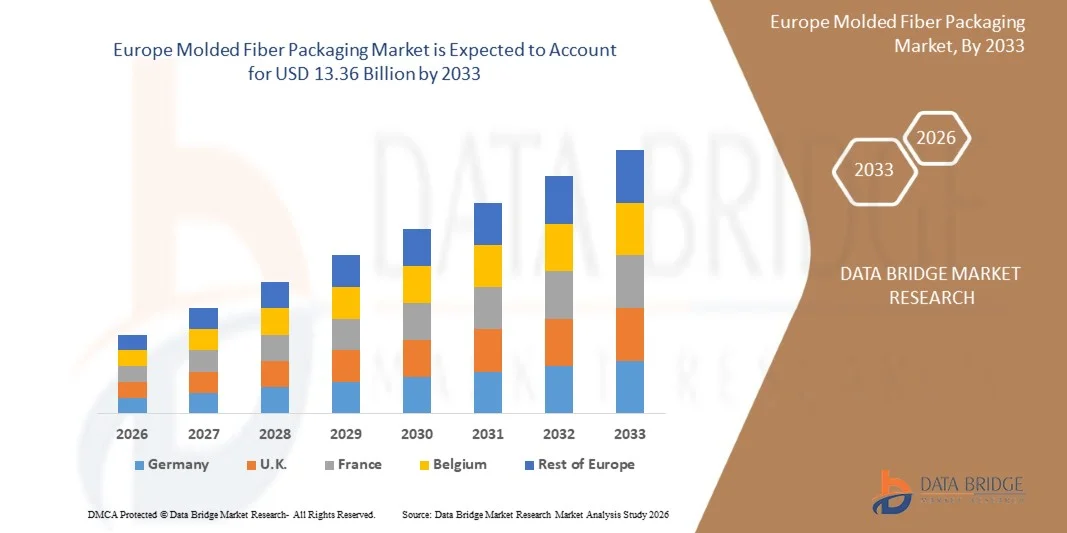
- The Europe Molded Fiber Packaging Market size was valued at USD 8.98 billion in 2025 and is expected to reach USD 13.36 billion by 2033, at a CAGR of 5.10% during the forecast period
- The market growth is primarily driven by increasing environmental regulations and a strong shift toward sustainable and biodegradable packaging solutions across the region, promoting the adoption of molded fiber products
- Additionally, growing consumer preference for eco-friendly packaging in food, electronics, and consumer goods, along with advancements in production technology, is enhancing the efficiency and appeal of molded fiber packaging, thereby propelling the market’s expansion
Europe Molded Fiber Packaging Market Analysis
- Molded fiber packaging, offering sustainable and biodegradable alternatives to conventional packaging, is increasingly essential across food, beverage, electronics, and consumer goods industries in Europe due to its eco-friendly properties, lightweight nature, and compatibility with automated packaging systems.
- The rising demand for molded fiber packaging is primarily driven by strict environmental regulations, growing consumer preference for sustainable packaging, and increasing corporate commitments toward reducing plastic usage.
- Germany dominated the Europe Molded Fiber Packaging Market with the largest revenue share of 32% in 2025, characterized by strong regulatory support, high consumer awareness of sustainability, and a robust presence of key industry players, with Germany and France experiencing substantial growth in molded fiber adoption across food and beverage sectors, supported by innovations in pulp molding technology and improved product design.
- U.K. is expected to be the fastest growing region in the Europe Molded Fiber Packaging Market during the forecast period due to rising industrialization, urbanization, and increasing investment in sustainable packaging infrastructure.
- The thick-wall segment dominated the market with the largest revenue share of 42.5% in 2025, driven by its superior strength, durability, and protective properties, making it ideal for transporting fragile goods such as electronics and beverages.
Report Scope and Europe Molded Fiber Packaging Market Segmentation
|
Attributes |
Europe Molded Fiber Packaging Key Market Insights |
|
Segments Covered |
|
|
Countries Covered |
Europe
|
|
Key Market Players |
|
|
Market Opportunities |
|
|
Value Added Data Infosets |
In addition to the insights on market scenarios such as market value, growth rate, segmentation, geographical coverage, and major players, the market reports curated by the Data Bridge Market Research also include import export analysis, production capacity overview, production consumption analysis, price trend analysis, climate change scenario, supply chain analysis, value chain analysis, raw material/consumables overview, vendor selection criteria, PESTLE Analysis, Porter Analysis, and regulatory framework |
Europe Molded Fiber Packaging Market Trends
“Enhanced Efficiency Through Automation and Smart Manufacturing”
- A significant and accelerating trend in the Europe Molded Fiber Packaging Market is the deepening integration of automation technologies and smart manufacturing systems, which are significantly enhancing production efficiency, precision, and sustainability.
- For instance, advanced pulp molding machines equipped with real-time monitoring and automated quality control can produce consistent molded fiber trays, containers, and packaging solutions at higher speeds while minimizing waste. Similarly, robotics-assisted packaging lines are being adopted by companies like Huhtamaki and WestRock to optimize material handling and reduce manual labor.
- AI and machine learning integration in molded fiber production enables predictive maintenance, real-time process optimization, and waste reduction. For example, smart systems can adjust pulp density, molding pressure, and drying times based on historical production data, improving overall product quality and operational efficiency. Furthermore, automated defect detection ensures that only high-quality packaging reaches the market, reducing returns and enhancing customer satisfaction.
- The seamless integration of smart manufacturing with enterprise resource planning (ERP) and supply chain systems facilitates centralized monitoring of production, inventory, and logistics. Through a single interface, manufacturers can manage material sourcing, production schedules, and delivery timelines, creating a more efficient and responsive supply chain.
- This trend towards more intelligent, automated, and interconnected production systems is fundamentally reshaping industry standards for speed, sustainability, and quality. Consequently, companies such as DS Smith and Smurfit Kappa are investing in AI-enabled molded fiber production lines that offer predictive maintenance, energy optimization, and real-time quality control.
- The demand for molded fiber packaging produced through smart, automated, and AI-enhanced manufacturing processes is growing rapidly across food, beverage, electronics, and consumer goods sectors, as companies increasingly prioritize efficiency, cost-effectiveness, and sustainable production.
Europe Molded Fiber Packaging Market Dynamics
Driver
“Growing Demand Driven by Sustainability Initiatives and Regulatory Support”
- The increasing focus on environmental sustainability, combined with stricter European regulations on single-use plastics, is a significant driver for the heightened demand for molded fiber packaging.
- For instance, in 2025, the European Commission reinforced its directives on reducing plastic waste, encouraging manufacturers and retailers to adopt biodegradable and recyclable alternatives such as molded fiber packaging. Such regulatory support by governments and industry bodies is expected to drive market growth during the forecast period.
- As consumers and businesses become more environmentally conscious, molded fiber packaging offers a compelling alternative to traditional plastic and Styrofoam packaging, providing benefits such as biodegradability, compostability, and reduced carbon footprint.
- Furthermore, the growing popularity of eco-friendly products and green supply chain initiatives is making molded fiber packaging an integral component of sustainable packaging strategies, offering compatibility with automated packaging systems and modern logistics requirements.
- The versatility of molded fiber in food service, electronics, and consumer goods packaging, combined with its customizable designs and protective properties, are key factors propelling adoption across both commercial and retail sectors. The trend toward environmentally responsible sourcing and corporate sustainability commitments further contributes to market growth.
Restraint/Challenge
“High Production Costs and Technical Limitations”
- Higher production costs compared to conventional plastic or paperboard packaging pose a significant challenge to broader market adoption. Although molded fiber packaging is sustainable, the initial investment in specialized machinery and advanced pulp molding technology can be a barrier for smaller manufacturers.
- For instance, small-scale packaging companies may hesitate to adopt molded fiber solutions due to the capital expenditure required for automated production lines and energy-intensive drying processes.
- Addressing these cost challenges through process optimization, energy-efficient machinery, and scalable production methods is crucial for wider adoption. Additionally, certain technical limitations, such as lower moisture resistance and strength compared to plastics, may restrict usage in specific applications without additional coatings or treatments.
- While ongoing innovations are improving the durability and functionality of molded fiber products, the perceived trade-off between cost, performance, and sustainability can slow adoption in price-sensitive sectors.
- Overcoming these challenges through technological advancements, process standardization, and continued government incentives for sustainable packaging will be vital for sustained market growth in Europe.
Europe Molded Fiber Packaging Market Scope
The molded fiber packaging market is segmented on the basis of the type, source, product and end user.
• By Type
On the basis of type, the Europe Molded Fiber Packaging Market is segmented into thick-wall, transfer molded, thermoformed fiber, and processed pulp. The thick-wall segment dominated the market with the largest revenue share of 42.5% in 2025, driven by its superior strength, durability, and protective properties, making it ideal for transporting fragile goods such as electronics and beverages. Thick-wall molded fiber packaging is highly preferred by manufacturers seeking high-impact resistance and reliable protection for their products during storage and logistics.
The transfer molded segment is expected to witness the fastest CAGR of 19.8% from 2026 to 2033, fueled by its versatility and precise molding capabilities. Transfer molding allows for complex shapes, lightweight designs, and enhanced efficiency in production, making it increasingly popular in food service, consumer goods, and specialty packaging applications.
• By Source
On the basis of source, the Europe Molded Fiber Packaging Market is segmented into wood pulp and non-wood pulp. The wood pulp segment held the largest revenue share of 58.3% in 2025, attributed to its high availability, renewable nature, and superior fiber strength, which ensures durable and protective packaging solutions. Wood pulp is widely used across food and beverage, electronics, and consumer goods packaging due to its ease of molding, biodegradability, and cost-effectiveness.
The non-wood pulp segment is expected to witness the fastest CAGR of 21.2% from 2026 to 2033, driven by growing environmental initiatives to utilize alternative fiber sources such as bamboo, bagasse, and agricultural residues. These sources provide sustainable options for regions with limited wood supply, reduce reliance on traditional forestry, and appeal to eco-conscious brands seeking innovative and environmentally responsible packaging solutions.
• By Product
On the basis of product, the Europe Molded Fiber Packaging Market is segmented into trays, clamshell containers, boxes, end caps, and others. The trays segment dominated the market with the largest revenue share of 46.7% in 2025, primarily driven by their widespread use in the food and beverage industry for eggs, bakery products, and fresh produce. Molded fiber trays are favored for their stackability, cushioning properties, and biodegradability, offering an environmentally friendly alternative to plastic packaging.
The clamshell containers segment is expected to witness the fastest CAGR of 20.5% from 2026 to 2033, fueled by rising demand for ready-to-eat meals, takeaways, and retail food packaging. Clamshell designs provide secure, lightweight, and protective packaging that preserves freshness while catering to consumer convenience and sustainability preferences.
• By End User
On the basis of end user, the Europe Molded Fiber Packaging Market is segmented into food and beverage, electronics, personal care, healthcare, and others. The food and beverage segment accounted for the largest market revenue share of 52.1% in 2025, driven by the increasing adoption of sustainable packaging solutions for fresh produce, bakery items, dairy products, and beverages. Molded fiber packaging offers thermal insulation, shock absorption, and eco-friendly disposal, making it ideal for this sector.
The electronics segment is expected to witness the fastest CAGR of 22.0% from 2026 to 2033, propelled by the rising need for protective, lightweight, and customizable packaging for devices such as smartphones, laptops, and home appliances. The growing e-commerce sector and stricter shipment safety standards further support the accelerated adoption of molded fiber packaging in electronics.
Europe Molded Fiber Packaging Market Regional Analysis
- Germany dominated the Europe Molded Fiber Packaging Market with the largest revenue share of 32% in 2025, driven by increasing regulatory support for sustainable packaging and growing consumer demand for eco-friendly alternatives to plastic.
- Businesses and consumers in the region highly value the biodegradability, recyclability, and protective properties offered by molded fiber packaging, which makes it an attractive solution across food, beverage, electronics, and consumer goods sectors.
- This widespread adoption is further supported by high environmental awareness, strong industrial infrastructure, and the presence of key packaging manufacturers, establishing molded fiber packaging as the preferred sustainable solution for both commercial and residential applications in Western Europe.
Germany Molded Fiber Packaging Market Insight
The Germany molded fiber packaging market is expected to expand at a considerable CAGR during the forecast period, driven by the country’s strong focus on sustainability, strict environmental regulations, and rising demand for eco-friendly packaging solutions. Germany’s well-developed industrial and logistics infrastructure, combined with a growing emphasis on reducing plastic waste, is promoting the adoption of molded fiber for food and beverage, electronics, and consumer goods packaging. Integration of advanced manufacturing technologies and process automation in molded fiber production is also enhancing efficiency and product quality, further supporting market growth.
France Molded Fiber Packaging Market Insight
The France molded fiber packaging market is projected to grow at a substantial CAGR over the forecast period, fueled by increasing consumer preference for biodegradable and recyclable packaging. Stringent environmental policies, such as bans on single-use plastics and incentives for sustainable materials, are driving manufacturers to adopt molded fiber solutions across the food service, retail, and e-commerce sectors. French companies are increasingly investing in innovative molded fiber designs that are lightweight, durable, and customizable, catering to growing demands for functional and eco-conscious packaging.
U.K. Molded Fiber Packaging Market Insight
The U.K. molded fiber packaging market is anticipated to grow at a noteworthy CAGR during the forecast period, driven by heightened environmental awareness among consumers and a strong regulatory push toward sustainable packaging. The country’s dynamic food and beverage industry, coupled with the growing e-commerce sector, is creating robust demand for molded fiber trays, clamshells, and boxes. Additionally, increasing adoption of molded fiber packaging in retail, logistics, and personal care sectors, alongside advancements in automated production and design flexibility, is expected to further stimulate market growth.
Netherlands Molded Fiber Packaging Market Insight
The Netherlands molded fiber packaging market is poised for significant growth during the forecast period, driven by progressive environmental policies, government support for sustainable materials, and high consumer preference for eco-friendly packaging. The country’s strong logistics and distribution networks, along with a growing food processing and export sector, are promoting the use of molded fiber trays, containers, and boxes. Dutch manufacturers are also investing in advanced molding technologies to enhance efficiency, reduce waste, and meet increasing demand for protective, biodegradable, and recyclable packaging solutions.
Europe Molded Fiber Packaging Market Share
The Molded Fiber Packaging industry is primarily led by well-established companies, including:
- Mondi Group (U.K.)
- Smurfit Kappa (Ireland)
- Huhtamaki (Finland)
- DS Smith (U.K.)
- Stora Enso (Sweden)
- WestRock (U.S.)
- Oliver-Tolas Group (France)
- International Paper (U.S.)
- Graphic Packaging International (U.S.)
- PulpWorks (Germany)
- Beijing Pack (China)
- Huhtamaki Foodservice Europe (Finland)
- Sonoco Products (U.S.)
- Molded Fiber Solutions (Austria)
- BioPak (Australia)
- Pactiv Evergreen (U.S.)
What are the Recent Developments in Europe Molded Fiber Packaging Market?
- In April 2024, Mondi Group, a global leader in sustainable packaging solutions, launched a new initiative in Germany focused on expanding its molded fiber product portfolio for the food and beverage sector. This initiative emphasizes the company’s commitment to eco-friendly packaging, providing high-strength, biodegradable alternatives to traditional plastics and reinforcing Mondi’s position in the rapidly growing Europe molded fiber packaging market.
- In March 2024, Huhtamaki Oyj, a Finnish packaging giant, introduced an advanced transfer-molded fiber tray specifically designed for ready-to-eat meals and fresh produce. The innovative tray improves product protection while reducing material usage, highlighting Huhtamaki’s dedication to sustainable packaging innovation and meeting rising consumer demand for environmentally responsible solutions.
- In March 2024, DS Smith Plc successfully implemented a large-scale sustainable packaging project for major European retailers, deploying molded fiber containers and clamshells across multiple logistics hubs. The project underscores DS Smith’s focus on reducing plastic waste and enhancing supply chain efficiency while promoting broader adoption of molded fiber packaging in commercial and retail sectors.
- In February 2024, Stora Enso, a leading provider of renewable packaging solutions, announced a strategic partnership with key food distributors in the Netherlands to develop a market for biodegradable molded fiber containers. This collaboration aims to streamline adoption, improve operational efficiency, and reinforce Stora Enso’s commitment to driving sustainable packaging innovation in Europe.
- In January 2024, Smurfit Kappa, a major European packaging company, unveiled its new thermoformed fiber clamshell for bakery and confectionery products at the European Packaging Expo 2024. This product combines durability, biodegradability, and aesthetic appeal, reflecting the company’s strategy to integrate advanced molded fiber solutions into mainstream consumer packaging while supporting sustainability initiatives.

- Interactive Data Analysis Dashboard
- Company Analysis Dashboard for high growth potential opportunities
- Research Analyst Access for customization & queries
- Competitor Analysis with Interactive dashboard
- Latest News, Updates & Trend analysis
- Harness the Power of Benchmark Analysis for Comprehensive Competitor Tracking
Europe Molded Fiber Packaging Market, Supply Chain Analysis and Ecosystem Framework
To support market growth and help clients navigate the impact of geopolitical shifts, DBMR has integrated in-depth supply chain analysis into its Europe Molded Fiber Packaging Market research reports. This addition empowers clients to respond effectively to global changes affecting their industries. The supply chain analysis section includes detailed insights such as Europe Molded Fiber Packaging Market consumption and production by country, price trend analysis, the impact of tariffs and geopolitical developments, and import and export trends by country and HSN code. It also highlights major suppliers with data on production capacity and company profiles, as well as key importers and exporters. In addition to research, DBMR offers specialized supply chain consulting services backed by over a decade of experience, providing solutions like supplier discovery, supplier risk assessment, price trend analysis, impact evaluation of inflation and trade route changes, and comprehensive market trend analysis.
Data collection and base year analysis are done using data collection modules with large sample sizes. The stage includes obtaining market information or related data through various sources and strategies. It includes examining and planning all the data acquired from the past in advance. It likewise envelops the examination of information inconsistencies seen across different information sources. The market data is analysed and estimated using market statistical and coherent models. Also, market share analysis and key trend analysis are the major success factors in the market report. To know more, please request an analyst call or drop down your inquiry.
The key research methodology used by DBMR research team is data triangulation which involves data mining, analysis of the impact of data variables on the market and primary (industry expert) validation. Data models include Vendor Positioning Grid, Market Time Line Analysis, Market Overview and Guide, Company Positioning Grid, Patent Analysis, Pricing Analysis, Company Market Share Analysis, Standards of Measurement, Global versus Regional and Vendor Share Analysis. To know more about the research methodology, drop in an inquiry to speak to our industry experts.
Data Bridge Market Research is a leader in advanced formative research. We take pride in servicing our existing and new customers with data and analysis that match and suits their goal. The report can be customized to include price trend analysis of target brands understanding the market for additional countries (ask for the list of countries), clinical trial results data, literature review, refurbished market and product base analysis. Market analysis of target competitors can be analyzed from technology-based analysis to market portfolio strategies. We can add as many competitors that you require data about in the format and data style you are looking for. Our team of analysts can also provide you data in crude raw excel files pivot tables (Fact book) or can assist you in creating presentations from the data sets available in the report.













