


What is the Europe MRI Coils Market Size and Growth Rate?
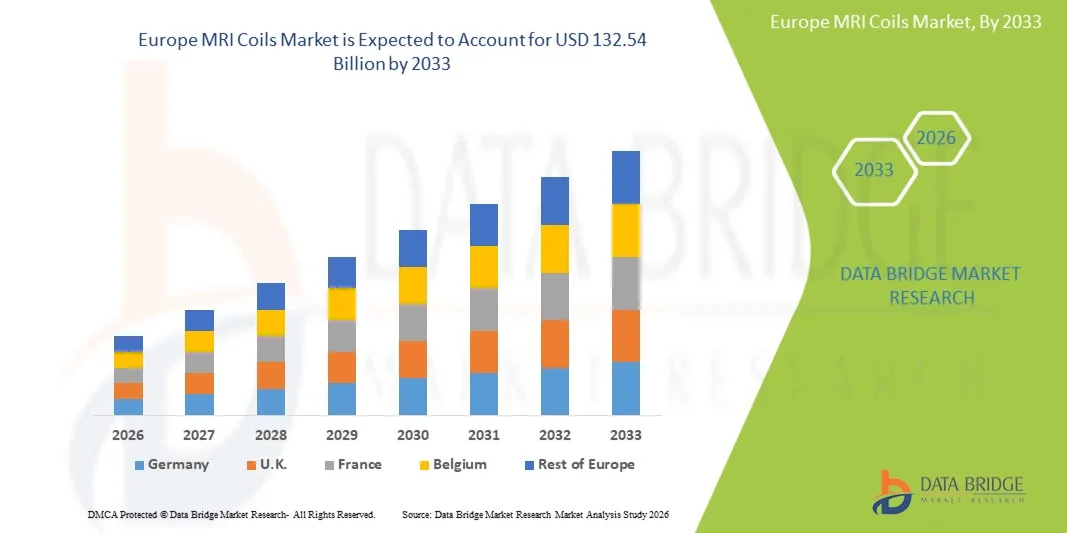
- As per Data Bridge Market Research analysis, the Europe MRI Coils Market size was valued at USD 99.11 billion in 2025 and is expected to reach USD 132.54 billion by 2033, at a CAGR of 3.70% during the forecast period
- The market growth is largely driven by continuous technological advancements in magnetic resonance imaging (MRI) systems and the increasing installation of advanced diagnostic imaging equipment across hospitals and diagnostic centers, leading to improved image quality and higher scanning efficiency in both clinical and research settings
- Furthermore, rising demand for early and accurate disease diagnosis, along with growing preference for high-resolution and faster imaging solutions, is establishing advanced MRI coils as essential components of modern MRI systems. These converging factors are accelerating the adoption of MRI coils, thereby significantly boosting the growth of the Europe MRI Coils Market
Market Size & Forecast
- Global Market Value (2025): USD 99.11 billion
- Expected Market Value (2033): USD 132.54 billion
- Forecast CAGR (2026-2033): 3.70%
What are the Major Takeaways of Europe MRI Coils Market?
- MRI coils, which enhance signal reception and image quality in magnetic resonance imaging systems, are increasingly vital components of modern diagnostic imaging across hospitals, diagnostic centers, and research institutions due to their role in improving spatial resolution, scan speed, and overall diagnostic accuracy
- The escalating demand for MRI coils is primarily fueled by the growing burden of chronic diseases, rising preference for early and precise diagnosis, and continuous technological advancements in coil design, including multi-channel and phased-array coils
- The U.K. dominated the Europe MRI Coils Market in Europe with the largest revenue share of 32.6% in 2025, supported by a well-established healthcare system, widespread availability of MRI scanners, and strong adoption of advanced imaging technologies across NHS hospitals and private diagnostic centers. Increasing MRI scan volumes, government investment in diagnostic capacity expansion, and replacement of aging imaging equipment are key factors driving demand for advanced MRI coils
- Germany is expected to be the fastest-growing market in the MRI coils industry during the forecast period, owing to rising healthcare expenditure, rapid technological advancements in MRI systems, and increasing demand for advanced diagnostic imaging. The country’s strong clinical research ecosystem, expanding hospital network, and growing focus on early disease detection are accelerating adoption of next-generation MRI coils
- The phased-array coils segment dominated the largest market revenue share of around 62.4% in 2025, primarily due to their ability to deliver superior signal-to-noise ratios and high-resolution imaging across larger anatomical regions
Report Scope and Europe MRI Coils Market Segmentation
|
Attributes |
MRI Coils Key Market Insights |
|
Segments Covered |
|
|
Countries Covered |
Europe
|
|
Key Market Players |
|
|
Market Opportunities |
|
|
Value Added Data Infosets |
In addition to the insights on market scenarios such as market value, growth rate, segmentation, geographical coverage, and major players, the market reports curated by the Data Bridge Market Research also include in-depth expert analysis, patient epidemiology, pipeline analysis, pricing analysis, and regulatory framework. |
What is the Key Trend in the Europe MRI Coils Market?
“Technological Advancements and Increasing Customization of MRI Coils”
- A significant and accelerating trend in the global Europe MRI Coils Market is the continuous advancement in coil design technologies aimed at improving image quality, patient comfort, and scanning efficiency. Manufacturers are increasingly focusing on developing high-channel, lightweight, and anatomically optimized coils to enhance signal-to-noise ratio (SNR) and support faster imaging workflows across a wide range of clinical applications
- For instance, leading imaging companies such as Siemens Healthineers and GE HealthCare have introduced advanced multi-channel and flexible MRI coil solutions that adapt to different patient anatomies, enabling improved diagnostic accuracy in neurological, musculoskeletal, and cardiovascular imaging. These innovations are particularly beneficial in high-throughput hospital environments
- The growing adoption of specialized coils for specific anatomical regions, including head, spine, cardiac, and breast imaging, is enabling more precise diagnostics and reducing scan times. Flexible and lightweight coil designs are also improving patient comfort, which is becoming an important consideration in clinical imaging practices
- Furthermore, the integration of digital and software-enabled coil technologies is allowing seamless compatibility with modern MRI systems, supporting advanced imaging techniques such as parallel imaging and high-resolution scans. This technological evolution is contributing to improved workflow efficiency and better utilization of MRI systems
- The trend toward customized and application-specific MRI coils is reshaping expectations among healthcare providers, as facilities increasingly seek solutions that balance diagnostic performance, operational efficiency, and patient experience. As a result, manufacturers are expanding their product portfolios to address diverse clinical needs across both developed and emerging healthcare markets
- The growing demand for technologically advanced MRI coils is evident across hospitals, diagnostic imaging centers, and research institutions worldwide, as healthcare systems prioritize early disease detection, precision diagnostics, and improved imaging outcomes
Europe MRI Coils Market Dynamics
Driver
“Rising Demand for Advanced Diagnostic Imaging and Growing Disease Burden”
- The increasing global prevalence of chronic diseases such as cancer, neurological disorders, and cardiovascular conditions is a key driver for the Europe MRI Coils Market. As MRI is a non-invasive and highly precise imaging modality, the demand for high-performance coils that enhance image clarity and diagnostic confidence continues to rise
- For instance, in recent years, several healthcare systems across North America and Europe have expanded investments in advanced MRI infrastructure to support early diagnosis and monitoring of complex conditions, driving demand for high-channel and specialty MRI coils designed for targeted imaging applications
- The growing emphasis on early disease detection and preventive healthcare is encouraging hospitals and diagnostic centers to upgrade existing MRI systems with advanced coil technologies that support faster scans and higher resolution imaging. This is particularly important in oncology and neurology, where diagnostic accuracy is critical
- In addition, the expansion of imaging services in emerging economies, supported by improving healthcare infrastructure and increasing access to diagnostic services, is contributing to rising adoption of MRI systems and associated consumables, including coils
- The increasing number of outpatient imaging centers and the growing use of MRI in research and clinical trials further support sustained demand for MRI coils across global markets
Restraint/Challenge
“High Costs and Technical Compatibility Challenges”
- The high cost associated with advanced MRI coils remains a significant challenge for market growth, particularly for smaller healthcare facilities and institutions in developing regions. Premium coils designed for specialized imaging applications often require substantial upfront investment
- For instance, hospitals upgrading to high-channel MRI systems may face additional expenses related to coil compatibility, system calibration, and staff training, which can limit adoption among budget-constrained healthcare providers
- Technical compatibility issues between MRI coils and existing MRI systems can also pose challenges, especially in facilities operating older imaging equipment. Ensuring seamless integration and optimal performance often requires vendor-specific coils, reducing flexibility in procurement decisions
- Moreover, maintenance requirements and the need for periodic replacement of coils due to wear and tear can increase total cost of ownership, further impacting purchasing decisions. These factors may slow adoption in cost-sensitive market
- Addressing these challenges through the development of more cost-effective coil solutions, improved cross-platform compatibility, and extended product lifecycles will be essential for manufacturers seeking to expand their global presence and drive long-term market growth
How is the Europe MRI Coils Market Segmented?
The market is segmented on the basis of product type, type, application, end user, and distribution channel.
• By Product Type
On the basis of product type, the Europe MRI Coils Market is segmented into phased-array and quadrature coils. The phased-array coils segment dominated the largest market revenue share of around 62.4% in 2025, primarily due to their ability to deliver superior signal-to-noise ratios and high-resolution imaging across larger anatomical regions. These coils enable parallel imaging, which significantly reduces scan time and improves patient throughput in clinical settings. Phased-array coils are widely used in advanced MRI systems installed in tertiary hospitals and diagnostic centers. Their flexibility in configuration allows clinicians to adapt imaging protocols for complex neurological, cardiovascular, and oncological examinations. Continuous technological upgrades aimed at improving imaging accuracy have further strengthened their adoption. The growing preference for high-field MRI scanners has also supported the dominance of phased-array coils. Increasing demand for early and precise disease diagnosis has accelerated usage across multiple applications. In addition, their compatibility with modern MRI software platforms enhances workflow efficiency. Rising healthcare expenditure in developed regions has contributed to higher installations. These factors collectively reinforce the leading position of this segment.
The quadrature coils segment is expected to witness the fastest growth at a CAGR of approximately 7.8% from 2026 to 2033, driven by their cost-effectiveness and ease of use in routine diagnostic procedures. These coils are commonly used in mid-field MRI systems across small and mid-sized healthcare facilities. Growing demand for affordable imaging solutions in emerging economies is a key growth driver. Quadrature coils require simpler system configurations, making them suitable for facilities with limited infrastructure. Increasing investments in secondary healthcare centers are further supporting adoption. Rising awareness about diagnostic imaging in rural and semi-urban areas is boosting demand. Technological improvements aimed at enhancing image quality are also contributing to growth. The expansion of diagnostic imaging centers globally favors this segment. In addition, shorter installation times and lower maintenance costs attract end users. These factors are expected to drive sustained growth during the forecast period.
• By Type
On the basis of type, the Europe MRI Coils Market is segmented into volume coils, gradient coils, radiofrequency coils, surface coils, and others. The radiofrequency coils segment accounted for the largest market revenue share of nearly 45.6% in 2025, owing to their essential role in transmitting and receiving MRI signals. These coils are integral components of all MRI systems, regardless of application or field strength. High adoption across hospitals and diagnostic centers supports segment dominance. Continuous innovation to improve signal penetration and image clarity has strengthened demand. Radiofrequency coils are used extensively in both routine and advanced diagnostic imaging. Their reliability and compatibility with multiple MRI platforms enhance adoption rates. Growing prevalence of chronic diseases has increased the volume of MRI procedures globally. Increased funding for medical imaging infrastructure further supports growth. Manufacturers focus on improving patient comfort without compromising performance. These factors collectively contribute to the dominant position of this segment.
The surface coils segment is projected to grow at the fastest CAGR of around 8.5% from 2026 to 2033, driven by their ability to deliver high-resolution images of localized anatomical regions. These coils are widely used in musculoskeletal, breast, and pediatric imaging applications. Increasing demand for targeted diagnostics is accelerating adoption. Surface coils enhance image clarity in small and superficial body areas. Technological advancements have improved coil sensitivity and reduced signal noise. Rising use of MRI in outpatient settings is supporting growth. Expansion of specialty diagnostic centers further drives demand. Growing awareness of early disease detection is also contributing. Increasing use in research and academic institutions supports market expansion. These trends collectively position surface coils as the fastest-growing segment.
• By Application
On the basis of application, the Europe MRI Coils Market is segmented into neuroimaging, cardiovascular, musculoskeletal, gastrointestinal, pediatric, breast, and others. The neuroimaging segment dominated the market with a revenue share of approximately 34.1% in 2025, driven by the high prevalence of neurological disorders worldwide. MRI is the preferred modality for diagnosing conditions such as stroke, brain tumors, epilepsy, and multiple sclerosis. High demand for accurate brain imaging supports segment dominance. Advanced neuro-specific coils enhance diagnostic precision. Increasing aging population has led to a rise in neurological cases. Hospitals prioritize MRI for non-invasive brain diagnostics. Continuous advancements in neuroimaging technology further boost adoption. Government initiatives supporting neurological research contribute to growth. Expansion of specialized neurology centers also supports demand. These factors reinforce the leading position of neuroimaging applications.
The cardiovascular segment is expected to witness the fastest growth at a CAGR of nearly 9.2% from 2026 to 2033, driven by rising incidences of heart-related disorders. Cardiac MRI is increasingly used for non-invasive assessment of heart structure and function. Technological advancements in cardiac-specific coils improve image quality. Growing awareness of early cardiovascular diagnosis supports adoption. Increasing preference for radiation-free imaging methods boosts MRI demand. Expansion of cardiac care centers contributes to growth. Improved reimbursement policies in developed regions further support adoption. Rising investments in cardiovascular research also play a role. Increasing use of MRI in preventive healthcare accelerates growth. These factors position cardiovascular imaging as the fastest-growing application.
• By End User
On the basis of end user, the Europe MRI Coils Market is segmented into hospitals, diagnostic imaging centres, and others. The hospitals segment held the largest market revenue share of about 58.7% in 2025, due to the high volume of MRI procedures performed in hospital settings. Hospitals are equipped with advanced MRI systems supporting multiple coil configurations. Availability of skilled radiologists enhances utilization rates. High patient inflow supports consistent demand. Hospitals invest heavily in diagnostic infrastructure. Increasing prevalence of chronic diseases boosts imaging demand. Government funding for public hospitals further supports growth. Hospitals offer comprehensive diagnostic services under one roof. Adoption of high-field MRI scanners strengthens demand for advanced coils. These factors collectively support segment dominance.
The diagnostic imaging centres segment is projected to grow at the fastest CAGR of around 8.9% from 2026 to 2033, driven by the shift toward outpatient diagnostic services. These centers offer faster appointment scheduling and cost-effective imaging solutions. Rising demand for standalone diagnostic facilities supports growth. Increasing urbanization contributes to higher patient volumes. Technological advancements make MRI systems more accessible. Expansion of private diagnostic chains fuels demand. Growing preference for preventive healthcare boosts imaging volumes. Increasing insurance coverage supports outpatient diagnostics. Rising investments in diagnostic infrastructure further drive growth. These trends position diagnostic imaging centers as the fastest-growing end-user segment.
• By Distribution Channel
On the basis of distribution channel, the Europe MRI Coils Market is segmented into direct tenders and retail sales. The direct tenders segment dominated the market with a revenue share of nearly 66.3% in 2025, as hospitals and large diagnostic networks procure MRI coils through bulk purchasing contracts. Long-term agreements with manufacturers support dominance. Direct tenders ensure product customization and service support. Government hospital procurement policies favor tender-based purchasing. Cost efficiency achieved through bulk orders supports adoption. Direct manufacturer relationships enhance reliability. Large healthcare institutions prefer this channel for advanced equipment. Standardization of procurement processes further supports dominance. Growing public healthcare investments reinforce this trend. These factors maintain the leading position of direct tenders.
The retail sales segment is expected to grow at the fastest CAGR of approximately 7.4% from 2026 to 2033, driven by demand from small and mid-sized diagnostic facilities. Independent imaging centers increasingly rely on retail distributors. Growing availability of aftermarket MRI coils supports growth. Expansion of distributor networks enhances accessibility. Rising demand for replacement coils boosts sales. Flexible purchasing options attract smaller facilities. Increasing private healthcare investments support adoption. Retail channels offer quicker procurement timelines. Growing demand in emerging markets accelerates growth. These factors position retail sales as the fastest-growing distribution channel.
Europe MRI Coils Market Regional Analysis
- The Europe MRI Coils Market is projected to expand at a substantial CAGR during the forecast period, driven by increasing demand for advanced diagnostic imaging, rising prevalence of chronic diseases, and continuous investments in healthcare infrastructure
- The region benefits from a well-established hospital network and widespread availability of MRI scanners across public and private healthcare facilities
- Growing emphasis on early and accurate disease diagnosis, along with the modernization and replacement of aging imaging equipment, is supporting steady demand for advanced MRI coils across Europe
U.K. Europe MRI Coils Market Insight
The U.K. Europe MRI Coils Market dominated the Europe MRI Coils Market in Europe with the largest revenue share of 32.6% in 2025, supported by a robust healthcare system and extensive deployment of MRI scanners across NHS hospitals and private diagnostic centers. Increasing MRI scan volumes, driven by rising diagnostic demand for neurological, musculoskeletal, and oncological conditions, are fueling the adoption of advanced MRI coils. In addition, sustained government investments aimed at expanding diagnostic capacity and upgrading outdated imaging infrastructure are accelerating the replacement of older coil systems with high-performance, next-generation MRI coils.
Germany Europe MRI Coils Market Insight
The Germany Europe MRI Coils Market is expected to grow at the fastest CAGR during the forecast period, owing to rising healthcare expenditure, rapid technological advancements in MRI systems, and growing demand for high-quality diagnostic imaging. Germany’s strong clinical research ecosystem, expanding hospital network, and increasing focus on early disease detection are key factors driving the adoption of advanced MRI coil technologies. Furthermore, the country’s emphasis on innovation and precision medicine is encouraging healthcare providers to invest in high-channel and application-specific MRI coils to improve diagnostic accuracy and workflow efficiency.
Which are the Top Companies in Europe MRI Coils Market?
The MRI Coils industry is primarily led by well-established companies, including:
- GE HealthCare (U.S.)
- Siemens Healthineers (Germany)
- Philips Healthcare (Netherlands)
- Canon Medical Systems (Japan)
- Hitachi Healthcare (Japan)
- United Imaging Healthcare (China)
- Esaote S.p.A. (Italy)
- Fujifilm Healthcare (Japan)
- RAPID Biomedical (Germany)
- NORAS MRI Products (Germany)
- Invivo Corporation (U.S.)
- MR Instruments, Inc. (U.S.)
- ScanMed A/S (Denmark)
- Stark Contrast (Germany)
- Tesla Engineering Ltd. (U.K.)
Latest Developments in Europe MRI Coils Market
- In November 2023, Royal Philips, a global leader in medical imaging technology, launched a new range of ultra-lightweight and flexible MR Smart Fit coils at the RSNA 2023 conference. These MR Smart Fit coils are designed to significantly reduce patient setup time and enhance diagnostic confidence by offering improved flexibility and ease of positioning around challenging anatomies such as shoulders and knees. This product introduction reflects an ongoing industry focus on improving both workflow efficiency and imaging quality in MRI procedures
- In November 2024, GE HealthCare received U.S. FDA clearance for its XENOVIEW 3T Chest Coil, a high-performance MRI coil that enhances lung imaging capabilities. Although this clearance is U.S. regulatory activity, the technology is highly relevant to the European coils market because many European facilities deploy GE platforms, and regulatory approvals often precede or align with European CE marking and adoption in clinical settings
- In July 2025, Philips Healthcare announced a sustainability initiative for its MRI coils operations across Europe. This development aims at reducing the environmental impact of MRI coil production by using eco-friendly materials and more energy-efficient manufacturing processes, aligning the company with broader sustainability goals in healthcare technology. It highlights how environmental considerations are becoming integrated into MRI coil product strategies in the European market

- Interactive Data Analysis Dashboard
- Company Analysis Dashboard for high growth potential opportunities
- Research Analyst Access for customization & queries
- Competitor Analysis with Interactive dashboard
- Latest News, Updates & Trend analysis
- Harness the Power of Benchmark Analysis for Comprehensive Competitor Tracking
Data collection and base year analysis are done using data collection modules with large sample sizes. The stage includes obtaining market information or related data through various sources and strategies. It includes examining and planning all the data acquired from the past in advance. It likewise envelops the examination of information inconsistencies seen across different information sources. The market data is analysed and estimated using market statistical and coherent models. Also, market share analysis and key trend analysis are the major success factors in the market report. To know more, please request an analyst call or drop down your inquiry.
The key research methodology used by DBMR research team is data triangulation which involves data mining, analysis of the impact of data variables on the market and primary (industry expert) validation. Data models include Vendor Positioning Grid, Market Time Line Analysis, Market Overview and Guide, Company Positioning Grid, Patent Analysis, Pricing Analysis, Company Market Share Analysis, Standards of Measurement, Global versus Regional and Vendor Share Analysis. To know more about the research methodology, drop in an inquiry to speak to our industry experts.
Data Bridge Market Research is a leader in advanced formative research. We take pride in servicing our existing and new customers with data and analysis that match and suits their goal. The report can be customized to include price trend analysis of target brands understanding the market for additional countries (ask for the list of countries), clinical trial results data, literature review, refurbished market and product base analysis. Market analysis of target competitors can be analyzed from technology-based analysis to market portfolio strategies. We can add as many competitors that you require data about in the format and data style you are looking for. Our team of analysts can also provide you data in crude raw excel files pivot tables (Fact book) or can assist you in creating presentations from the data sets available in the report.













